

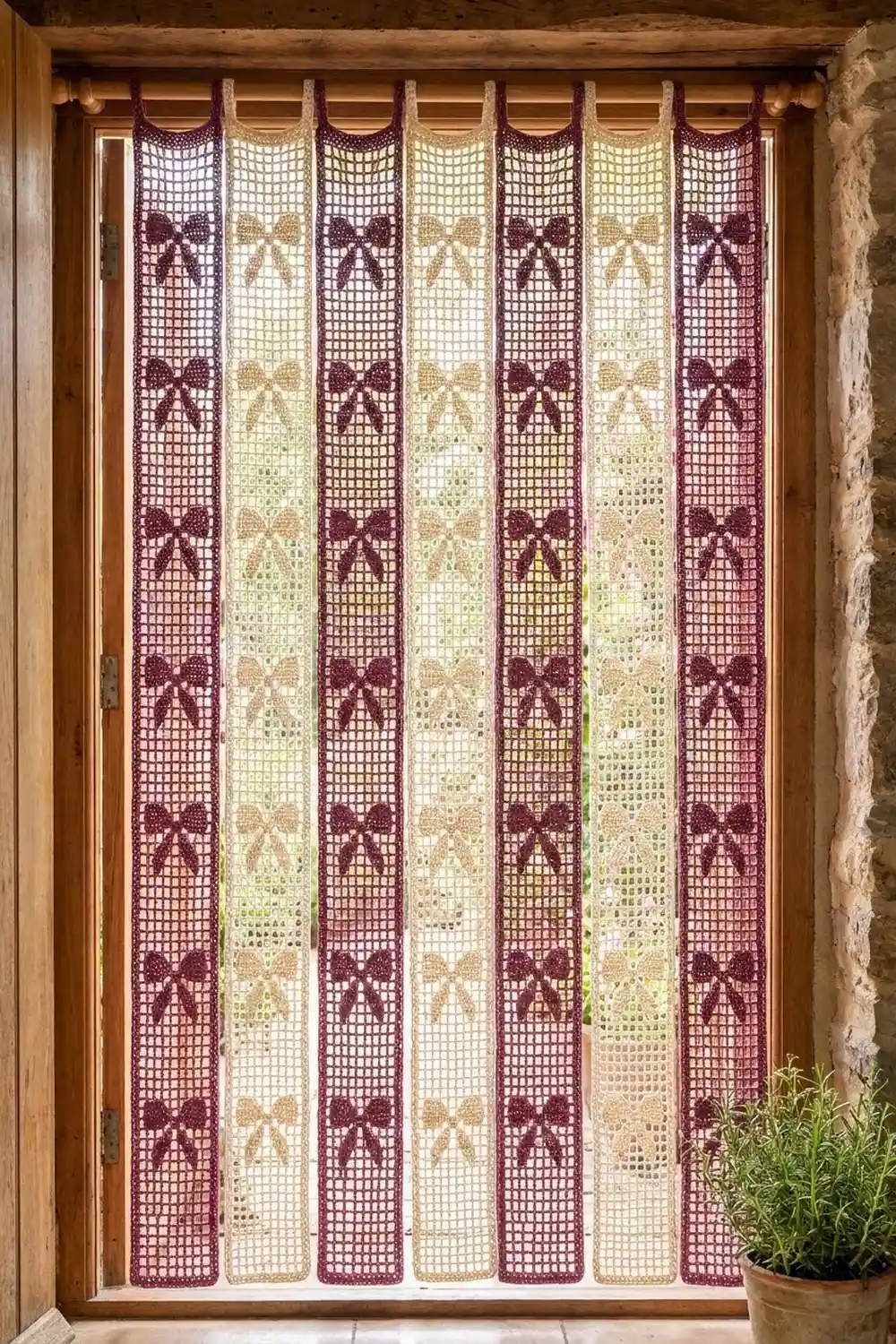
This curtain is made from seven narrow filet mesh strips, each with a column of solid bows running down its center. The strips hang side by side from a rod and stay unjoined, so they part easily as you walk through the doorway and fall back into place behind you.
The palette is deep plum and soft cream, used in alternating strips: four plum and three cream. The look is cottage-romantic, with crisp grid lines and bows that stand out clearly against the open mesh.
All terms are US crochet terms. Each finished strip measures 6.5 in (16.5 cm) wide by 76.5 in (194.3 cm) long, not counting the tabs. With the tabs, each strip hangs about 78.5 in (199.4 cm) from the rod.
Each strip is worked flat from the bottom up in dc mesh with filled blocks, then gets a two-round sc border and two folded hanging tabs. You make all seven strips the same way, changing only the color.
Finished Size and Construction
- Strip size: 6.5 in x 76.5 in (16.5 cm x 194.3 cm)
- Skill level: Intermediate (filet basics)
- Terminology: US
- Yarn weight: Worsted (#4)
- Hook: 5.0 mm (H-8)
- Number of pieces: 7 strips (4 plum, 3 cream)
- Layout: 7 strips side by side, unjoined, hung from one rod
- Strip size before border: 5.5 in x 75.5 in (14.0 cm x 191.8 cm)
- Border depth: 0.5 in (1.3 cm) on every side
- Mesh grid: 11 squares wide x 151 rows tall
- Bows per strip: 9, each 4.5 in x 4.5 in (11.4 cm x 11.4 cm)
Materials
Pick a smooth cotton or cotton-blend worsted yarn with clear stitch definition. Fuzzy or very splitty yarns blur the mesh grid. Cotton also hangs straighter and holds its shape against sunlight and handling better than acrylic.
- Plum: 1,300 g / approx. 2,600 m (4 strips)
- Cream: 1,000 g / approx. 2,000 m (3 strips)
Each strip uses about 300 g (approx. 600 m). The quantities above include a margin of roughly 10% for gauge swatches and differences between dye lots. Buy all of each color from one dye lot.
Tools:
– 5.0 mm (H-8) crochet hook
– Tapestry needle
– Locking stitch markers
– Tape measure
– Blocking pins and blocking boards (or a long, clean, padded surface)
– Spray bottle
– Curtain rod, 1 in (2.5 cm) diameter or less, at least 52 in (132.1 cm) long
Abbreviations (US Terms)
- ch – chain
- sc – single crochet
- dc – double crochet
- sk – skip
- sp – space
- st(s) – stitch(es)
- sl st – slip stitch
- RS / WS – right side / wrong side
Special stitches:
- Open mesh (O): ch 1, sk next ch-1 sp (or ch), dc in next dc.
- Block (B): dc in next ch-1 sp, dc in next dc.
Every row has 11 meshes. That’s 12 dc plus 11 spaces or fills, so 23 sts per row no matter how many blocks the row has.
Gauge and Checkpoints
Gauge: 4 mesh squares x 4 rows = 2 in x 2 in (5.1 cm x 5.1 cm). Each square is 0.5 in (1.3 cm) each way.
Test one piece first. Work Rows 1–23 of the first strip as your real test: that’s the bottom spacing plus the first bow. Then measure before you continue.
- After Row 1: width is 5.5 in (14.0 cm).
- After Row 23: height is 11.5 in (29.2 cm), and the bow measures 4.5 in (11.4 cm) square.
- After Row 151: height is 75.5 in (191.8 cm).
- After the border: 6.5 in x 76.5 in (16.5 cm x 194.3 cm).
If your squares are too big (fewer than 4 squares per 2 in), go down to a 4.5 mm hook. If they’re too small, go up to a 5.5 mm hook. If your width is right but your rows are too tall, wrap the yarn more snugly on each dc instead of changing hooks. Being off by 1/16 in per row adds up to almost 9.5 in (24.1 cm) over 151 rows, so check this before going further.
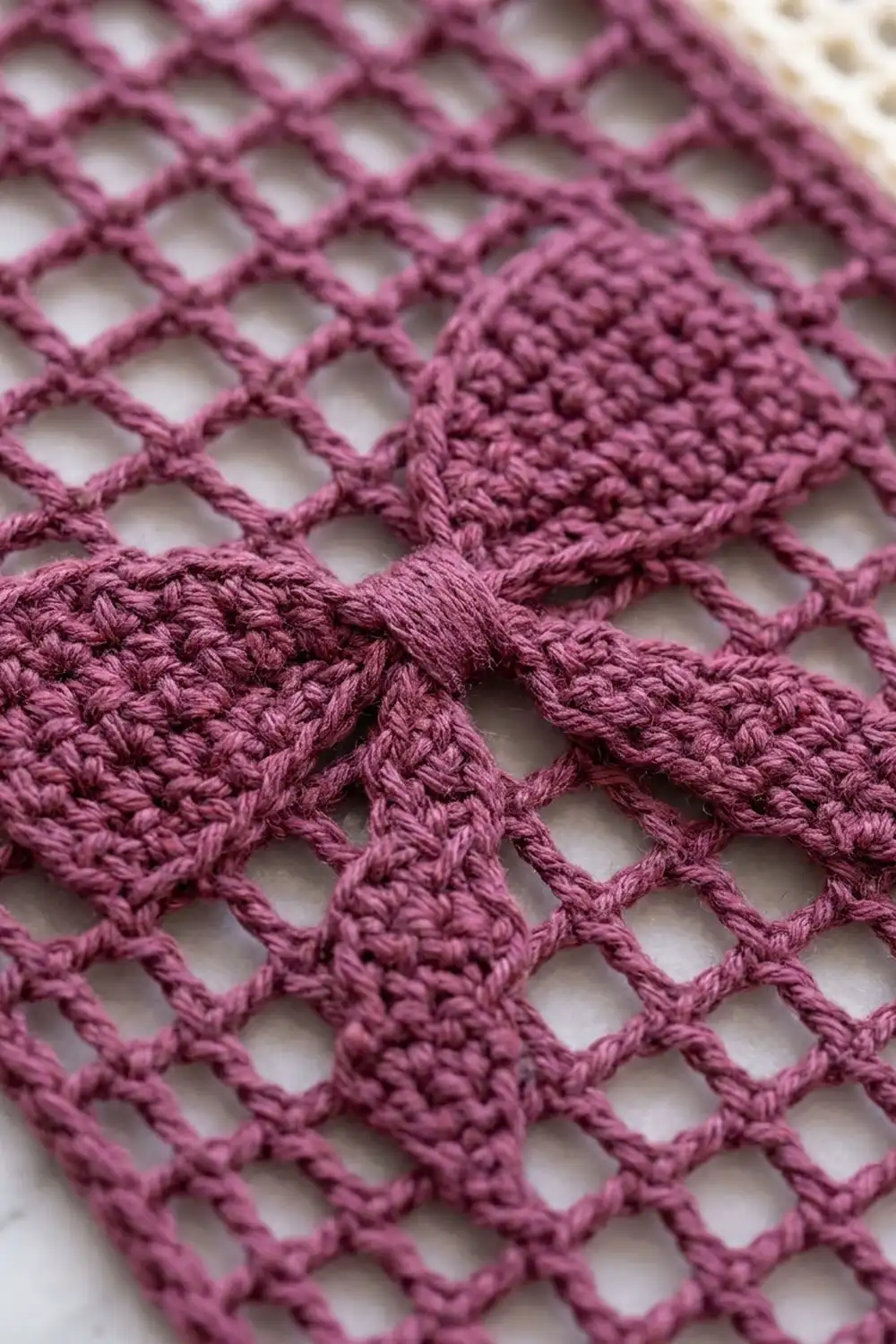
Strip Pattern
Every row starts with ch 3, turn. The ch 3 counts as the first dc. Work the 11 meshes as listed, and put the last dc of each row into the top of the turning ch. Every row has 23 sts.
Foundation: Ch 26.
Row 1 (RS): Dc in 6th ch from hook (first O made), ch 1, sk 1 ch, dc in next ch 10 times. (11 O; 12 dc + 11 ch-1 sps = 23 sts)
Rows 2–7: Ch 3, turn, 11 O. (23 sts per row)
Bow Motif (9 rows)
The bow is worked upside down from the strip’s point of view. You start at the tail tips and finish at the top of the wings. The chart is symmetrical, so it reads the same from either direction. B = block, O = open mesh.
- Motif Row 1 (tail tips): 1 O, 1 B, 7 O, 1 B, 1 O. (2 B)
- Motif Row 2: 1 O, 2 B, 5 O, 2 B, 1 O. (4 B)
- Motif Row 3: 2 O, 2 B, 3 O, 2 B, 2 O. (4 B)
- Motif Row 4: 3 O, 2 B, 1 O, 2 B, 3 O. (4 B)
- Motif Row 5 (knot): 4 O, 3 B, 4 O. (3 B)
- Motif Row 6 (knot and wing bases): 2 O, 7 B, 2 O. (7 B)
- Motif Row 7 (widest wings): 1 O, 4 B, 1 O, 4 B, 1 O. (8 B)
- Motif Row 8: 1 O, 3 B, 3 O, 3 B, 1 O. (6 B)
- Motif Row 9 (wing tops): 1 O, 2 B, 5 O, 2 B, 1 O. (4 B)
Each motif row has 11 meshes and 23 sts. One bow has 42 blocks in total.
The two diagonal tails in Rows 1–4 slant toward each other and meet at the 3-block knot. Rows 6–9 open outward into two wings that slope down to the knot, with a single open square between them in Row 7. That open square gives the tied-ribbon look.
Repeat Sequence
- Rows 8–16: Bow Motif Rows 1–9.
- Rows 17–23: Ch 3, turn, 11 O. (7 open rows, 23 sts each)
Rows 8–23 are one 16-row repeat, which is 8 in (20.3 cm) tall. Repeat Rows 8–23 eight more times, for 9 bows in total. Work the 9th repeat’s 7 open rows as Rows 145–151.
Row map: 7 open rows + 9 x (9 bow rows + 7 open rows) = 7 + 144 = 151 rows.
So each strip has 7 open rows below the first bow and 7 open rows above the last one. The top and bottom margins are each 3.5 in (8.9 cm).
Don’t fasten off. Turn so the RS faces you, ready for the border.
Make All Pieces
Make 7 strips exactly as written, using a single color for each strip, including its border and tabs.
- Plum: 4 strips
- Cream: 3 strips
Layout (left to right, facing the RS):
| P | C | P | C | P | C | P |
P = plum, C = cream. Each strip is 6.5 in (16.5 cm) wide.
Hanging the Strips (No Joining)
These strips are left unjoined on purpose, so there are no seams to stitch. Instead, they’re spaced evenly along the rod.
Method: Slide each strip onto the rod by its two tabs, following the layout order. Leave a 0.5 in (1.3 cm) gap between neighboring strips.
Spacing logic: 7 strips x 6.5 in = 45.5 in (115.6 cm) of fabric. Add 6 gaps x 0.5 in = 3 in (7.6 cm), for a total curtain width of 48.5 in (123.2 cm). That fits a standard 36 in (91.4 cm) door plus its trim, with a little overlap onto the frame.
Tension advice: Hang all the strips for 24 hours before you trim the rod or fix its height. Cotton mesh lengthens slightly under its own weight. Strips that were crocheted on different days can come out with different tension, so compare their hanging lengths now and re-block any strip that differs by more than 0.5 in (1.3 cm).
Size checkpoint: Check that all seven bottom edges line up within 0.5 in (1.3 cm) of each other, and that the curtain measures 48.5 in (123.2 cm) across at the rod.
Border
Border gauge: 4 sc = 1 in (2.5 cm), and each sc round is 0.25 in (0.6 cm) deep.
Why the math works: Each mesh row is 0.5 in tall, so 2 sc per row-end covers exactly 0.5 in at 4 sc per inch. Across the short edges, 23 sts over 5.5 in works out to about 4.2 sc per inch. That’s close enough that the edge lies flat without ruffling or pulling in.
Round 1 (RS): Ch 1. Along the top edge (Row 151), work 3 sc in the first st, 1 sc in each of the next 21 sts, and 3 sc in the last st. Rotate the strip. Down the long side, work 2 sc around each row-end post, 151 rows x 2 = 302 sc. Along the bottom edge, working into the foundation ch, work 3 sc in the first ch, 1 sc in each of the next 21 ch, and 3 sc in the last ch. Up the second long side, work 302 sc. Sl st to the first sc.
- Top edge: 27 sc (3 + 21 + 3, which includes both corner groups)
- Each long side: 302 sc (no corner sts; the corners belong to the short edges)
- Bottom edge: 27 sc
- Total: 27 + 302 + 27 + 302 = 658 sc
Place a marker in the center sc of each 3-sc corner group.
Round 2: Ch 1, sc in each sc around, working 3 sc in each marked corner center. Sl st to the first sc. Move the markers up to the new corner centers.
- Each short edge: 31 sc (each corner group grows from 3 to 5)
- Each long side: 302 sc
- Total: 31 + 302 + 31 + 302 = 666 sc (658 + 8)
Fasten off.
Hanging Tabs (make 2 per strip)
Count the 31 sts across the top edge, starting from the first st of the right corner group. Number them 1–31. The tabs sit on sts 4–6 and sts 26–28. That leaves 3 sts at each outer end and 19 sts between the two tabs (3 + 3 + 19 + 3 + 3 = 31).
Tab Row 1: With RS facing, join yarn in st 4. Ch 1, sc in the same st and in the next 2 sts, turn. (3 sc)
Tab Rows 2–16: Ch 1, sc in each of the 3 sts, turn. (3 sc)
The tab is now 4 in (10.2 cm) long. Fasten off, leaving a 10 in (25.4 cm) tail. Fold the tab to the WS and whipstitch its last row to the back of border Round 1, directly behind the tab’s base. This makes a loop about 2 in (5.1 cm) deep.
Repeat on sts 26–28.
Final Blocking
- Weave in all ends along the dc posts of the mesh, never across open squares.
- Pin each strip RS up to the finished size of 6.5 in x 76.5 in (16.5 cm x 194.3 cm). Work in sections if your board is shorter than the strip.
- Pin both long edges every 4 in (10.2 cm), keeping the edges perfectly straight.
- Run a tape measure across the grid and nudge the mesh until every square is 0.5 in (1.3 cm).
- Mist the strip until it’s evenly damp, not soaked.
- Press the bow blocks flat with your palm so the solid areas sit level with the mesh.
- Let the strip dry completely, at least 12 hours, before unpinning.
- Steam the tabs lightly so the loops stay open and round.
Final Quality-Control Checklist
- Every strip has exactly 151 rows and 9 bows.
- Every row has 11 meshes and 23 sts.
- The bottom and top margins are both 7 open rows.
- Each bow has 42 blocks, and its single open square sits centered in Motif Row 7.
- Border Round 1 has 658 sc and Round 2 has 666 sc.
- The corners are square and the long edges are straight.
- The tabs are on sts 4–6 and 26–28, and both are 16 rows long.
- Every strip measures 6.5 in x 76.5 in (16.5 cm x 194.3 cm).
- All ends are woven in invisibly.
Troubleshooting
The strip is drifting narrower or wider. You’re probably missing the turning ch on one end or working into it twice. Count your 12 dc every 10 rows.
The bow looks lopsided. Check that both tails in Motif Rows 1–4 step inward by exactly one square per row.
Blocks bulge outward. Your dc in the ch-1 sps are too loose. Go down a hook size for block stitches only.
The long border edge ripples. Go down to 3 sc per 2 row-ends, then re-block.
The border edge cups. Make sure you’re working 2 sc per row-end, not 1.
Strips hang at different lengths. Re-block the longer strip shorter while it’s damp, or add or remove an open row at the top margin of the shorter strip.
The tabs twist. Sew the fold flat and centered behind the tab’s base.
Care
Hand wash in cool water with mild detergent, roll in a towel to remove the water, and dry flat to the blocked measurements. Don’t tumble dry or hang the strips while they’re wet, because the mesh stretches easily when wet.
Final Notes
The whole curtain comes from one measurement chain. A 0.5 in (1.3 cm) mesh square times 11 squares gives a 5.5 in (14.0 cm) width. 151 rows give a height of 75.5 in (191.8 cm). The two-round border adds 0.5 in (1.3 cm) per side, for a finished strip of 6.5 in x 76.5 in (16.5 cm x 194.3 cm). Seven strips with six 0.5 in gaps hang 48.5 in (123.2 cm) wide. If you keep your squares true, every bow, border and tab lands where it should.
Happy crocheting!