
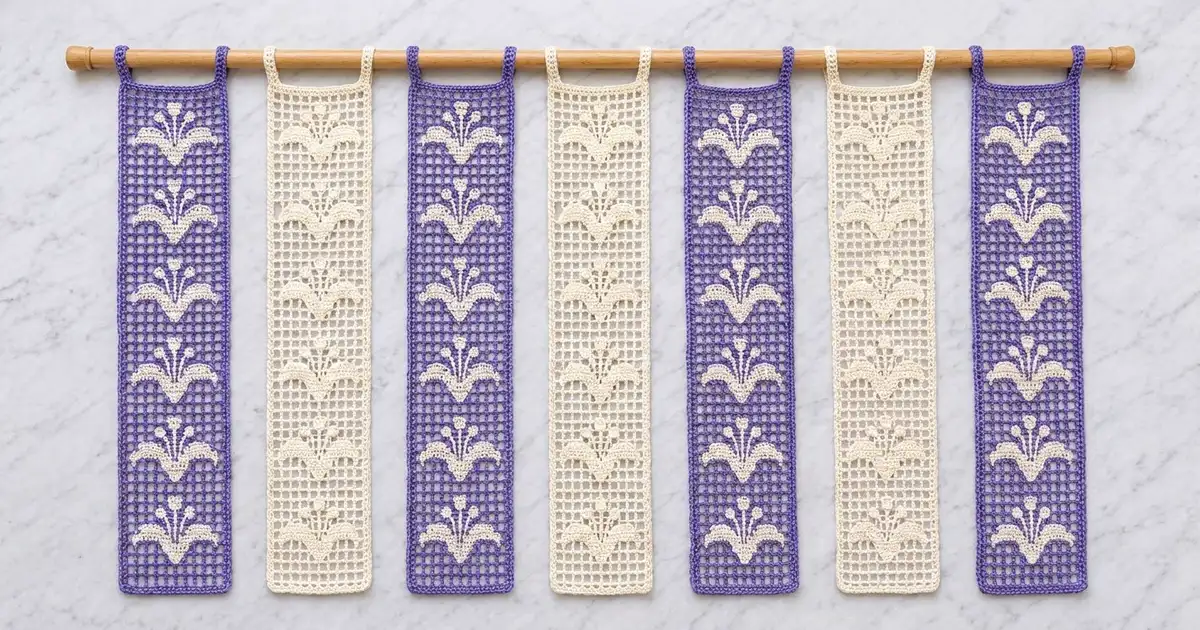
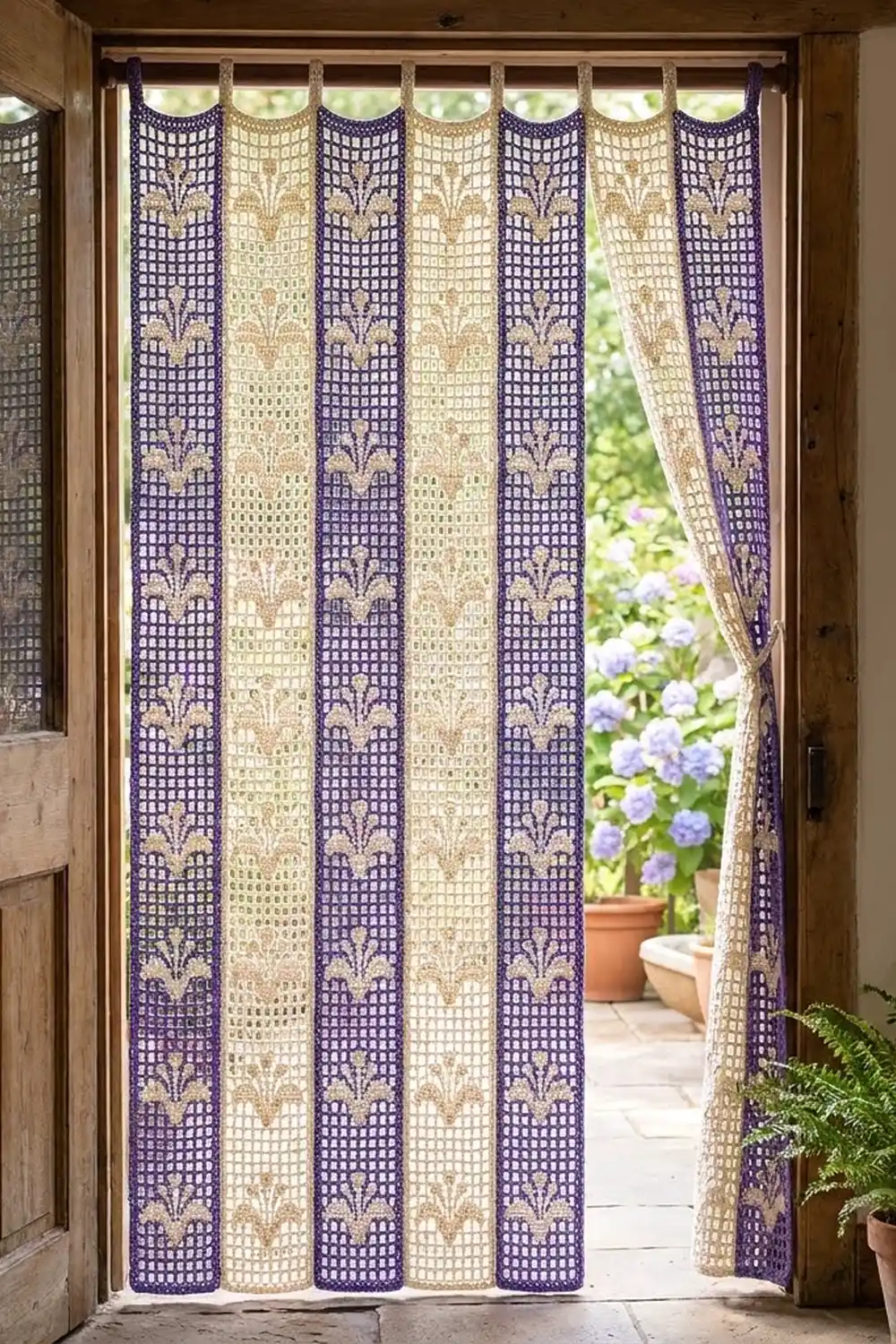
This door curtain is made of seven narrow filet crochet strips that hang side by side from a rod. Four strips are violet purple and three are cream, and they alternate across the doorway. Each strip carries a column of twelve stylized tulips with a pointed base, upturned crescent wings and three budded stems.
On the cream strips the tulips are tone-on-tone filled blocks. On the purple strips you crochet the same filled blocks, then cover them with cream satin stitch so the motif reads clearly from across the room. The style is light and airy: it lets air and daylight through but still frames the doorway.
The pattern uses US crochet terms. Each finished strip measures 4.9 in × 74.4 in (12.4 cm × 189.0 cm) including the border, plus 1.5 in (3.8 cm) hanging loops. Seven strips hung with small gaps cover 35.8 in (90.9 cm), which suits a standard 36 in (91.4 cm) doorway.
Construction is simple and repeats seven times. You work each strip flat in rows of filet mesh, add one round of single crochet with two reinforced hanging loops, then block it. The strips are never sewn together. They move independently, so you can walk through them.
Finished Size and Construction
- Finished strip size: 4.9 in × 74.4 in (12.4 cm × 189.0 cm), plus 1.5 in (3.8 cm) loops
- Skill level: Intermediate (filet mesh, reading block counts, simple embroidery)
- Terminology: US
- Yarn weight: Sport / fine (#2) mercerized cotton
- Hook: 2.75 mm (US C-2)
- Number of pieces: 7 separate strips (4 purple, 3 cream)
- Layout: 7 strips in one row, hung side by side and not joined
- Strip size before border: 4.5 in × 74.0 in (11.4 cm × 188.0 cm), 9 meshes wide × 148 rows tall
- Border depth: 0.2 in (0.5 cm), one round of single crochet plus a slip-stitch finishing round
- Curtain width as hung: 35.8 in (90.9 cm) with 0.25 in (0.6 cm) gaps
Materials
Choose a smooth, mercerized sport-weight cotton of about 155 m per 50 g. Cotton holds the square shape of the mesh, keeps the blocks crisp and hangs straight. Avoid fuzzy or very stretchy yarns, because a long strip will drop under its own weight.
- Violet purple: 250 g (approx. 775 m), for 4 strips
- Cream: 300 g (approx. 930 m), for 3 strips plus satin-stitch overlay on the purple motifs
These quantities include a margin of roughly 20–45% for gauge differences and swatching. One strip uses about 42 g (approx. 130 m). The overlay uses about 26 g (approx. 80 m) per purple strip.
Tools:
– 2.75 mm (US C-2) crochet hook
– Blunt tapestry needle
– Stitch markers
– Tape measure
– Blocking mats or a long padded surface, rust-proof pins, spray bottle
– Curtain rod up to 1 in (2.5 cm) in diameter
Abbreviations (US Terms)
- ch – chain
- sl st – slip stitch
- sc – single crochet
- dc – double crochet
- sp – space
- sk – skip
- st(s) – stitch(es)
- rnd – round
Special stitches:
- Open mesh (O): ch 2, sk 2 sts (or the ch-2 sp), dc in next dc.
- Block (B): 2 dc in the ch-2 sp (or 1 dc in each of the next 2 sts), then dc in next dc.
Every row is 9 meshes and 28 stitches: 10 dc posts plus 9 two-stitch spaces, which are either chains or dc. Blocks change the look of a row but never its count.
Gauge and Checkpoints
Gauge: 10 meshes = 5 in (12.7 cm) wide and 10 rows = 5 in (12.7 cm) tall. One square mesh measures 0.5 in (1.3 cm).
Test one piece first. Treat the first 16 rows of your first strip as your swatch. That covers 4 open rows, one full tulip and 4 more open rows. Pin it flat and measure.
- After Row 16: 4.5 in × 8.0 in (11.4 cm × 20.3 cm)
- After Row 76: 4.5 in × 38.0 in (11.4 cm × 96.5 cm)
- After Row 148: 4.5 in × 74.0 in (11.4 cm × 188.0 cm)
- After border: 4.9 in × 74.4 in (12.4 cm × 189.0 cm)
If your swatch is too large, go down 0.25 mm in hook size. If it is too small, go up 0.25 mm. If the width is right but the rows are too tall, pull up less yarn on each dc rather than changing hooks. Meshes should be square. An error of 0.05 in per row adds up to 7.4 in (18.8 cm) over a full strip.
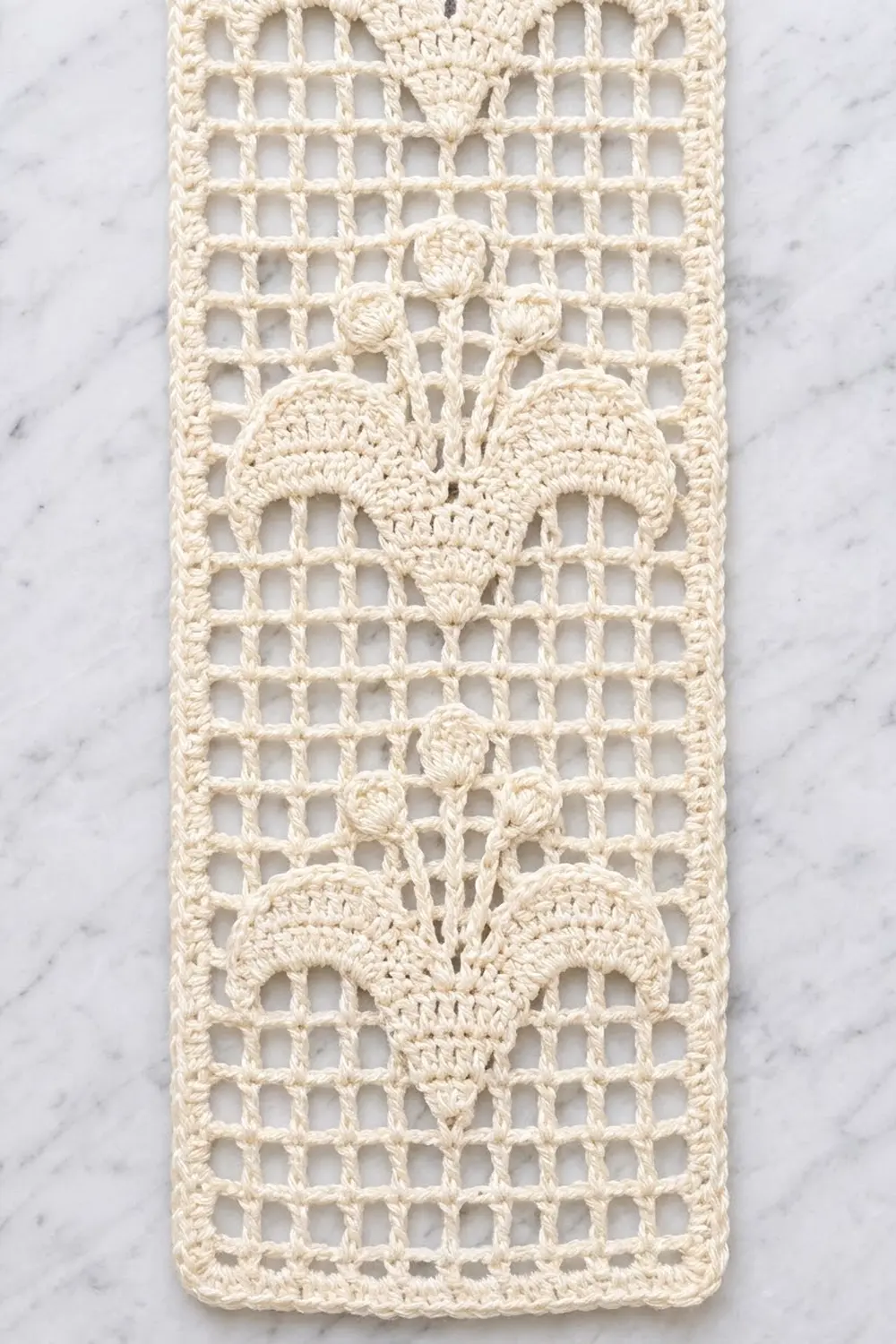
Strip Pattern (Make 7)
Work all strips the same way, 4 in purple and 3 in cream. Columns 1 and 9 are always open mesh, and the tulip sits in columns 2–8.
Foundation: Ch 32.
Row 1 (open): Dc in 8th ch from hook. This counts as the first mesh, and the skipped chains form the first post. Ch 2, sk 2 ch, dc in next ch 8 times. Turn. (9 meshes, 28 sts)
Rows 2–4 (open): Ch 5 (counts as dc + ch 2), dc in next dc. Ch 2, dc in next dc 7 times, working the last dc into the 3rd ch of the turning ch-5. Turn. (9 O, 28 sts)
Place a marker in Row 1 to mark the right side.
Tulip Repeat (12 rows)
Begin every row with ch 5, which counts as the first post and the first open space. Read each row from the start of the row. The motif is symmetrical, so the same instructions work in both directions.
- Motif Row 1: 4 O, 1 B, 4 O. (1 block)
- Motif Row 2: 3 O, 3 B, 3 O. (3 blocks)
- Motif Row 3: 2 O, 5 B, 2 O. (5 blocks)
- Motif Row 4: 1 O, 7 B, 1 O. (7 blocks, the full width of the crescent)
- Motif Row 5: 1 O, 1 B, 2 O, 1 B, 2 O, 1 B, 1 O. (3 blocks: the wing tips and the base of the centre stem)
- Motif Row 6: 2 O, 1 B, 1 O, 1 B, 1 O, 1 B, 2 O. (3 blocks: the side stems and the centre stem)
- Motif Row 7: 2 O, 1 B, 1 O, 1 B, 1 O, 1 B, 2 O. (3 blocks: the side buds and the centre stem)
- Motif Row 8: 4 O, 1 B, 4 O. (1 block, the centre bud)
- Spacer Rows 9–12: 9 O in each row.
Each tulip uses 1 + 3 + 5 + 7 + 3 + 3 + 3 + 1 = 26 blocks. Every row still has 28 stitches.
Rows 5–148: Work the 12-row Tulip Repeat 12 times. The first repeat covers Rows 5–16 and the last covers Rows 137–148. Total rows: 4 open + (12 × 12) = 148. Do not fasten off; go straight to the border.
A strip begins with 4 open rows and ends with the 4 spacer rows of the last repeat. That leaves equal plain mesh at the top and bottom.
Cream Overlay (Purple Strips Only)
When a purple strip is complete and bordered, cover every block with cream. Cut a 60 in (152.4 cm) length of cream and thread the tapestry needle.
Start at the bottom block of a tulip. Work 4 vertical satin stitches over each block, coming up at the base of the block and going down at its top, between the dc posts. Lay the stitches side by side so no purple shows. On the back, travel between nearby blocks by running the yarn through the dc posts, never across an open space. Join a new length on the back when needed. Keep the stitches smooth and relaxed: tight satin stitch puckers the mesh.
Each tulip uses 26 blocks × 4 stitches = 104 satin stitches. Work all 12 tulips on each purple strip.
Make All Pieces
- Purple: 4 strips, 48 tulips in total, all overlaid with cream
- Cream: 3 strips, 36 tulips in total, tone-on-tone
Layout, left to right as hung:
| P | C | P | C | P | C | P |
  1   2   3   4   5   6   7
P = purple strip with cream tulips, C = cream strip with cream tulips. Purple strips sit at both outer edges, so the curtain looks balanced.
Joining and Hanging
The strips are not joined. No stitches are shared between them, so the border counts below apply to each strip on its own.
- Slide the strips onto the rod in layout order: two loops per strip, 14 loops in total.
- Space the strips evenly, leaving a gap of about 0.25 in (0.6 cm) between neighbors.
- Keep loop tension equal so that all bottom edges hang level.
Size checkpoint: 7 × 4.9 in = 34.3 in (87.1 cm) of fabric, plus 6 gaps × 0.25 in = 1.5 in (3.8 cm), equals 35.8 in (90.9 cm). The total drop is 74.4 in (189.0 cm) of strip plus 1.5 in (3.8 cm) of loop, or 75.9 in (192.8 cm).
Border
Border gauge: 6 sc = 1 in (2.5 cm). This matches the 28 stitches across 4.5 in at the top and bottom edges. Along the sides, 3 sc per dc row end gives the same 6 sc per inch, because each row is 0.5 in (1.3 cm) tall.
Rnd 1: With the strip’s own color, ch 1. Work along the top edge first: 3 sc in the first st (corner), sc in each of the next 26 sts, 3 sc in the last st (corner).
Rotate the strip. Down the long side, work 3 sc around each dc row end: 148 rows × 3 = 444 sc.
Along the foundation edge, work into the base of each of the 28 sts: 3 sc in the first base st (corner), sc in each of the next 26, 3 sc in the last (corner).
Up the second long side, work 444 sc. Join with a sl st to the first sc.
(952 sc: 4 corners × 3 = 12, plus 2 × 26 = 52, plus 2 × 444 = 888)
Counts per side, measured from corner centre to corner centre with corner centres included:
– Top and bottom: 1 + 1 + 26 + 1 + 1 = 30 sc
– Long sides: 1 + 1 + 444 + 1 + 1 = 448 sc
– Check: 2 × 30 + 2 × 448 − 4 shared corners = 952
Rnd 2 (finish and loops): Sl st in each sc around. When you reach the centre sc of each top corner, sl st in it and make a hanging loop:
- Ch 36, which is about 3.6 in (9.1 cm).
- Sl st in the same corner sc.
- Work 40 sc into the loop to reinforce it, then continue with sl sts.
Join and fasten off. (952 sl st + 2 reinforced loops)
Each loop hangs about 1.5 in (3.8 cm) and fits a rod up to 1 in (2.5 cm) thick.
Why the math works: The border stitch rate (6 per inch) matches the rate of the body on all four sides. The edges neither ruffle nor pull in. One sc round adds 0.2 in (0.5 cm) on each side, so the width grows from 4.5 in to 4.9 in and the length from 74.0 in to 74.4 in.
Final Blocking
- Weave in all ends along the dc posts or inside the border, never across open meshes.
- Wet each strip in cool water and press out the water in a towel. Do not wring.
- Lay the strip on mats. A strip this long can be blocked in two halves.
- Pin the long edges straight at 4.9 in (12.4 cm) wide, placing a pin every 3 in (7.6 cm).
- Square up the meshes by eye along the length. Check the mesh rows with a straight edge.
- Pin the length to 74.4 in (189.0 cm). Do not stretch it longer, because hanging will add a little drop.
- Spray lightly, let it dry completely, then unpin.
- Smooth the satin stitches with your fingertips while they are still damp.
Final Quality-Control Checklist
- Every strip has 148 rows and 9 meshes across.
- Each strip has 12 tulips, each with 26 blocks.
- Columns 1 and 9 are open in every row.
- Rnd 1 has 952 sc: 30 per short side and 448 per long side, with corners included.
- Both loops are reinforced with 40 sc each.
- On the purple strips, no purple shows through the cream overlay.
- All strips measure 4.9 in × 74.4 in (12.4 cm × 189.0 cm) after blocking.
- All bottom edges hang level on the rod.
Troubleshooting
- The strip leans or twists. You may be missing the last dc into the turning ch-5. Count the 10 posts in each row.
- The meshes look like tall rectangles. Your dc are too tall. Shorten the yarn-overs or use a smaller hook.
- The blocks bulge. Work 2 dc into the ch-2 sp rather than into the chains themselves, and keep the tension even.
- The satin stitch puckers. Loosen the stitches. Re-wet and re-block that area.
- The border ruffles or pulls in. Recount to 3 sc per row end, 444 per long side.
- The strips hang at different lengths. Re-block the short strip, or adjust its rows before you work the border.
Care
Hand wash in cool water with a mild detergent and dry flat, pinned to its blocked size. Do not hang the strips to dry wet, because the cotton will stretch.
Final Notes
The measurement chain:
– Square 0.5 in (1.3 cm) meshes
– 9 meshes give a width of 4.5 in (11.4 cm)
– 148 rows give a length of 74.0 in (188.0 cm)
– The border brings each strip to 4.9 in × 74.4 in (12.4 cm × 189.0 cm)
– Seven strips with small gaps fill 35.8 in (90.9 cm)
If you keep the meshes square, every later number follows.
Happy crocheting!