

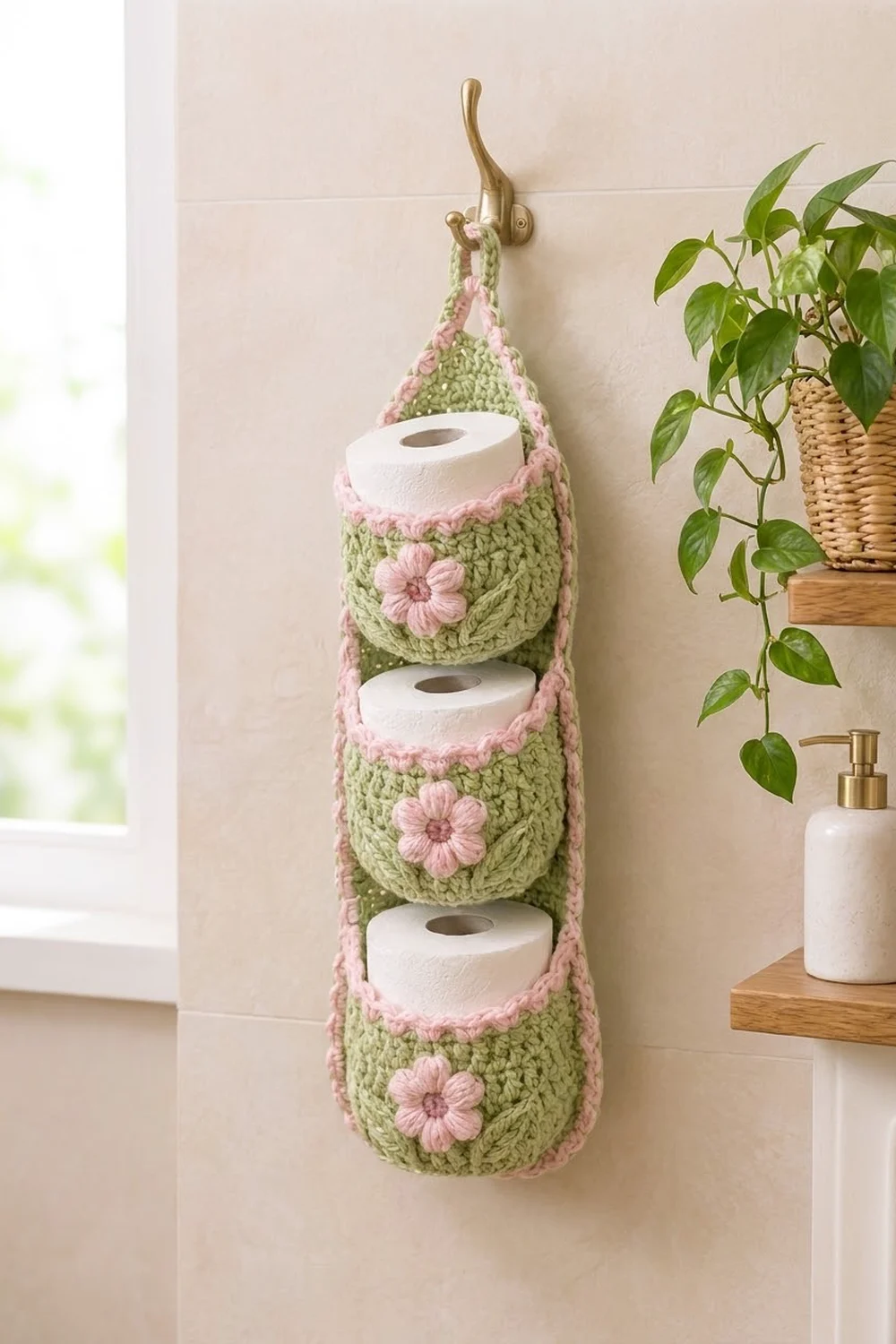
This hanging toilet paper holder keeps three spare rolls tidy. A sage-green triangular back panel hangs from a hook by a loop at its point. Three deep, round-bottomed pockets are sewn to the front: one near the top and two side by side below it, so the three rolls form a small pyramid.
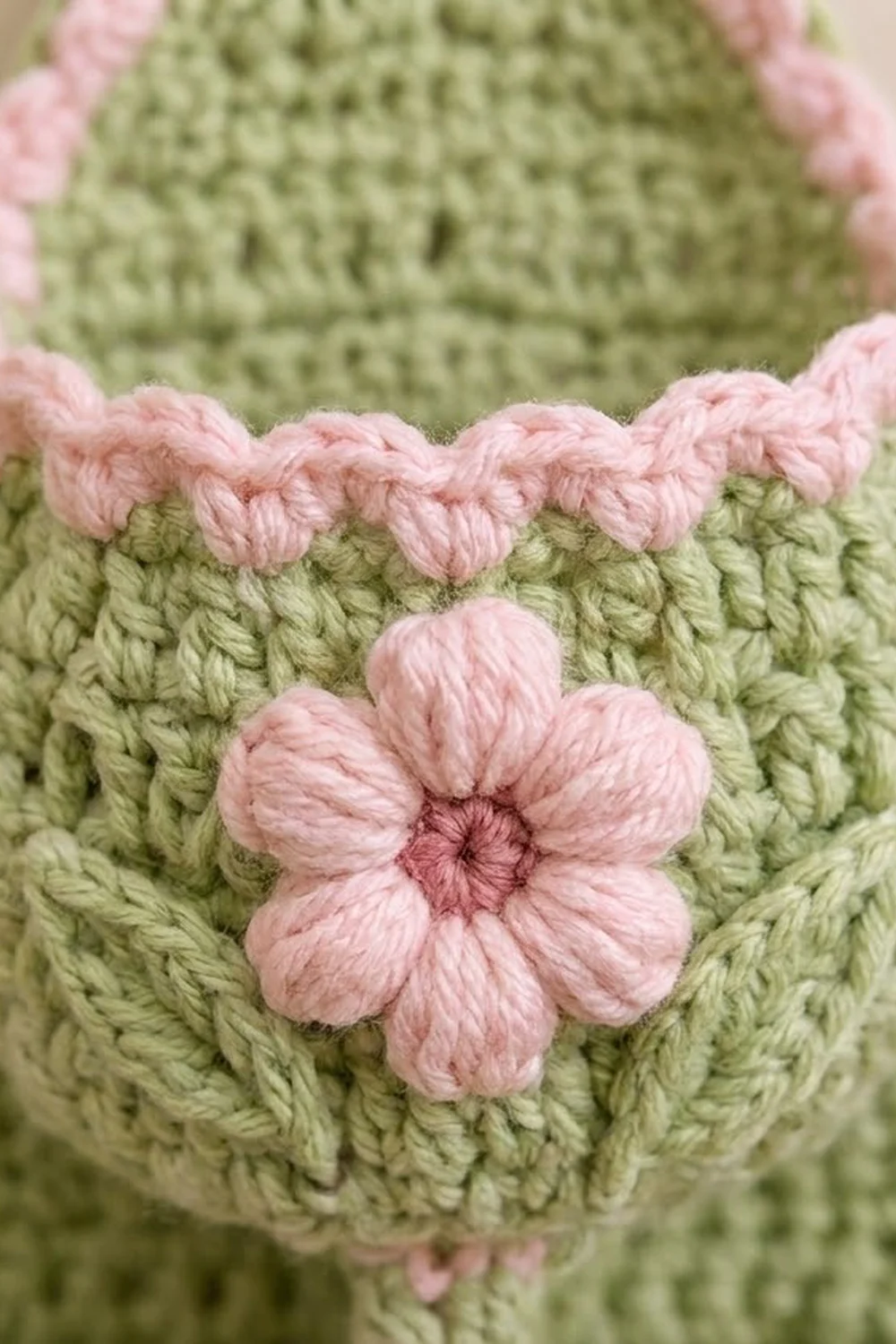
The palette is soft and cottage-style. The main fabric is sage green, the edges have light pink scalloped trim, and each pocket carries a puffy pink flower with a deeper rose center between two green leaves. The texture is dense double crochet, which is firm enough to hold its shape when filled.
The pattern uses US crochet terms. The finished back panel measures 13.0 in (33.0 cm) wide and 11.0 in (27.9 cm) tall, plus a 3.0 in (7.6 cm) hanging loop, for a total hanging length of 14.0 in (35.6 cm). Each pocket fits a standard roll up to about 4.5 in (11.4 cm) across and 4.25 in (10.8 cm) tall.
Construction is simple. You work the triangle top-down in rows, make three cup pockets in the round, add flowers and leaves, sew the pockets on, and finish with a pink border and the hanging loop.
Finished Size and Construction
- Finished size: 13.0 in (33.0 cm) wide × 11.0 in (27.9 cm) tall, plus a 3.0 in (7.6 cm) loop
- Skill level: Intermediate
- Terminology: US crochet terms
- Yarn weight: Worsted (#4)
- Hook: 5.0 mm (H-8)
- Number of pieces: 1 back panel, 3 pockets, 3 flowers, 6 leaves
- Layout: 1 pocket on top, 2 pockets below, arranged in a triangle
- Back panel before border: 12.0 in (30.5 cm) wide × 10.0 in (25.4 cm) tall
- Pocket size: 4.9 in (12.4 cm) base diameter, 3.75 in (9.5 cm) wall height including trim
- Border depth: 0.5 in (1.3 cm), 2 rounds
Materials
Use a smooth worsted cotton or a cotton blend. Cotton holds its shape, resists stretching under the weight of the rolls, and copes well with bathroom humidity. Acrylic also works, but the pockets may sag slightly over time.
- Sage green (MC): 150 g / 270 m, for the back panel, pockets, leaves and loop
- Light pink (CC1): 60 g / 110 m, for the borders, pocket trims and petals
- Rose pink (CC2): 10 g / 18 m, for the flower centers
All quantities include a margin of about 20%.
Tools:
– 5.0 mm (H-8) crochet hook
– Tapestry needle
– 6 locking stitch markers
– Scissors
– Measuring tape
– Blocking mat and pins
– Spray bottle
Abbreviations (US Terms)
- ch: chain
- sl st: slip stitch
- sc: single crochet
- hdc: half double crochet
- dc: double crochet
- BLO: back loop only
- st(s): stitch(es)
- rnd: round
- MR: magic ring
Puff st: (Yarn over, insert hook in the indicated st, yarn over, pull up a loop to 0.5 in [1.3 cm] height) 4 times. Yarn over and pull through all 9 loops on the hook.
Scallop: Sl st in the next st, then work (hdc, dc, hdc) in the following st. Each scallop uses 2 sts.
Gauge and Checkpoints
Gauge: 14 dc and 8 rows = 4 in (10.2 cm), and 14 sc = 4 in (10.2 cm). That works out to 3.5 sts and 2 dc rows per inch.
Make one pocket first. It is the best gauge test because it must fit a real roll.
Checkpoints:
– Pocket base after Rnd 5: 4.9 in (12.4 cm) across, with a circumference of about 15.4 in (39.1 cm).
– Back panel after Row 10: 22 sts measure 6.3 in (16.0 cm) wide, and the piece is 5.0 in (12.7 cm) tall.
– Back panel after Row 20: 42 sts measure 12.0 in (30.5 cm) wide, and the piece is 10.0 in (25.4 cm) tall.
If your pieces are too big, go down 0.5 mm in hook size. If they are too small, go up 0.5 mm. If the pocket base is right but the roll still fits tightly, add one extra wall round to keep the height. Don’t add base stitches.
Back Panel
With MC. The ch-2 at the start of each row does not count as a stitch.
Row 1: Ch 6. Dc in the 3rd ch from the hook and in each of the next 3 ch. Turn. (4 sts)
Row 2: Ch 2. 2 dc in the first st, dc in each st to the last st, 2 dc in the last st. Turn. (6 sts)
Rows 3–20: Repeat Row 2. Each row has 2 more sts than the row before, so Row n has 2n + 2 sts.
Key counts:
– Row 5: 12 sts
– Row 8: 18 sts
– Row 10: 22 sts
– Row 14: 30 sts
– Row 20: 42 sts
Do not fasten off at the end of Row 20. Leave a live loop on a marker for the border later.
Placement markers: Mark the first and last sts of Row 8 (top pocket line) and the first and last sts of Row 14 (lower pocket line). Then mark the center of Row 14, between sts 15 and 16.
Pockets (Make 3)
With MC, worked in continuous joined rounds. Join each rnd with a sl st to the first st, and ch 2 to start each rnd (the ch-2 does not count).
Base:
– Rnd 1: 12 dc in MR. (12 sts)
– Rnd 2: 2 dc in each st. (24 sts)
– Rnd 3: (Dc in next st, 2 dc in next st) 6 times. (36 sts)
– Rnd 4: (Dc in next 2 sts, 2 dc in next st) 12 times. (48 sts)
– Rnd 5: (Dc in next 7 sts, 2 dc in next st) 6 times. (54 sts)
Check: the base should be 4.9 in (12.4 cm) across and lie flat.
Wall:
– Rnd 6 (turning round): Ch 1, sc in BLO of each st. (54 sc + 0 added = 54 sts) The unworked front loops form a crisp base edge.
– Rnds 7–12: Dc in each st. (54 sts)
Fasten off MC. The wall measures 3.25 in (8.3 cm) at this point.
Trim:
– Rnd 13: Join CC1. Ch 1, sc in each st. (54 sc + 0 added = 54 sts)
– Rnd 14: Work 27 scallops around. Each scallop uses 2 sts, and 54 ÷ 2 = 27, so this round contains 27 sl sts and 27 three-stitch shells. Fasten off.
The finished wall height is 3.75 in (9.5 cm). A standard roll stands about 0.5 in (1.3 cm) above the trim.
Flowers (Make 3)
Rnd 1: With CC2, 10 sc in MR. Join and fasten off. (10 sts)
Rnd 2: Join CC1 in any st. Ch 2, (puff st, ch 1, puff st) in the next st, ch 2, sl st in the next st. Repeat from * 4 more times. (5 petals)
Each petal uses 2 of the 10 center sts. The flower measures about 2 in (5.1 cm) across. Leave a 12 in (30.5 cm) tail for sewing.
Leaves (Make 6)
With MC, ch 8.
– Side 1: Starting in the 2nd ch from the hook, sc, hdc, dc, dc, hdc, sc. Then work 3 sc in the last ch.
– Side 2: Working along the other side of the chain, sc, hdc, dc, dc, hdc, sc. Sl st to the first sc. (15 sts)
Each leaf measures 2 in (5.1 cm) long. For a vein, surface sl st down the center with MC. Leave a tail for sewing.
Make All Pieces
Totals:
– MC: 1 back panel, 3 pocket bodies (Rnds 1–12), 6 leaves
– CC1: 3 pocket trims, 3 flower petal rounds, the back border
– CC2: 3 flower centers
Assemble the pocket fronts: Pin 2 leaves in a V on each pocket front, with their tips pointing out and down, roughly over Rnds 8–11. Sew the flower centered on top so the petals overlap the leaf bases. Use the tails to backstitch through the petal bases and around the center ring.
Layout grid:
        [  /\  ]
        [ /P1\ ]     P1 rim on Row 8
        [/----\]
       [ P2 | P3 ]   P2 + P3 rims on Row 14
       [____|____]
Joining
Sew the pockets on before working the border. Use MC and a tapestry needle, and whipstitch through both loops of the pocket and the front of the panel.
Top pocket (P1): Fold the pocket flat with the flower centered at the front, and count 18 sts across its back (the half of the rim opposite the flower). Line up those 18 Rnd 12 sts with the 18 sts of Row 8, one to one. Sew along the top of Rnd 12, so the pink trim stays free above the seam. Then continue the seam down each side of the pocket and along the Rnd 6 ridge behind the base, making a U-shaped seam.
The stitch math works out exactly: 18 sts at 3.5 per inch is 5.1 in (13.0 cm), which equals the width of Row 8.
Lower pockets (P2 and P3): Each pocket also uses 18 back rim sts. Row 14 has 30 sts, or 15 per side of the center marker. Sew the inner 15 rim sts of each pocket to its half of Row 14, one to one, so the two rims meet at the center. The outer 3 rim sts of each pocket hang past the panel edge by about 0.9 in (2.3 cm), which gives the bulging look. Sew the U-seam down to the Rnd 6 ridge.
The top pocket’s base rests between the two lower rims.
Tension: Pull each stitch snug but don’t pucker the panel. If the panel ripples, remove that section and resew with looser stitches.
Checkpoint: The panel should still measure 12.0 in (30.5 cm) wide at Row 20.
Border
Border gauge: 14 sc = 4 in (10.2 cm). Each dc row-end slants about 0.57 in (1.4 cm), and 2 sc also cover 0.57 in (1.4 cm). That is why the edge lies flat.
Rnd 1 (CC1): Join CC1 at the live loop.
– Bottom edge: 3 sc in the first st of Row 20, 1 sc in each of the next 40 sts, 3 sc in the last st. (46 sts)
– Right side: 2 sc in each row-end from Row 19 up to Row 1. 19 row-ends × 2 = 38 sts.
– Top: Sc in each of the 4 sts of Row 1. (4 sts)
– Left side: 2 sc in each row-end from Row 1 down to Row 19. (38 sts)
Join. Total: 46 + 38 + 4 + 38 = 126 sts.
Fold the pocket overhangs forward while you work so they stay out of the way.
Rnd 2 (CC1): Work scallops all around: 23 on the bottom, 19 on each side and 2 on the top, for 63 scallops. Every side has an even count, so the scallops line up with the corners. Join and fasten off.
The border adds 0.5 in (1.3 cm) all around. The panel now measures 13.0 in (33.0 cm) × 11.0 in (27.9 cm).
Hanging loop (MC): Join MC at the top center between the two top scallops. Ch 18, then sl st in the same spot. Work 26 sc over the chain loop and sl st to the base. The loop extends 3.0 in (7.6 cm) above the border. Fasten off and weave in the end securely.
Final Blocking
- Weave in all ends, working through same-color stitches.
- Lay the holder face up on the blocking mat.
- Pin the panel to 13.0 in (33.0 cm) × 11.0 in (27.9 cm), with the point centered.
- Pin the scallops out evenly.
- Mist the whole piece and pat it flat. Keep pins away from the flower petals.
- Stuff each pocket with a dry roll wrapped in plastic so the cups set round.
- Let it dry completely, then remove the pins.
Final Quality-Control Checklist
- The panel measures 13.0 in (33.0 cm) wide and 11.0 in (27.9 cm) tall.
- The loop is 3.0 in (7.6 cm) and sewn on securely.
- Each pocket has 54 sts and holds a roll without straining.
- The top pocket is centered on Row 8, and the lower rims meet at the center of Row 14.
- The pink trim on each pocket stands free above its seam.
- The 63 border scallops are even, with no gaps at the corners.
- Each flower has 5 petals, and the leaves are symmetrical.
- All ends are hidden.
Troubleshooting
- The panel curls at the sides: The increases are too tight. Work the 2-dc increases looser, or go up a hook size.
- The border ruffles: You added extra sc at the row-ends. Recount to 38 sts per side.
- The border pulls in: You skipped row-ends. Work exactly 2 sc in each one.
- The roll doesn’t fit: Check the Rnd 5 count (54) and the base diameter.
- The pockets sag: Use cotton yarn and resew the U-seam firmly at the Rnd 6 ridge.
- The puff sts look flat: Pull the loops up taller before closing the stitch.
Care
Hand wash in cool water, press out the water in a towel and dry flat, reshaping the pockets while damp. Do not tumble dry.
Final Notes
The measurement chain is simple. At 3.5 sts per inch, the 54-st pocket gives a 4.9 in (12.4 cm) base. The 42-st Row 20 gives a 12.0 in (30.5 cm) panel. A 126-st border holds 63 scallops and adds 0.5 in (1.3 cm) per side, for a 13.0 in (33.0 cm) × 11.0 in (27.9 cm) holder. If you check each stage, the pockets will sit exactly where they should.
Happy crocheting!