

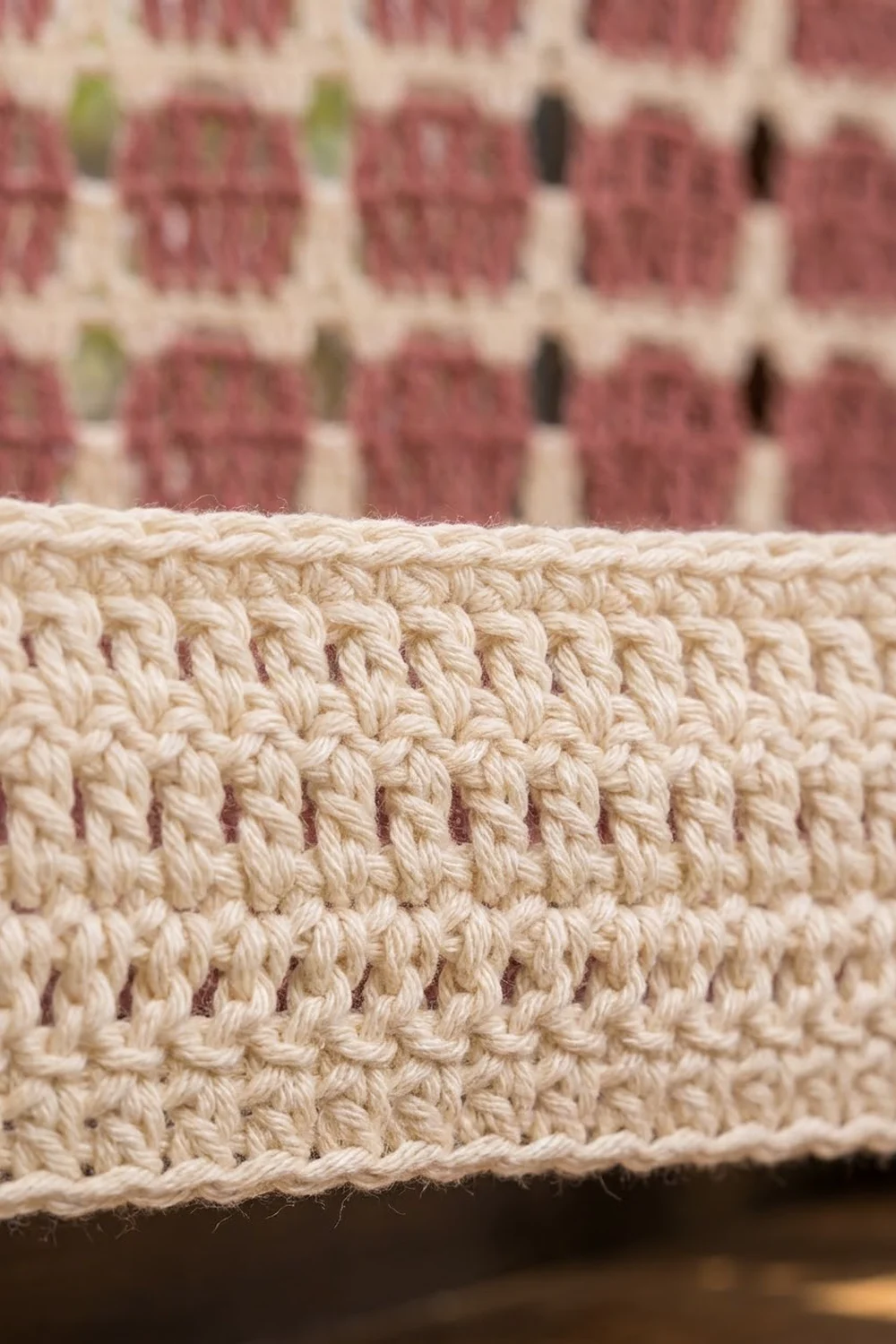
The Rose Windowpane Curtain Panel gives a window a soft café look. Rows of dusty rose blocks sit inside a crisp cream grid. In daylight the small holes at each grid corner let light through, while the solid blocks still give some privacy.
The pattern uses US crochet terms and worsted-weight cotton. The finished panel measures 30 in (76.2 cm) wide and 79 in (200.7 cm) long. The tabs add about 3 in (7.6 cm), so the total hanging length is 82 in (208.3 cm).
Each panel is worked flat in one piece from the bottom up. You make a cream hem band, then 50 repeats of the windowpane grid, then a short top band. Next comes one round of cream border, and the rose tabs are worked straight into the top border. For a pair, make two identical panels. They are never joined.
The vertical cream bars are long spike stitches worked down over the rose chain gaps. There is no tapestry crochet or bobbin work, and each color is simply carried up the side edge.
Finished Size and Construction
- Finished size: 30 in × 79 in (76.2 × 200.7 cm), plus 3 in (7.6 cm) tabs
- Skill level: Intermediate
- Terminology: US
- Yarn weight: Worsted (#4) cotton
- Hook: 5.0 mm (H-8)
- Number of pieces: 1 panel, worked in one piece (make 2 for a pair)
- Layout: 20 blocks across × 50 blocks tall
- Grid cell size: 1.5 in × 1.5 in (3.8 × 3.8 cm)
- Size before border: 29.5 in × 78.5 in (74.9 × 199.4 cm)
- Border depth: 0.25 in (0.6 cm) on each edge
Materials
Use a smooth, mercerized or combed worsted cotton, about 50 g / 85 m (1.75 oz / 93 yd) per ball. Cotton holds the grid’s shape and doesn’t stretch much when it hangs. Avoid acrylic: the weight of a long panel will pull it longer over time.
Per panel:
– Rose: 1,300 g, about 2,210 m (2,417 yd), roughly 26 balls
– Cream: 1,400 g, about 2,380 m (2,603 yd), roughly 28 balls
Double these amounts for a pair. They include a margin of about 10% for your swatch, small gauge differences and weaving in ends. Buy all of each color from a single dye lot.
Tools:
– 5.0 mm (H-8) hook
– Tapestry needle
– Stitch markers
– Tape measure
– Rust-proof pins and a large blocking surface (or a clean floor and towels)
– Spray bottle
Abbreviations (US Terms)
- ch: chain
- sc: single crochet
- dc: double crochet
- sk: skip
- sp: space
- st(s): stitch(es)
- RS / WS: right side / wrong side
- sl st: slip stitch
Special stitch: Long double treble (Ldtr). Yarn over 3 times. Insert the hook in the stitch you’re told to use, 3 rows below. Keep the rose ch-2 loops behind the hook. Pull up a loop to the height of the current row. Then (yarn over, pull through 2 loops) 4 times. Each Ldtr counts as 1 stitch and sits at the height of a single crochet.
Note: The beginning ch 3 counts as a dc. Ch 1 at the start of sc rows does not count as a stitch.
Gauge and Checkpoints
Gauge: 16 sts = 4 in (10.2 cm) in the grid pattern. One 4-row grid repeat is 1.5 in (3.8 cm) tall, so 2 repeats are 3 in (7.6 cm).
Test swatch: With cream, ch 29. Sc in the 2nd ch from the hook and in each ch across (28 sc). Work Rows 8–11 of the grid twice, using 4 blocks and 3 gaps per row instead of 20 blocks and 19 gaps. Block the swatch. It should measure 7 in (17.8 cm) wide, and the 2 repeats should measure 3 in (7.6 cm) tall.
- Too big: go down to a 4.5 mm hook.
- Too small: go up to a 5.5 mm hook.
- Blocks taller than they are wide: your dc stitches are loose. Pull each dc’s loop up a little shorter before you finish it.
Checkpoints (measure flat, without stretching):
– After Row 1: 29.5 in (74.9 cm) wide
– After the hem band: 2.5 in (6.4 cm) tall
– After 10 repeats: 2.5 in (6.4 cm) of hem plus 15 in (38.1 cm) of grid
– After 20 repeats: 30 in (76.2 cm) of grid
– After 30 repeats: 45 in (114.3 cm) of grid
– After 40 repeats: 60 in (152.4 cm) of grid
– After 50 repeats: 77.5 in (196.9 cm) in total
– After the top band: 78.5 in (199.4 cm) in total
Hem Band (Cream)
With cream, ch 119.
Row 1 (WS): Sc in the 2nd ch from the hook and in each ch across. Turn. (118 sc)
Row 2 (RS): Ch 3, dc in each st across. Turn. (118 dc)
Row 3: Ch 1, sc in each st across, including the top of the turning ch. Turn. (118 sc)
Rows 4–7: Repeat Rows 2–3 twice. Row 7 is a WS sc row. (118 sc)
Don’t cut the cream. Leave it at the edge where you finished.
Each sc row is 0.25 in (0.6 cm) tall and each dc row is 0.5 in (1.3 cm), so the 4 sc rows and 3 dc rows add up to 2.5 in (6.4 cm).
Windowpane Grid
Each grid repeat is 4 rows: 2 rose rows and then 2 cream rows. Because each color always works an even number of rows, it finishes at the edge where it started. Carry the color you’re not using loosely up that side edge, and catch it under your first stitch every 4 rows. The border will cover it.
Row 8 (RS, rose): Join rose at the same edge where the cream is waiting. Ch 3, dc in the next 3 sts, ch 2, sk 2 sts, dc in the next 4 sts; repeat from * 18 more times. Turn. (20 blocks of 4 dc and 19 ch-2 sps = 80 dc + 38 ch = 118 sts)*
Row 9 (WS, rose): Ch 3, dc in the next 3 dc, ch 2, sk the ch-2 sp, dc in the next 4 dc; repeat from * 18 more times. Turn. (118 sts)* Drop rose.
Row 10 (RS, cream): Pick up cream. Ch 1, sc in the first 4 dc. Keep both ch-2 loops behind your work and make 1 Ldtr in each of the 2 skipped cream sts 3 rows below, then sc in the next 4 dc. Repeat from * 18 more times. Turn. (80 sc + 38 Ldtr = 118 sts)*
In this row, the pairs of Ldtr make the vertical cream bars. They cover the rose chains, and the gap at each side of every pair leaves the small corner holes.
Row 11 (WS, cream): Ch 1, sc in each st across. Turn. (118 sc)
Rows 12–207: Repeat Rows 8–11 another 49 times, for 50 repeats in total.
In every later repeat, the Ldtr go into the sc of the cream row just below the rose rows, which is the last row of the previous repeat. After Row 205, fasten off rose. Row 207 is a WS cream sc row.
Top Band (Cream)
Row 208 (RS): Ch 1, sc in each st across. Turn. (118 sc)
Row 209 (WS): Ch 3, dc in each st across. Turn. (118 dc)
Row 210 (RS): Ch 1, sc in each st across. (118 sc) Don’t turn.
The panel now measures 29.5 in × 78.5 in (74.9 × 199.4 cm).
Border (Cream)
Border gauge: 4 sc per 1 in (2.5 cm), which matches the body gauge of 16 sts per 4 in.
The counts below give the sc between the corners. The 3-sc corner groups are counted separately and are not part of any side’s count.
Round 1 (RS): Use the cream yarn that’s still attached, or join it in the first st of Row 210. Ch 1.
– Top: 3 sc in the first st (corner), sc in the next 116 sts, 3 sc in the last st (corner).
– First long side: work 314 sc evenly down the row ends.
– Bottom: 3 sc in the first foundation ch (corner), sc in the next 116 ch, 3 sc in the last ch (corner).
– Second long side: work 314 sc up the row ends.
Sl st to the first sc. Fasten off. (116 + 314 + 116 + 314 + 12 corner sts = 872 sc)
Long-side placement: Work 1 sc in the end of each sc-height row and 2 sc in the end of each dc row.
– The panel has 106 sc-height rows: 4 in the hem, 100 in the grid and 2 in the top band. That’s 106 sc.
– It has 104 dc rows: 3 in the hem, 100 in the grid and 1 in the top band. That’s 208 sc.
– Total per long side: 106 + 208 = 314 sc.
Why the math works: The 314 sc at 4 sc per inch cover 78.5 in exactly. The top and bottom also run at 4 per inch, so the edges stay flat and don’t ruffle or pull in.
The border adds 0.25 in (0.6 cm) on each edge, bringing the panel to 30 in × 79 in (76.2 × 200.7 cm).
Tabs (Rose)
There are 9 tabs. Each is 8 sts wide, or 2 in (5.1 cm). They’re worked into the 116 top-edge sc of the border, leaving out the corner groups.
Tab placement: Skip the first 2 top-edge sc. Work Tab 1 over the next 8 sc. Then skip 5 sc, work the next tab over the next 8 sc, and repeat from * 7 more times. That leaves 2 sc at the end.
Check: 2 + 8 + (5 + 8) × 8 + 2 = 116. The gaps between tabs are 1.25 in (3.2 cm).
Each tab:
1. Row 1 (RS): Join rose in the first of its 8 sts. Ch 1, sc in the same st and in the next 7 sts. Turn. (8 sc)
2. Rows 2–24: Ch 1, sc in each st across. Turn. (8 sc)
The tab should be 6 in (15.2 cm) long. Fasten off, leaving a 12 in (30.5 cm) tail.
Fold the tab over to the WS. Whipstitch Row 24 to the WS along the base of Row 210, lining it up stitch for stitch. This makes a loop that rises about 3 in (7.6 cm) above the edge.
Final Blocking
- Weave in all ends along the border or inside the solid blocks, running each one 2 in (5.1 cm) in one direction and then back.
- Soak the panel in cool water for 15 minutes. Press the water out gently. Never wring it.
- Roll the panel in towels to take out most of the water.
- Lay it flat on a clean floor or a blocking surface lined with towels.
- Pin it to 30 in × 79 in (76.2 × 200.7 cm). Pin the corners first, then the middle of each side, then every 4 in (10.2 cm).
- Straighten the grid by eye. Every cream line should be level, and the vertical bars should line up in straight columns.
- Pin the tabs so they lie flat at 2 in (5.1 cm) wide.
- Let it dry completely, which takes 24–48 hours. Don’t hang the panel while it’s damp, or the weight will stretch it.
Final Quality-Control Checklist
- Each block row has 20 blocks and 19 bar pairs
- Each Ldtr pair fully covers the rose chains behind it
- Every row has 118 sts
- The hem is 2.5 in (6.4 cm) tall, and the cream lines and blocks run level all the way up
- The long sides lie flat with no waves or puckers
- Each corner has a 3-sc group
- There are 9 evenly spaced tabs, and all of them are the same length
- The panel is 30 in × 79 in (76.2 × 200.7 cm) after blocking
Troubleshooting
Rose chains show through the bars: You worked the Ldtr behind the chains. Rip back the row and keep the chains behind the hook.
Bars are puckering the grid: Your Ldtr loops are too short. Pull each one up to the full height of the row before finishing it.
Panel is getting narrower: You’re probably missing the last stitch in the turning chain. Count each row to 118.
Wavy side edges: You’ve worked too many border sc. Go back to 2 sc per dc row end and 1 sc per sc row end.
Carried strand shows at the edge: Catch it more often, and keep it slack.
Panel grew longer after hanging: Block it again and let it dry flat. A sturdier rod can help.
Care
Hand wash in cool water with a mild soap, or use a gentle machine cycle inside a large mesh bag. Always dry the panel flat, because hanging it wet will stretch it.

Final Notes
Everything starts from your gauge. At 16 sts per 4 in, the 118 sts give 29.5 in. Each 4-row repeat is 1.5 in tall. The hem band (2.5 in), the 50 grid repeats (75 in) and the top band (1 in) make 78.5 in. The border makes it 30 in × 79 in (76.2 × 200.7 cm), and the tabs bring the hanging length to 82 in (208.3 cm). Check your measurements at each checkpoint and you’ll get a straight, even panel.
Happy crocheting!