

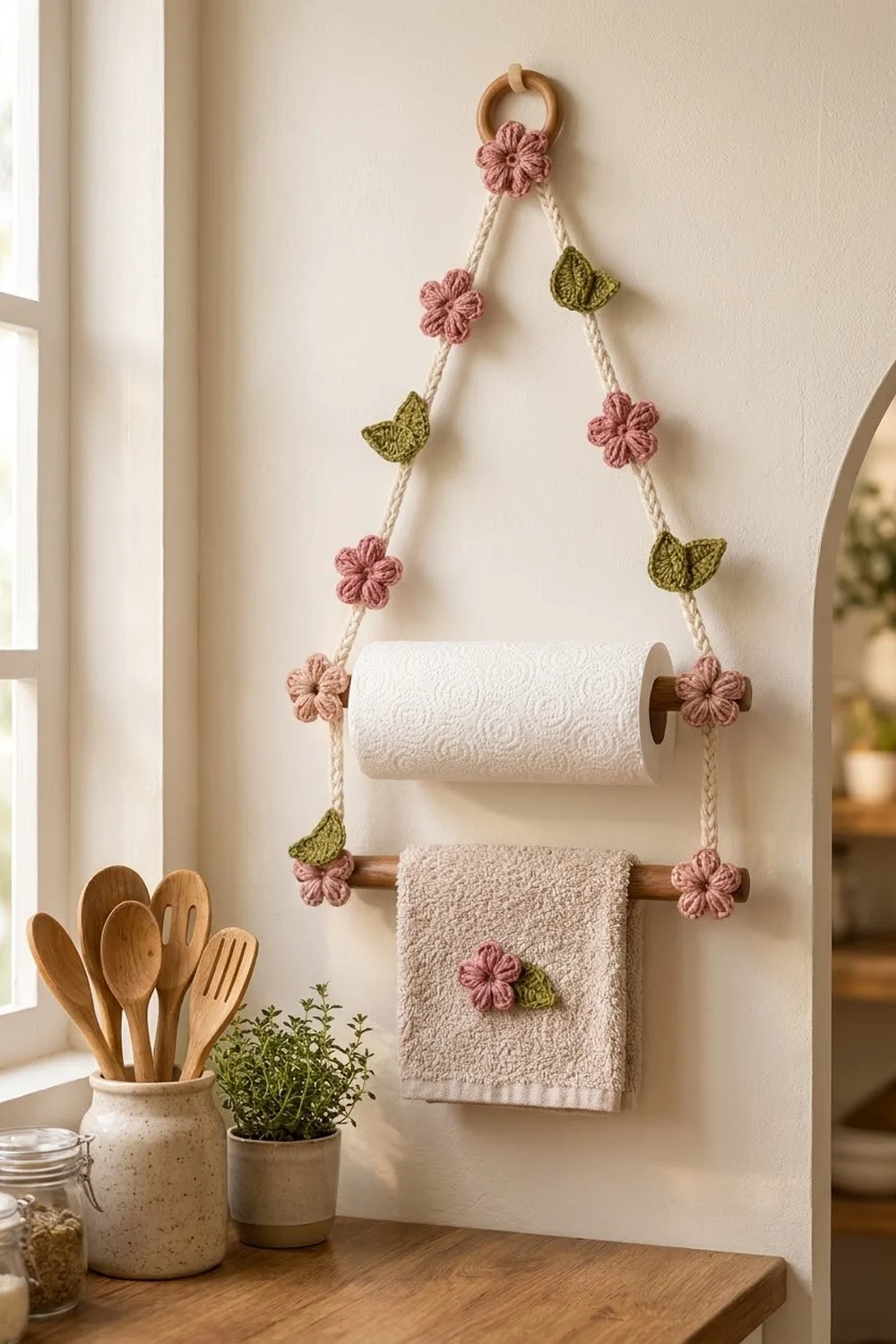
This hanging holder takes a paper towel roll and a hand towel. Two cream cords hang from a wooden ring in a tall triangle and wrap around the ends of two wooden dowels. Dusty-rose puff flowers and olive-green leaves are sewn along the cords, so the hanger looks like a climbing vine.
The colors are cream, dusty rose and olive green. The style is cottage-kitchen: soft, natural and simple. The pattern uses US crochet terms throughout.
The finished hanger is about 14 in (35.6 cm) wide and 27 in (68.6 cm) tall, including the ring. Each cord is 30 in (76.2 cm) long before it is attached.
You make two slip-stitch cords, ten five-petal puff flowers and seven leaves. Then you fold the cords over the ring, wrap them around the dowels and sew on the motifs. One flower and one leaf go on a purchased hand towel to match.
Finished Size and Construction
- Finished size: 14 in (35.6 cm) wide × 27 in (68.6 cm) tall
- Skill level: Easy
- Terminology: US crochet terms
- Yarn weight: Worsted (#4), cotton recommended
- Hook: 5.0 mm (H-8)
- Number of pieces: 19 (2 cords, 10 flowers, 7 leaves)
- Layout: Triangle from the ring to the top dowel, then a straight drop to the bottom dowel
- Piece sizes: cord 30 in (76.2 cm) × 3/8 in (1.0 cm); flower 1.75 in (4.4 cm) across; leaf 1.75 in (4.4 cm) × 1 in (2.5 cm)
- Size before border: each cord is 120 sts long, 30 in (76.2 cm)
- Border depth: none added. In this pattern, the “border” step means splitting each cord into measured segments for the ring fold, the slant and the dowel wraps.
Materials
Choose a smooth worsted-weight cotton or cotton blend. Cotton holds its shape near a sink, survives washing and won’t stretch much under the weight of a damp towel.
- Cream (cords): 30 g / 45 m
- Dusty rose (flowers): 35 g / 55 m
- Olive green (leaves): 20 g / 30 m
These amounts include a margin of roughly 20% for gauge swatches and sewing tails.
Tools and hardware:
- 5.0 mm (H-8) crochet hook
- Tapestry needle
- 4 locking stitch markers
- 1 wooden ring, 2 in (5.1 cm)
- 2 wooden dowels, 14 in (35.6 cm) long and 5/8 in (1.6 cm) thick
- 1 purchased hand towel
- Measuring tape, scissors and rust-proof pins
Abbreviations (US Terms)
- ch – chain
- sl st – slip stitch
- sc – single crochet
- hdc – half double crochet
- dc – double crochet
- st(s) – stitch(es)
- sp – space
- MR – magic ring
- puff st – puff stitch: (yarn over, insert hook in the stitch, pull up a loop) 4 times, giving 9 loops on the hook. Yarn over and pull through all 9 loops, then ch 1 to lock.
- back bump – the horizontal bar on the back of a foundation chain
Gauge and Checkpoints
Cord gauge: 4 sl sts = 1 in (2.5 cm), worked into the chain’s back bumps.
Test one piece first. Ch 21, then sl st in the back bump of the 2nd ch from the hook and in each ch across: 20 sts. The strip should measure 5 in (12.7 cm). Next, make one flower and one leaf before starting the full cords.
Checkpoints:
- Test strip: 20 sts = 5 in (12.7 cm)
- Flower: 1.75 in (4.4 cm) across, from petal tip to petal tip
- Leaf: 1.75 in (4.4 cm) long × 1 in (2.5 cm) wide
- Finished cord: 120 sts = 30 in (76.2 cm)
If your strip is too long, go down to a 4.5 mm hook. If it’s too short, go up to a 5.5 mm hook. A finished cord can be up to 0.5 in (1.3 cm) off without causing problems. Any bigger difference will change the triangle’s height and how the dowels sit.
Flowers and leaves can be up to 0.25 in (0.6 cm) off either way. If they’re larger, use a smaller hook for the motifs only.
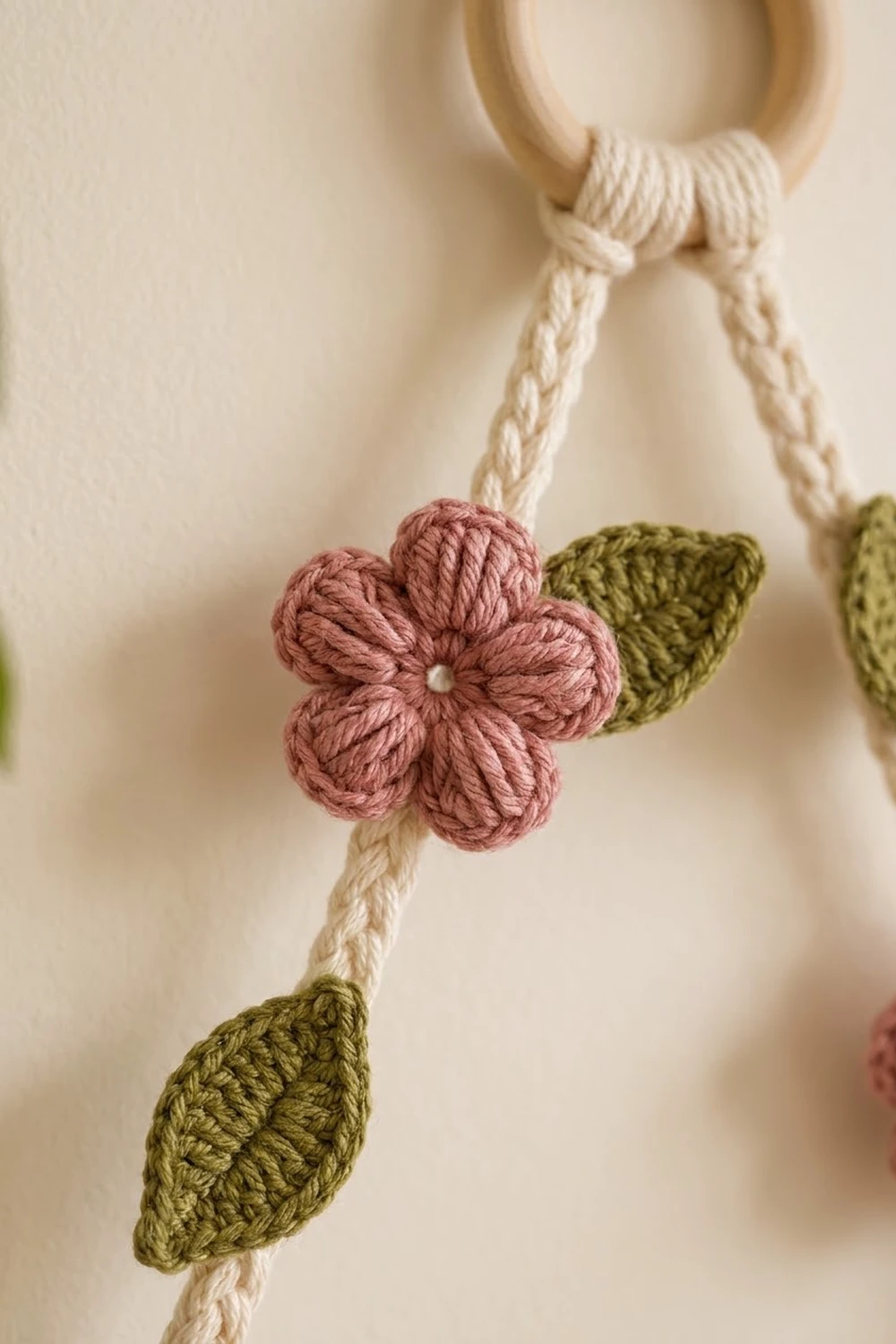
Cord (Make 2, Cream)
Foundation: Ch 121, loosely.
Row 1: Sl st in the back bump of the 2nd ch from the hook and in each ch across. (120 sts)
Fasten off and leave an 8 in (20.3 cm) tail. Weave in the starting tail.
Working into the back bumps leaves the two top loops of each chain standing up, which gives the cord its braided look. Keep your sl sts relaxed. If they’re tight, the cord will curl and come out short.
Checkpoint: Lay the cord flat without stretching it. It should measure 30 in (76.2 cm).
Puff Flower (Make 10, Dusty Rose)
Round 1: MR, ch 1, 10 sc in the ring. Join with a sl st to the first sc. (10 sc)
Round 2: (Ch 2, puff st, ch 2) all in the next sc, sl st in the next sc. Repeat from * to * 4 more times, ending with the last sl st in the joining st of Round 1. (5 petals: 5 puff sts, 20 ch, 5 sl sts)
Each petal uses 2 sc from Round 1: one holds the puff, and the next holds the sl st. 5 petals × 2 sc = 10 sc, so the round comes out exactly.
Pull the magic ring snug, but leave a small open center about 1/4 in (0.6 cm) wide. Fasten off and leave a 10 in (25.4 cm) tail for sewing.
Checkpoint: 1.75 in (4.4 cm) across.
Leaf (Make 7, Olive Green)
Foundation: Ch 7.
Round 1:
- Work up the first side: sc in the 2nd ch from the hook, hdc in the next ch, dc in each of the next 2 ch, hdc in the next ch.
- Make the tip: work (sc, ch 2, sc) in the last ch.
- Rotate the piece and work along the other side of the foundation chain: hdc in the next ch, dc in each of the next 2 ch, hdc in the next ch, sc in the next ch. This last sc goes into the same ch as the first sc.
- Make the stem point: ch 2, sl st in the first sc. (12 sts + 2 ch-2 sps)
The stitch heights rise from sc to dc and fall back to sc on each side, which makes the pointed oval shape. The two ch-2 spaces sharpen the tip and the stem end.
Fasten off and leave a 10 in (25.4 cm) tail.
Checkpoint: 1.75 in (4.4 cm) long × 1 in (2.5 cm) wide.
Make All Pieces
| Piece | Color | Qty |
|---|---|---|
| Cord | Cream | 2 |
| Puff flower | Dusty rose | 10 |
| Leaf | Olive green | 7 |
Where the pieces go: 1 flower on the ring, 2 flowers and 2 leaves on each slant, 1 flower on each of the 4 dowel ends, 1 leaf on each cord between the dowels, and 1 flower plus 1 leaf on the towel.
That totals 1 + 4 + 4 + 1 = 10 flowers and 4 + 2 + 1 = 7 leaves.
Layout grid (F = flower, L = leaf, | = cord):
              ( RING )
                 F
              L     L
           F           F
        L                 L
     F                       F
  F==========TOP DOWEL==========F
  |                             |
  L                             L
  |                             |
  F=========BOTTOM DOWEL========F
          [ towel: F L ]
Joining
Place stitch markers at these cord stitches, counting from the end where you fastened off:
- St 4: end of the ring fold
- St 80: end of the slant
- St 88: end of the top dowel wrap
- St 112: end of the drop between the dowels
Ring:
- Fold sts 1–4 over the ring toward the back.
- Whipstitch the cord end to the back of sts 5–8, sewing one stitch to one stitch.
- Repeat with the second cord, placing it right beside the first.
Top dowel:
- Wrap sts 81–88 once around the dowel, 1 in (2.5 cm) in from its end.
- Sew st 88 to st 81 so the wrap is snug and can’t slide.
- Repeat at the other end of the dowel with the second cord.
The two wrap centers should now be 12 in (30.5 cm) apart. That leaves enough room for a standard 11 in (27.9 cm) paper towel roll.
Bottom dowel: Wrap sts 113–120 the same way, sewing st 120 to st 113.
Tension: Keep each sewing stitch just firm enough to close the gap. Pulling hard will pucker the cord and shorten it.
Size checkpoint:
- Hang the frame from the ring.
- Each slant (sts 5–80) is 76 sts, 19 in (48.3 cm). With the cords 6 in (15.2 cm) out from center at each end, the drop from the ring to the top dowel is about 18 in (45.7 cm).
- The drop between the dowels should be 6 in (15.2 cm).
Border: Cord Segments and Dowel Wraps
A hanger has no fabric edge, so in this pattern the “border” means dividing each cord into exact segments and placing the motifs on them. The border gauge is the cord gauge: 4 sts = 1 in (2.5 cm).
Segments on each cord:
| Segment | Stitches | Length |
|---|---|---|
| Ring fold | sts 1–4 = 4 sts | 1 in (2.5 cm) |
| Slant | sts 5–80 = 76 sts | 19 in (48.3 cm) |
| Top wrap | sts 81–88 = 8 sts | 2 in (5.1 cm) |
| Drop | sts 89–112 = 24 sts | 6 in (15.2 cm) |
| Bottom wrap | sts 113–120 = 8 sts | 2 in (5.1 cm) |
Why the math works:
- 4 + 76 + 8 + 24 + 8 = 120 sts, the exact length of the cord.
- 1 + 19 + 2 + 6 + 2 = 30 in (76.2 cm).
- Each 8-st wrap is 2 in (5.1 cm), just longer than the dowel’s distance around (about 1.96 in, or 5.0 cm). That leaves a little overlap for sewing.
Motif placement on each slant: The motifs sit every 15 sts, or 3.75 in (9.5 cm).
| Cord stitch | Motif |
|---|---|
| 19 | Leaf |
| 34 | Flower |
| 49 | Leaf |
| 64 | Flower |
Stitch 64 sits 16 sts, or 4 in (10.2 cm), above the top wrap.
On the drop: Sew a leaf at st 100, the center of the 24-st segment.
Dowel-end flowers: Sew one flower over each wrap seam so it hides the join.
Ring flower: Sew one flower to the front of the ring, covering both folded cord ends.
How to sew motifs on:
- Flowers: Use the tail to tack each flower through its Round 1 sts with 5–6 small stitches, catching only the top loops of the cord.
- Leaves: Sew down only the stem end and the middle, so the tip stays loose.
- Angle: Point the leaves alternately outward, away from the cord.
Towel: Sew one flower and one leaf to the lower corner of the hand towel, with the leaf tucked under the right side of the flower.
Final Blocking
- Lightly mist all the flowers and leaves with water.
- Pin each flower to a 1.75 in (4.4 cm) circle, opening the petals evenly.
- Pin each leaf to 1.75 in × 1 in (4.4 cm × 2.5 cm), stretching the tip to a point.
- Let the motifs dry completely before sewing them on.
- Hang each cord from a hook with a small clip at the bottom for 1 hour. This removes any twist.
- After assembly, steam the cords lightly from 1 in (2.5 cm) away. Don’t press them flat.
Final Quality-Control Checklist
- [ ] Both cords are 120 sts and 30 in (76.2 cm) long
- [ ] Both slants are the same length, and the dowels hang level
- [ ] The dowel wraps are 12 in (30.5 cm) apart, center to center
- [ ] The drop between the dowels is 6 in (15.2 cm) on both sides
- [ ] Ten flowers and seven leaves are sewn on, with no loose tails
- [ ] The wrap seams are completely hidden under the flowers
- [ ] The hanger holds a full roll without the cords slipping
Troubleshooting
- The cord curls into a spiral. Your sl sts are too tight. Remake it with a hook one size larger, or block it hanging with a weight at the bottom.
- The dowels hang crooked. One cord is longer. Count the slant stitches and refold the ring end until both slants are 76 sts.
- A wrap slides along the dowel. Add a second sewing pass through the dowel-side loops, or put a small dot of fabric glue under the wrap.
- The petals flop over. Your puff sts are loose. Keep all 9 loops the same height, and don’t skip the locking ch 1.
- The leaf tip is rounded. Make sure the (sc, ch 2, sc) all goes into the single last chain.
- The flower center has closed up. Loosen the magic ring until the center is about 1/4 in (0.6 cm) across.
Care
Hand wash in cool water and lay flat to dry, reshaping the flowers while damp. Take the dowels out before washing.
Final Notes
Everything in this pattern follows from one gauge: 4 sl sts = 1 in (2.5 cm). That gives 120-st cords of 30 in (76.2 cm). Each cord splits into a 1 in (2.5 cm) ring fold, a 19 in (48.3 cm) slant, two 2 in (5.1 cm) wraps and a 6 in (15.2 cm) drop. The finished hanger is about 14 in (35.6 cm) wide and 27 in (68.6 cm) tall. Check your test strip, one flower and one leaf before making the full set, and every later measurement will line up.
Happy crocheting!