
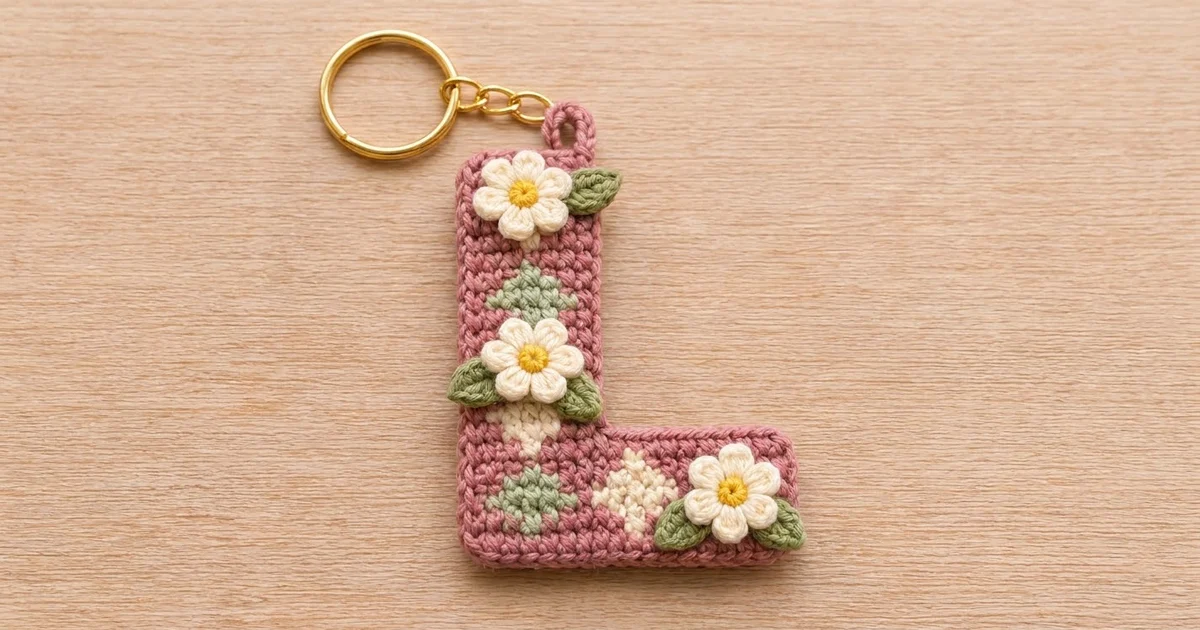
The Rosy Meadow Letter L Keychain is a small, sturdy initial charm worked in tight tapestry single crochet. A dusty rose background carries a column of stepped diamonds in cream and sage. On top, three tiny cream flowers with golden centers and sage leaves add a raised layer.
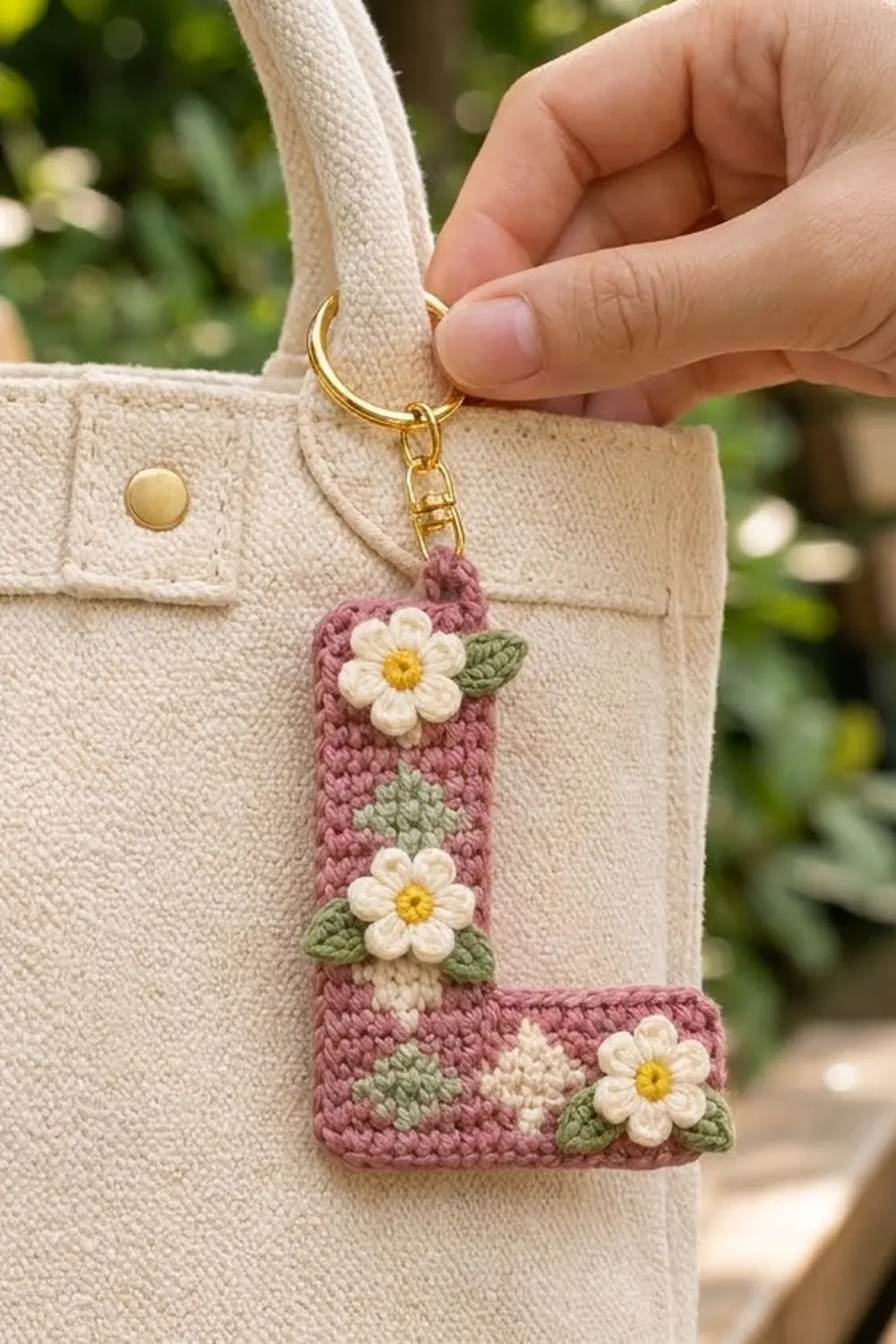
The colors are soft and vintage: dusty rose, warm cream, muted sage and a touch of mustard yellow. The finished letter is flat, firm and slightly padded, so it keeps its shape on a bag handle or key ring.
This pattern uses US crochet terms. The finished letter measures 3.375 in (8.6 cm) wide and 4 in (10.2 cm) tall, not counting the hanging loop.
Construction is simple. First you work the foot of the L in rows, then you continue up the left 9 stitches to make the stem. One round of rose single crochet goes around the whole shape, and a small loop goes on at the top. Last, you crochet three flowers and five leaves and sew them on.
Finished Size and Construction
- Finished size: 3.375 in (8.6 cm) wide x 4 in (10.2 cm) tall
- Skill level: Intermediate (tapestry color changes)
- Terminology: US crochet terms
- Yarn weight: Fingering / 4-ply cotton (Super Fine, #1)
- Hook: 2.25 mm (US B-1)
- Number of pieces: 1 L-shaped body, plus 3 flowers and 5 leaves sewn on top
- Layout: One letter; the foot is 25 sts wide x 9 rows, and the stem is 9 sts wide x 21 rows
- Size before border: 3.125 in (7.9 cm) wide x 3.75 in (9.5 cm) tall
- Stem width before border: 1.125 in (2.9 cm)
- Border depth: 1 round of sc, about 1/8 in (0.3 cm) per edge
Materials
Choose a smooth, tightly plied mercerized cotton. It gives crisp color edges and won’t fuzz on a keychain. These amounts assume about 170 m per 50 g.
- Color A, dusty rose: 10 g (34 m), for the body background, border and loop
- Color B, cream: 6 g (20 m), for the diamonds and flower petals
- Color C, sage green: 4 g (14 m), for the diamonds and leaves
- Color D, mustard yellow: 1 g (3 m), for the flower centers
All quantities include a margin for swatching and sewing tails.
Tools:
- 2.25 mm (US B-1) crochet hook
- Tapestry needle
- 1 gold split key ring, 1 in (2.5 cm), with a short chain and jump ring
- Scissors
- Pins and a blocking mat
- Spray bottle with water
Abbreviations (US Terms)
- ch: chain
- sl st: slip stitch
- sc: single crochet
- hdc: half double crochet
- dc: double crochet
- sc2tog: single crochet 2 together
- st(s): stitch(es)
- A / B / C / D: rose / cream / sage / yellow
Tapestry single crochet: Lay the colors you aren’t using along the top of the previous row and crochet over them so they stay hidden inside the stitches. To change color, work the last sc before the change until 2 loops are left on the hook. Then yarn over with the new color and pull it through. Carry all three body colors (A, B and C) through every row so the fabric is the same thickness everywhere.
Turning: Ch 1 at the start of every row. It doesn’t count as a stitch.
Gauge and Checkpoints
Gauge: 16 sc x 16 rows = 2 in (5.1 cm) in tapestry sc with three colors carried.
Your stitch gauge and row gauge need to match, because the border puts 1 sc in each row end.
Test first: Work Rows 1–9 (the foot) and measure before you start the stem. The foot is your gauge swatch.
Checkpoints:
- After Row 9: 3.125 in (7.9 cm) wide x 1.125 in (2.9 cm) tall
- After Row 30: 3.75 in (9.5 cm) tall overall; stem 1.125 in (2.9 cm) wide
- After the border: 3.375 in (8.6 cm) x 4 in (10.2 cm)
- Each diamond: 5 sts x 5 rows, 0.625 in (1.6 cm) square
- Each flower: about 0.75 in (1.9 cm) across
Too big? Go down to a 2.0 mm hook, or pull the carried strands snug every few stitches.
Too small? Go up to a 2.5 mm hook.
Rows taller than your stitches are wide? Keep your yarn-over loops even. Uneven rows will make the side borders ripple.
Body: Foot (Rows 1–9)
With A, ch 26.
Row 1 (A): Sc in 2nd ch from hook and in each ch across. (25 sts)
Row 2 (A): Ch 1, turn, sc in each st across. (25 sts) Start carrying B and C in this row so they’re in place for Row 3.
Row 3: Ch 1, turn. 4 A, 1 C, 7 A, 1 B, 7 A, 1 C, 4 A. (25 sts)
Row 4: Ch 1, turn. 3 A, 3 C, 5 A, 3 B, 5 A, 3 C, 3 A. (25 sts)
Row 5: Ch 1, turn. 2 A, 5 C, 3 A, 5 B, 3 A, 5 C, 2 A. (25 sts)
Row 6: Repeat Row 4. (25 sts)
Row 7: Repeat Row 3. (25 sts)
Rows 8–9 (A): Ch 1, turn, sc in each st across. (25 sts)
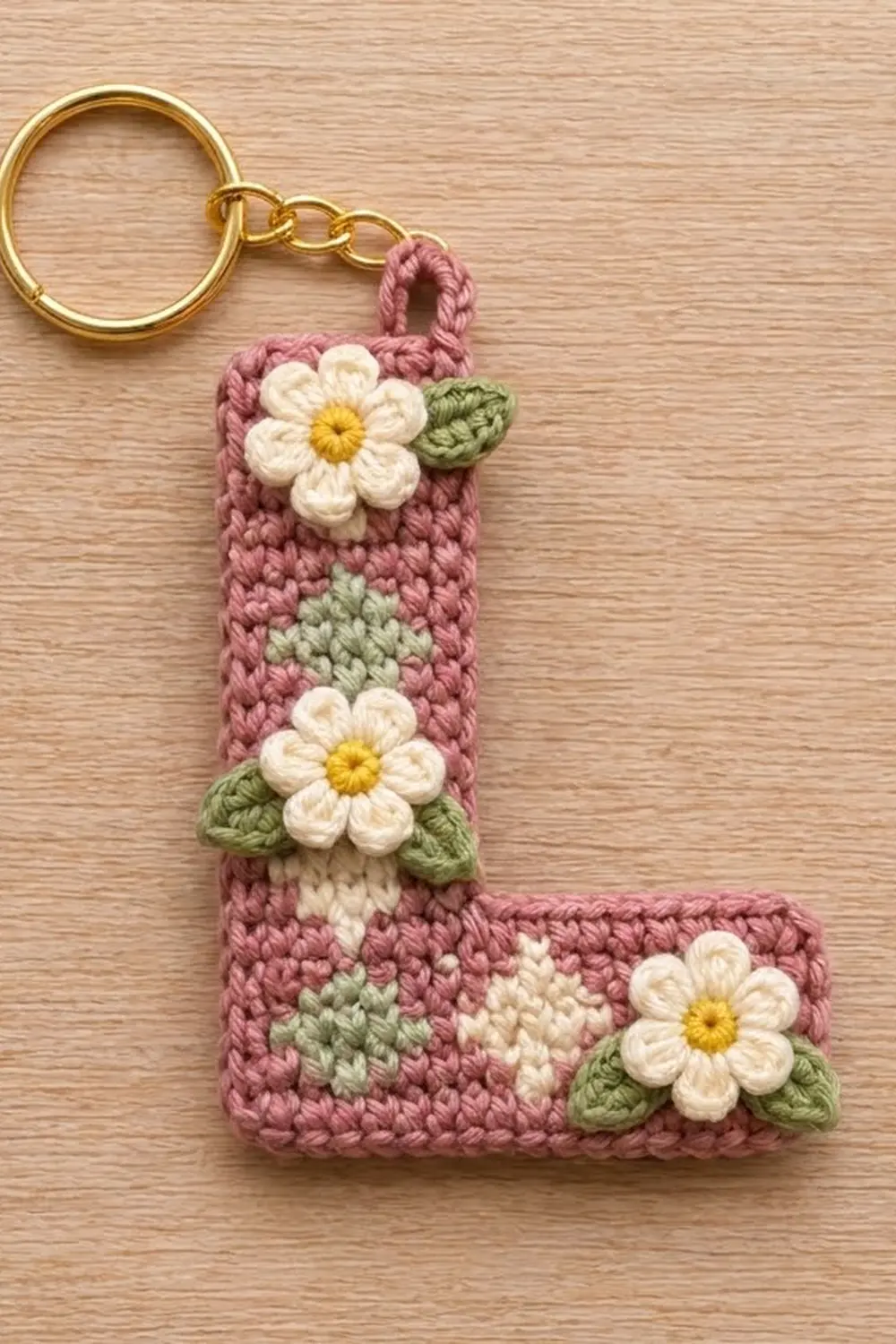
The foot now has three diamonds: sage, cream, sage. Each one is 5 sts wide and 5 rows tall. There are 2 rose sts at each outer end and 3 rose sts between diamonds. The layout is symmetrical, so it reads the same in either row direction.
Checkpoint: 3.125 in (7.9 cm) x 1.125 in (2.9 cm).
Body: Stem (Rows 10–30)
Row 9 ends at the left end of the foot. Each stem row is worked over the first 9 stitches only.
Row 10: Ch 1, turn. 4 A, 1 B, 4 A. Leave the other 16 sts of Row 9 unworked. (9 sts)
Row 11: Ch 1, turn. 3 A, 3 B, 3 A. (9 sts)
Row 12: Ch 1, turn. 2 A, 5 B, 2 A. (9 sts)
Row 13: Repeat Row 11. (9 sts)
Row 14: Repeat Row 10. (9 sts)
Rows 15–16 (A): Ch 1, turn, sc in each st across. (9 sts)
Rows 17–21: Repeat Rows 10–14, using C instead of B. (9 sts)
Rows 22–23 (A): Ch 1, turn, sc in each st across. (9 sts)
Rows 24–28: Repeat Rows 10–14 with B. (9 sts)
Rows 29–30 (A): Ch 1, turn, sc in each st across. (9 sts)
From the top down, the stem now reads cream, sage, cream, then the sage corner diamond in the foot. Cut B and C, but leave A attached. Row 30 ends at the top-right corner of the stem.
Checkpoint: 3.75 in (9.5 cm) tall. The stem is 1.125 in (2.9 cm) wide and rises 2.625 in (6.7 cm) above the foot.
Border
Border gauge: Work 1 sc per stitch along the top and bottom edges and 1 sc per row end along the sides. Because your stitch and row gauge match (8 per inch), this keeps every edge flat. Each of the 5 outer corners gets 3 sc in the corner stitch, and the one inner corner gets an sc2tog.
Rnd 1 (A): Ch 1 and turn the piece so you can work down the right side of the stem.
- Stem right side: Sc in the row ends of Rows 29 down to 11. (19 sc)
- Inner corner: Sc2tog over the row end of Row 10 and the first unworked st of Row 9. (1 st)
- Foot top: Sc in each of the next 14 unworked sts of Row 9. (14 sc)
- Corner: 3 sc in the last st of Row 9. (3 sc)
- Foot right end: Sc in the row ends of Rows 8 down to 2. (7 sc)
- Corner: 3 sc in the corner st of Row 1. (3 sc)
- Bottom: Sc in the free loops of the foundation chain across the next 23 sts. (23 sc)
- Corner: 3 sc in the last foundation st. (3 sc)
- Left side: Sc in the row ends of Rows 2 up to 29. (28 sc)
- Corner: 3 sc in the first st of Row 30. (3 sc)
- Stem top: Sc in each of the next 7 sts. (7 sc)
- Corner: 3 sc in the last st of Row 30. (3 sc)
Join with sl st to the first sc. (114 sts)
Why the math works: The straight edges add up to 19 + 1 + 14 + 7 + 23 + 28 + 7 = 99 sts. Five corners at 3 sc each add 15, for 114 in total.
Each full side, with its corner groups, equals its body edge plus 2 corner stitches:
- Bottom: 3 + 23 + 3 = 29 sc over 25 body sts
- Left side: 3 + 28 + 3 = 34 sc over 30 rows
- Stem top: 3 + 7 + 3 = 13 sc over 9 sts
The border adds one sc on each side. The width becomes 27 sts (3.375 in / 8.6 cm), and the height becomes 32 rows (4 in / 10.2 cm).
Fasten off and weave in the ends.
Hanging loop: Join A with sl st in the center sc of the stem top (the 4th of the 7 straight sc). Ch 8 and sl st in the same st. Ch 1, work 12 sc into the ch-8 loop, then sl st in the same top st. Fasten off and weave in. The loop stands about 0.5 in (1.3 cm) above the top edge.
Flowers (Make 3)
Rnd 1 (D): Make a magic ring. Ch 1, 5 sc in the ring, sl st to the first sc, and pull the ring tight. (5 sts) Fasten off D.
Rnd 2 (B): Join B in any sc. (Sl st, ch 2, 2 dc, ch 2, sl st) in the same sc, then move to the next sc. Repeat from * around. (5 petals, 2 dc each)
Fasten off, leaving a 10 in (25.4 cm) tail for sewing. Each flower is about 0.75 in (1.9 cm) across, so it overlaps the stem border slightly.
Leaves (Make 5)
With C, ch 6.
Side 1: Sl st in 2nd ch from hook, sc in next ch, hdc in next ch, sc in next ch, sl st in last ch. (5 sts)
Side 2: Ch 1, then turn and work into the free loops on the other side of the chain: sl st in first ch, sc in next ch, hdc in next ch, sc in next ch, sl st in last ch. (5 sts)
Sl st into the tip. Fasten off, leaving an 8 in (20.3 cm) tail. Each leaf is pointed at both ends and about 0.625 in (1.6 cm) long.
Final Blocking
- Weave in all body ends before blocking. Hide them inside the carried strands on the back.
- Lay the letter face up on a blocking mat.
- Pin it to 3.375 in (8.6 cm) wide and 4 in (10.2 cm) tall. Pin the stem to 1.375 in (3.5 cm) wide, including the border.
- Check that the inner corner is a clean right angle and the top of the foot is straight.
- Mist with water until damp but not soaked.
- Let it dry completely, about 4–6 hours.
- Unpin it and sew on the appliqués:
- Top flower: centered over the top cream diamond, with 1 leaf tucked under its right side
- Middle flower: centered over the lower cream stem diamond, with 2 leaves under its lower left and lower right
- Foot flower: over the right sage diamond on the foot, with 2 leaves under its lower left and lower right
- Tack each leaf at its base and tip. Sew each flower down with small stitches between the petals so the petals stay raised.
- Open the jump ring, pass it through the hanging loop and close it.
Final Quality-Control Checklist
- The body measures 3.375 in x 4 in (8.6 cm x 10.2 cm).
- The stem is 1.375 in (3.5 cm) wide with the border.
- All six diamonds are 5 sts x 5 rows with clean stepped edges.
- No carried colors show through on the front.
- The border has 114 sts, and all 5 outer corners lie flat.
- The inner corner is sharp, not puckered.
- Each of the three flowers has 5 even petals and a yellow center.
- The five leaves are placed 1 / 2 / 2.
- The loop is centered and the key ring is closed tight.
Troubleshooting
- Colors show through: Pull the carried strands snug and keep them on top of the row while you work over them.
- Fabric curls: Your tension is too tight. Go up 0.25 mm or loosen how firmly you carry the strands.
- Diamonds look lopsided: Recount the A stitches on both sides of each diamond. The two sides should mirror each other.
- Side border ruffles: Your rows are shorter than your stitches are wide. Skip 1 row end every 10 rows and note the new count.
- Side border pulls in: Add 1 sc every 10 row ends.
- Inner corner gapes: Redo the sc2tog and pull it firm.
- Flowers cup: Press them flat under a warm, damp cloth before sewing.
Care
Spot clean with cool water and mild soap, then lay flat to dry. Don’t soak it, because the metal key ring can tarnish.
Final Notes
Here is the measurement chain:
- Gauge is 16 sc x 16 rows = 2 in (5.1 cm).
- The foot is 25 sts x 9 rows, or 3.125 in x 1.125 in (7.9 cm x 2.9 cm).
- The finished body is 3.125 in x 3.75 in (7.9 cm x 9.5 cm).
- The 114-stitch border brings it to 3.375 in x 4 in (8.6 cm x 10.2 cm).
- Three 0.75 in (1.9 cm) flowers add the raised floral layer.
If you check your size at each stage, the letter will come out square, flat and ready to hang.
Happy crocheting!