
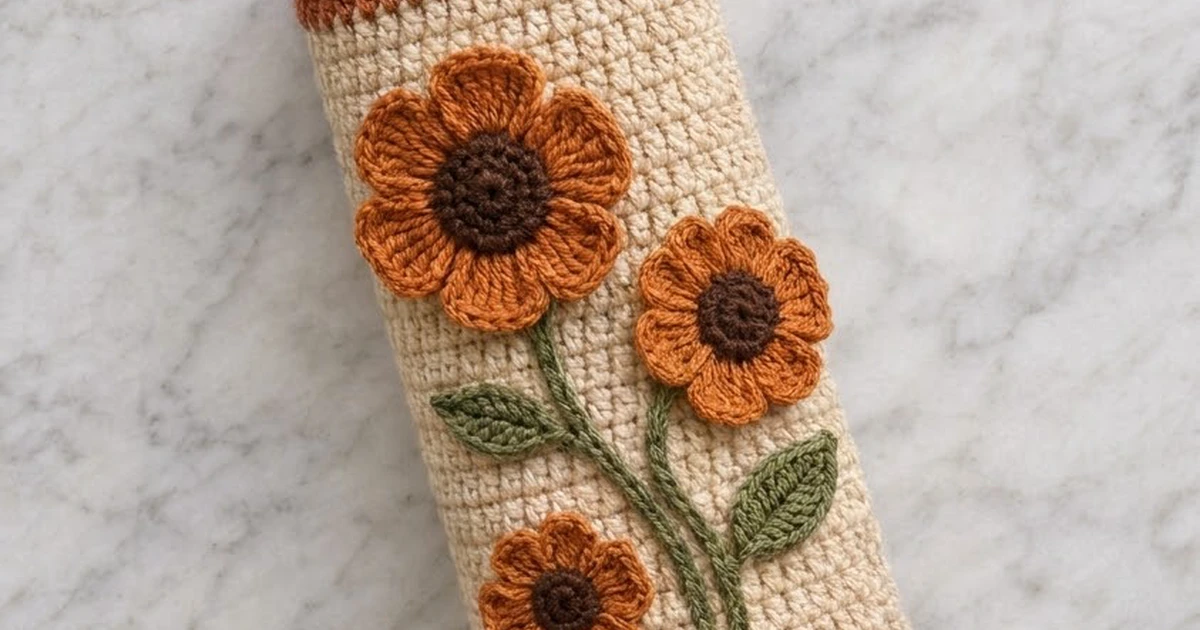
This bag holder is a tall cream tube with warm rust stripes, an oval slot near the bottom for pulling out bags, and a small bunch of orange flowers growing up the front. A rust-covered ring at the top lets it hang from a cabinet hook, a door knob, or a pantry rail.
The colors are cream, rust, burnt orange, dark brown, and olive green. The style is cozy farmhouse: dense single crochet for a sturdy body, rounded flowers with dark centers, and simple chain stems with two leaves.
The pattern uses US crochet terms. The flattened body measures about 5 in (12.7 cm) wide and 14.5 in (36.8 cm) tall. With the tab and ring, the holder is about 18.75 in (47.6 cm) tall.
You start with an oval base, turn up the walls by working in back loops, and then work in joined rounds. To make the slot, you work a few turned rows over part of the round, then chain across the gap. A rust rim finishes the top and a rust edging finishes the slot. The flowers, stems, leaves, tab, and ring are sewn on last.
Finished Size and Construction
- Finished size: body 5 in (12.7 cm) wide flat x 14.5 in (36.8 cm) tall; about 18.75 in (47.6 cm) including the ring
- Skill level: Easy-intermediate
- Terminology: US
- Yarn weight: Worsted (#4) cotton
- Hook: 4.0 mm (G-6)
- Number of pieces: 1 finished holder, made from a body, 1 tab, 1 covered ring, 3 flowers, 3 stems, and 2 leaves
- Layout: Flowers on the front, slot centered on the front near the bottom, tab centered at the back rim
- Body circumference: 40 sts = 10 in (25.4 cm); 20 sts per flattened side
- Size before top border: 5 in x 13.6 in (12.7 cm x 34.5 cm)
- Top border depth: 4 rounds, about 0.9 in (2.3 cm)
Materials
Use a smooth worsted-weight cotton or cotton blend. Cotton holds its shape and won’t stretch out as bags are pushed in. The amounts below assume about 1.7 m per gram, which is typical for worsted cotton.
- Cream (body): 90 g, about 153 m
- Rust (bands, slot edging, tab, ring cover): 30 g, about 51 m
- Burnt orange (petals): 10 g, about 17 m
- Dark brown (flower centers): 5 g, about 9 m
- Olive green (stems and leaves): 8 g, about 14 m
All amounts include a small extra margin.
Tools:
- 4.0 mm (G-6) crochet hook
- One 2.75 in (7.0 cm) wooden or plastic ring
- Stitch marker
- Tapestry needle
- Scissors
- Rust-proof pins and a tape measure
Abbreviations (US Terms)
- ch – chain
- sl st – slip stitch
- sc – single crochet
- hdc – half double crochet
- dc – double crochet
- inc – 2 sc in the same stitch
- BLO – back loop only
- st(s) – stitch(es)
- sp – space
- MR – magic ring
Special technique – color change at a join: Insert the hook into the first st of the round, yarn over with the new color, and pull through to finish the sl st join. Carry unused colors loosely up the inside of the tube.
Gauge and Checkpoints
Gauge: 16 sc and 18 rounds = 4 in (10.2 cm) in sc worked in the round. That is 4 sts and 4.5 rounds per 1 in (2.5 cm).
Use the base and the first 9 wall rounds as your test piece. If they measure correctly, keep going.
- After Rnd 4: oval base about 4.25 in x 1.75 in (10.8 cm x 4.4 cm)
- After Rnd 13: tube flattens to 5 in (12.7 cm) wide; walls 2 in (5.1 cm) tall above the base edge
- After Rnd 18: slot about 3 in (7.6 cm) wide x 0.9 in (2.3 cm) tall
- After Rnd 62: flattened body 13.6 in (34.5 cm) from base fold to top edge
- After Rnd 66: 14.5 in (36.8 cm)
If your tube is wider than 5 in (12.7 cm), go down a hook size. If it is narrower, go up a hook size. If the width is right but the height is off, add or remove plain cream rounds between Rnd 19 and Rnd 62. Each round adds or removes about 0.25 in (0.6 cm).
Body
All rounds are joined. Start each round with ch 1 (it does not count as a st), work the sts, and sl st to the first sc. The join line runs straight up from the left end of the slot. The stems and leaves cover most of it.
Oval Base (Cream)
Ch 11.
Rnd 1: Sc in 2nd ch from hook, sc in next 8 ch, 3 sc in last ch. Turn the piece to work along the underside of the chain: sc in next 8 ch, 2 sc in the same ch as the first sc. Join. (22 sts)
Rnd 2: Ch 1, inc in first st, sc in next 8, inc in each of next 3, sc in next 8, inc in each of last 2. Join. (28 sts)
Rnd 3: Ch 1, sc in first st, inc in next, sc in next 8, (sc 1, inc) 3 times, sc in next 8, (sc 1, inc) 2 times. Join. (34 sts)
Rnd 4: Ch 1, (sc 1, inc, sc 1) once, sc in next 8, (sc 2, inc) 3 times, sc in next 8, (sc 2, inc) 2 times. Join. (40 sts)
The two straight sides stay at 8 sts each. All increases sit on the curved ends, so the base stays a long oval.
Walls
Rnd 5: Ch 1, sc in BLO of each st around. Join. (40 sts) This makes the wall turn up sharply from the base.
Rnds 6–7: Ch 1, sc in each st around. Join. (40 sts) Change to rust at the end of Rnd 7.
Rnds 8–10 (rust band): Ch 1, sc in each st around. Join. (40 sts) Change to cream at the end of Rnd 10.
Rnds 11–13 (cream): Ch 1, sc in each st around. Join. (40 sts)
Dispensing Slot
The first 12 sts of Rnd 13 become the bottom edge of the slot. That side of the tube is the front.
Row 14 (WS): Ch 1, turn. Sc in the last st of Rnd 13, then keep working back toward the slot and stop after the 13th st. (28 sts) Leave sts 1–12 of Rnd 13 unworked.
Rows 15–17: Ch 1, turn, sc in each st across. (28 sts) Row 17 is a right-side row and ends next to the gap.
Rnd 18: Ch 12 loosely, skip the gap, sc in the first sc of Row 17 and in each of the next 27 sc. Sl st to the first ch. (12 ch + 28 sc = 40 sts)
Rnd 19: Ch 1, sc in each of the 12 ch and each of the 28 sc. Join. (40 sts)
The slot is 12 sts wide, 3 in (7.6 cm), and 4 rows tall, about 0.9 in (2.3 cm).
Upper Body
Rnds 20–62 (cream): Ch 1, sc in each st around. Join. (40 sts) Change to rust at the end of Rnd 62.
Checkpoint: flattened, the body measures 5 in x 13.6 in (12.7 cm x 34.5 cm).
Flowers, Stems, Leaves, Tab, and Ring
Leave long tails on every appliqué for sewing.
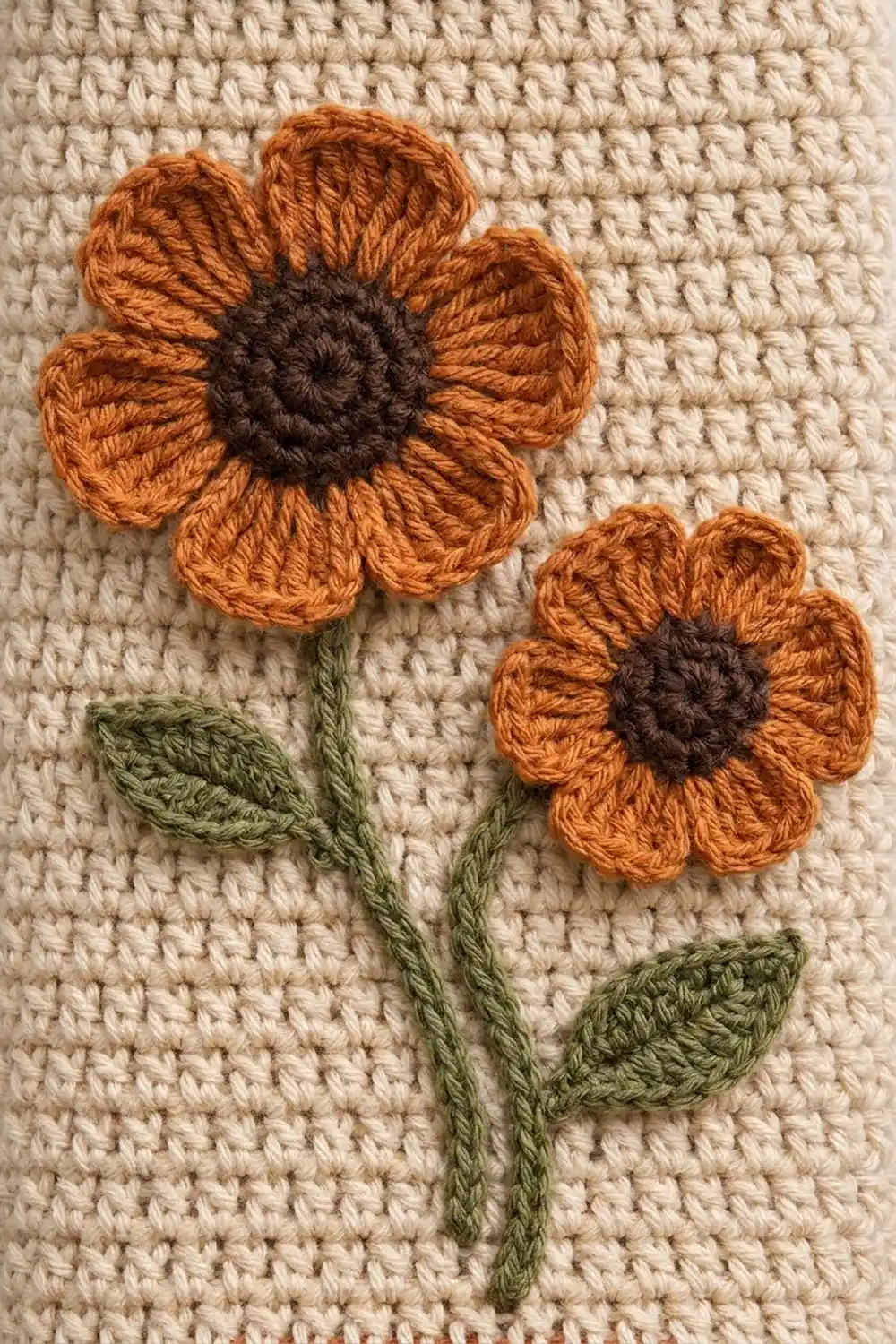
Large Flower (make 1)
Rnd 1 (brown): 8 sc in MR. Join. (8 sts)
Rnd 2: Ch 1, inc in each st. Join with orange. (16 sts)
Rnd 3 (orange): (Sc in next st, ch 3, skip 1 st) 8 times. Join. (8 ch-3 sps)
Rnd 4: In each ch-3 sp work (sc, hdc, 3 dc, hdc, sc). Join. (8 petals)
Diameter: about 2.75 in (7.0 cm).
Medium Flower (make 1)
Rnds 1–2: Work as for the Large Flower. (16 sts)
Rnd 3 (orange): (Sc in next st, ch 2, skip 1 st) 8 times. Join. (8 ch-2 sps)
Rnd 4: In each ch-2 sp work (sc, hdc, 2 dc, hdc, sc). Join. (8 petals)
Diameter: about 2.25 in (5.7 cm).
Small Flower (make 1)
Rnd 1 (brown): 8 sc in MR. Join with orange. (8 sts)
Rnd 2 (orange): (Sc in next st, ch 2) 8 times. Join. (8 ch-2 sps)
Rnd 3: In each ch-2 sp work (sc, hdc, dc, hdc, sc). Join. (8 petals)
Diameter: about 1.75 in (4.4 cm).
Stems (green)
- Main stem: Ch 28, sl st in the back bump of the 2nd ch from hook and of each ch across. (27 sl sts) About 5 in (12.7 cm).
- Right branch: Ch 15, sl st back the same way. (14 sl sts) About 2.5 in (6.4 cm).
- Left branch: Ch 10, sl st back the same way. (9 sl sts) About 1.75 in (4.4 cm).
Leaves (make 2, green)
Ch 8. Sc in 2nd ch from hook, hdc in next, dc in next 3, hdc in next, 3 sc in last ch. Working along the underside of the chain: hdc in next, dc in next 3, hdc in next, sc in last. Sl st to the first sc. (15 sts)
Each leaf is about 1.75 in x 0.75 in (4.4 cm x 1.9 cm) with a pointed tip. For a vein, you can slip-stitch a few sts up the center with green yarn.
Tab (rust)
Ch 5.
Row 1: Sc in 2nd ch from hook and in each ch across. (4 sts)
Rows 2–24: Ch 1, turn, sc across. (4 sts)
The tab is 1 in (2.5 cm) wide and about 5.3 in (13.5 cm) long.
Covered Ring (rust)
Join rust around the 2.75 in (7.0 cm) ring with a sc. Work sc tightly around the ring, pushing the sts together, until the ring is fully covered (about 60 sc). Join and fasten off. The covered ring measures about 3.25 in (8.3 cm) across.
Border
The border is the rust rim at the top plus the rust edging around the slot. Work it at the same gauge as the body: 4 sc per 1 in (2.5 cm).
Top Rim
Rnds 63–66 (rust): Ch 1, sc in each st around. Join. (40 sts; 20 per flattened side) Fasten off after Rnd 66.
Why the math works: Each border round puts exactly 1 sc in each of the 40 body sts. That keeps 20 sts on each flattened side, the same 5 in (12.7 cm) width as the body, so the rim does not flare out or pull in. Four rounds add about 0.9 in (2.3 cm), taking the body from 13.6 in (34.5 cm) to 14.5 in (36.8 cm).
Slot Edging
Rnd 1 (rust): With the right side facing, join rust at a lower corner of the slot. Work 12 sc along the unworked sts of Rnd 13, 4 sc up the row ends (1 per row), 12 sc in the free loops of the ch-12, and 4 sc down the other row ends. Join. (32 sts)
Rnd 2: Sl st loosely in BLO of each st. Join. (32 sts) Fasten off.
The 12 + 4 + 12 + 4 count matches the slot exactly: 1 sc per stitch on the long edges and 1 sc per row on the short edges. The sl st round firms the edge without making the opening smaller.
Assembly
- Fold the tab through the ring. Overlap the two tab ends and sew them to the inside of the back rim, centered and 1 in (2.5 cm) down, so 1.25 in (3.2 cm) shows above the rim.
- Flatten the body with the slot centered on the front. Pin the large flower about 3.5 in (8.9 cm) below the rim, toward the left fold. Pin the medium flower about 5.5 in (14.0 cm) below the rim on the right. Pin the small flower about 8 in (20.3 cm) below the rim on the left.
- Pin the main stem from the large flower down to a point about 9 in (22.9 cm) below the rim. Run the right branch to the medium flower and the left branch to the small flower.
- Pin one leaf on each side of the main stem.
- Sew everything with matching yarn through the front layer only. Keep one hand inside the tube so you don’t catch the back.
Final Blocking
- Weave in all ends on the inside.
- Roll a towel to about 10 in (25.4 cm) around and slide it into the tube.
- Shape the oval base and line the slot up with the center front.
- Mist lightly, or hold a steam iron just above the fabric. Do not press the flowers flat.
- Pin the petals into rounded shapes and smooth the stems into gentle curves.
- Let it dry fully before removing the towel.
Final Quality-Control Checklist
- Every body round has 40 sts.
- Flattened width is 5 in (12.7 cm) from base to rim.
- Slot is 3 in x 0.9 in (7.6 cm x 2.3 cm), centered on the front.
- Rust bands are straight, with no visible jogs on the front.
- Slot edging has 32 sts and lies flat.
- Each flower has 8 even petals.
- Appliqués are sewn through the front layer only.
- Tab is centered and secure, and the ring hangs straight.
Troubleshooting
- Base is round instead of oval: Check that you kept 8 plain sts on each straight side.
- Walls flare outward: Your tension has loosened. Go down a hook size or crochet more tightly.
- Slot gapes or puckers: The ch-12 was too tight or too loose. Redo Rnd 18 so the slot measures 3 in (7.6 cm).
- Join line leans: This is normal in joined sc. Line it up with the left end of the slot and cover it with the stems.
- Petals cup: Block them flat and pin them while they dry.
- Holder tips forward when full: Sew the tab ends a little lower inside the back rim.
Care
Hand wash in cool water and lay flat to dry, reshaping the tube over a rolled towel. Do not tumble dry, because the appliqués may lose their shape.

Final Notes
Every measurement follows from your gauge. 4 sc per 1 in (2.5 cm) gives 40 sts per round, which flattens to 5 in (12.7 cm) wide. At 4.5 rounds per 1 in (2.5 cm), the body reaches 13.6 in (34.5 cm) before the border. The 4-round rust rim adds about 0.9 in (2.3 cm), for 14.5 in (36.8 cm). The tab and ring bring the full holder to about 18.75 in (47.6 cm). Check each stage against these numbers and the finished holder will match.
Happy crocheting!