

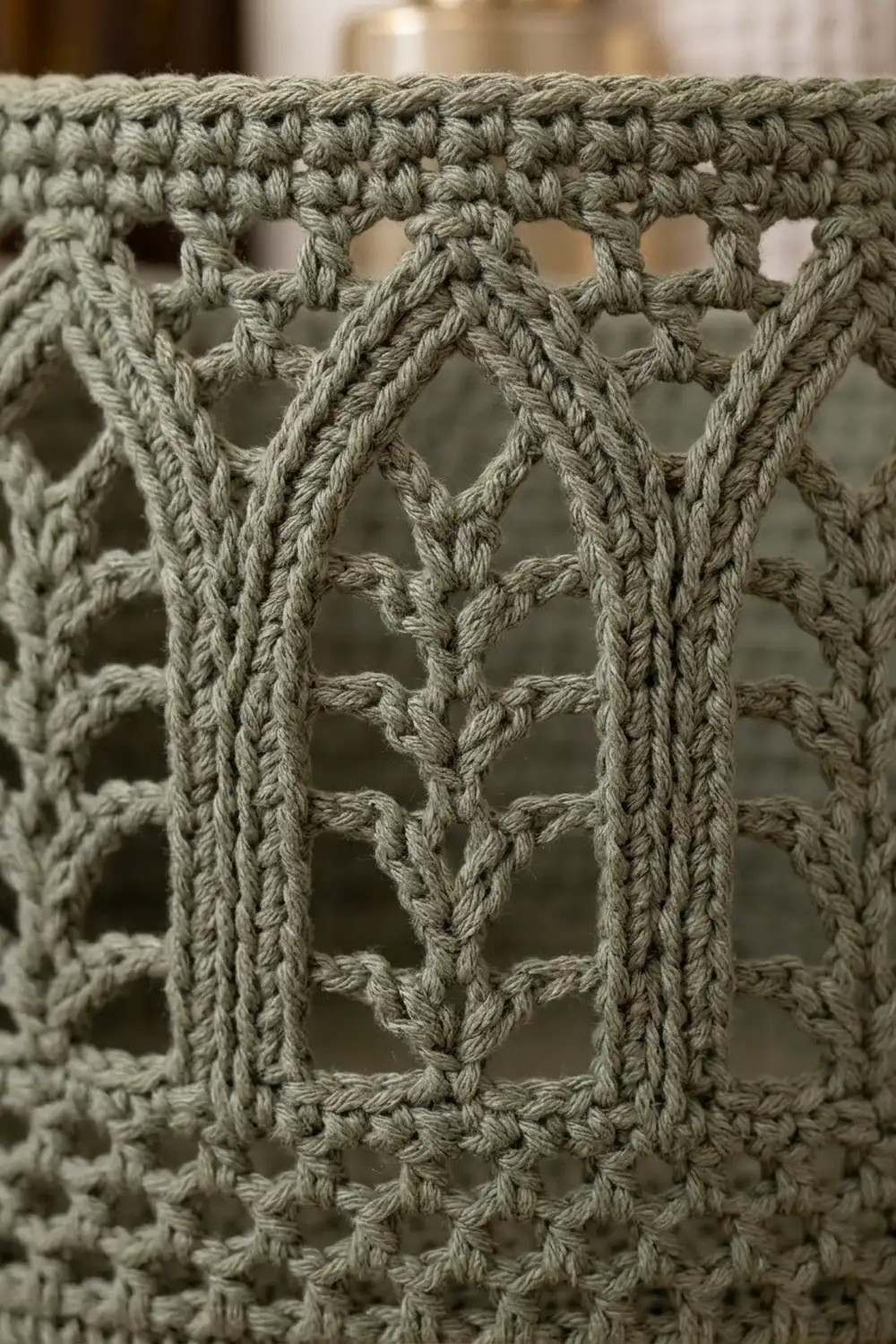
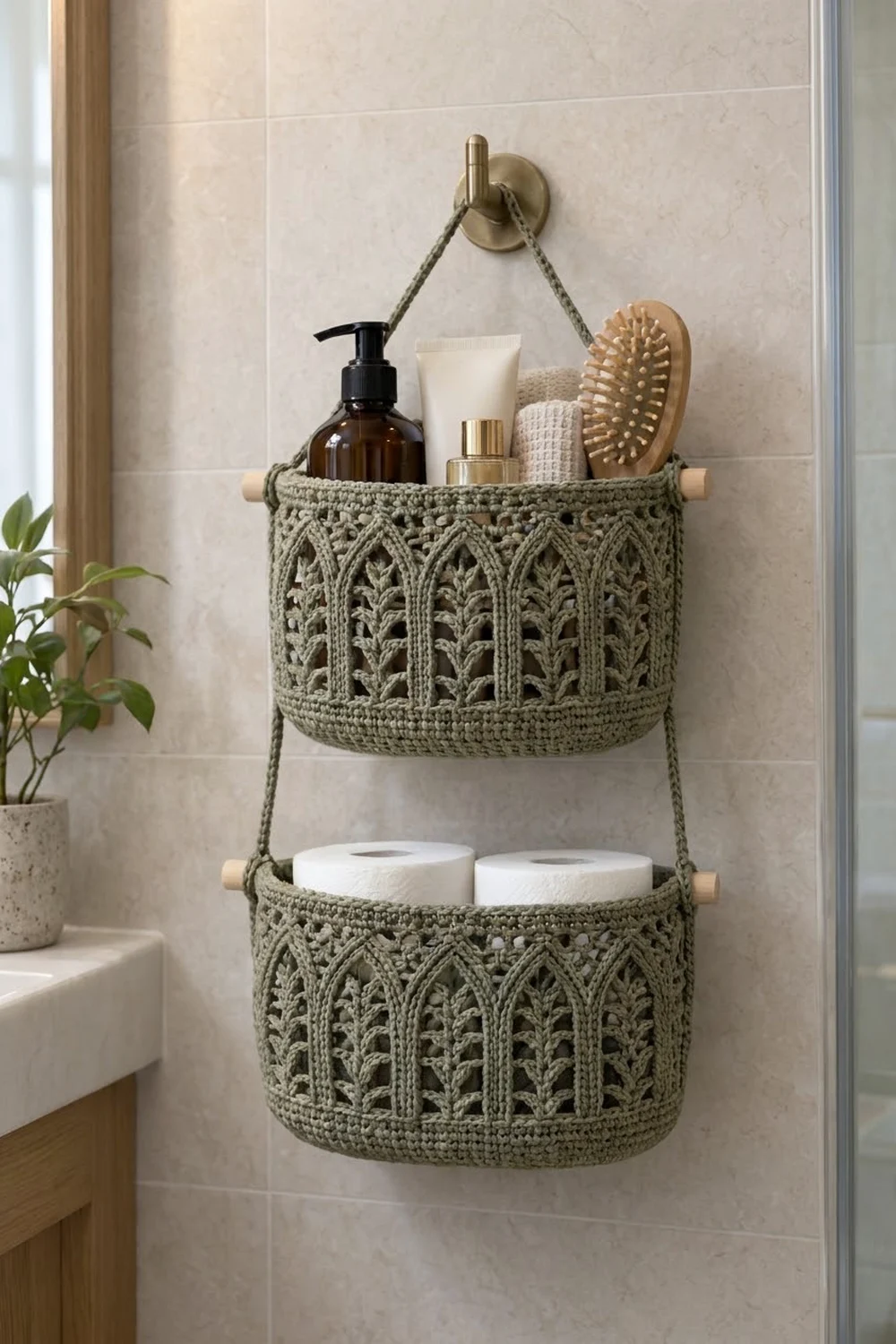
This set is two oval baskets that hang one above the other from a single wall hook. Every wall has a band of pointed arch windows, with a small leafy vine running up the middle of each one. The Sage Cathedral set works well in a bathroom for toiletries, spare rolls, brushes and washcloths. It also suits a nursery or an entryway.
The sample uses one color, a soft sage green, which keeps the lace easy to read. The solid single crochet base and rim make the baskets firm, and the open arches keep them light. Natural wooden dowels and crocheted cords give the set a calm, slightly rustic look.
This pattern uses US crochet terms. Each basket measures about 11.75 in (29.8 cm) long, 5 in (12.7 cm) deep and 7 in (17.8 cm) tall. Hung, the full set measures about 25 in (63.5 cm) from the hook to the bottom of the lower basket.
Each basket starts with an oval single crochet base. You turn the walls up with a back-loop round, then work a solid band, a mesh round and the arch lace. A solid rim with two dowel holes finishes the top. Three slip-stitch cords with rings at their ends hold the dowels and connect the two tiers.
Finished Size and Construction
- Finished basket size: 11.75 in (29.8 cm) long x 5 in (12.7 cm) deep x 7 in (17.8 cm) tall
- Total hanging length: about 25 in (63.5 cm)
- Skill level: Intermediate
- Terminology: US
- Yarn weight: Worsted (#4) cotton
- Hook: 5.0 mm (H-8)
- Number of pieces: 5 crocheted (2 baskets, 1 hanging cord, 2 drop cords), plus 2 wooden dowels
- Layout: 2 baskets stacked vertically, 12 in (30.5 cm) from dowel to dowel
- Base size (each basket): 11.75 in x 5 in (29.8 cm x 12.7 cm), 120 sts around
- Height before rim: about 5.75 in (14.6 cm)
- Rim depth: 5 rounds, about 1.1 in (2.8 cm)
Materials
Choose a smooth, firm worsted cotton or cotton blend. Cotton holds its shape when the baskets are full and copes well with bathroom humidity. Avoid soft acrylic or fuzzy yarn: the arches would sag and the vines would get lost.
- Sage green: 400 g (approx. 680 m)
- Each basket: approx. 165 g (280 m)
- All three cords: approx. 25 g (43 m)
These amounts include about 12% extra for a gauge check and normal differences in tension.
Tools:
– 5.0 mm (H-8) crochet hook
– 2 wooden dowels, 3/8 in (1.0 cm) diameter, each cut to 14 in (35.6 cm)
– Fine sandpaper for the dowel ends
– 4 stitch markers
– Tapestry needle
– Scissors and a measuring tape
– Spray bottle and towels for blocking
Abbreviations (US Terms)
- ch chain
- sc single crochet
- dc double crochet
- sl st slip stitch
- sk skip
- st(s) stitch(es)
- sp space
- BLO back loop only
- rep repeat
- rnd round
FPdc (front post double crochet): Yarn over. Insert the hook from front to back to front around the post of the stitch named in the instructions. Yarn over and pull up a loop, then [yarn over, pull through 2 loops] twice. Each FPdc counts as one stitch.
Starting dc rounds: Ch 2. This ch 2 does not count as a stitch. Work the first stitch into the same stitch, and at the end of the round join with a sl st to the top of that first real stitch. Work every round with the right side facing, and never turn.
Gauge and Checkpoints
- Sc gauge: 16 sc and 18 rnds = 4 in (10.2 cm)
- Dc gauge: 16 dc and 8 rnds = 4 in (10.2 cm)
Make one complete basket first and check it at each stage below.
- After Rnd 6: 90 sts, about 9.5 in x 2.75 in (24.1 cm x 7.0 cm)
- After Rnd 11: 120 sts, 11.75 in x 5 in (29.8 cm x 12.7 cm)
- After Rnd 16: wall height 1.1 in (2.8 cm)
- After Rnd 26: wall height about 5.75 in (14.6 cm)
- After Rnd 31: wall height 7 in (17.8 cm)
If the basket is too big: Switch to a 4.5 mm hook. Don’t remove stitches from the base, because the lace needs exactly 120 stitches.
If the basket is too small: Switch to a 5.5 mm hook. If the walls flare out or pull in, recount Rnd 11 before you go on.
Basket Base (Make 2)
The base is an oval. The two long sides stay at 27 sts, and each end grows by 3 sts every round, so every round adds 6 sts.
Foundation: Ch 30.
Rnd 1: Work 3 sc in the 2nd ch from the hook (end A). Sc in the next 27 ch. Work 3 sc in the last ch (end B). Rotate the work and sc in the 27 remaining loops on the other side of the chain. Join with a sl st to the first sc. (60 sts: 3 + 27 + 3 + 27)
Rnd 2: Ch 1. 2 sc in each of the next 3 sts, sc in the next 27 sts, 2 sc in each of the next 3 sts, sc in the next 27 sts. Join. (66 sts)
Rnds 3–11: Ch 1. *[Sc in the next (R − 2) sts, 2 sc in the next st] 3 times, then sc in the next 27 sts; rep from * once more. Join. R is the number of the round you are working. On Rnd 3 you work [sc 1, 2 sc] 3 times. On Rnd 11 you work [sc 9, 2 sc] 3 times.
Each end ends up with 3 x R sts, so the round total is 2 x (3R) + 54. Full count for each round:
- Rnd 3: 72 sts
- Rnd 4: 78 sts
- Rnd 5: 84 sts
- Rnd 6: 90 sts
- Rnd 7: 96 sts
- Rnd 8: 102 sts
- Rnd 9: 108 sts
- Rnd 10: 114 sts
- Rnd 11: 120 sts (33 + 27 + 33 + 27)
After Rnd 11, place markers in st 1 (start of end A), st 34 (start of the front), st 61 (start of end B) and st 94 (start of the back). Move the markers up as you work.
Lower Walls
Rnd 12 (turning round): Ch 1, sc in BLO of each st around. Join. (120 sts) This round leaves a crisp ridge where the base turns up into the wall.
Rnds 13–16: Ch 1, sc in each st around. Join. (120 sts each round)
Rnd 17 (mesh): Ch 2, dc in the first st, ch 1, sk 1. Dc in the next st, ch 1, sk 1; rep from * 58 more times. Join. (120 sts: 60 dc + 60 ch)*
Rnd 18: Ch 1. Sc in each dc and in each ch-1 sp around. Join. (120 sts)
Arch Lace Band
The lace has 10 repeats of 12 sts. Each repeat has a 2-st pillar, a window, a 4-st vine stem in the middle, and a second window. You work the pillars as FPdc so they stand out like stone ribs.
Rnd 19 (set-up): Ch 2. Dc in the next 2 sts (pillar), ch 3, sk 3, dc in the next 4 sts (stem), ch 3, sk 3; rep from * 9 more times. Join. (120 sts: 60 dc + 60 ch; 12 per repeat)*
Rnd 20 (leaf round): Ch 2. FPdc around each of the 2 pillar sts. Ch 2, sk 2 ch, then dc in the next ch (leaf). Dc in the 4 stem sts. Dc in the first ch of the next ch-3 (leaf), ch 2, sk the last 2 ch; rep from * 9 more times. Join. (120 sts: 80 dc + 40 ch; 12 per repeat)*
Rnd 21 (stem round): Ch 2. FPdc around each of the 2 pillar sts. Ch 3, sk 2 ch and the leaf dc, then dc in the next 4 stem dc. Ch 3, sk the leaf dc and 2 ch; rep from * 9 more times. Join. (120 sts: 60 dc + 60 ch)*
Rnds 22–23: Rep Rnds 20 and 21 once. Because the leaf stitches stick out only on every other round and the stem narrows between them, the stem turns into a stacked column of small leaves.
Rnd 24 (arch narrows): Ch 2. FPdc around each of the 2 pillar sts, then dc in the first ch (arch). Ch 2, sk 2 ch, dc in the 4 stem sts. Ch 2, sk 2 ch, dc in the 3rd ch (arch); rep from * 9 more times. Join. (120 sts: 80 dc + 40 ch)*
Rnd 25 (arch peak): Ch 2. FPdc around each of the 2 pillar sts, then dc in the arch dc. Dc in the first ch, ch 1, sk 1 ch, dc in the 4 stem sts. Ch 1, sk 1 ch, dc in the next ch, dc in the arch dc; rep from * 9 more times. Join. (120 sts: 100 dc + 20 ch)*
Rnd 26 (closing): Ch 2. Dc in each st and each ch around. Join. (120 dc)
The windows close in from both sides, which gives each arch its pointed top. Checkpoint: the wall should be about 5.75 in (14.6 cm) tall, with 10 arches around and 5 on each long face.
Top Rim and Dowel Holes (Border)
Border gauge: 16 sc = 4 in (10.2 cm). 5 rounds = 1.1 in (2.8 cm).
The rim uses the same four sections you marked after Rnd 11: end A 33, front 27, end B 33, back 27.
Rnds 27–28: Ch 1, sc in each st around. Join. (120 sts each round: 33 / 27 / 33 / 27)
Rnd 29 (dowel holes): Ch 1. Sc in the next 15 sts, ch 2, sk 2. Sc in the next 58 sts, ch 2, sk 2. Sc in the last 43 sts. Join. (120 sts = 116 sc + 4 ch)
- End A: 15 sc + ch 2 + 16 sc = 33
- Front: 27 sc
- End B: 15 sc + ch 2 + 16 sc = 33
- Back: 27 sc
Rnd 30: Ch 1. Sc in each sc and 2 sc in each ch-2 sp. Join. (120 sts = 116 sc worked one per existing st + 4 sc worked into the two ch-2 sps)
Rnd 31: Ch 1, sc in each st around. Join with an invisible fasten-off. (120 sts)
Why the math works: The 120 sts of Rnd 11 carry straight up through every wall round, with no increases or decreases. That keeps the walls vertical and makes the opening the same size as the base. The holes are at sts 16–17 and 76–77, the exact center of each 33-st end, so the dowel runs level along the center line. Each 2-st gap is about 0.5 in (1.3 cm) wide, enough for a 3/8 in (1.0 cm) dowel to pass through.
Cords (Make 3)
Hanging cord (make 1): Ch 8, then sl st in the first ch to form a ring. Ch 72. Ch 8 more and sl st in the 8th ch from the hook to form the second ring. Sl st in the back bump of each of the 72 ch, then sl st at the base of the first ring. Fasten off. The cord should measure 18 in (45.7 cm) between rings.
Drop cords (make 2): Make these the same way, with ch 48 between the rings. Each cord should measure 12 in (30.5 cm) between rings. Check that the two drop cords are exactly the same length.
Make All Pieces
All pieces are sage green:
- 2 baskets (Rnds 1–31), approx. 165 g (280 m) each
- 1 hanging cord, 18 in (45.7 cm)
- 2 drop cords, 12 in (30.5 cm)
- 2 dowels, 14 in (35.6 cm), with sanded ends
              [ wall hook ]
               /         \
        hanging cord 18 in (45.7 cm)
             /             \
   o====[  BASKET 1  ]====o   dowel 14 in (35.6 cm)
   |                       |
 drop cord             drop cord
 12 in (30.5 cm)       12 in (30.5 cm)
   |                       |
   o====[  BASKET 2  ]====o   dowel 14 in (35.6 cm)
Joining
Method: Slide the cord rings over the dowel ends. No sewing is needed.
- Push a dowel in through the hole at end A, across the inside of the basket and out through the hole at end B. About 1.125 in (2.9 cm) should stick out on each side.
- Upper basket: On each dowel end, slide on the top ring of a drop cord first, then one ring of the hanging cord. Push both rings against the rim.
- Lower basket: Slide the bottom ring of each drop cord onto the same-side end of the second dowel.
Matching logic: The left drop cord runs from the left end of the top dowel to the left end of the bottom dowel, and the right cord does the same on the right. Don’t let the cords cross or twist.
Tension advice: An 8-ch ring should fit snugly on the dowel but still slide. If your rings come out loose, remake them with ch 7.
Size checkpoint: Check these measurements:
- 12 in (30.5 cm) from dowel to dowel
- A gap of about 5 in (12.7 cm) between the baskets
- The hanging cord peak about 6 in (15.2 cm) above the top dowel
- An overall length of about 25 in (63.5 cm)
Final Blocking
- Take the dowels out.
- Mist each basket until it is evenly damp.
- Pack it firmly with rolled towels until it measures 11.75 in x 5 in (29.8 cm x 12.7 cm).
- Straighten the pillars so they stand vertical, and open each window with your fingertips.
- Pinch each leaf stitch so it points outward.
- Let the baskets dry completely, standing on their bases.
- Put the dowels back in and hang the set.
Final Quality-Control Checklist
- Both bases have 120 sts and measure 11.75 in x 5 in (29.8 cm x 12.7 cm)
- Each basket has 10 arches, and the pillars are straight
- Every lace round has 120 sts (12 per repeat)
- The dowel holes are centered on each end
- Both baskets are 7 in (17.8 cm) tall
- Both drop cords are exactly 12 in (30.5 cm)
- All tails are woven in on the wrong side
Troubleshooting
- The base cups upward: Your tension at the ends is too tight. Go up a hook size for Rnds 3–11.
- The base ripples: Recount; there are probably extra increases at the ends.
- The arches lean: Work each FPdc around the pillar st directly below it.
- The windows pucker: Make your ch-3 sps looser.
- The basket tilts when hung: Recount Rnd 29 against your markers to make sure the holes are centered.
- The rings slide off the dowel: Remake them with ch 7, or glue small wooden beads onto the dowel tips.
Care
Take the dowels out first. Hand wash in cool water, roll each basket in a towel to remove water, and let it dry packed into shape.
Final Notes
All the measurements build on each other. A gauge of 16 sc = 4 in (10.2 cm) gives a 120-st base of 11.75 in x 5 in (29.8 cm x 12.7 cm). The walls rise straight from that base through 10 arch repeats of 12 sts. A 5-round rim brings each basket to 7 in (17.8 cm). Two 12 in (30.5 cm) drop cords and one 18 in (45.7 cm) hanging cord stack the tiers to about 25 in (63.5 cm). If every checkpoint matches, the set will hang level and keep its shape. Happy crocheting!