

This lace curtain is made from six-petal flowers in soft sage green and cream. Each flower has a padded cream center ring. The petals alternate in color, and each one has a puff-stitch heart under a smooth scalloped arch. The flowers hang in airy vertical strands, so daylight comes through and the panel moves gently in a breeze.
The look is cottage-garden and calm: two quiet colors, lots of open space, and a crisp motif shape you can read from across the room. The pattern uses US crochet terms throughout.
Each finished panel measures about 19 in (48.3 cm) wide and 78 in (198.1 cm) long from the top of the heading band to the bottom flower tip. The hanging tabs sit above that. The pattern gives two panels.
Construction is simple. You make 56 flowers per panel, join them tip to tip into four strands of 14 with short chain links, and then crochet a single-crochet heading band with tabs. Last, you link the top of each strand to the band.
Finished Size and Construction
- Finished panel size: 19 in (48.3 cm) wide x 78 in (198.1 cm) long, plus tabs
- Skill level: Intermediate
- Terminology: US crochet terms
- Yarn weight: DK (weight 3) cotton
- Hook: 3.5 mm (E-4)
- Number of pieces: 112 flowers (56 per panel)
- Layout: 2 panels, each 4 strands wide x 14 flowers tall
- Piece size: 4.5 in (11.4 cm) tip to tip, top to bottom; 4 in (10.2 cm) across
- Size before border: 19 in (48.3 cm) wide x 76 in (193.0 cm) long per panel
- Border depth: 2 in (5.1 cm): a 1 in (2.5 cm) link plus a 1 in (2.5 cm) heading band
Materials
Choose a smooth, mercerized or combed DK cotton. Cotton keeps the petals crisp and the arches open, and it does not stretch much while hanging. Avoid fuzzy or very stretchy yarns, because long strands of flowers will grow with them.
- Cream: 1,000 g / 2,400 m (twenty 50 g balls of about 120 m each) for centers, cream petals, links, and heading band
- Sage green: 850 g / 2,040 m (seventeen 50 g balls of about 120 m each) for sage petals
These quantities include a margin of about 10 percent for swatching, weaving in ends, and dye-lot safety. Buy each color from one dye lot.
Tools:
- 3.5 mm (E-4) crochet hook
- Tapestry needle
- Stitch markers
- Scissors
- Tape measure
- Blocking mats, rust-proof pins, and a spray bottle
- Curtain rod up to 1 in (2.5 cm) in diameter
Abbreviations (US Terms)
- ch – chain
- sl st – slip stitch
- sc – single crochet
- hdc – half double crochet
- dc – double crochet
- tr – treble crochet
- sp – space
- st(s) – stitch(es)
- RS / WS – right side / wrong side
- rep – repeat
Puff stitch (puff): [Yarn over, insert hook in the stitch, yarn over and pull up a loop to about 0.75 in (1.9 cm) tall] 4 times, yarn over and pull through all 9 loops on the hook, ch 1 to close. The closing ch 1 is not counted as a stitch.
Gauge and Checkpoints
Make one complete flower before anything else. Block it lightly and measure.
- After the center ring: outer diameter 1.25 in (3.2 cm).
- After Petal Row 1: the spokes stand about 1 in (2.5 cm) above the ring.
- After Petal Row 3: each petal reaches about 1.6 in (4.1 cm) beyond the ring.
- Finished flower: 4.5 in (11.4 cm) tip to tip, top to bottom, and 4 in (10.2 cm) across.
- Band gauge: 20 sc and 20 rows = 4 in (10.2 cm) in sc.
If your flower is larger than 4.5 in (11.4 cm), go down to a 3.25 mm hook. If it is smaller, go up to a 3.75 mm hook. A difference of only 0.25 in (0.6 cm) per flower adds up to 3.5 in (8.9 cm) over 14 flowers, so the test flower matters.
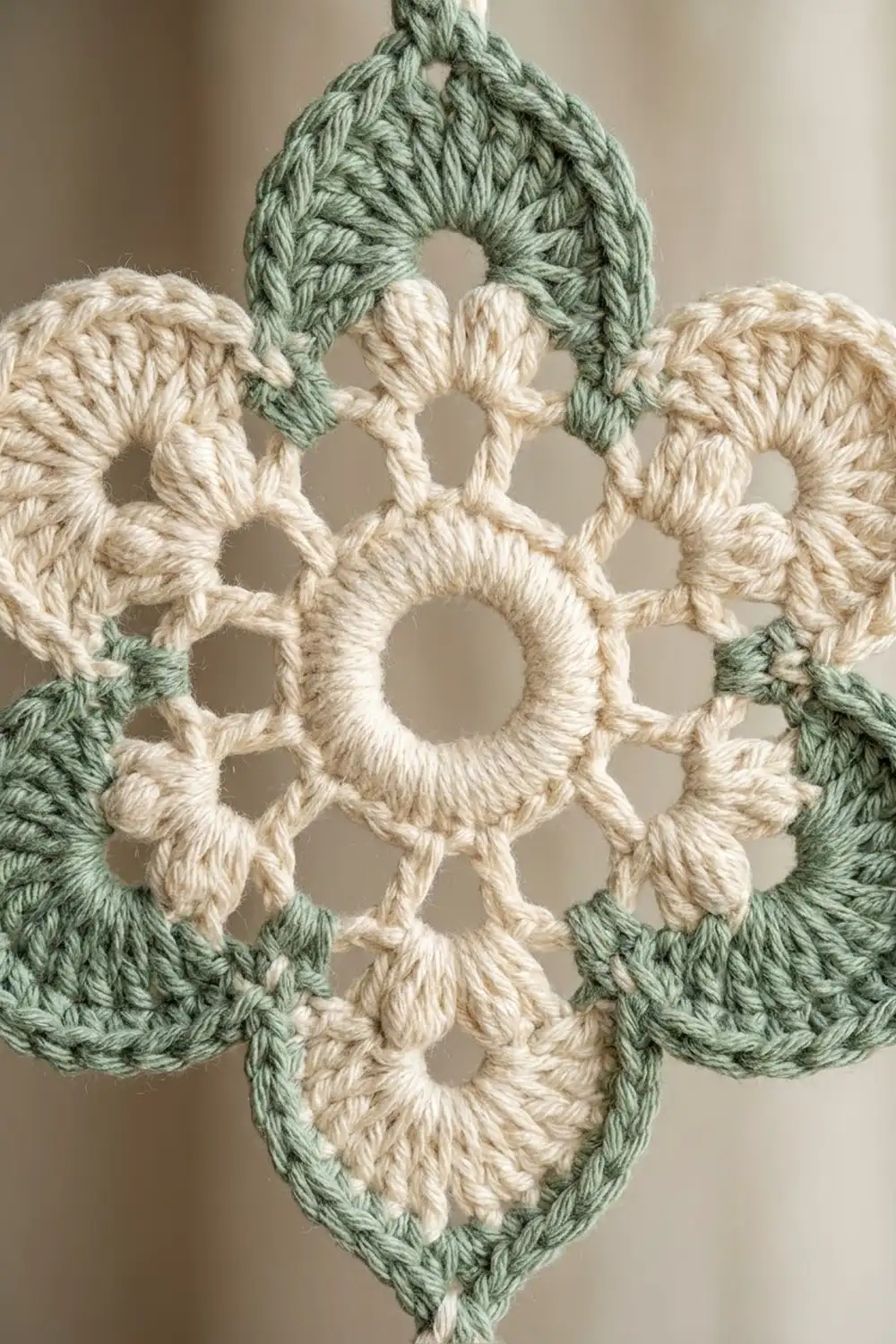
Flower Motif
Each flower has a cream center ring and six petals. Petals 1, 3, and 5 are sage; petals 2, 4, and 6 are cream. You work each petal separately over 4 sts of the ring.
Center Ring (Cream)
Rnd 1: Ch 8, sl st in the first ch to form a ring. Ch 1, work 24 sc in the ring, sl st in the first sc to join. Fasten off. (24 sc)
Packing 24 sc around a ch-8 ring makes the padded, rolled ring with an open hole. Place a marker in the first sc. Count the sts in groups of 4: sts 1–4 hold Petal 1, sts 5–8 hold Petal 2, and so on to sts 21–24 for Petal 6.
Petal (Make 6 per Flower)
Name the 4 sc of the petal’s group A, B, C, and D, in working order.
Row 1 (RS): Join the petal color with a sl st in sc A. Ch 4 (counts as tr), tr in the same sc A, ch 2, puff in sc B, ch 2, puff in sc C, ch 2, 2 tr in sc D. Turn. (4 tr, 2 puffs, 3 ch-2 sps)
The tr pairs form the outer spokes, and the two puffs sit side by side in the middle as the raised cluster.
Row 2 (WS): Ch 1, sc in the first tr, ch 10, skip all remaining sts, sc in the top of the beginning ch-4. Turn. (2 sc, 1 ch-10 arch)
Row 3 (RS): Ch 1, work (2 sc, 3 hdc, 9 dc, 3 hdc, 2 sc) in the ch-10 arch, sl st in the last sc of Row 2. Fasten off. (19 sts)
The short stitches at each end and the dc in the middle round the arch into a smooth petal tip. The center stitch of Row 3, st 10 (the 5th dc), is the petal tip. You will use it for joining.
Petal colors: Work Petal 1 in sage on sts 1–4, Petal 2 in cream on sts 5–8, Petal 3 in sage on sts 9–12, Petal 4 in cream on sts 13–16, Petal 5 in sage on sts 17–20, and Petal 6 in cream on sts 21–24. Petal 1 (sage) becomes the top of the flower, and Petal 4 (cream) sits directly opposite it at the bottom.
Weave in each petal’s ends along the back of its own color so nothing shows through the lace.
Per-flower check: 24 ring sts and 6 petals of 19 edge sts each, for 114 outer edge sts in total.
Make All Pieces
Make 112 flowers in total: 56 for each panel.
- Cream: 112 center rings and 336 cream petals (3 per flower)
- Sage: 336 sage petals (3 per flower)
Block the flowers in batches so they are all the same size before joining.
Layout for one panel (4 strands across, 14 flowers down; T = top sage petal, and every flower faces the same way):
Band  ==========================
Row 1    T      T      T      T
Row 2    T      T      T      T
Row 3    T      T      T      T
 ...    ...    ...    ...    ...
Row 13   T      T      T      T
Row 14   T      T      T      T
       Str A  Str B  Str C  Str D
The strands are not joined to each other. They connect only at the heading band.
Joining
Each strand is 14 flowers linked tip to tip. Every link runs from the bottom cream petal tip (Petal 4, st 10) of one flower to the top sage petal tip (Petal 1, st 10) of the next flower.
Link: With cream, join with a sl st in st 10 of Petal 4 on the upper flower. Ch 7. Sl st in st 10 of Petal 1 on the lower flower. Sl st back up in each of the 7 ch. Fasten off.
The sl sts worked back along the chain double the link, so it looks like a firm twisted cord and holds up under the weight of the strand below. Joining stitch to stitch at both petal tips keeps every flower centered under the one above.
Tension: Work the ch 7 at your normal tension. Work the return sl sts firmly but not tightly, so the link stays 1 in (2.5 cm) long. A tight return shortens the link and makes the strand pucker. A loose one lets the link stretch.
Make 13 links per strand and 4 strands per panel.
Size checkpoint: 14 flowers x 4.5 in (11.4 cm) = 63 in (160.0 cm). Add 13 links x 1 in (2.5 cm) = 13 in (33.0 cm), for a strand length of 76 in (193.0 cm). Lay the four strands side by side with 1 in (2.5 cm) gaps. The width is 4 x 4 in (10.2 cm) plus 3 x 1 in (2.5 cm) = 19 in (48.3 cm).
Border: Heading Band and Tabs
The border is a cream single-crochet band across the top of each panel. You work it on its own foundation and then link it to the strands.
Border gauge: 20 sc = 4 in (10.2 cm), so 5 sc = 1 in (2.5 cm). Each strand gets a 20-st section that is 4 in (10.2 cm) wide, and each gap gets a 5-st section that is 1 in (2.5 cm) wide.
Starting count: 4 strands x 20 sts + 3 gaps x 5 sts = 80 + 15 = 95 sts.
Row 1 (RS): Ch 96, sc in the 2nd ch from the hook and in each ch across. Turn. (95 sc)
Rows 2–5: Ch 1, sc in each sc across. Turn. (95 sc per row)
The band now measures 19 in (48.3 cm) wide and 1 in (2.5 cm) tall.
Row 6 (tab loops): Ch 1, sc in the first 2 sc, ch 16, skip the next sc, sc in the next 9 sc; rep from * 8 more times, ch 16, skip the next sc, sc in the last 2 sc. Turn. (85 sc and 10 ch-16 loops)*
Check: 2 + 9 x (1 skipped + 9 sc) + 1 skipped + 2 = 95 sts of Row 5 used.
Row 7 (covering row): Ch 1, sc in each sc and work 20 sc in each ch-16 loop. Fasten off. (85 sc worked 1 per existing sc + 200 sc added in the loops = 285 sc)
Each covered loop fits a rod up to 1 in (2.5 cm) in diameter.
Linking strands to the band: On the free loops of the foundation chain, find the center of each strand section: sts 10, 35, 60, and 85. With cream, join with a sl st in st 10 of Petal 1 on the top flower of a strand. Ch 7, sl st in the matching foundation st, then sl st back down in each of the 7 ch. Fasten off.
Why the math works: Each 20-st section is exactly one flower width, and each 5-st gap is exactly one strand gap. The sections start at sts 1, 26, 51, and 76, so the 10th st of each section (10, 35, 60, 85) sits directly above that strand’s center. The 76 in (193.0 cm) strands gain 1 in (2.5 cm) of link plus 1 in (2.5 cm) of band, for 78 in (198.1 cm) in total.
Final Blocking
- Block each finished panel in sections on mats, working from the band down.
- Pin the band flat to 19 in (48.3 cm) wide.
- Pin each flower’s six petal tips so it measures 4.5 in (11.4 cm) from top to bottom.
- Open each arch with a pin at st 10 and at both ends of the arch.
- Pin the links straight at 1 in (2.5 cm).
- Mist with water until damp but not soaked.
- Let each section dry completely before moving to the next.
- Hang the panel for a day so it settles before you measure the final length.
Final Quality-Control Checklist
- Every flower has sage on top and cream on the bottom.
- Petal colors alternate all the way around each flower.
- Each petal edge has 19 sts, and st 10 is the tip.
- All 13 links per strand and the 4 band links measure 1 in (2.5 cm).
- Each strand measures 76 in (193.0 cm) before the band is added.
- The band has 95 sts and 10 evenly spaced tabs.
- All ends are woven in on the back, each in its own color.
Troubleshooting
Petals cup or curl: The Row 2 chain is too short. Work the ch 10 more loosely, or work ch 11 and add 1 dc to Row 3. Note the change in your stitch counts.
Puffs look flat: Pull each loop up to a full 0.75 in (1.9 cm) before you close the puff.
Center hole closes up: Work the ch 8 ring more loosely, and don’t pull the tail tight.
Strand grows longer than 76 in (193.0 cm): Your links are stretching. Keep the return sl sts firm so each link holds its 1 in (2.5 cm) length, and check that your yarn is not a stretchy blend.
Strand hangs crooked: A link was joined off-center. Rework it so it runs from st 10 to st 10.
Band wider than 19 in (48.3 cm): Recheck your sc gauge and rework the band with a smaller hook.
Care
Hand wash in cool water with a mild detergent, roll in a towel, and dry flat, then rehang while slightly damp. Don’t wring or tumble dry, because heavy wet strands will stretch.

Final Notes
Here is the measurement chain. A 1.25 in (3.2 cm) ring becomes a 4.5 in (11.4 cm) flower. Fourteen flowers plus thirteen 1 in (2.5 cm) links make a 76 in (193.0 cm) strand. Four strands with 1 in (2.5 cm) gaps make 19 in (48.3 cm) of width, which matches the 95-st band. One more link plus the band give a 78 in (198.1 cm) panel. If your test flower measures right, everything after it will too.
Happy crocheting!