

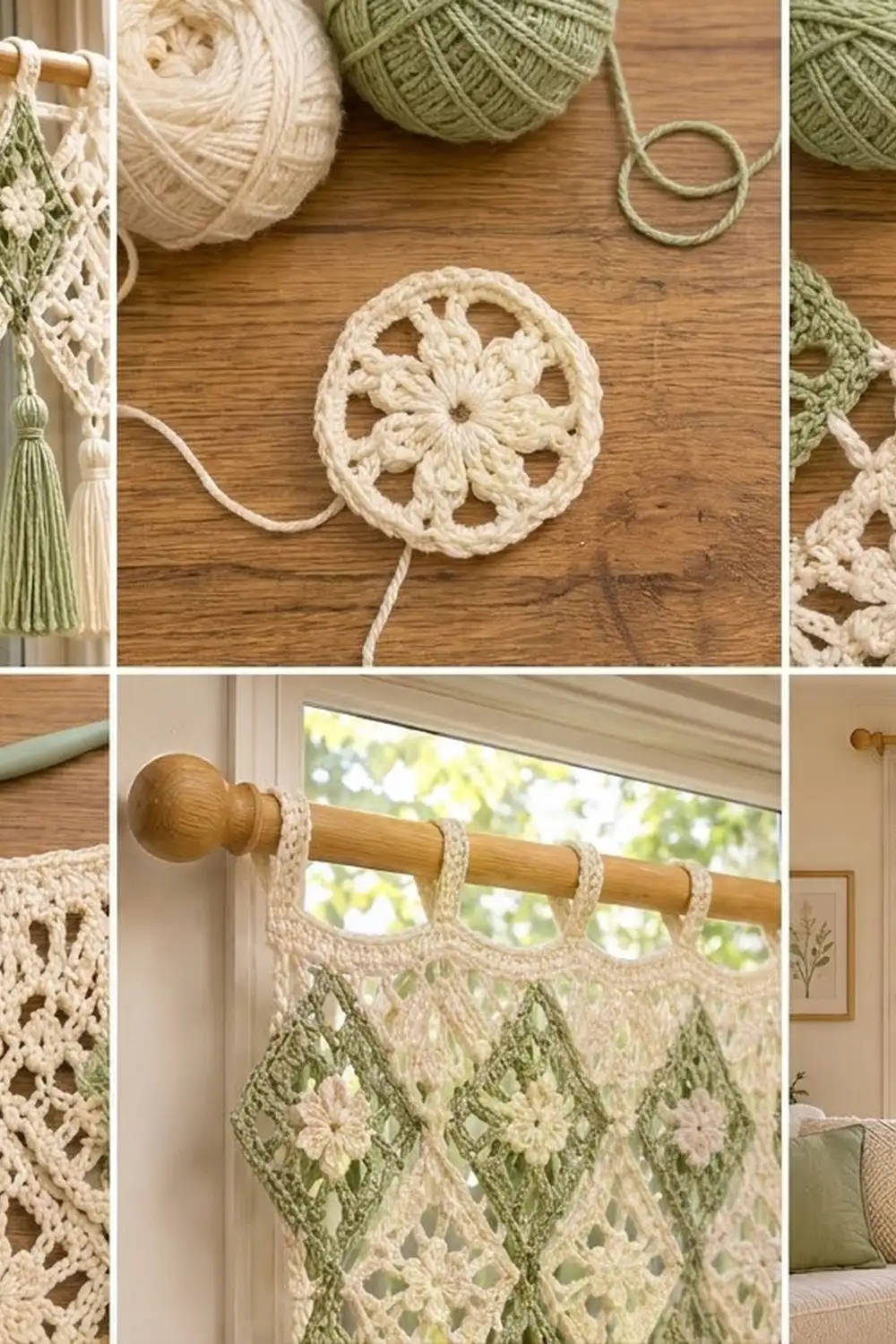
This curtain is a field of on-point diamonds in sage green and warm cream. Every diamond has a raised eight-petal cream flower in the center. An open mesh ring surrounds each flower, and a crisp single crochet edge finishes it. Green diamonds and cream diamonds alternate row by row, so the green forms a light, airy lattice.
Five crocheted loop tabs at the top slide onto a wooden rod. Nine chunky tassels hang from the bottom edge. Green tassels hang from the five low points and cream tassels from the four valleys between them. The side edges are left pointed, so the zigzag outline repeats down both sides.
The pattern uses US crochet terms. The finished curtain body measures 36.2 in (91.9 cm) wide and 36.2 in (91.9 cm) tall, point to point. Add the loop tabs above and the tassels below.
Construction is simple and modular. You make 41 square motifs, turn them on point, and join them with flat slip stitch seams. Then you work a two-round edging around the whole outline. Loop tabs and tassels finish the piece.
Finished Size and Construction
- Finished size (body): 36.2 in x 36.2 in (91.9 cm x 91.9 cm), point to point
- Skill level: Intermediate
- Terminology: US crochet terms
- Yarn weight: Worsted (#4), cotton or cotton blend
- Hook: 5.0 mm (US H-8)
- Number of pieces: 41 square motifs (25 green, 16 cream), plus 5 loop tabs and 9 tassels
- Layout: 9 staggered horizontal rows of on-point diamonds, alternating 5 and 4 diamonds
- Piece size: 5 in (12.7 cm) per side; 7.1 in (18.0 cm) point to point
- Size before border: 35.4 in x 35.4 in (89.9 cm x 89.9 cm)
- Border depth: 0.4 in (1.0 cm) on every edge
- Loop tabs: about 2.5 in (6.4 cm) tall
- Tassels: 5.5 in (14.0 cm) long
Materials
Use a smooth worsted cotton or cotton blend. Cotton gives crisp stitch definition, holds its shape when blocked, and doesn’t stretch much in sunlight. The amounts below assume about 85 m (93 yd) per 50 g.
- Color A, sage green: 300 g, about 510 m (558 yd), for the green motif outer rounds and 5 tassels
- Color B, cream: 450 g, about 765 m (837 yd), for all flower centers, the cream motifs, joining, border, tabs, and 4 tassels
The quantities include a margin of about 25% for gauge differences and swatching.
Tools:
- 5.0 mm (US H-8) crochet hook
- Tapestry needle
- Stitch markers
- Stiff card, 6 in (15.2 cm) wide, for tassels
- Sharp scissors
- Blocking mats, rustproof pins, and a spray bottle
- Measuring tape
Abbreviations (US Terms)
- ch – chain
- sl st – slip stitch
- sc – single crochet
- hdc – half double crochet
- dc – double crochet
- sk – skip
- sp – space
- st(s) – stitch(es)
- MR – magic ring
- sc2tog – single crochet 2 together
- BLO – back loop only
- rev sc – reverse single crochet (crab stitch)
Special stitch – back post single crochet (bpsc): Insert the hook from the back, around the post of the stitch, and out to the back again. Yarn over, pull up a loop, yarn over, and draw through both loops on the hook.
Gauge and Checkpoints
Make one green motif before anything else. Block it lightly and measure it. Gauge matters here because every seam, border count, and finished measurement depends on the motif.
Gauge: One finished motif (Rounds 1–7) = 5 in (12.7 cm) per side.
Checkpoints, measured flat:
- After Round 3 (flower): 2.25 in (5.7 cm) across
- After Round 5: 3.5 in (8.9 cm) per side
- After Round 6: 4.5 in (11.4 cm) per side
- After Round 7: 5 in (12.7 cm) per side
If your motif is too big, go down 0.5 mm in hook size. If it is too small, go up 0.5 mm. Even a 0.25 in (0.6 cm) error per motif grows to about 1.8 in (4.6 cm) across the width of five diamonds. Fix it before you make all 41.
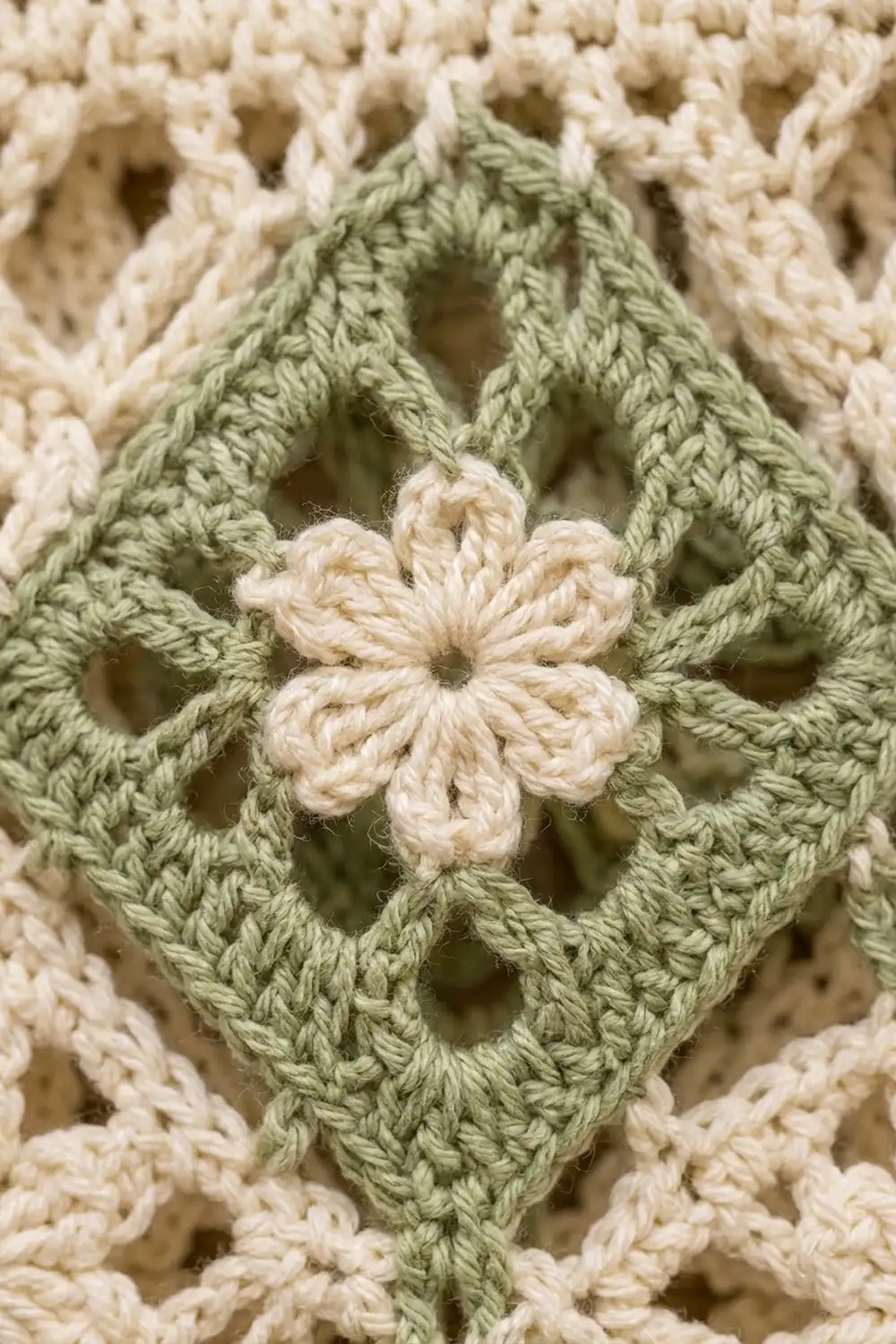
Motif Pattern
Every motif starts with the same cream flower. Green motifs change to Color A at Round 4. Cream motifs keep working in Color B.
Round 1 (Color B): MR, ch 3 (counts as dc), 15 dc in the ring, sl st to the top of ch-3. Pull the ring closed. (16 dc)
Round 2: Ch 1, sc in the same st, ch 3, sk 1, sc in the next st, ch 3, sk 1; repeat from * 6 more times, sl st to the first sc. (8 sc, 8 ch-3 sps)
Round 3 (petals): Sl st into the first ch-3 sp. In each ch-3 sp work (sc, hdc, 3 dc, hdc, sc), then sl st to the first sc. (8 petals, 56 sts)
For green motifs, fasten off Color B here. For cream motifs, keep going with Color B.
Round 4: Join the motif color with a bpsc around any Round 2 sc, working behind the petals. Ch 5, bpsc around the next Round 2 sc, ch 5; repeat from * 6 more times, sl st to the first bpsc. (8 bpsc, 8 ch-5 sps)
The petals now sit in front of this round. That gives the flower its raised, layered look.
Round 5 (squaring): Sl st into the first ch-5 sp. Ch 3 (counts as dc), then work (2 dc, ch 2, 3 dc) in the same sp for a corner. Work 5 dc in the next sp for a side. Work (3 dc, ch 2, 3 dc) in the next sp, then 5 dc in the next sp; repeat from * 2 more times, sl st to the top of ch-3. (44 dc and 4 ch-2 corner sps; 11 dc per side)
Round 6 (mesh): Sl st into the next 2 dc and into the corner sp. Ch 6 (counts as dc and ch 3), then dc in the same sp. Ch 1, dc in the first dc of the side, (ch 1, sk 1, dc in the next dc) 5 times, ch 1, then work (dc, ch 3, dc) in the corner sp. Repeat from * around, omitting the last corner. Ch 1, then sl st to the 3rd ch of ch-6. (32 dc, 28 ch-1 sps, 4 ch-3 corner sps)
Each side, from corner dc to corner dc, now holds 8 dc and 7 ch-1 sps, which is 15 sts.
Round 7 (edge): Sl st into the corner sp. Ch 1, then 3 sc in the same sp. Sc in each dc and each ch-1 sp across the side (15 sc), then 3 sc in the corner sp. Repeat from * around, omitting the last corner, and sl st to the first sc. (72 sc)
Each side has 15 sc between the corner groups. Counting the side sc of each corner group and the 2 corner center sc gives 19 sts per side, including both corner center sts. That’s 4 x 17 + 4 corner centers = 72. Fasten off and weave in the ends.
Make All Pieces
- Green motifs: 25 (Rounds 1–3 in Color B, Rounds 4–7 in Color A)
- Cream motifs: 16 (all rounds in Color B)
- Total: 41 motifs
Turn every motif so a corner points up. Lay the diamonds out in this staggered grid (G = green, C = cream):
Row 1:  G   G   G   G   G
Row 2:    C   C   C   C
Row 3:  G   G   G   G   G
Row 4:    C   C   C   C
Row 5:  G   G   G   G   G
Row 6:    C   C   C   C
Row 7:  G   G   G   G   G
Row 8:    C   C   C   C
Row 9:  G   G   G   G   G
Each cream diamond nests into the valley between two green diamonds above it and two below it. Every edge it touches is a shared seam.
Joining
Method: Flat slip stitch join through the back loops, using Color B.
Hold two motifs with wrong sides together. Join with a sl st through both corner center sts. Then sl st through the BLO of each pair of matching sts along the edge: 17 side sts, then the 2nd corner center. That’s 19 sl sts per seam, stitch for stitch, with no extra chains.
Work in long diagonal lines. In this layout, the seams line up into straight diagonals running through the whole curtain. First, join every seam that runs from upper left to lower right. Work each diagonal as one continuous line. When you reach a meeting point, ch 1 across it and carry on to the next pair of motifs. Then turn the curtain and join all the seams running the other way. Where the lines cross, sl st across the meeting point to lock all four corners together.
Tension: Keep the slip stitches as loose as the motif stitches. Tight seams pucker the lattice and pull the diamonds narrower. If you tend to pull tight, use a 5.5 mm hook for the joins only.
Size checkpoint: Lay the joined piece flat without stretching it. It should measure 35.4 in (89.9 cm) from the left side point to the right side point, and 35.4 in (89.9 cm) from a top point to a bottom point. Five diagonals of 7.1 in (18.0 cm) each give 35.4 in either way.
Border
Border gauge: One sc per motif edge stitch keeps the edge flat. The border adds 0.4 in (1.0 cm) on every edge.
The outline has 36 exposed motif edges, 20 outer points, and 16 inner valleys. Valley points are where two outer diamonds meet. On each exposed edge, work into its 17 side sts. Each outer point is one corner center st. Each valley has two exposed corner center sts, one from each diamond.
Round 1 (Color B): Join with a sc in the side st just after the top point of the top-left diamond. Work around the whole outline as follows:
- Each exposed edge: sc in each of the 17 side sts
- Each outer point: 3 sc in the corner center st
- Each valley: sc2tog over the 2 corner center sts
Sl st to the first sc.
Counts per side:
- Top (5 top points, 4 valleys, 10 edges): (170 sc worked 1 per edge st) + (5 points x 3 sc = 15) + (4 sc2tog = 4) = 189 sts
- Bottom: the same as the top, 189 sts
- Left side (5 side points, 4 valleys, 8 edges): (136 sc worked 1 per edge st) + (5 points x 3 sc = 15) + (4 sc2tog = 4) = 155 sts
- Right side: the same as the left, 155 sts
- Round total: 189 + 189 + 155 + 155 = 688 sts
Why the math works: Each motif side has 19 sts, including its 2 corner centers. Take those 2 corners away and 17 side sts are left. The 36 exposed edges give 36 x 17 = 612. Each corner center is used once. Every outer point gets 3 sc (20 x 3 = 60), and every valley pair becomes 1 sc2tog (16 x 1 = 16). So 612 + 60 + 16 = 688. The extra sts at the points let the edge turn 90° outward. The decreases at the valleys let it turn 90° inward, so the edge stays flat.
Round 2: Ch 1, then rev sc in each st around. Sl st to the first st and fasten off. (688 sts)
Loop tabs: Join Color B in the rev sc above the center sc of a top point. Ch 18, then sl st in the same st to form a loop. Ch 1 and work 24 sc into the loop. Sl st into the starting st and fasten off. Repeat on all 5 top points. Each tab stands about 2.5 in (6.4 cm) tall and fits a rod up to 1.25 in (3.2 cm) thick.
Tassels (make 5 in Color A and 4 in Color B): Wrap yarn 40 times around the 6 in (15.2 cm) card. Slide a 12 in (30.5 cm) tie strand under the top and knot it tightly. Cut the loops at the bottom. Wrap a second strand 6 times around the bundle, 0.75 in (1.9 cm) below the top, then knot and bury the ends. Trim to 5.5 in (14.0 cm). Tie the green tassels to the 5 bottom points and the cream tassels to the 4 bottom valleys.
Final Blocking
- Weave in all ends before blocking, but don’t trim them close yet.
- Lay the curtain face down on blocking mats.
- Pin the 5 top points and 5 bottom points in straight lines, 7.1 in (18.0 cm) apart.
- Pin the 5 left and 5 right side points so the width measures 36.2 in (91.9 cm).
- Set a pin in every valley and at every 4-way meeting point. Check that each diamond is 5 in (12.7 cm) per side.
- Ease each flower so the petals sit forward and open.
- Mist the piece until it is evenly damp, not soaked.
- Let it dry completely, then trim the woven ends.
- Comb out the tassels with a damp comb and re-trim them evenly.
Final Quality-Control Checklist
- 41 motifs, each with 72 sts in Round 7 and 19 sts per side, including the corners
- 25 green and 16 cream diamonds, placed as shown in the grid
- Every seam has 19 sl sts, with no skipped or doubled sts
- All 4-way meeting points are locked and lie flat
- Border Round 1 has 189 sts on the top, 189 on the bottom, and 155 on each side
- The body measures 36.2 in x 36.2 in (91.9 cm x 91.9 cm)
- 5 tabs are evenly spaced on the top points
- 5 green and 4 cream tassels are trimmed to the same length
Troubleshooting
The flower petals look flat. Make sure the Round 4 bpsc goes behind the petals and around the Round 2 sc. Front-post sts push the petals backward.
The motif cups or ruffles. In Round 4, cupping means your ch-5 loops are too short. Ruffling means they are too long. Adjust your chain tension.
The motif sides won’t match up for joining. Recount Round 7. It must have 15 sc between corner groups. One missed ch-1 sp in Round 6 throws off the whole side.
The seams pucker. Your joins are too tight. Undo them and rejoin with a larger hook.
The border points curl. Check for exactly 3 sc in each point and 1 sc2tog in each valley.
The tabs twist on the rod. Spread the 24 sc evenly around each ch-18 loop.
Care
Hand wash in cool water with mild soap and press out the water in a towel. Dry flat and re-pin the points if needed. Don’t hang the curtain while it’s wet.
Final Notes
The measurement chain is short and reliable. One motif is 5 in (12.7 cm) per side and 7.1 in (18.0 cm) point to point. Five diagonals give a joined body of 35.4 in (89.9 cm) each way. The 0.4 in (1.0 cm) border brings it to 36.2 in (91.9 cm). Check your first motif and count each seam and border side, and the curtain will hang straight and even.
Happy crocheting!