

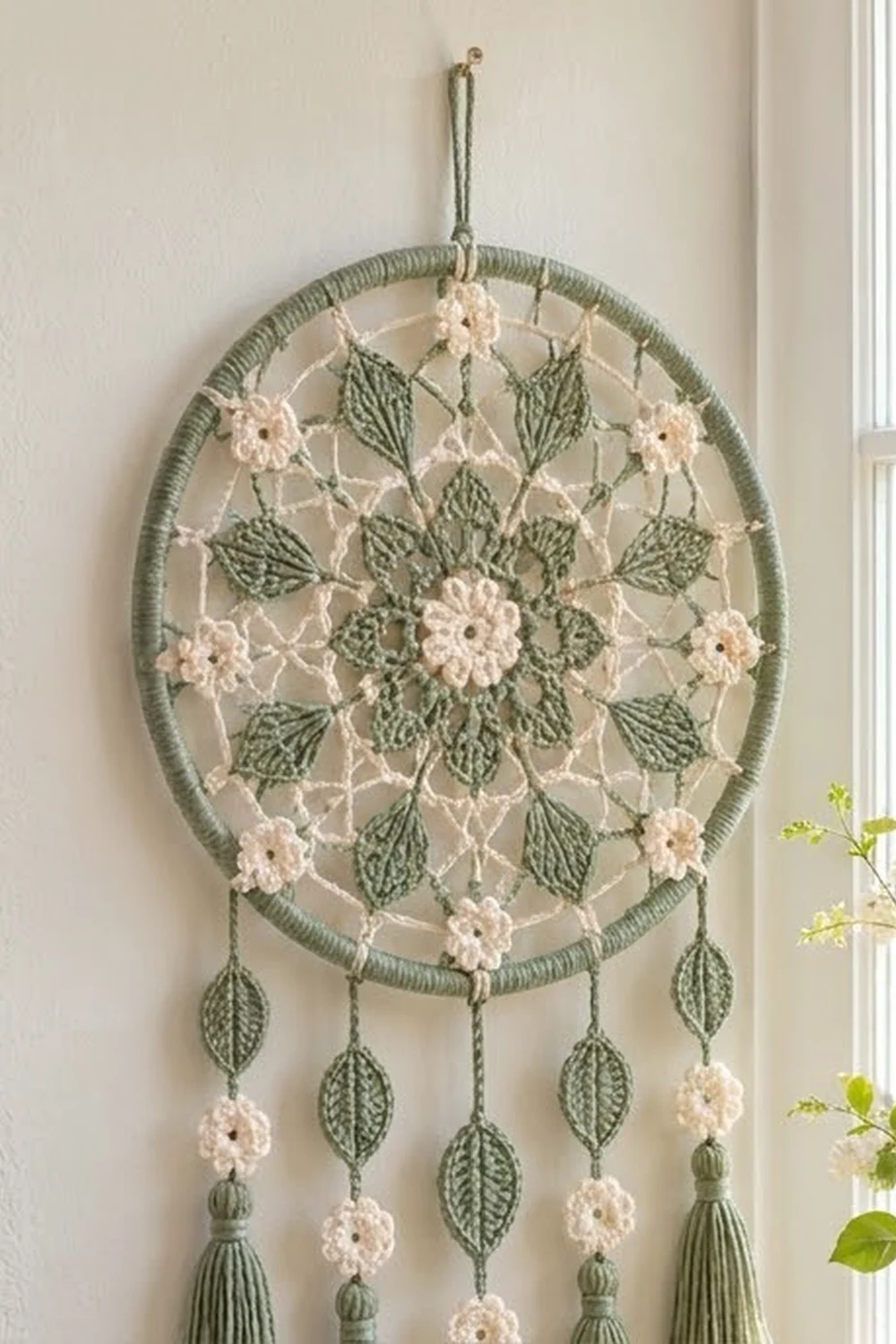
This is a calm, botanical dreamcatcher in two colors: soft sage green and warm cream. A lacy mandala sits inside a yarn-wrapped hoop. A cream flower is at the center, ringed by sage petals and eight pointed sage leaves.
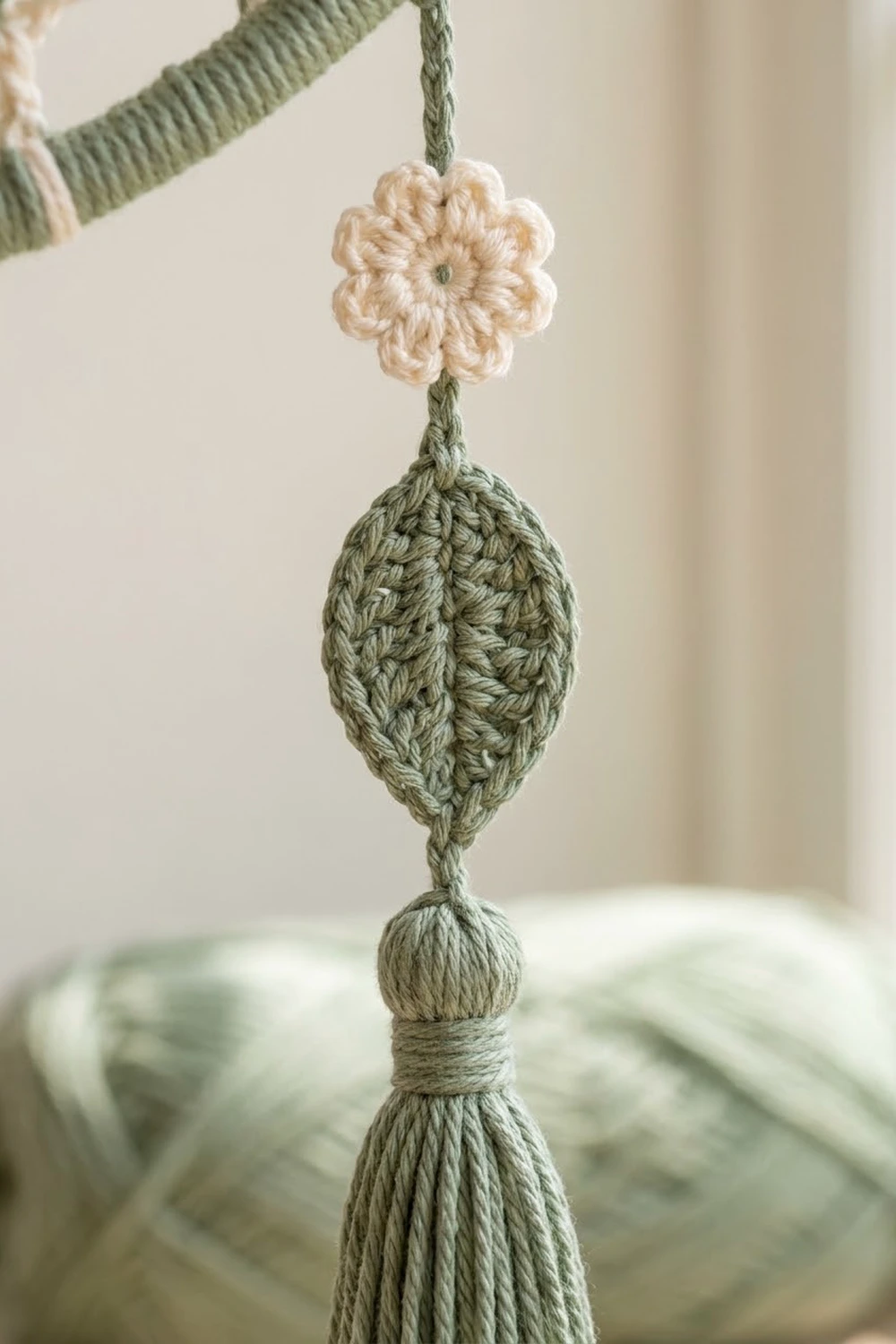
Eight small cream flowers sit around the inside of the hoop. Five sage cords hang from the bottom, each with a leaf, a flower, and a full tassel. The style is cottage-meets-boho, and it looks right in a nursery, a reading corner, or next to a window.
The pattern uses US crochet terms. Including the hanging loop and tassels, the finished hanging measures 10 in (25.4 cm) wide by about 24.5 in (62.2 cm) long.
Construction is simple. You crochet the mandala in the round, then wrap the hoop and lace the mandala into it with a zigzag chain round. Last, you add the small flowers, leaves, cords, and tassels.
Finished Size and Construction
- Finished size: 10 in (25.4 cm) wide x 24.5 in (62.2 cm) long
- Skill level: Intermediate
- Terminology: US crochet terms
- Yarn weight: DK (#3) cotton or cotton blend
- Hook: 3.5 mm (E-4)
- Number of pieces: 1 mandala, 13 small flowers, 5 leaves, 5 tassels, all assembled into one hanging
- Layout: Mandala centered in the hoop. 8 flowers on the hoop. 5 cords hang from the bottom.
- Mandala size before lacing (Rnd 9): 8 in (20.3 cm) across
- Hoop: 10 in (25.4 cm) metal or wooden ring
- Lacing (border) depth: 1 in (2.5 cm) from mandala edge to hoop on every side
Materials
Pick a smooth, mercerized or matte cotton in DK weight. Cotton holds the leaf points crisp and does not stretch out on the hoop over time. Avoid fuzzy yarns, because they hide the lace.
- Sage green: 40 g, about 92 m. Used for the mandala, hoop wrap, loop, cords, leaves, and tassels.
- Cream: 30 g, about 69 m. Used for the mandala and all 13 flowers.
These amounts include a margin of about 15%. The tassels use the most sage, so don’t cut corners there.
Tools:
– 3.5 mm (E-4) crochet hook
– 10 in (25.4 cm) metal or wooden hoop
– Tapestry needle
– Scissors
– 4 in (10.2 cm) piece of cardboard for the tassels
– 16 locking stitch markers
– Rust-proof pins and a foam blocking mat
– Small dab of fabric glue (optional, for the hoop-wrap ends)
Abbreviations (US Terms)
- ch – chain
- sl st – slip stitch
- sc – single crochet
- hdc – half double crochet
- dc – double crochet
- tr – treble crochet
- MR – magic ring
- sp(s) – space(s)
- st(s) – stitch(es)
- rep – repeat
Special stitches:
– Standing sc: With a slip knot on the hook, insert the hook into the stitch, yarn over, pull up a loop, yarn over, and pull through both loops.
– Picot: Ch 3, then sl st into the 3rd ch from the hook.
– Tip sp: The small gap between the two dc at the top of a Rnd 2 petal.
Gauge and Checkpoints
Make one small flower first (see Small Flowers). It should measure 1.25 in (3.2 cm) across. This quick test checks your hook and yarn before you start the mandala.
Chain gauge matters for the cords and the lacing: 5 ch = 1 in (2.5 cm).
Measure the mandala flat, without stretching it:
– After Rnd 2: 1.5 in (3.8 cm)
– After Rnd 4: 3 in (7.6 cm)
– After Rnd 6: 5 in (12.7 cm)
– After Rnd 8: 7 in (17.8 cm)
– After Rnd 9: 8 in (20.3 cm)
If your work is too big, go down to a 3.25 mm hook. A mandala over 8.5 in (21.6 cm) leaves too little room to lace it tightly.
If your work is too small, go up to a 3.75 mm hook. A mandala under 7.25 in (18.4 cm) makes the spokes strain and the edges pucker.
Mandala
Rnd 1 (cream)
Make a MR. Ch 3 (counts as dc). Work 15 dc in the ring. Sl st to the top of the ch-3. Pull the ring snug, but leave a small hole in the center. (16 dc)
Rnd 2 (cream) – flower petals
Ch 1. Work (sc, hdc, dc) in the next dc, then (dc, hdc, sc) in the next dc. Rep from * 7 more times. Sl st to the first sc. Fasten off. (48 sts, 8 petals)
Each petal uses 2 sts from Rnd 1 and has 6 sts: 8 x 6 = 48.
Rnd 3 (sage)
Join sage with a standing sc in the tip sp of any petal. Ch 5. Sc in the next tip sp, ch 5. Rep from * 6 more times. Sl st to the first sc. (8 sc, 8 ch-5 sps)
Rnd 4 (sage) – pointed petal ring
Sl st into the first ch-5 sp. In each ch-5 sp, work (sc, hdc, 2 dc, ch 2, 2 dc, hdc, sc). Sl st to the first sc. Fasten off. (64 sts, 8 ch-2 tips)
Rnd 5 (cream) – lace round
Join cream with a standing sc in any ch-2 tip. Ch 7. Sc in the next ch-2 tip, ch 7. Rep from * 6 more times. Sl st to the first sc. Fasten off. (8 sc, 8 ch-7 sps)
Rnd 6 (sage) – leaves
Join sage with a sl st in any ch-7 sp. In each ch-7 sp, work (sc, hdc, 2 dc, tr, picot, tr, 2 dc, hdc, sc). Sl st to the first sc. Fasten off. (80 sts, 8 picots)
Each leaf spans one ch-7 arch, so its picot tip points straight out. The Rnd 5 sc shows between leaves.
Rnd 7 (cream)
Join cream with a standing sc in any picot. Ch 6, sc in the next Rnd 5 sc between leaves, ch 6, sc in the next picot. Rep from * around. Leave off the last sc and sl st to the first sc instead. (16 sc, 16 ch-6 sps)
Rnd 8 (cream) – mesh
Sl st in the next 3 ch, ch 1, and sc in the same ch-6 sp. Ch 6, sc in the next ch-6 sp. Rep from * 14 more times. Ch 6 and sl st to the first sc. (16 sc, 16 ch-6 sps)
Rnd 9 (cream) – conversion round
Ch 1. Sc in the next sc, 6 sc in the next ch-6 sp. Rep from * 15 more times. Sl st to the first sc. Fasten off.
Count: 16 sc worked 1-per-existing sc + 96 sc added in the spaces (16 x 6) = 112 sc.
Place a marker in each of the 16 sc worked into a Rnd 8 sc. These are your anchor stitches, and every 7th stitch is one. Before you lace the mandala, pin-block it to 8 in (20.3 cm), following step 1 of Final Blocking.
Hoop Preparation
- Tie sage to the hoop and leave a 6 in (15.2 cm) tail. Lay the tail along the hoop and wrap over it.
- Wrap tightly, laying each wrap snugly against the last, until the hoop is covered. This takes about 10 m.
- Tuck the end under the last 10 wraps with a needle. Add a dab of glue if you like.
- Mark 16 evenly spaced points, about 1.96 in (5.0 cm) apart. Mark the 4 quarter points first, then halve each section twice. Point 1 is at 12 o’clock.
Hanging loop: Attach sage with a sl st around the hoop at point 1. Ch 20, then sl st around the hoop at the same point. Turn, and sl st in each ch back (20 sl st). Fasten off. The loop stands about 2 in (5.1 cm) tall.
Small Flowers (make 13, cream)
Rnd 1: Make a MR. Ch 1 and work 8 sc in the ring. Sl st to the first sc. (8 sc)
Rnd 2: Work (sl st, ch 2, 2 dc, ch 2, sl st) in the next sc. Rep from * 7 more times. (8 petals)
Fasten off and leave a 10 in (25.4 cm) tail for sewing. Each flower measures 1.25 in (3.2 cm). Eight go on the hoop and five go on the cords.
Leaves (make 5, sage)
Ch 11. Start in the 2nd ch from the hook (this is the tip end). Work sc, hdc, dc, dc, tr, tr, dc, dc, hdc (9 sts). Work 3 sc in the last ch (the base).
Rotate the work and continue along the other side of the foundation chain: hdc, dc, dc, tr, tr, dc, dc, hdc, sc (9 sts). Ch 2 and sl st to the first sc to form the pointed tip. (21 sts + ch-2 tip)
Vein: With sage, sl st along the surface of the center line, from base to tip. Each leaf is 2.5 in (6.4 cm) long and 1.25 in (3.2 cm) wide. Leave a sewing tail.
Cords (sage)
Work each cord straight from the hoop. Attach with a sl st around the hoop, ch the stated number, then sl st in the back bump of the 2nd ch from the hook and in each ch back to the hoop. Finish with a sl st around the hoop.
The center cord hangs from point 9 (6 o’clock). The other cords sit 1.75 in (4.4 cm) apart along the hoop, two on each side.
- Outer cords (make 2): Ch 25, then 24 sl st back. About 5 in (12.7 cm) long.
- Inner cords (make 2): Ch 35, then 34 sl st back. About 7 in (17.8 cm) long.
- Center cord (make 1): Ch 45, then 44 sl st back. About 9 in (22.9 cm) long.
Tassels (make 5, sage)
Wrap sage 30 times around the 4 in (10.2 cm) cardboard. Slide a 10 in (25.4 cm) strand under the top and tie it tightly. Cut the loops at the bottom.
Wrap a second strand 6 times around the neck, 0.5 in (1.3 cm) below the top, and bury its ends inside the tassel. Trim the tassel to 3.5 in (8.9 cm).
Border (Lacing Round)
Border gauge: One ch-6 relaxes to about 1.2 in (3.0 cm). Each spoke has to cover about 1.33 in (3.4 cm), so the lacing stretches about 10%. That stretch holds the mandala taut.
Rnd 10 (cream)
Center the mandala in the hoop, with one anchor sc just to the left of point 1. Join cream with a standing sc in that anchor.
Ch 6, sc around the hoop at the next marked point. Ch 6, skip 6 sc, sc in the next anchor sc. Rep from * around. On the last rep, sl st to the first sc instead of working the final sc. Fasten off.
Counts per eighth of the circle: 2 anchor sc, 2 hoop sc, and 4 ch-6 spokes.
Full round: 16 anchor sc + 16 hoop sc + 32 ch-6 spokes.
Why the math works
Rnd 9 has 112 sts, and 112 ÷ 16 = 7, so anchors fall exactly every 7th stitch. The mandala edge measures 25.1 in (63.8 cm) around, which puts anchors 1.57 in (4.0 cm) apart. The hoop measures 31.4 in (79.8 cm) around, which puts hoop points 1.96 in (5.0 cm) apart.
Because anchors and hoop points alternate, the spokes form an even zigzag. The 1 in (2.5 cm) gap stays the same on every side.
Attaching the flowers, leaves, and tassels
- Sew one small flower over every other hoop sc (points 1, 3, 5, 7, 9, 11, 13, 15). Stitch it to the hoop wrap and the spoke junction.
- Sew a leaf onto each cord with its base 0.25 in (0.6 cm) below the hoop and its tip pointing down.
- Sew a flower onto each cord 1 in (2.5 cm) above the cord’s end.
- Tie each tassel to the end of a cord with its top tie, and bury the tie ends inside the tassel.
Final Blocking
- Before lacing: Wet the mandala and press out the water in a towel. Pin it to an 8 in (20.3 cm) circle, with a pin in each leaf picot and each Rnd 8 sc. Let it dry completely.
- After lacing: Lightly mist the mandala in the hoop. Ease any loose spoke tight by nudging stitches along the hoop.
- Leaves: Steam them flat and pinch the tips to a point.
- Small flowers: Steam them flat and open the center holes with a hook tip.
- Tassels: Steam them, comb with your fingers, hang to dry, then trim the bottoms level.
Final Quality-Control Checklist
- Mandala is 8 in (20.3 cm) across and centered, with a 1 in (2.5 cm) gap all around
- 8 sage petals, 8 sage leaves, and 32 even spokes
- Hoop wrap is solid, with no wood or metal showing
- 8 hoop flowers sit at evenly spaced points
- Cords measure 5 in, 7 in, 9 in, 7 in, and 5 in (12.7, 17.8, 22.9, 17.8, and 12.7 cm)
- All 5 tassels are 3.5 in (8.9 cm) with a neat neck wrap
- All ends are woven in securely
Troubleshooting
- Mandala ruffles: Your tension is too loose or the hook is too large. Drop down a hook size and redo it from Rnd 5.
- Mandala cups: The chains are too tight. Go up a hook size for the ch-6 and ch-7 rounds only.
- Lacing sags on one side: The hoop points are uneven. Re-measure, move the markers, and redo Rnd 10.
- Leaves curl: Steam them and pin them flat while they dry.
- Cords twist: Hang a damp tassel on each cord overnight.
- Hoop wrap slips: Glue the start and end, and pack the wraps tighter.
Care
Dust with a hair dryer on the cool setting, or a soft brush. If you need to clean it, spot-clean with cool water and reshape it while damp.
Final Notes
The measurement chain goes like this: a 1.25 in (3.2 cm) test flower confirms your gauge. The mandala grows to 1.5, 3, 5, 7, and then 8 in (3.8, 7.6, 12.7, 17.8, and 20.3 cm). 112 edge stitches divide into 16 anchors. Those anchors meet 16 points on a 10 in (25.4 cm) hoop through a 1 in (2.5 cm) zigzag lacing round. The cords and tassels bring the length to 24.5 in (62.2 cm).
If each checkpoint matches, the hanging will lie flat and taut. Happy crocheting!