

The Sage Meadow Bedspread is a field of soft green flowers sewn together into one large, airy bedspread. Every motif is a five-petal flower with a lacy spoked center and solid fan-shaped petals. A smooth single crochet outline gives each petal a crisp, rounded edge.
The whole bedspread uses one color, a muted sage green, so the texture stands out. The tall stitches in the petals form fine ridges that radiate from the center, and the small holes around the middle keep the fabric light. The look is calm and cottage-style.
This pattern uses US crochet terms. The finished bedspread measures 76.75 in x 87 in (194.9 cm x 221.0 cm). It is made from 414 flowers, and each one is 4.5 in (11.4 cm) across from petal tip to petal tip.
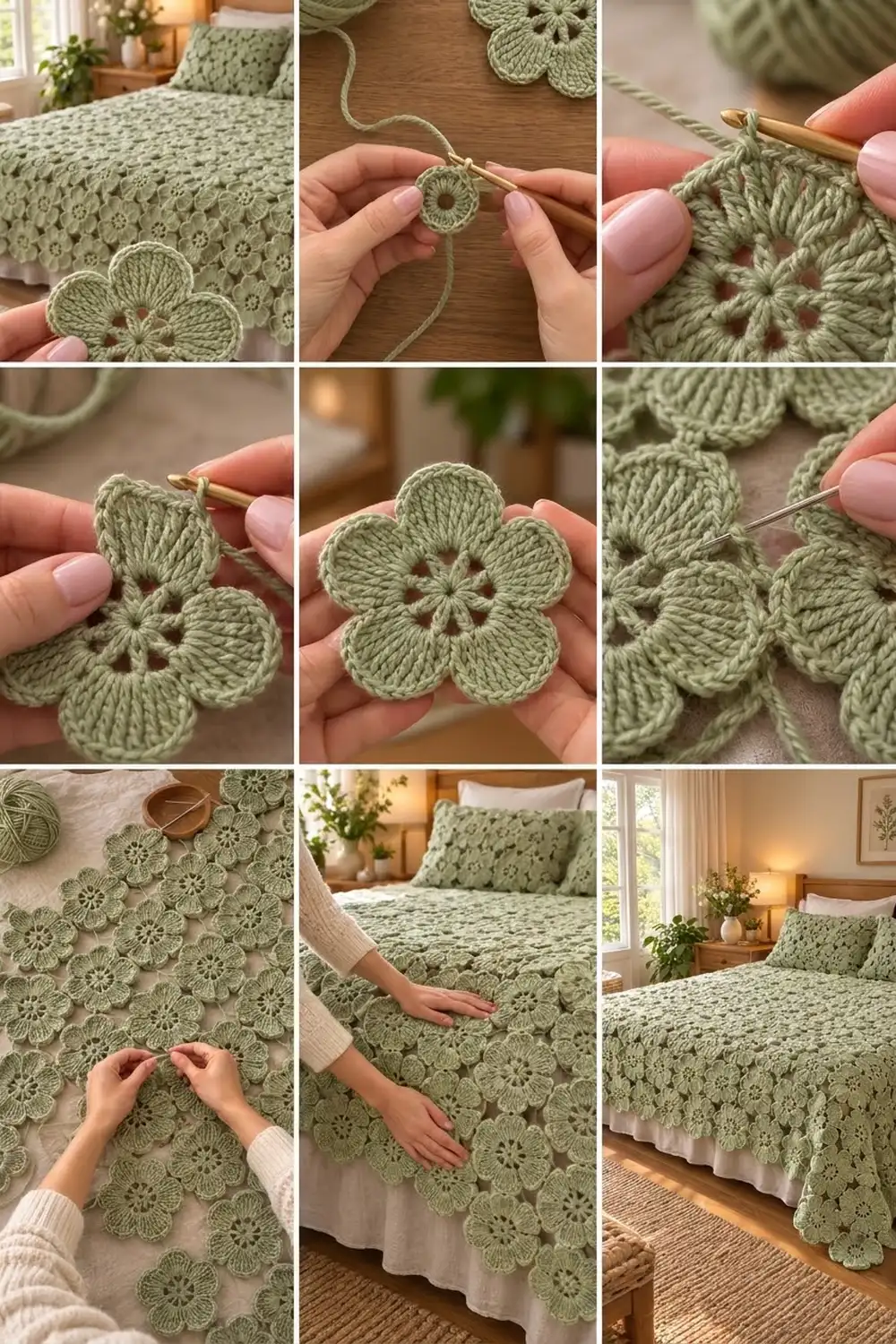
The construction is simple. Crochet each flower in five rounds, block the motifs, then sew them together with a tapestry needle in straight columns and rows. There is no added border because the outer petals form a natural scalloped edge.
Finished Size and Construction
- Finished size: 76.75 in x 87 in (194.9 cm x 221.0 cm)
- Skill level: Intermediate
- Terminology: US crochet terms
- Yarn weight: Worsted (#4)
- Hook: 5 mm (H-8)
- Number of pieces: 414 flower motifs
- Layout: 18 columns x 23 rows
- Piece size: 4.5 in (11.4 cm) tip to tip
- Spacing: 4.25 in (10.8 cm) center to center across a row; 3.75 in (9.5 cm) center to center down a column
- Size before border: 76.75 in x 87 in (194.9 cm x 221.0 cm)
- Border depth: 0 in (0 cm); the flower edge is the finished edge
Materials
Choose a smooth worsted-weight yarn that shows stitches clearly. A wool blend or soft acrylic works well. A cotton blend gives crisper petals but makes a heavier bedspread. Avoid fuzzy or very splitty yarns, which blur the petal ridges and make sewing harder.
- Sage green: about 3,700 g (about 7,400 m / 8,090 yd), which is roughly 37 skeins of 100 g / 200 m
Each flower uses about 8 g (about 16 m) of yarn. The quantities above include a margin of roughly 10 percent to allow for gauge differences, the test flower, and sewing yarn.
Tools:
- 5 mm (H-8) crochet hook
- Tapestry needle with a large eye
- Stitch markers
- Scissors
- Tape measure
- Blocking mats, rustproof pins, and a spray bottle
Abbreviations (US Terms)
- ch = chain
- sl st = slip stitch
- sc = single crochet
- hdc = half double crochet
- dc = double crochet
- tr = treble crochet (yarn over twice, insert hook, pull up a loop, [yarn over, pull through 2 loops] 3 times)
- sk = skip
- sp = space
- st(s) = stitch(es)
Special technique, magic ring: Wrap the yarn into a loop, work the first round into the loop, then pull the tail to close the center.
Gauge and Checkpoints
Gauge is measured on a single finished flower. Make one test flower before you start the full bedspread, then block it and measure it.
- After Round 1: about 1.25 in (3.2 cm) across
- After Round 2: about 2 in (5.1 cm) across
- After Round 4: about 4 in (10.2 cm) tip to tip
- After Round 5: 4.5 in (11.4 cm) tip to tip, blocked
The finished flower can be up to 0.25 in (0.6 cm) larger or smaller, as long as every flower matches.
If your flower is too big: Go down to a 4.5 mm hook, or check that you aren’t pulling your tr stitches extra tall.
If your flower is too small: Go up to a 5.5 mm hook. Small flowers usually come from tight chain loops in Round 3.
A difference of 0.25 in (0.6 cm) per flower adds up to about 4.5 in (11.4 cm) across 18 columns, so gauge matters.
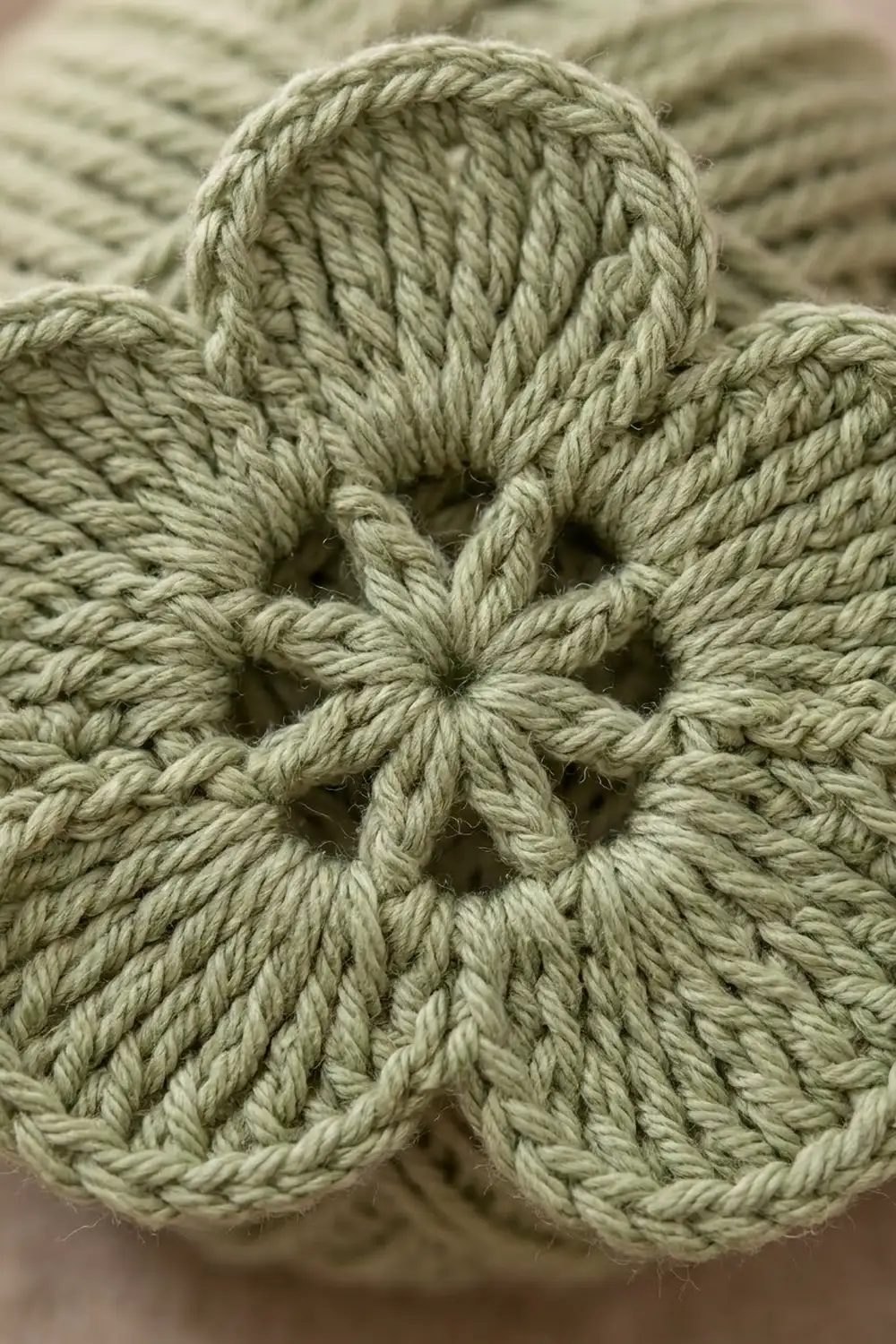
Flower Motif
Make 414. Work in joined rounds with the right side facing. Do not turn.
Round 1: Make a magic ring. Ch 5 (counts as dc + ch 2), [dc in ring, ch 2] 9 times. Sl st in 3rd ch of beginning ch-5 to join. Pull the ring closed. (10 dc, 10 ch-2 sps)
The 10 dc are the spokes, and the 10 ch-2 spaces become the small holes around the center.
Round 2: Sl st in first ch-2 sp. Ch 3 (counts as dc), 2 dc in same sp. Work 3 dc in each of the remaining 9 ch-2 sps. Sl st in top of beginning ch-3 to join. (30 dc)
This round closes the holes into a solid ring. It should lie flat and measure about 2 in (5.1 cm) across.
Round 3: Ch 1, sc in same st as join. Ch 5, sk next 5 dc, sc in next dc. Repeat from * to * 3 more times. Ch 5, sk last 5 dc, sl st in first sc to join. (5 sc, 5 ch-5 loops)
Check the math: each repeat uses 1 sc plus 5 skipped dc, which is 6 sts, and 5 repeats x 6 sts = 30 sts.
Round 4 (petals): Sl st in first ch-5 loop. In the same ch-5 loop, work: hdc, 2 dc, 9 tr, 2 dc, hdc. Sl st in next sc. Repeat from * to * 4 more times, working into each ch-5 loop in turn. The last sl st lands in the first sc of Round 3. (5 petals of 15 sts each = 75 sts, plus 5 sl sts)
Push the stitches along the loop as you go so each petal fans out evenly. The 9 tr make the radiating ridges in each petal.
Round 5 (outline): Sl st in first hdc. Ch 1. Sc in hdc, sc in each of next 2 dc, [2 sc in next tr, sc in next tr] 4 times, 2 sc in next tr, sc in each of next 2 dc, sc in next hdc, sk the sl st between petals. Repeat from * to * 4 more times. Sl st in first sc to join. (20 sc per petal, 100 sc total)
Petal count check: 1 + 2 + 12 + 2 + 2 + 1 = 20 sc. The increases sit only over the tr stitches, so the petal curves without ruffling.
Fasten off, leaving a 6 in (15.2 cm) tail. Weave in all ends on the wrong side.
Petal stitch map: Number the sc in each petal 1 to 20 in the direction you worked them. Sc 9 to 12 form the petal tip. Sc 1 to 2 and sc 19 to 20 sit low, beside the notches between petals. You will use these numbers when joining.
Make All Pieces
Make 414 flowers in sage green, using about 8 g (about 16 m) each.
Block the flowers in batches before joining. Pin each one to 4.5 in (11.4 cm) tip to tip, mist lightly, and let dry. Flowers blocked before joining are much easier to match while sewing.
Orientation: Lay each flower right side up with one petal pointing straight up. Name the petals clockwise:
- A = top petal
- B = upper right petal
- C = lower right petal
- D = lower left petal
- E = upper left petal
Layout grid (18 columns x 23 rows):
Row 1:   F F F F F F F F F F F F F F F F F F
Row 2:   F F F F F F F F F F F F F F F F F F
Row 3:   F F F F F F F F F F F F F F F F F F
  ...    (repeat for Rows 4 to 22)
Row 23:  F F F F F F F F F F F F F F F F F F
F = one flower. All flowers face the same way. Each row has 18 flowers and there are 23 rows, so you need 18 x 23 = 414 flowers.
Joining
Sew all the flowers together with a tapestry needle and lengths of the same yarn. Work on a large flat surface with the wrong sides facing down.
Side joins (within a row): Petal B of one flower meets petal E of the flower to its right, tip to tip. Hold the two tips together. Whipstitch sc 9 to 12 of petal B to sc 12 to 9 of petal E, one stitch to one stitch, through the back loops. That joins 4 stitches to 4 stitches.
Row joins (between rows): Petal A of each lower flower nests into the notch between petals C and D of the flower directly above. Whipstitch sc 9 to 12 of petal A to the 4 sc on either side of that notch: the last 2 sc of one lower petal and the first 2 sc of the other. Again, this joins 4 stitches to 4 stitches.
Each flower has up to four joins: B to the flower on the right, E to the flower on the left, A to the flower above, and the C-D notch to the flower below. No stitches are added at any seam.
Tension: Sew snugly enough that the joined stitches touch, but not so tight that the petals pucker. Knot each join on the wrong side, then weave the tail through the outline round before cutting.
Size checkpoints:
- Two flowers joined side by side: 8.75 in (22.2 cm) wide
- A full row of 18 flowers: 76.75 in (194.9 cm) wide
- Two rows joined: 8.25 in (21.0 cm) tall
- Four rows joined: 15.75 in (40.0 cm) tall
- All 23 rows: 87 in (221.0 cm) tall
The math: width = 17 spaces x 4.25 in + one flower of 4.5 in = 76.75 in (194.9 cm). Height = 22 spaces x 3.75 in + one flower of 4.5 in = 87 in (221.0 cm).
Border
This bedspread has no added border. The outer petals are the finished edge, and their scallops are part of the design. Adding rounds of stitches would flatten that outline.
Instead, count the free outer petals on each side so you know every scallop is in place:
- Top edge: 18 free A petals, each with all 20 sc free = 18 scallops
- Bottom edge: 18 flowers x 2 free petals (C and D) = 36 scallops
- Left edge: 23 free E petals = 23 scallops
- Right edge: 23 free B petals = 23 scallops
Edge gauge: Each free petal should measure about 1.25 in (3.2 cm) from the ring to the tip, with its 20-sc outline intact.
Why the math works: every outer petal is a complete 20-sc petal from Round 5, and no seam touches it. The joins only use petals inside the bedspread, so no stitches are stretched or removed at the edge. That lets all four sides block out evenly.
Final Blocking
- Weave in any remaining tails and trim them.
- Lay the bedspread flat on blocking mats, a clean carpet covered with a towel, or a spare bed.
- Mist the whole piece until it is damp, not soaked.
- Measure and pin the four corners to 76.75 in x 87 in (194.9 cm x 221.0 cm).
- Pin along each side, placing one pin in the tip of every outer petal.
- Gently smooth each flower so the center holes open and the petals lie flat.
- Let it dry completely before removing the pins.
Final Quality-Control Checklist
- Every flower has 10 open center holes and 5 petals.
- Every petal has 20 sc in Round 5.
- All flowers measure 4.5 in (11.4 cm) tip to tip, within 0.25 in (0.6 cm).
- All flowers face the same direction, with petal A at the top.
- Every side join is 4 stitches to 4 stitches.
- Every row join sits centered in the C-D notch.
- The width is 76.75 in (194.9 cm) and the length is 87 in (221.0 cm).
- No loose tails show on the right side.
Troubleshooting
The center bulges or cups: Round 2 is too tight. Go up a hook size for Rounds 1 and 2 only.
The petals ruffle: Check that Round 5 has exactly 20 sc per petal. Extra increases cause waves.
The petals curl inward: Your tr are too short or too tight. Relax your tension and pull up the first loop of each tr a little higher.
The center holes close up: Make sure you ch 2, not ch 1, between dc in Round 1.
There are gaps between rows: Petal A isn’t centered in the notch. Recount, then sew sc 9 to 12 to the 4 notch stitches again.
The bedspread is narrower than expected: Either your flowers are too small or your side joins use more than 4 stitches. Measure a single flower and a joined pair.
Care
Hand wash in cool water with a gentle wool wash. Press out the water in a towel, reshape the flowers while damp, and dry flat.
Final Notes
The measurements build on each other. Round 2 is 2 in (5.1 cm) across. One flower is 4.5 in (11.4 cm). Flowers sit 4.25 in (10.8 cm) apart across each row and 3.75 in (9.5 cm) apart down each column. Eighteen columns give 76.75 in (194.9 cm), and 23 rows give 87 in (221.0 cm). If each step matches, the bedspread will come out the right size.
Take your time with the first few flowers, keep them consistent, and enjoy watching the meadow grow.
Happy crocheting!