

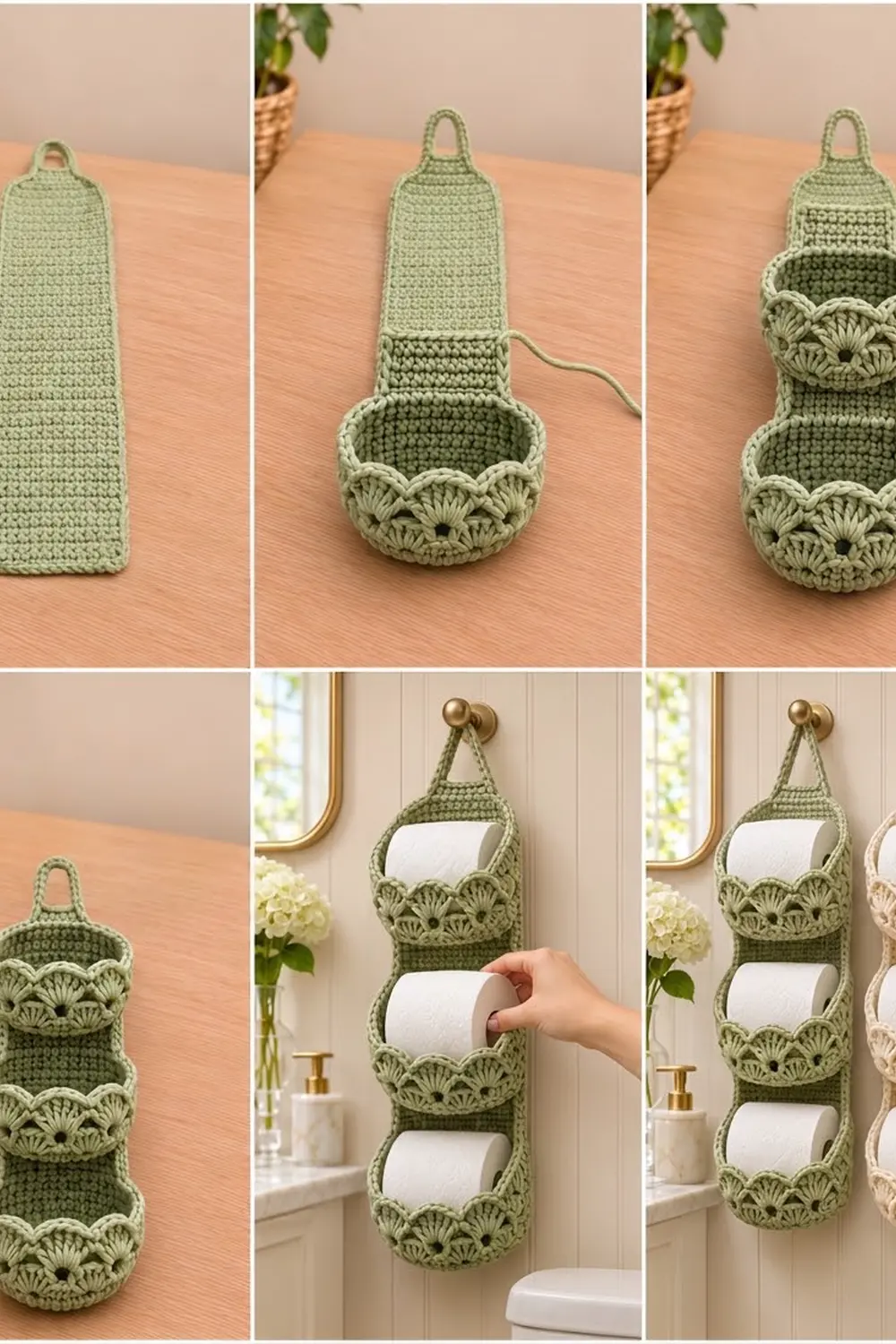
This hanging holder stores three spare rolls in a narrow strip of wall space. A plain single crochet back panel carries three oval pockets. Each pocket has a band of open fans and a scalloped rim. Each roll lies on its side in its pocket and sits a little higher than the rim, so you can lift it straight out.
The sample is sage green, which suits white tile, wood, and brass hardware. A soft cream version looks just as good. The pattern uses one color, so any solid shade works.
This pattern uses US crochet terms. The finished holder measures about 6 in (15.2 cm) wide and 25 in (63.5 cm) tall, plus a hanging loop about 3 in (7.6 cm) tall. Total height is about 28 in (71.1 cm). Each pocket is about 6.5 in (16.5 cm) wide and 3.75 in (9.5 cm) tall.
You work a flat back panel in rows and add a two-round border. Next, you make three oval pocket baskets in the round and a short strap. Finally, you sew each pocket flat against the panel and attach the strap at the top.
Finished Size and Construction
- Finished size: 6 in x 25 in (15.2 cm x 63.5 cm) panel, plus a 3 in (7.6 cm) loop
- Skill level: Intermediate
- Terminology: US
- Yarn weight: Bulky (#5) cotton or cotton blend
- Hook: 6.0 mm (US J-10)
- Number of pieces: 5 (1 back panel, 3 pockets, 1 strap)
- Layout: 3 pockets stacked vertically, 8 in (20.3 cm) apart from base to base
- Pocket size: 6.5 in (16.5 cm) wide, 2.75 in (7.0 cm) deep, 3.75 in (9.5 cm) tall
- Panel size before border: 5 in x 24 in (12.7 cm x 61.0 cm)
- Border depth: 0.5 in (1.3 cm) on every side
Materials
Choose a firm, smooth cotton or cotton-blend yarn. It needs to hold its shape when the pockets are full. Avoid very soft acrylics, which let the pocket walls sag. Chunky cotton cord-style yarns work well and show the fan texture clearly.
- Sage green, bulky (#5): 250 g, about 275 m (approx. 1.1 m per gram)
- Back panel and border: about 55 g
- Each pocket: about 45 g (135 g for three)
- Strap: about 10 g
- Margin: about 50 g
Tools:
– 6.0 mm (US J-10) crochet hook
– Tapestry needle
– Stitch markers (at least 4)
– Locking pins or clips for assembly
– Measuring tape
– Scissors
– Spray bottle and blocking mats
Quantities include a margin for gauge differences and the gauge swatch.
Abbreviations (US Terms)
- ch – chain
- sl st – slip stitch
- sc – single crochet
- dc – double crochet
- inc – 2 sc in the same stitch
- BLO – back loop only
- sp – space
- st(s) – stitch(es)
- rnd – round
Special stitches:
– V-stitch (V-st): (dc, ch 2, dc) in the same stitch. The ch-2 opening becomes the small hole at the base of each fan.
– Fan: 7 dc in the same stitch or space.
– Reverse sc (crab stitch): Working from left to right (right-handed), insert the hook into the next stitch to the right, yarn over, pull up a loop, yarn over, and pull through both loops.
Gauge and Checkpoints
Gauge: 12 sc x 13 rows = 4 in (10.2 cm) in sc worked flat.
Make one pocket before you start the panel. If the pocket matches the checkpoints below, the panel and border will match too.
Checkpoints:
– Pocket base after Rnd 4: about 6.5 in x 2.75 in (16.5 cm x 7.0 cm), lying flat
– Pocket wall after Rnd 9: about 1.5 in (3.8 cm) tall
– Finished pocket after Rnd 13: about 3.75 in (9.5 cm) tall, including the base edge
– Back panel after Row 13: 5 in (12.7 cm) wide, 4 in (10.2 cm) tall
– Back panel after Row 78: 5 in x 24 in (12.7 cm x 61.0 cm)
If your work is too big: go down 0.5 mm in hook size. Loose pockets will slump when filled.
If your work is too small: go up 0.5 mm in hook size. Check whether a roll still fits loosely in the pocket.
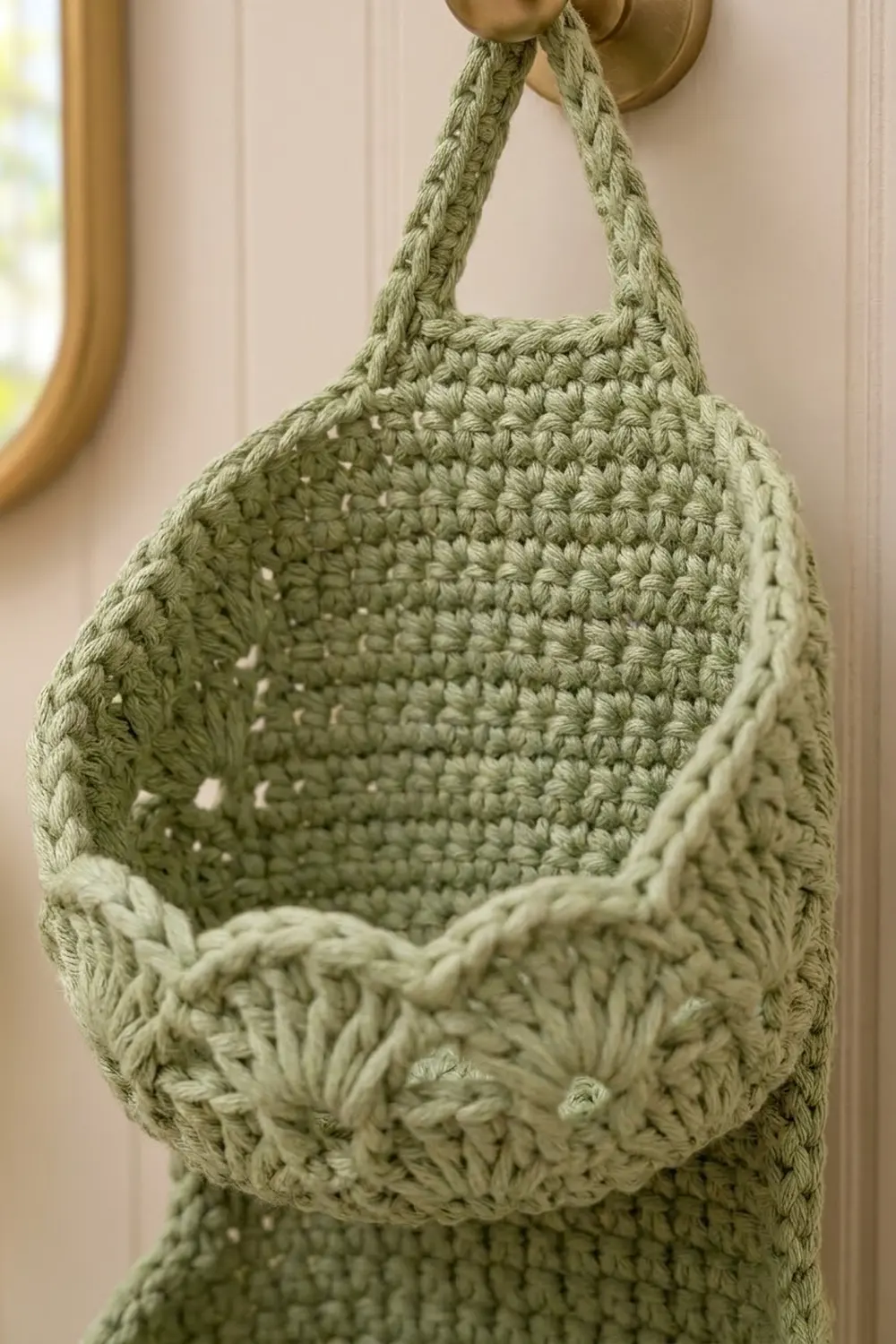
Pocket (Make 3)
The pockets are worked in continuous rounds. Mark the first stitch of each round with a stitch marker.
Base
Ch 13.
Rnd 1: 2 sc in 2nd ch from hook, sc in next 10 ch, 4 sc in last ch. Turn to work along the other side of the foundation chain: sc in next 10 ch, 2 sc in the first ch (the same ch that holds the first 2 sc). (28 sts)
Each end of the oval now has 4 end stitches, with 10 straight stitches along each side.
Rnd 2: Sc in next 10 sts, inc in each of next 4 sts twice. (36 sts)
Start the round at the beginning of a straight side. Keep this order for every base round.
Rnd 3: Sc in next 10 sts, (sc, inc) 4 times twice. (44 sts)
Rnd 4: Sc in next 10 sts, (sc in next 2 sts, inc) 4 times twice. (52 sts)
Checkpoint: the base lies flat and measures about 6.5 in x 2.75 in (16.5 cm x 7.0 cm). Each straight side has 10 stitches and each curved end has 16 (10 + 16 + 10 + 16 = 52).
Wall
Rnd 5: Sc in BLO of each st around. (52 sts) This makes the ridge where the wall turns up from the base.
Rnds 6–9: Sc in each st around. (52 sts)
At the end of Rnd 9, sl st into the next st to finish the spiral smoothly. The wall is about 1.5 in (3.8 cm) tall.
Fan Band
The fan band uses a 4-stitch repeat. 52 ÷ 4 = 13 repeats, so it fits exactly with no leftover stitches.
Rnd 10 (V-st round): Ch 1. Sc in next st, skip 1 st, V-st in next st, skip 1 st 13 times. Join with sl st to the first sc. (13 V-sts, 13 sc)
Rnd 11 (lower fans): Sl st into the first ch-2 sp. Fan (7 dc) in the ch-2 sp of the V-st, sc in next sc 13 times. Join with sl st to the first dc. (13 fans, 13 sc; 104 sts)
Each fan opens up from the hole left by the V-st below. This makes the fans with a dark center visible in the photo.
Rnd 12 (offset scallop fans): Sl st across to the 4th (center) dc of the first fan. Ch 1. Sc in center dc of fan, fan (7 dc) in next sc between fans 13 times. Join with sl st to the first sc. (13 fans, 13 sc; 104 sts)
The top fans now sit between the lower fans, so the band has two staggered rows of fans.
Rnd 13 (rim trim, conversion round): Ch 1. Sc in sc, sc in next 3 dc, 3 sc in center dc, sc in next 3 dc 13 times. Join with sl st to the first sc.
(104 sts worked 1-per-stitch + 26 extra = 130 sts)
The 3-sc groups at each fan peak give the rim its rounded scallop. Fasten off and leave a 24 in (61.0 cm) tail for sewing.
Checkpoint: the pocket is about 3.75 in (9.5 cm) tall from the base ridge to the scallop tips.
Back Panel
Ch 16.
Row 1: Sc in 2nd ch from hook and in each ch across. Turn. (15 sts)
Rows 2–78: Ch 1, sc in each st across. Turn. (15 sts)
Checkpoint after Row 13: 5 in (12.7 cm) wide and 4 in (10.2 cm) tall. After Row 78 the panel measures 5 in x 24 in (12.7 cm x 61.0 cm). Do not fasten off; continue to the border.
Strap
Ch 6.
Row 1: Sc in 2nd ch from hook and in each ch across. Turn. (5 sts)
Rows 2–30: Ch 1, sc in each st across. Turn. (5 sts)
The strap measures about 1.75 in x 9.25 in (4.4 cm x 23.5 cm). Fasten off and leave an 18 in (45.7 cm) tail.
Make All Pieces
- Pockets: 3, sage green, about 45 g each
- Back panel: 1, sage green, about 55 g including the border
- Strap: 1, sage green, about 10 g
Layout (front view, top to bottom):
        [ STRAP LOOP ]
   +----------------------+   <- top edge (Row 78)
   |                      |
   |    [ POCKET 3 ]      |   base at Row 53
   |                      |
   |    [ POCKET 2 ]      |   base at Row 27
   |                      |
   |    [ POCKET 1 ]      |   base at Row 1
   +----------------------+   <- bottom edge
The bases are 26 rows apart, which is 8 in (20.3 cm). Each pocket is 3.75 in (9.5 cm) tall. That leaves 4.25 in (10.8 cm) of clear panel above each rim, enough for a 4.5 in (11.4 cm) roll to sit in the pocket and lift out.
Joining
Finish the border (next section) before joining. You sew each pocket to the bordered panel.
Mark the pocket back: Flatten the pocket base. Choose one straight side as the back. Its 10 straight stitches in Rnd 5 form the center. Count 4 more stitches into each curved end, giving 18 back stitches. Place a marker at the first and 18th of these stitches.
Why 18 stitches: the bordered panel is 6 in (15.2 cm) wide. At 3 sts per inch, 18 pocket stitches also span 6 in. That gives exactly 1 pocket stitch for each stitch-width of panel, so the pocket lies flat without puckering or gaps.
Sew the base line: Pin the Rnd 5 ridge across the panel at the correct row. The ridge sits along Row 1 for Pocket 1, Row 27 for Pocket 2, and Row 53 for Pocket 3. Whipstitch the 18 marked back stitches straight across, one pocket stitch to each panel stitch-width, edge to edge.
Sew the sides: At each marked stitch, sew straight up the wall through Rnds 6–9 into the panel border. Then catch the side of the fan band at Rnds 10–13 into the border. That is 9 rounds on each side.
Tack the back fans: The back fans rest against the panel. Tack each fan peak at the back of Rnd 13 to the panel with 2 small stitches. This keeps the rim from tipping forward when the pocket is empty.
Tension: Sew snugly, but do not pull so tight that the panel puckers. Every 2 in (5.1 cm), check that the panel still lies flat.
Attach the strap: Fold the strap into a U. Sew 5 rows at each end flat to the back of the panel, just below the top border, with the strap’s 5 stitches centered across the panel. That leaves 20 rows free, about 6.25 in (15.9 cm), which arches into a loop about 3 in (7.6 cm) tall.
Size checkpoint: The assembled holder measures about 6 in x 25 in (15.2 cm x 63.5 cm) without the loop, and about 28 in (71.1 cm) with it.
Border
The border goes around the back panel only. It is two rounds, and the depth is 0.5 in (1.3 cm) on every side.
Border gauge: sc along row ends at 12 sc per 13 rows. This matches the 3 sts per inch width gauge, so the long edges neither stretch nor ruffle.
Rnd 1: Continue from the last stitch of Row 78. Ch 1, 3 sc in the first st (corner).
– Top edge: sc in next 13 sts, 3 sc in last st (corner).
– Long side: work 72 sc down the row ends. Work 12 sc over every 13 rows, skipping 1 row end in each group of 13.
– Bottom edge: working into the foundation chain, 3 sc in the first ch (corner), sc in next 13 ch, 3 sc in last ch (corner).
– Second long side: work 72 sc up the row ends, as before.
Join with sl st to the first sc.
Count: 13 + 13 + 72 + 72 + (4 corners x 3) = 182 sts
Why the math works: each short edge has 15 row stitches: 13 between the corners plus 2 corner stitches. Each corner stitch gets 3 sc, so the corners turn flat. On the long sides, 78 rows ÷ 13 = 6 groups, and 6 x 12 = 72 sc. That matches the 24 in (61.0 cm) length at 3 sts per inch.
Rnd 2: Ch 1, reverse sc in each st around. Join with sl st and fasten off. (182 sts)
No corner increases are needed in this round. Crab stitch twists sideways and turns the corners on its own. It adds a firm, rope-like edge that matches the pocket rims.
The panel now measures 6 in x 25 in (15.2 cm x 63.5 cm).
Final Blocking
- Weave in all ends, running each one through at least 2 in (5.1 cm) of stitches.
- Lay the holder face up on blocking mats.
- Spray it evenly until damp, but not soaked.
- Pin the panel to 6 in x 25 in (15.2 cm x 63.5 cm). Keep the long edges straight.
- Stuff each pocket with a toilet roll wrapped in a plastic bag, or a rolled towel, so the oval dries in shape.
- Lift each fan peak gently and pin the scallops evenly.
- Leave it to dry completely, 24–48 hours for cotton.
- Remove the pins and hang the holder to check that it hangs straight.
Final Quality-Control Checklist
- Each pocket has 52 sts in the wall, 13 fans in each fan round, and 130 sts in the rim
- All three pockets match in height, about 3.75 in (9.5 cm)
- The panel measures 6 in x 25 in (15.2 cm x 63.5 cm) with the border
- The pocket bases sit 8 in (20.3 cm) apart and are level across the panel
- The 18 back stitches of each pocket are sewn edge to edge with no gaps
- The strap is centered and the loop is about 3 in (7.6 cm) tall
- The crab stitch border is even, with no puckering at the corners
- A standard roll sits in each pocket and lifts out easily
Troubleshooting
The pocket base cups instead of lying flat: Check that you made 8 increases per round, all in the curved ends. Tight tension can also cause cupping, so try a larger hook for the base only.
The base ruffles: You probably added extra increases. Recount against 28, 36, 44, and 52.
The fans lean or twist: Check that Rnd 10 used the full 4-stitch repeat with 13 V-sts. Join each fan round with a sl st rather than working in a spiral.
The pocket sags forward when empty: Tack the back fan peaks more firmly, or use a stiffer cotton.
The long border edges wave: You used too many stitches. Rework with exactly 72 sc per long side.
The panel puckers at the pockets: The pocket was sewn too tightly. Redo it with looser whipstitches, one per stitch.
The holder tilts on the hook: The strap is off-center. Re-sew the strap ends so they sit an equal distance from each side edge.
Care
Hand wash in cool water with mild soap, press out the water in a towel, and dry flat with the pockets stuffed so they keep their shape. Do not tumble dry, because the pockets may lose their shape.
Final Notes
The measurements build on each other:
– Gauge is 12 sc per 4 in (10.2 cm), or 3 sts per inch.
– Each pocket base is 52 sts around, 6.5 in (16.5 cm) wide.
– The 52-stitch wall takes 13 fan repeats of 4 sts, and the rim trim brings it to 130 sts.
– The 15-stitch panel is 5 in (12.7 cm) wide. Its two-round border adds 0.5 in (1.3 cm) per side, for 6 in x 25 in (15.2 cm x 63.5 cm).
– That 6 in width matches the 18 back stitches sewn from each pocket, so every pocket sits flat.
– The bases are spaced 26 rows (8 in, 20.3 cm) apart.
Check your measurements at each of these steps and the finished holder will hang straight and hold three rolls neatly.
Happy crocheting!