

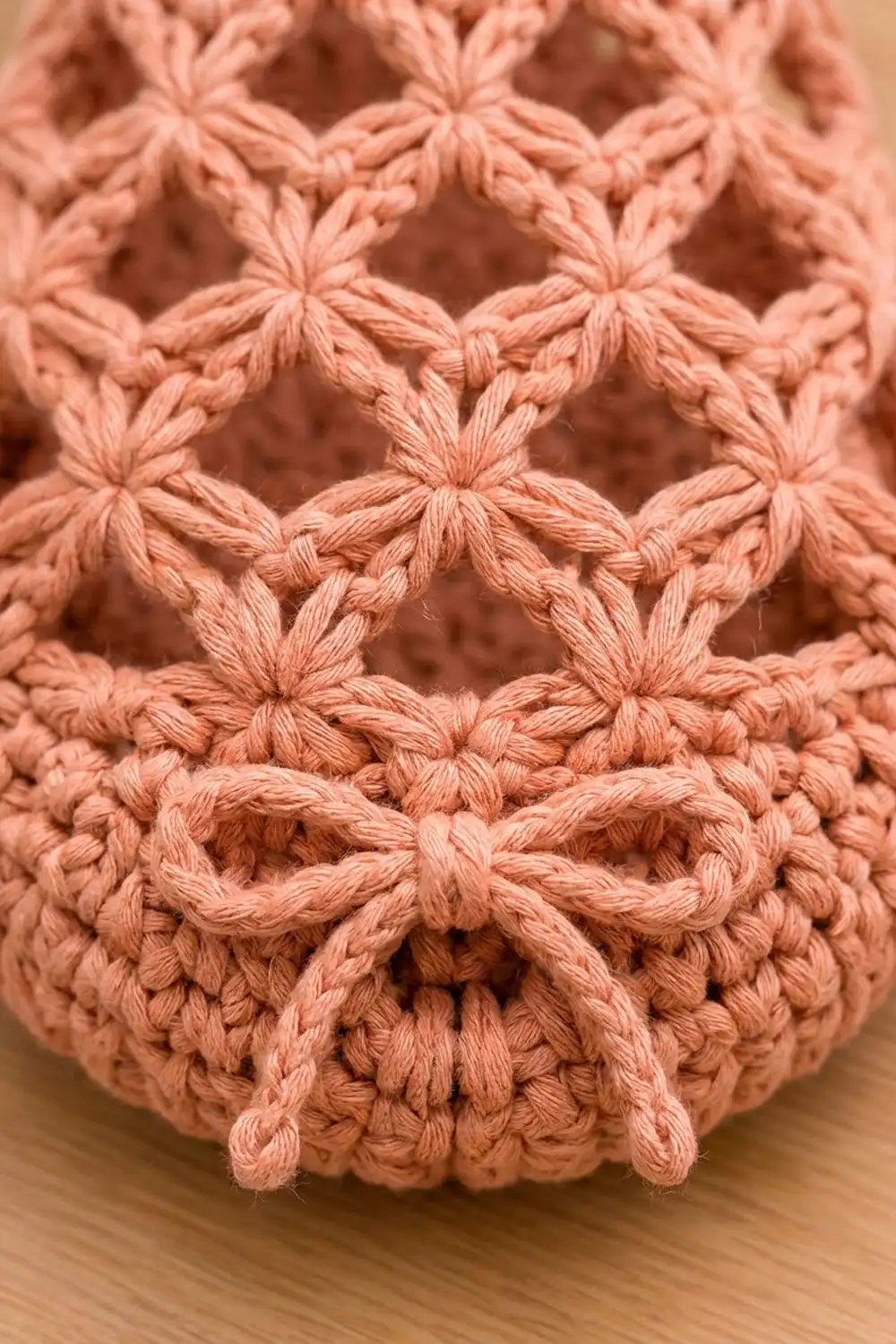
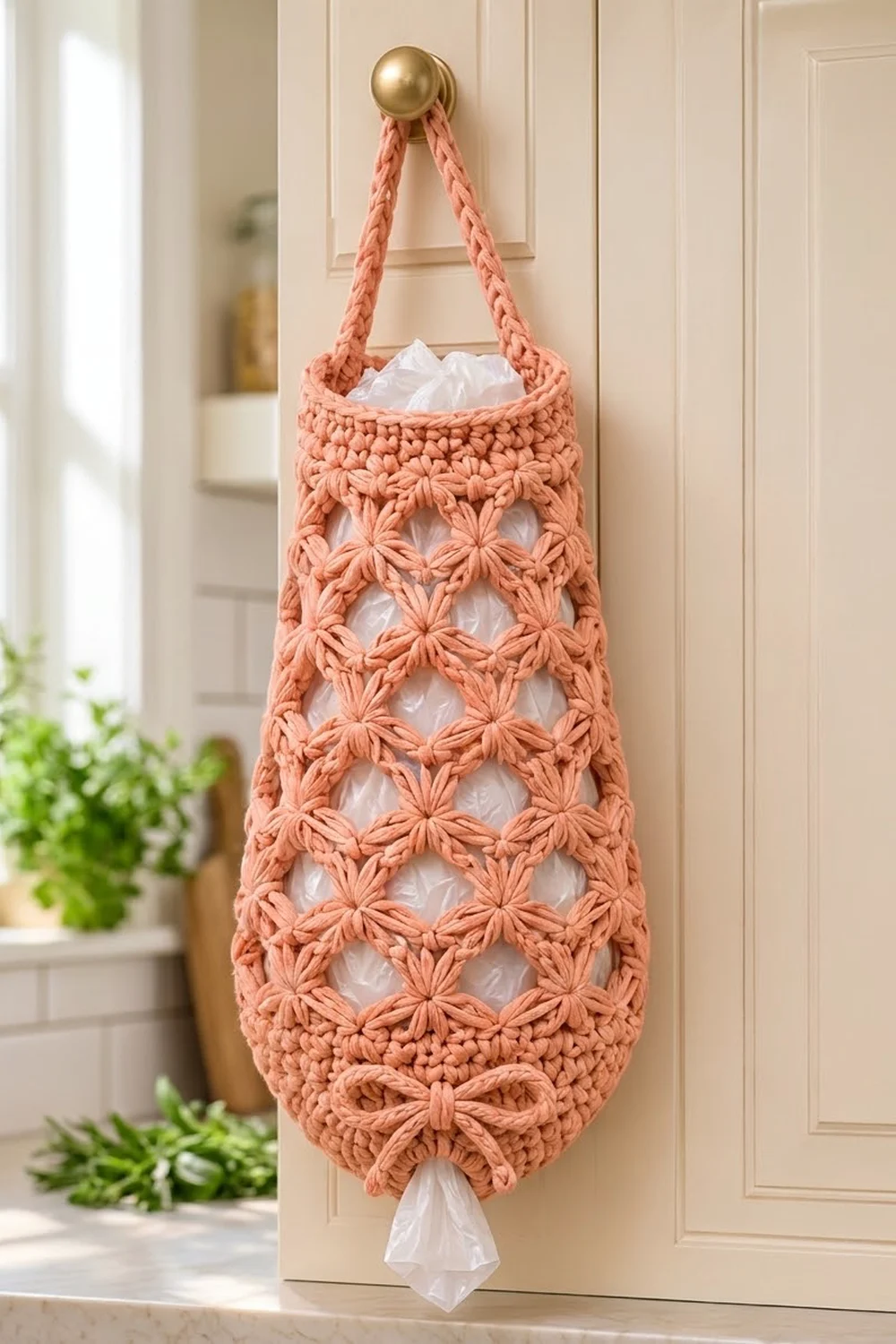
This plastic bag holder is a tall teardrop with an open starburst lattice. You stuff bags in through the top and pull them out one at a time from a small hole at the bottom. The lattice lets you see how many bags are left, and the solid base keeps them from slipping out too fast.
The sample is worked in a warm coral bulky cotton-look yarn. A soft aqua works just as well. A short strap hangs it from a cabinet knob or hook, and a small cord bow on the front adds a finishing touch.
The pattern uses US crochet terms. The finished holder measures about 9 in (22.9 cm) wide at its widest point when laid flat and 14 in (35.6 cm) tall, plus a hanging loop of about 4.5 in (11.4 cm).
The holder is one piece worked in the round from the bottom up. You start at the dispensing hole, increase to make a cupped solid base, work alternating net and starburst rounds for the lattice, then finish with a solid band at the top. The strap and bow are made separately and sewn on.
Finished Size and Construction
- Finished size (laid flat): 9 in (22.9 cm) wide at the widest point, 14 in (35.6 cm) tall, plus a 4.5 in (11.4 cm) loop
- Skill level: Easy-intermediate
- Terminology: US crochet terms
- Yarn weight: Bulky (#5)
- Hook: 6 mm (US J-10)
- Number of pieces: 1 main body, plus 1 strap and 1 bow sewn on
- Layout: Single seamless tube, worked in joined rounds
- Bottom hole: about 1.25 in (3.2 cm) across
- Base width (flat, after Rnd 9): 8 in (20.3 cm)
- Size before border (after Rnd 22): 12.75 in (32.4 cm) tall
- Border (top band) depth: 1.25 in (3.2 cm), 4 rounds
- Top opening width (flat): 6.7 in (17.0 cm)
Materials
Yarn: Use a bulky (#5) cotton or cotton-blend yarn with a smooth, plied, rounded twist. Cotton holds the shape of the lattice well and doesn’t stretch out much when the holder is full. Stay away from very fuzzy or loosely spun yarns, because they hide the starburst clusters.
- Coral (main color): 150 g, about 210 m (230 yd)
- Optional aqua version: the same amount, 150 g, about 210 m (230 yd)
The quantities include a margin of about 15 percent for your swatch, the strap, the bow, and differences in tension.
Tools:
- 6 mm (US J-10) crochet hook
- Yarn needle with a large eye
- 1 stitch marker
- Scissors
- Measuring tape
- Rust-proof pins and a spray bottle for blocking
Abbreviations (US Terms)
- ch = chain
- sl st = slip stitch
- sc = single crochet
- dc = double crochet
- inc = 2 sc in the same stitch
- sk = skip
- sp = space
- st(s) = stitch(es)
- Rnd = round
Special stitches:
- 3-dc cluster (cl): [yo, insert hook in the space, yo, pull up a loop, yo, pull through 2 loops] 3 times, yo, pull through all 4 loops on hook.
- Beginning cluster (beg cl): ch 2, then [yo, insert, pull up a loop, yo, pull through 2] 2 times, yo, pull through all 3 loops on hook.
- Star: (cl, ch 3, cl) all in the same loop. The ch-3 between the two clusters is the star center.
Gauge and Checkpoints
Gauge: 12 sc x 13 rounds = 4 in (10.2 cm) in sc worked in the round.
Test piece first: Before you commit to the whole holder, work Rnds 1–7 of the base. That disk is your gauge test. Lay it flat and measure.
- After Rnd 7: the base should be about 5.5 in (14.0 cm) across and cup up slightly at the edges.
- After Rnd 9: flattened, the base measures 8 in (20.3 cm) wide.
- After Rnd 15: about 7.75 in (19.7 cm) from the bottom fold to the top edge, flattened.
- After Rnd 22: 12.75 in (32.4 cm) tall.
- After Rnd 26: 14 in (35.6 cm) tall.
If your disk is too big (over 5.75 in / 14.6 cm), go down one hook size. If it’s too small (under 5.25 in / 13.3 cm), go up one hook size. If the disk ruffles, your tension is too loose for the yarn, so go down a size. If it cups a lot more than slightly, go up a size.
Pattern
Work in joined rounds with the right side facing you the whole time. Don’t turn. Join each round with a sl st to the first stitch. The ch 1 at the start of sc rounds doesn’t count as a stitch.
Solid Base
Foundation: Ch 12 and join with a sl st to the first ch to form a ring. Don’t twist it. This ring is the dispensing hole.
Rnd 1: Ch 1, sc in each ch around, join. (12 sc)
Rnd 2: Ch 1, *sc in next st, inc in next st; rep from * 5 more times, join. (18 sc)
Rnd 3: Ch 1, *sc in next 2 sts, inc; rep from * 5 more times, join. (24 sc)
Rnd 4: Ch 1, *sc in next 3 sts, inc; rep from * 5 more times, join. (30 sc)
Rnd 5: Ch 1, *sc in next 4 sts, inc; rep from * 5 more times, join. (36 sc)
Rnd 6: Ch 1, *sc in next 5 sts, inc; rep from * 5 more times, join. (42 sc)
Rnd 7: Ch 1, *sc in next 6 sts, inc; rep from * 5 more times, join. (48 sc)
Checkpoint: about 5.5 in (14.0 cm) across, with a gentle cup.
Rnds 8–9: Ch 1, sc in each st around, join. (48 sc)
These two even rounds turn the edge upward and form the bowl of the base. Place your marker in the first stitch of Rnd 9. This marks the back of the holder.
Checkpoint: flattened, 8 in (20.3 cm) wide.
Starburst Lattice
The lattice alternates net rounds (single crochets joined by chain loops) and star rounds (a star worked into each loop). Every net round anchors its single crochets in the star centers below. Each new loop spans the gap between two stars, so the next row of stars sits halfway between the last. That offset is what makes the diamond openings.
Every round in this section has 8 repeats. The shaping comes only from the chain loop length: 6, 7, 8, 8, 7, 6, then 5. This widens the holder into the teardrop and then draws it back in at the top.
Rnd 10 (net): Ch 1, sc in first st, *ch 6, sk next 5 sts, sc in next st; rep from * 6 more times, ch 6, sk last 5 sts, join to first sc. (8 sc, 8 ch-6 loops)
Check: 8 repeats x 6 sts = 48. All the base stitches are used up.
Rnd 11 (star): Sl st into the first ch-6 loop. Work (beg cl, ch 3, cl) in that loop for the first star. *Ch 3, star in next loop; rep from * 6 more times, ch 3, join to top of beg cl. (8 stars = 16 cl, 8 star-center ch-3 sps, 8 between ch-3 sps)
Rnd 12 (net): Sl st into the next ch-3 sp (the first star center). Ch 1, sc in same sp, *ch 7, sk (cl, ch-3 sp, cl), sc in next star center; rep from * 6 more times, ch 7, join to first sc. (8 sc, 8 ch-7 loops)
Rnd 13 (star): Repeat Rnd 11, working each star into a ch-7 loop. (8 stars)
Rnd 14 (net): Repeat Rnd 12, but ch 8 for each loop. (8 sc, 8 ch-8 loops)
Rnd 15 (star): Repeat Rnd 11. (8 stars)
Checkpoint: about 7.75 in (19.7 cm) tall and about 9 in (22.9 cm) wide, flattened and lightly stretched.
Rnd 16 (net): Repeat Rnd 12 with ch 8 loops. (8 sc, 8 ch-8 loops)
Rnd 17 (star): Repeat Rnd 11. (8 stars)
Rnd 18 (net): Repeat Rnd 12 with ch 7 loops. (8 sc, 8 ch-7 loops)
Rnd 19 (star): Repeat Rnd 11. (8 stars)
Rnd 20 (net): Repeat Rnd 12 with ch 6 loops. (8 sc, 8 ch-6 loops)
Rnd 21 (star): Repeat Rnd 11. (8 stars)
Rnd 22 (net): Repeat Rnd 12 with ch 5 loops. (8 sc, 8 ch-5 loops)
Checkpoint: 12.75 in (32.4 cm) tall, flattened. The top edge now draws in noticeably. That’s the teardrop shoulder.
Border (Top Band)
The top band works as the border for this piece. It’s solid single crochet, which gives the opening a firm rim and somewhere to anchor the strap.
Border gauge: the same as the base, 3 sc per inch (12 sc = 4 in / 10.2 cm) and 13 rounds = 4 in (10.2 cm).
Rnd 23 (conversion): Ch 1, sc in first sc, 4 sc in next ch-5 loop, *sc in next sc, 4 sc in next ch-5 loop; rep from * 6 more times, join. (8 sc worked 1-per-existing-sc + 32 sc worked into the loops = 40 sc)
Rnds 24–26: Ch 1, sc in each st around, join. (40 sc)
Fasten off and weave in the end.
Counts per side: A tube has no corners. When the holder lies flat, it folds into a front and a back of 20 sc each (4 repeats x 5 sts per side). The fold lines sit between stitches, so no stitch is shared or counted twice.
Why the math works: 20 sc ÷ 3 sc per inch = 6.7 in (17.0 cm) of flat top width. Four rounds at 13 rounds per 4 in give 1.25 in (3.2 cm) of depth. Then 12.75 in (32.4 cm) + 1.25 in (3.2 cm) = 14 in (35.6 cm) of finished height. Because each ch-5 loop gets only 4 sc instead of 5, the rim is slightly narrower than the last net round. That gentle cinch keeps the bags inside.
Hanging Strap
Foundation: Ch 34.
Row 1: Sc in 2nd ch from hook and in each ch across, turn. (33 sc)
Row 2: Ch 1, sc in each st across. (33 sc)
Fasten off and leave a 12 in (30.5 cm) tail. The strap is 11 in (27.9 cm) long and about 0.6 in (1.5 cm) wide.
Center the strap over the marker at the back of the band. Overlap each end 0.75 in (1.9 cm) onto the inside of the band, with the two ends 1.5 in (3.8 cm) apart. Whipstitch each end on securely through both band layers it touches. Don’t go through to the front. The loop stands about 4.5 in (11.4 cm) tall.
Bow
Foundation: Ch 61.
Row 1: Sl st in the back bump of the 2nd ch from hook and each ch across. (60 sl st)
Fasten off. The cord measures about 18 in (45.7 cm). Tie it into a bow with loops of about 1.5 in (3.8 cm) and tails of about 2 in (5.1 cm). Sew the knot to the front center, directly opposite the marker, right on Rnd 10 where the solid base meets the lattice. Tack each bow loop down at its tip so it stays flat when you pull out bags.
Final Blocking
- Lightly spray the holder until it’s damp but not wet.
- Stuff it loosely with a towel or plastic bags so it takes on its full teardrop shape.
- Ease each star so the two clusters fan out and the diamonds open evenly.
- Check the flat width at the widest round, about 9 in (22.9 cm), and the overall height, 14 in (35.6 cm).
- Press the top band so it sits round and straight.
- Hang it or lay it flat until completely dry.
- Remove the stuffing and check that the strap and bow are still centered.
Final Quality-Control Checklist
- The bottom hole is round, about 1.25 in (3.2 cm), and the Rnd 1 stitches are even.
- Base rounds have the right counts: 12, 18, 24, 30, 36, 42, 48, 48, 48.
- Every net round has 8 sc and 8 loops.
- Every star round has 8 stars (16 clusters).
- The diamonds are offset round to round and don’t stack into columns.
- The top band has 40 sc in all four rounds.
- The strap is centered at the back and sewn through the band only.
- The bow is centered at the front on Rnd 10.
- All ends are woven in securely.
Troubleshooting
The lattice stacks into straight columns: You worked a net round’s sc into the between-star space instead of the star center. Rip back and anchor each sc in the ch-3 between the two clusters of one star.
The base ruffles: Your tension is too loose, or you added extra increases. Recount Rnds 2–7, which should increase by 6 each round, and go down a hook size if needed.
The base is flat, not cupped: You skipped Rnds 8–9, or your stitches are very loose. Those even rounds are what lift the edge.
The holder is too wide in the middle: Shorten the ch-8 loops in Rnds 14 and 16 to ch 7.
Bags fall out of the bottom: The hole is too large. Work Rnd 1 into the ring more tightly, or start with a ch 10 ring and add 2 extra increases in Rnd 2.
The top band flares: Work 4 sc per loop in Rnd 23 exactly, and check that every round has 40 sc.
Care
Hand wash in cool water with mild soap, gently press out the water, and dry flat or reshape while hanging. Avoid the dryer so the lattice keeps its shape.
Final Notes
The measurement chain is short. Rnd 7 gives a 5.5 in (14.0 cm) disk, Rnd 9 an 8 in (20.3 cm) base, and the lattice widens to 9 in (22.9 cm) and reaches 12.75 in (32.4 cm) at Rnd 22. The 40-stitch band then adds 1.25 in (3.2 cm) for a 14 in (35.6 cm) holder with a 6.7 in (17.0 cm) opening. If your disk checks out, everything after it follows. Make one in coral, another in aqua, and keep your bags tidy in every room.
Happy crocheting!