

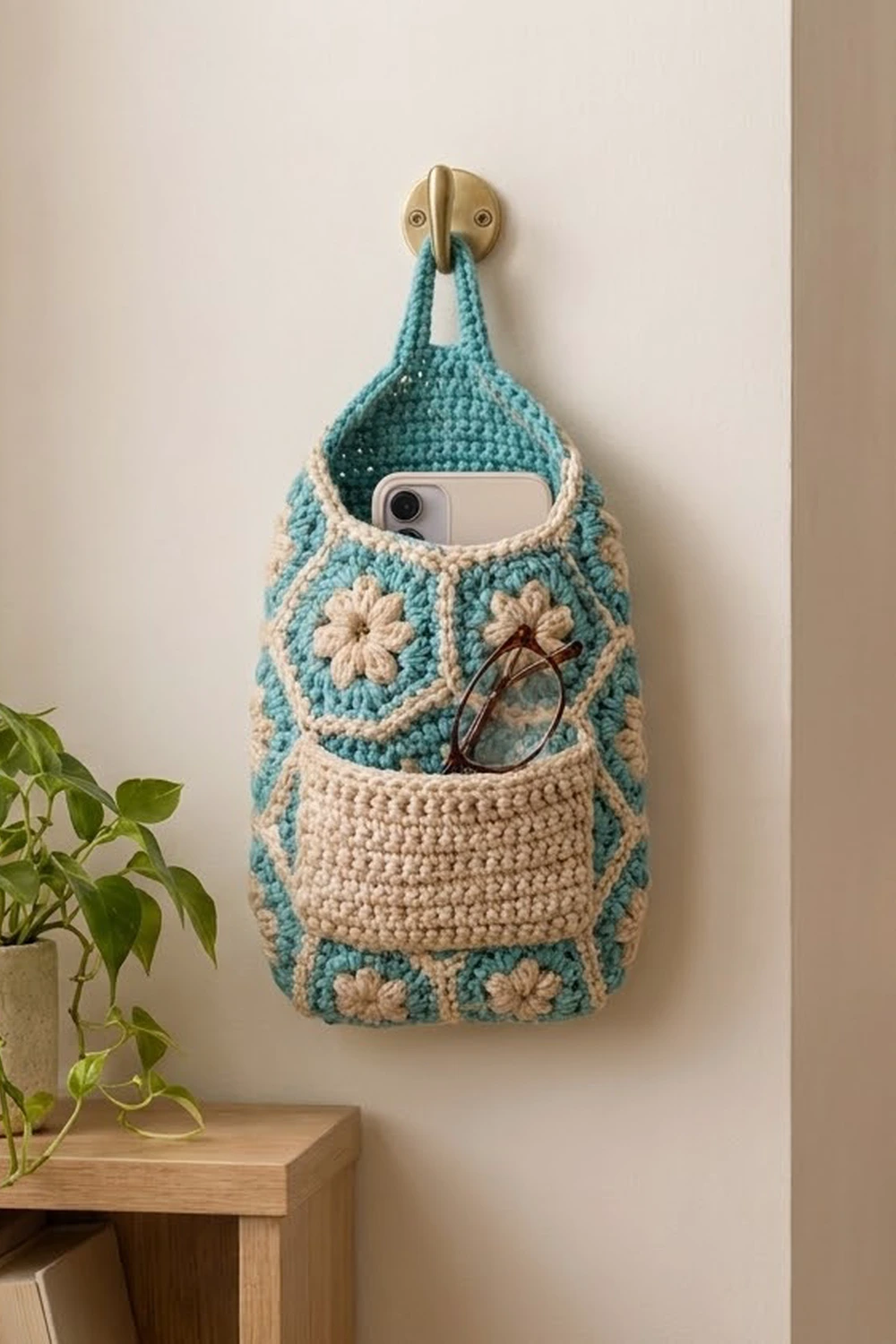
The Seaglass Honeycomb Wall Pocket is a soft hanging organizer made from small flower hexagons. Teal and warm beige alternate in every motif, so the front reads as a tidy honeycomb with a little cream flower inside each cell.
A solid beige pocket across the lower front holds glasses, pens, or a charging cable. The main compartment holds a phone, a remote, or a small notebook. A teal band finishes the top, and a tapered tab on the back ends in a sturdy loop for a wall hook or door knob.
This pattern uses US crochet terms. The finished pouch is about 9 in (22.9 cm) wide and 10 in (25.4 cm) tall at the front rim, or about 13.5 in (34.3 cm) tall including the tab and loop.
The pouch is built in simple modules. Make 14 hexagons and join them into two 7-hexagon panels. Seam the panels front to back, work the teal rim band and back tab, then sew on the pocket.
Finished Size and Construction
- Finished size: 9 in (22.9 cm) wide x 10 in (25.4 cm) tall body; 13.5 in (34.3 cm) tall with loop
- Skill level: Intermediate
- Terminology: US
- Yarn weight: Worsted (#4), cotton or cotton blend
- Hook: 5 mm (H-8)
- Number of pieces: 14 hexagons + 1 pocket (rim, tab, and loop are worked directly on the body)
- Layout: two panels, each a 2-3-2 honeycomb rosette (one center hexagon with six around it)
- Hexagon size: 3 in (7.6 cm) from flat side to flat side, 3.5 in (8.9 cm) from point to point, 1.75 in (4.4 cm) per side
- Panel size before rim: 9 in (22.9 cm) wide x 8.75 in (22.2 cm) tall
- Rim band depth: 1.3 in (3.3 cm)
Materials
Choose a smooth cotton or cotton-acrylic worsted. Cotton keeps the hexagon points crisp and stops the pouch from stretching under the weight of a phone.
- Color A, teal: 85 g, about 170 m (186 yd)
- Color B, warm beige: 95 g, about 190 m (208 yd)
These quantities include a margin of roughly 20% for gauge swatches and seaming.
Tools:
– 5 mm (H-8) crochet hook
– Tapestry needle
– Stitch markers (at least 4)
– Scissors
– Measuring tape
– Blocking mat and pins
– Spray bottle or steamer
Abbreviations (US Terms)
- ch – chain
- sl st – slip stitch
- sc – single crochet
- dc – double crochet
- sc2tog – single crochet 2 together
- sp – space
- st(s) – stitch(es)
- RS / WS – right side / wrong side
Puff stitch (puff): (Yarn over, insert hook in st, yarn over, pull up a loop to about 0.5 in (1.3 cm)) 3 times, yarn over and draw through all 7 loops on hook.
Beginning puff (beg puff): Ch 1 and pull the loop up to 0.5 in (1.3 cm). Then (yarn over, insert hook in same st, yarn over, pull up a loop) 2 times, yarn over and draw through all 5 loops on hook.
Gauge and Checkpoints
Body gauge: 16 sc x 18 rows = 4 in (10.2 cm), worked in sc rows. That is 4 sc per inch (2.5 cm), which gives 7 sc along each 1.75 in (4.4 cm) hexagon side.
Make one hexagon first and measure it at each stage:
- After Round 1: 1.25 in (3.2 cm) across
- After Round 2: 1.75 in (4.4 cm) across
- After Round 3: 2.5 in (6.4 cm) from flat side to flat side
- After Round 4: 3 in (7.6 cm) from flat side to flat side, 1.75 in (4.4 cm) per side
If your hexagon is larger than 3.1 in (7.9 cm), go down half a hook size. If it is smaller than 2.9 in (7.4 cm), go up half a size. An error of 0.1 in (0.3 cm) per hexagon adds up to 0.3 in (0.8 cm) across each panel, so it’s worth getting right.
Hexagon (Make 14)
Work each hexagon in joined rounds with the RS facing throughout.
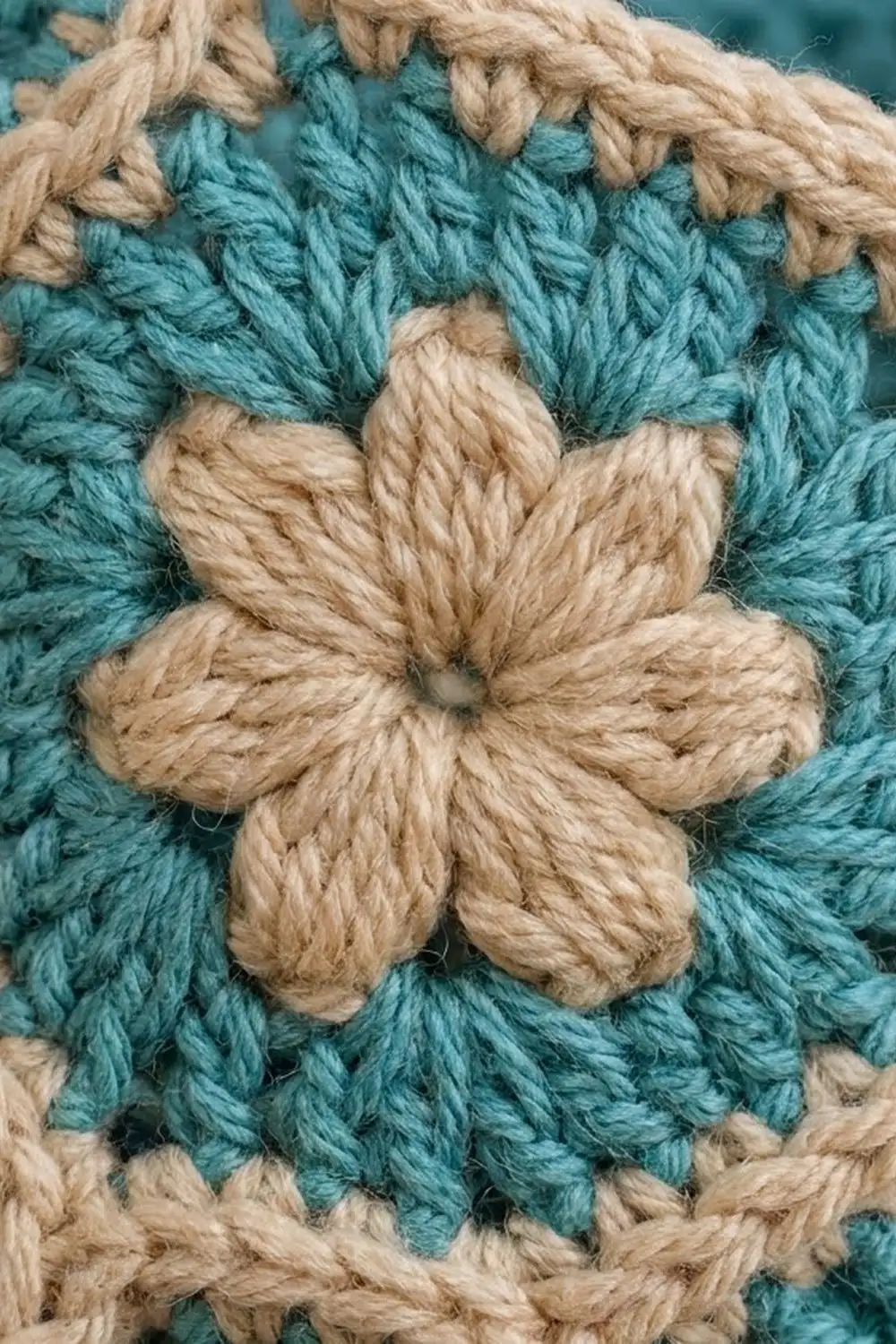
Round 1 (Color B): Make a magic ring. Ch 2 (does not count as a st), 12 dc in ring. Pull the ring closed and sl st to the first dc to join. (12 dc)
Round 2 (Color B): Beg puff in same st as join, ch 2, skip next st, puff in next st, ch 2, skip next st; repeat from * to * 4 more times. Sl st to top of beg puff. Fasten off. (6 puffs, 6 ch-2 sps)
The six puffs are the flower petals.
Round 3 (Color A): Join teal in any ch-2 sp. Ch 3 (counts as dc), (dc, ch 2, 2 dc) in same sp, dc in top of next puff, (2 dc, ch 2, 2 dc) in next ch-2 sp, dc in top of next puff; repeat from * to * 4 more times. Sl st to top of beginning ch-3. Fasten off. (30 dc, 6 ch-2 corner sps; 5 dc per side between corners)
Round 4 (Color B): Join beige in any ch-2 corner sp. Ch 1, (sc, ch 1, sc) in same sp, sc in each of next 5 dc, (sc, ch 1, sc) in next ch-2 sp, sc in each of next 5 dc; repeat from * to * 4 more times. Sl st to first sc. Fasten off. On 7 of the 14 hexagons, leave a 12 in (30.5 cm) tail for joining. (42 sc, 6 ch-1 corner sps; 7 sc per side)
Each side’s 7 sc include the 2 sc next to its corner ch-1 sps, one at each end. The ch-1 sps are not counted as sts.
Weave in all other ends now. Lightly steam each hexagon flat to 3 in (7.6 cm) before joining.
Make All Pieces
- Hexagons: 14 total (7 per panel). Each uses Color B for Rounds 1, 2, and 4 and Color A for Round 3.
- Pocket: 1 in Color B (instructions below).
Lay out each panel with the hexagon points facing up (H = hexagon, C = center):
   H   H
 H   C   H
   H   H
Label the hexagons by position: top-left (TL), top-right (TR), middle-left (ML), center (C), middle-right (MR), bottom-left (BL), bottom-right (BR).
Joining
Panels: Place the hexagons RS up. With a beige tail and the tapestry needle, whipstitch through the back (outer) loops only of matching sc. For each seam, work 1 stitch in the corner ch-1 sp, 1 stitch in each of the 7 matching sc pairs, and 1 stitch in the next corner ch-1 sp. Every shared side matches 7 sc to 7 sc, so no easing is needed.
First join C to each of its six neighbors (6 seams). Then join each outer hexagon to the next one around the ring (6 seams). That makes 12 seams and 84 matched sc pairs per panel.
Keep the whipstitch snug but not tight, so the joined edges lie flat without puckering. Checkpoint: each panel measures 9 in (22.9 cm) across the middle row and 8.75 in (22.2 cm) from the top points to the bottom points.
Front to back: Hold the two panels WS together with the edges matching. With beige, whipstitch through both loops of both layers. Start at the upper-right point of MR and work down these sides in order:
- MR: right and lower-right
- BR: right, lower-right, and lower-left
- BL: lower-right, lower-left, and left
- ML: lower-left and left
Finish at ML’s upper-left point.
That is 10 sides x 7 sc = 70 matched pairs, plus 1 stitch through each matched ch-1 sp along the way. The upper 8 sides of each panel stay open to form the mouth of the pouch.
Rim Band (Border)
The border gauge is the same as the body: 4 sc per inch (2.5 cm), and about 4.5 rounds per inch (2.5 cm).
Each panel’s open top edge runs along 8 hexagon sides, in this order:
- ML: upper-left
- TL: left, upper-left, and upper-right
- TR: upper-left, upper-right, and right
- MR: upper-right
Along this edge there are 4 outward points (on TL and TR) and 3 inward valleys where hexagons meet.
Round 1 (Color A): With the RS facing, join teal in the first sc of ML’s upper-left side on the front panel, just past the side seam. Ch 1. Along the front edge:
- Sc in each sc of each side.
- Work 1 sc in each outward-point ch-1 sp.
- Skip both ch-1 sps at each valley and at each side seam.
Work the back edge the same way. Sl st to first sc.
Each panel gives (8 sides x 7 sc) + 4 point sc = 56 + 4 = 60 sts. (120 sc total: 60 front + 60 back)
Round 2: Ch 1, sc in next 3 sts, sc2tog; repeat from * to * around. Sl st to first sc. (96 sc: 24 repeats of 3 sc + 1 dec; 48 per panel)
Round 3: Ch 1, sc in next 2 sts, sc2tog; repeat from * to * around. Sl st to first sc. (72 sc: 24 repeats of 2 sc + 1 dec; 36 per panel)
Rounds 4–6: Ch 1, sc in each st around. Sl st to first sc. Fasten off after Round 6. (72 sc)
Why the math works: The zigzag top of one panel is 8 sides x 1.75 in (4.4 cm) = 14 in (35.6 cm) of edge. Round 1 picks this up at 1 sc per sc, so 120 sts make 30 in (76.2 cm) of circumference. The panels are only 9 in (22.9 cm) wide, so the mouth should be 18 in (45.7 cm) around. At 4 sc per inch, 18 in (45.7 cm) x 4 = 72 sts.
Rounds 2 and 3 remove 48 sts evenly, which gathers the points and valleys into a smooth, firm curve. Both decrease rounds have 24 repeats starting at the side seam, so each panel keeps an equal share. In Round 6, sts 1–36 are on the front and sts 37–72 are on the back.
The finished band is 6 rounds, about 1.3 in (3.3 cm) deep.
Back Tab and Loop
Row 1 (Color A): With the RS of the back facing, skip the first 10 back sts (sts 37–46) and join teal in st 47. Ch 1, sc in same st and in each of next 15 sts (sts 47–62), turn. (16 sc; 10 sts left free on each side)
Row 2: Ch 1, sc2tog, sc in next 10 sts, sc2tog, turn. (12 sc)
Wait — use these exact counts for Rows 2–6, which decrease by 2 sts per row:
Row 2: Ch 1, sc2tog, sc in next 12 sts, sc2tog, turn. (14 sc)
Row 3: Ch 1, sc2tog, sc in next 10 sts, sc2tog, turn. (12 sc)
Row 4: Ch 1, sc2tog, sc in next 8 sts, sc2tog, turn. (10 sc)
Row 5: Ch 1, sc2tog, sc in next 6 sts, sc2tog, turn. (8 sc)
Row 6: Ch 1, sc2tog, sc in next 4 sts, sc2tog, turn. (6 sc)
The tab narrows from 4 in (10.2 cm) to 1.5 in (3.8 cm) over about 1.3 in (3.3 cm).
Rows 7–26: Ch 1, sc in each st across, turn. (6 sc) The strap measures about 4.4 in (11.2 cm).
Fasten off, leaving a 12 in (30.5 cm) tail. Fold the strap toward the inside of the pouch. Sew the last row to the WS of the tab at the base of Row 7. The finished loop stands about 2.2 in (5.6 cm) tall.
Foundation (Color B): Ch 29.
Row 1: Sc in 2nd ch from hook and in each ch across, turn. (28 sc)
Rows 2–16: Ch 1, sc in each st across, turn. (28 sc)
The pocket now measures 7 in (17.8 cm) x 3.5 in (8.9 cm).
Edging: Ch 1, do not turn. Then work around the pocket:
- 1 sc in each of the 16 row ends down the side, ch 1
- 1 sc in each of the 28 foundation loops along the bottom, ch 1
- 1 sc in each of the 16 row ends up the other side, ch 1
- 1 sc in each of the 28 sts across the top, ch 1
Sl st to first sc. Fasten off, leaving a 24 in (61.0 cm) tail. (88 sc: 28 + 16 + 28 + 16, plus 4 ch-1 corner sps)
The finished pocket measures 7.5 in (19.1 cm) x 4 in (10.2 cm).
Attach: Center the pocket on the front panel, with its bottom edge 1.75 in (4.4 cm) above the lowest hexagon points. It should cover the lower half of C, ML, and MR and the upper part of BL and BR. Pin it in place. Whipstitch the two sides and the bottom to the front panel only, catching the beige outline rounds underneath. Leave the top open.
Final Blocking
- Weave in any remaining ends along the beige outlines, where they hide best.
- Mist the pouch lightly with water until it is just damp.
- Stuff it with a folded towel so the body holds its shape.
- Pin the pouch to 9 in (22.9 cm) wide and the rim to 18 in (45.7 cm) around.
- Shape the flower petals with your fingers so they sit evenly.
- Pin the tab flat and the loop open.
- Let it dry completely, for at least 12 hours, before hanging.
Final Quality-Control Checklist
- All 14 hexagons measure 3 in (7.6 cm) from flat side to flat side.
- Each hexagon has 7 sc per side and 6 clean ch-1 corners.
- Each panel measures 9 in x 8.75 in (22.9 cm x 22.2 cm).
- The side and bottom seam covers exactly 10 sides per panel.
- Rim Round 1 has 120 sts, and Round 3 has 72 sts.
- The tab is centered, with 10 free sts on each side.
- The pocket is level, centered, and open at the top.
- The loop is sewn firmly and holds the filled pouch without stretching.
Troubleshooting
Hexagons cup: The teal round is too tight. Use a larger hook for Round 3 only.
Hexagons ruffle: You have too many sts or loose dc. Recount for 5 dc per side and go down half a hook size.
Petals look flat: Pull the puff loops up taller, to about 0.5 in (1.3 cm), before closing.
Gaps at valleys: Add an extra whipstitch through the corner ch-1 sps where three hexagons meet.
Rim flares: Recount Round 3; it must have 72 sts. If it still flares, work Rounds 4–6 with a hook half a size smaller.
Pocket sags: Sew the bottom edge in every stitch, not every other one, and keep the pocket rows firm.
Care
Hand wash in cool water with mild soap. Press out the water in a towel, reshape the hexagons while damp, and dry flat.
Final Notes
The measurement chain is short and easy to check:
- A 3 in (7.6 cm) hexagon with 7 sc per side builds a 9 in x 8.75 in (22.9 cm x 22.2 cm) panel.
- Two panels seamed along 10 sides form the pouch.
- The 120-st rim gathers to 72 sts, making an 18 in (45.7 cm) mouth.
- The 16-st tab tapers to a 6-st strap and loop.
Check each stage, and the finished wall pocket will hang straight and hold its shape.
Happy crocheting!