

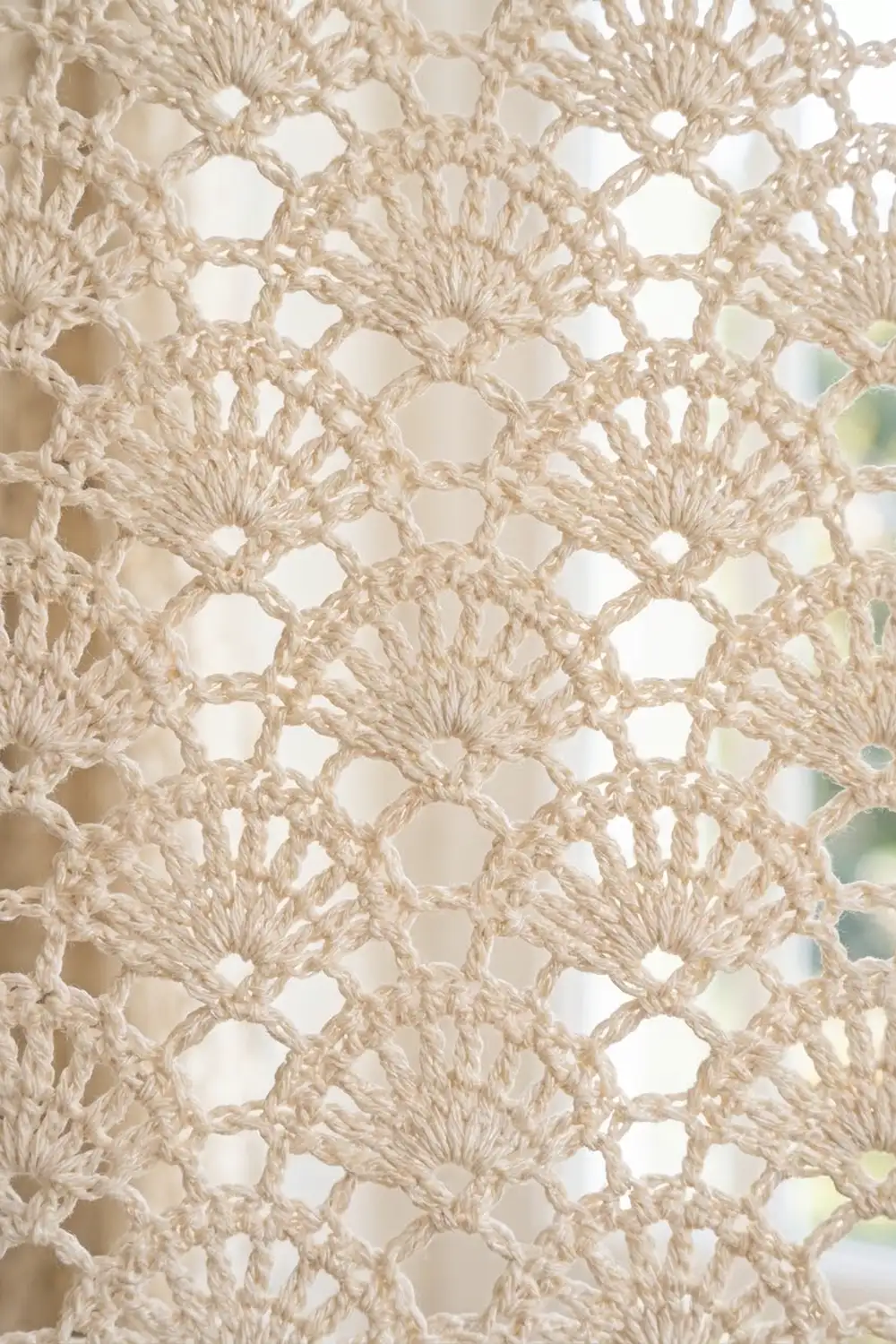
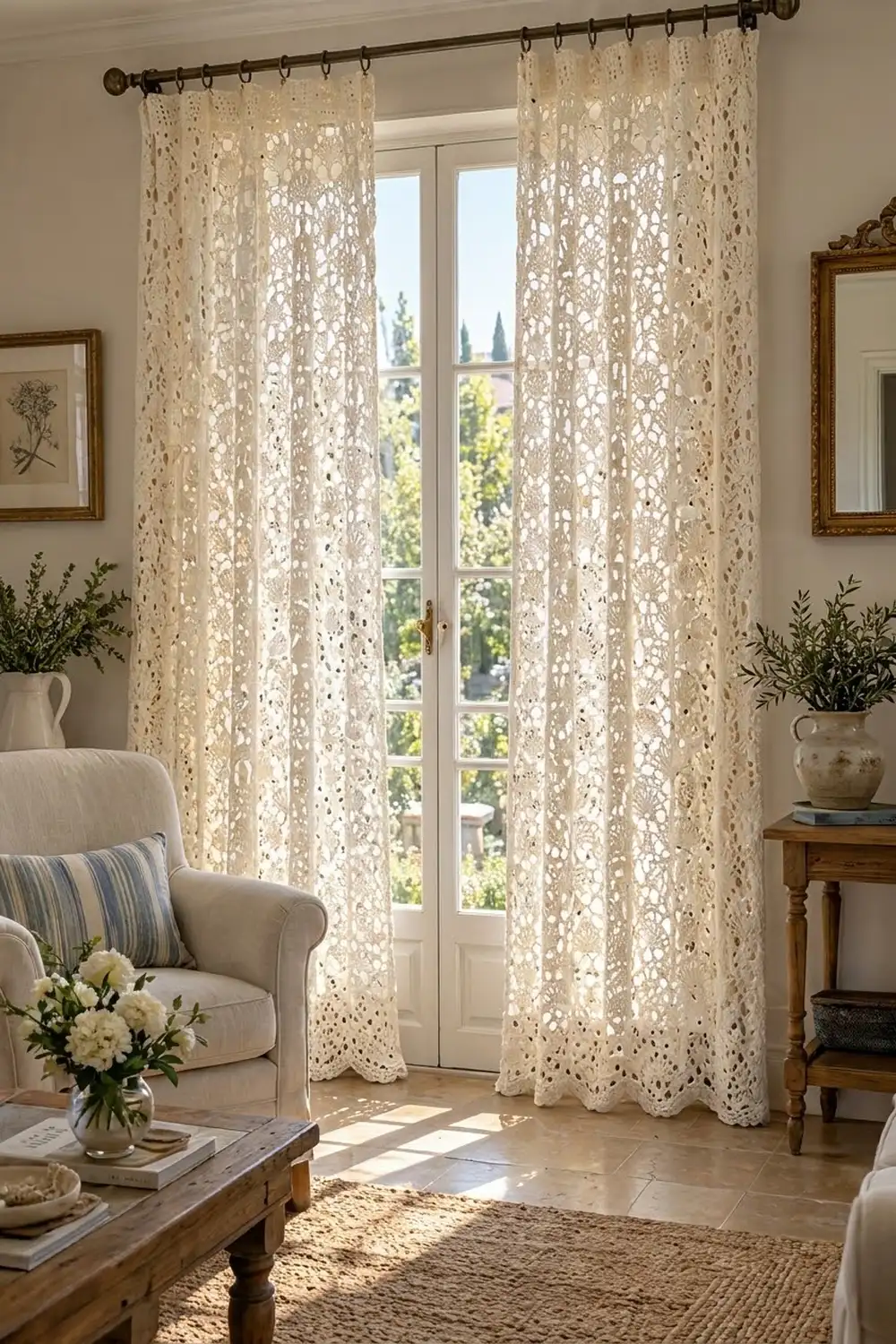
Seashell Light is a floor-length lace curtain made of rows of cream fans that look like stacked seashells. Light passes through the open chain arcs, and the fans keep enough body to give some privacy. The bottom edge finishes in a row of full fans, which gives the hem its natural scallop.
The panel uses a single color, soft cream cotton, which suits a cottage, farmhouse, or vintage room. The pattern uses US crochet terms throughout.
One finished panel measures 43 in × 81.5 in (109.2 cm × 207.0 cm). The photo shows a matching pair. Make two identical panels for a pair. Nothing is joined: each panel hangs separately on its own clip rings.
You work the panel flat from the top down. You start with a single-crochet arc row, then repeat a four-row fan-and-arc pattern, end with a fan row for the scalloped hem, and finish with a two-round border.
Finished Size and Construction
- Finished size (one panel): 43 in × 81.5 in (109.2 cm × 207.0 cm)
- Skill level: Intermediate
- Terminology: US crochet terms
- Yarn weight: DK / light (#3) cotton
- Hook: 4.0 mm (US G-6)
- Number of pieces: 1 per panel (make 2 for a pair)
- Layout: one rectangle worked in rows, no joining
- Piece size before border: 42 in × 80.5 in (106.7 cm × 204.5 cm)
- Border depth: 0.5 in (1.3 cm) on every side
- Pattern repeat width: 12 foundation chains = 3 in (7.6 cm)
Materials
Yarn: Use a smooth mercerized or matte cotton in DK weight. Cotton holds the shape of the fans, does not stretch out much on a long drop, and washes well. Avoid fuzzy or brushed yarns, because they blur the lace.
- Cream: 750 g / 1,725 m per panel (for example, fifteen 50 g balls of 115 m each)
- For a pair: 1,500 g / 3,450 m
These quantities include a margin of roughly 15% for the gauge swatch, the border, and any differences in tension.
Tools:
– 4.0 mm (US G-6) crochet hook
– Tapestry needle
– Locking stitch markers (at least 10)
– Measuring tape, 120 in (304.8 cm) or longer
– Rust-proof blocking pins
– Spray bottle
– 14 curtain clip rings per panel
Abbreviations (US Terms)
- ch – chain
- sc – single crochet
- tr – treble crochet
- sl st – slip stitch
- sk – skip
- sp – space
- st(s) – stitch(es)
- rep – repeat
- RS / WS – right side / wrong side
Special stitches:
– Fan: 9 tr in the same stitch.
– Half fan: at the start of a row, ch 4 (counts as 1 tr) plus 4 tr in the same stitch, for 5 tr. At the end of a row, 5 tr in the same stitch.
– Picot: ch 3, sl st in the top of the sc just made.
Gauge and Checkpoints
Body gauge: 1 pattern repeat (12 foundation chains) = 3 in (7.6 cm) wide. One four-row repeat (Rows 2–5) = 3.5 in (8.9 cm) tall. A fan row is about 1.25 in (3.2 cm) tall, and an arc row is about 0.5 in (1.3 cm).
Border gauge: 4 sc and 4 rounds = 1 in (2.5 cm).
Test swatch: Make a swatch before starting the full panel.
- Ch 26.
- Work Row 1 (5 sc, 4 arcs).
- Work Rows 2–5 twice, ending after Row 9.
- Wet it, pin it flat, and let it dry.
The blocked swatch should measure 6 in (15.2 cm) wide and 7.5 in (19.1 cm) tall.
- Swatch too big: go down to a 3.75 mm hook.
- Swatch too small: go up to a 4.5 mm hook.
- Width correct but height wrong: check how tall your trebles are. Pull each loop fully up to hook height before yarning over.
Checkpoints during the panel:
– After Row 1: 42 in (106.7 cm) wide, lightly stretched.
– After Row 41 (10 repeats): 35.5 in (90.2 cm) long.
– After Row 89 (22 repeats): 77.5 in (196.9 cm) long.
– After Row 92: 80.5 in (204.5 cm) long, 42 in (106.7 cm) wide.
Measure flat, without stretching, and pin gently if the lace has bunched up.
Panel Pattern
The panel is 14 repeats wide. Row 1 is the top edge of the curtain.
Foundation: Ch 170 (12 × 14 + 2). Keep the chain loose. If it tightens, the top edge will pull in. A good fix is to go up one hook size for the chain only.
Row 1 (RS): Sc in the 2nd ch from hook. Ch 5, sk 5 ch, sc in next ch. Rep from * across. Turn.
(29 sc, 28 ch-5 arcs; 169 chains used)
Row 2 (WS): Ch 4 (counts as tr), 4 tr in the first sc (half fan). Ch 2, sk next arc, sc in next sc, ch 2, sk next arc, fan in next sc. Rep from * 12 more times. Then ch 2, sk next arc, sc in next sc, ch 2, sk last arc, 5 tr in the last sc (half fan). Turn.
(13 fans + 2 half fans = 127 tr including the turning ch; 14 sc; 28 ch-2 sps)
The fans spread out over the skipped arcs. Each sc between fans anchors the lace and becomes the base of the fan in the offset fan row.
Row 3 (RS): Ch 1, sc in the first tr. Ch 5, sc in next sc, ch 5, sc in the 5th (center) tr of the next fan. Rep from * 12 more times. Then ch 5, sc in next sc, ch 5, sc in the top of the turning ch-4. Turn.
(29 sc, 28 ch-5 arcs)
Row 4 (WS): Ch 1, sc in the first sc. Ch 2, sk next arc, fan in next sc, ch 2, sk next arc, sc in next sc. Rep from * 13 more times (14 times in total). Turn.
(14 fans = 126 tr; 15 sc; 28 ch-2 sps)
Each fan in this row sits above an sc from Row 2, which shifts it half a repeat from the fans below. This offset creates the brick-like shell layout.
Row 5 (RS): Ch 1, sc in the first sc. Ch 5, sc in the center tr of the next fan, ch 5, sc in next sc. Rep from * 13 more times. Turn.
(29 sc, 28 ch-5 arcs)
Row 5 has the same count and layout as Row 1, so the fans of the next Row 2 will sit above the Row 4 sc stitches.
Rows 6–89: Rep Rows 2–5 another 21 times, for 22 repeats in total. The panel should now measure 77.5 in (196.9 cm).
Row 90: Work as Row 2 (127 tr, 14 sc).
Row 91: Work as Row 3 (29 sc).
Row 92: Work as Row 4 (14 full fans, 15 sc).
Row 92 is the hem row. Its 14 full fans form the scallops. Do not fasten off. Turn so the RS faces you, ready for the border.
Checkpoint: 42 in × 80.5 in (106.7 cm × 204.5 cm).
Border
The border is two rounds of single crochet. It straightens the top and side edges, and it adds a small picot to each fan on the hem. Corners are worked as (sc, ch 2, sc). The ch-2 is never counted. Each side’s count includes the sc worked into each of its two corners.
Border gauge: 4 sc = 1 in (2.5 cm).
Round 1 (RS): Start at the bottom-right corner.
- Bottom-right corner: (sc, ch 2, sc) in the first sc of Row 92.
- Right side: Work 4 sc along the side of the final fan row, 2 sc along each arc row, and 5 sc along each fan row. Over each four-row repeat this gives 14 sc. Finish with 1 sc along the edge of Row 1. The corner sc’s are shared: the Bottom-right corner gave this side 1 and the top corner gives it 1. In total there are 320 sc along the row ends.
- Top-right corner: (sc, ch 2, sc) in the last foundation ch.
- Top: Sc in each of the next 167 foundation ch.
- Top-left corner: (sc, ch 2, sc) in the first foundation ch.
- Left side: Work as for the right side, in reverse order.
- Bottom-left corner: (sc, ch 2, sc) in the last sc of Row 92.
- Bottom edge: 2 sc in the ch-2 sp, sc in each of the 9 tr of the fan, 2 sc in the next ch-2 sp, sc in the next sc. Rep from * across. On the last repeat, skip the final sc, because it is the corner you started in.
- Sl st to the first sc.
Round 1 counts:
– Top: 1 + 167 + 1 = 169 sc
– Each side: 1 + 1 (Row 1) + 308 (22 × 14) + 11 (Rows 90–92: 5 + 2 + 4) + 1 = 322 sc
– Bottom: 1 + (14 × 13) + 13 sc between fans + 1 = 197 sc
– Total: 169 + 197 + 322 + 322 = 1,010 sc
Round 2 (RS): Do not turn. Sl st into the corner ch-2 sp.
- Corners: Work (sc, ch 2, sc) in each corner sp.
- Top and sides: Sc in each sc.
- Bottom edge: Sc in each sc. Each time you reach the sc above the 5th (center) tr of a fan, work sc in that st and then a picot.
- Sl st to the first sc and fasten off.
Round 2 counts:
– Top: 171 sc
– Each side: 324 sc
– Bottom: 199 sc plus 14 picots (picots are not counted)
– Total: 1,018 sc
Why the math works:
– Sides: At 4 sc per inch, 322 sc covers 80.5 in (204.5 cm), the same as the body length. The 14 sc per repeat match 3.5 in (8.9 cm) of fabric, so the sides neither ruffle nor pull in.
– Top: 169 sc covers 42.25 in (107.3 cm). That is a quarter inch more than the body width, which allows for the slight give in the foundation chain.
– Bottom: The hem follows the curves of the fans, so its 197 sc go around the scallops instead of across them, and this keeps each fan rounded.
Two rounds add 0.5 in (1.3 cm) on each side, so the finished panel measures 43 in × 81.5 in (109.2 cm × 207.0 cm).
Final Blocking
- Weave in all the ends along the solid tr fans, not through the open arcs.
- Soak the panel in lukewarm water for 15 minutes. Press the water out gently without wringing.
- Roll the panel in towels to remove extra moisture.
- Lay it flat on blocking mats or a clean sheet on the floor.
- Pin the top edge straight to 43 in (109.2 cm).
- Pin both sides straight to 81.5 in (207.0 cm). Pin every 6 in (15.2 cm).
- Pin the bottom hem at the center of each fan, at the picot, so the 14 scallops curve evenly.
- Open up the fans with your fingers so the trebles spread out evenly.
- Leave the panel to dry completely, usually 24–48 hours.
- Remove the pins. Then hang the panel for a day before attaching the clip rings, so it can settle to its full length.
Final Quality-Control Checklist
- The panel measures 43 in × 81.5 in (109.2 cm × 207.0 cm) after blocking.
- The top edge is straight and has no pulled-in areas.
- The side edges hang straight, with no waves and no tightness.
- There are 14 full fans along the hem, with a picot centered on each one.
- The fans alternate rows in a clean offset pattern all the way down.
- Every fan has 9 trebles.
- Round 1 of the border has 169 / 322 / 197 / 322 sc.
- All ends are woven in securely, with none visible from the RS.
- The second panel matches the first within 0.5 in (1.3 cm).
Troubleshooting
The top edge cups inward. The foundation chain is too tight. Rework it one hook size larger, or crochet a foundation-sc version that is 169 sts wide.
The fans lean to one side. You worked the fan into the wrong sc. Count the arcs: there must be one arc on each side of every fan base.
The arcs sag. Your chains are too loose. Work them on a hook 0.5 mm smaller, but keep the trebles on the main hook.
The panel is too short. Add more repeats of Rows 2–5 before Rows 90–92. Each repeat adds 3.5 in (8.9 cm). You also need to add 14 sc per extra repeat to each side of the border.
The panel is too long. Leave out repeats in the same way, and subtract 14 sc per side for each repeat removed.
The sides ripple after the border. Your side count is too high. Rework Round 1 to exactly 322 sc.
The scallops look flat. Pin more firmly at the center of each fan while blocking, and check that you worked 2 sc in each ch-2 space.
Care
Hand wash or machine wash on a gentle cycle in cool water, inside a mesh laundry bag. Lay flat to dry and re-pin the scallops if needed. Do not tumble dry, because heat can shrink cotton and distort the lace.
Final Notes
Here is the full measurement chain for the panel:
- The 3 in (7.6 cm) repeat gives the 42 in (106.7 cm) width.
- The 3.5 in (8.9 cm) row repeat builds to 80.5 in (204.5 cm).
- A 0.5 in (1.3 cm) border brings the finished size to 43 in × 81.5 in (109.2 cm × 207.0 cm).
If your swatch and checkpoints match at each stage, the finished panel will hang straight and the scallops will sit evenly. Make a second panel to the same measurements, clip both to your rod, and enjoy the light through the lace.
Happy crocheting!