

These curtain panels combine soft sage-teal ripple bands with airy cream fan lace. The teal stripes give each panel structure and color. The cream stripes open up into fans and gaps, so the window glows through in a pattern of waves.
The style is relaxed cottage-meets-coastal. The panels work well in a bright living room, a sunroom, or a bedroom window where you want some privacy during the day without blocking the light. The waves run across the full width, and the bottom edge keeps a gentle scallop that echoes every stripe above it.
This pattern uses US crochet terms. Each finished panel measures 30.5 in (77.5 cm) wide by 78 in (198.1 cm) long, plus hanging tabs. The instructions make one panel. Make two for a pair.
The construction is simple. Each panel is worked flat in rows from the bottom up, alternating a 4-row teal band with a 4-row cream lace band. One round of single crochet tidies all four edges. Then eight teal tabs are worked straight off the top edge, folded over, and sewn down.
Finished Size and Construction
- Finished panel size: 30.5 in (77.5 cm) wide x 78 in (198.1 cm) long, plus tabs
- Skill level: Intermediate
- Terminology: US crochet terms
- Yarn weight: Worsted (#4), cotton or cotton blend
- Hook: 6 mm (US J-10)
- Number of pieces: 2 identical panels, not joined
- Layout: One panel on each side of the window
- Piece size before border: 30 in (76.2 cm) x 77.5 in (196.9 cm)
- Border depth: 1 round of sc, about 0.25 in (0.6 cm)
- Tabs: 8 per panel, about 1.8 in (4.6 cm) wide, fit a rod up to 1.5 in (3.8 cm) across
Materials
Choose a smooth worsted-weight cotton or cotton blend at about 190 m per 100 g. Cotton drapes well and holds the lace open after blocking. It also stands up to sunlight and washing better than most acrylics. Avoid fuzzy or very splitty yarns, because the fans look best with crisp stitch definition.
Yarn (for the pair of panels):
- Color A, sage-teal: 950 g / 1,805 m (1,974 yd), or 475 g / 903 m per panel
- Color B, cream: 800 g / 1,520 m (1,662 yd), or 400 g / 760 m per panel
These quantities include about a 10% margin for the gauge swatch, differences in tension, and weaving in ends. Buy all of each color from one dye lot. A shade shift in the middle of a long panel is easy to see against the light.
Tools:
- 6 mm (US J-10) crochet hook
- Tapestry needle
- Stitch markers (at least 16)
- Measuring tape
- Rust-proof pins and a blocking area at least 32 in x 80 in (81.3 cm x 203.2 cm)
- Spray bottle
- Curtain rod up to 1.5 in (3.8 cm) in diameter
Abbreviations (US Terms)
- ch: chain
- sc: single crochet
- dc: double crochet
- sl st: slip stitch
- sk: skip
- sp: space
- st(s): stitch(es)
- rep: repeat
- RS / WS: right side / wrong side
dc2tog (double crochet 2 together): [Yarn over, insert hook in next st, yarn over and pull up a loop, yarn over and pull through 2 loops] twice, then yarn over and pull through all 3 loops on the hook. This uses 2 sts and makes 1.
Counting rule: Every ch-1 sp counts as 1 st. The ch-2 at the start of each row does NOT count as a st and is never worked into.
Gauge and Checkpoints
Ripple gauge: After blocking, 1 repeat (12 sts) = 3.75 in (9.5 cm) wide, measured straight across, and 8 rows = 5 in (12.7 cm) tall.
Sc gauge: 13 sc and 16 rows = 4 in (10.2 cm).
Test first. Ch 38 and work Rows 1–8 below over 3 repeats (36 sts). Wet block the swatch and let it dry. It should measure 11.25 in (28.6 cm) wide by 5 in (12.7 cm) tall. Measure width straight across from edge to edge, not along the curve of the wave.
- Too big: go down to a 5.5 mm (US I-9) hook.
- Too small: go up to a 6.5 mm (US K-10.5) hook.
- Width matters more than height. You can adjust height later by adding or removing stripe repeats.
Checkpoints on the panel (lightly stretched, measured at a wave peak):
- After Row 8: 30 in (76.2 cm) wide and 5 in (12.7 cm) tall
- After Row 40: 25 in (63.5 cm) tall
- After Row 120: 75 in (190.5 cm) tall
- After Row 124: 77.5 in (196.9 cm) tall
- After the border: 30.5 in (77.5 cm) x 78 in (198.1 cm)
Unblocked lace is usually a little shorter than these numbers. Judge width on the unblocked panel and height after blocking.
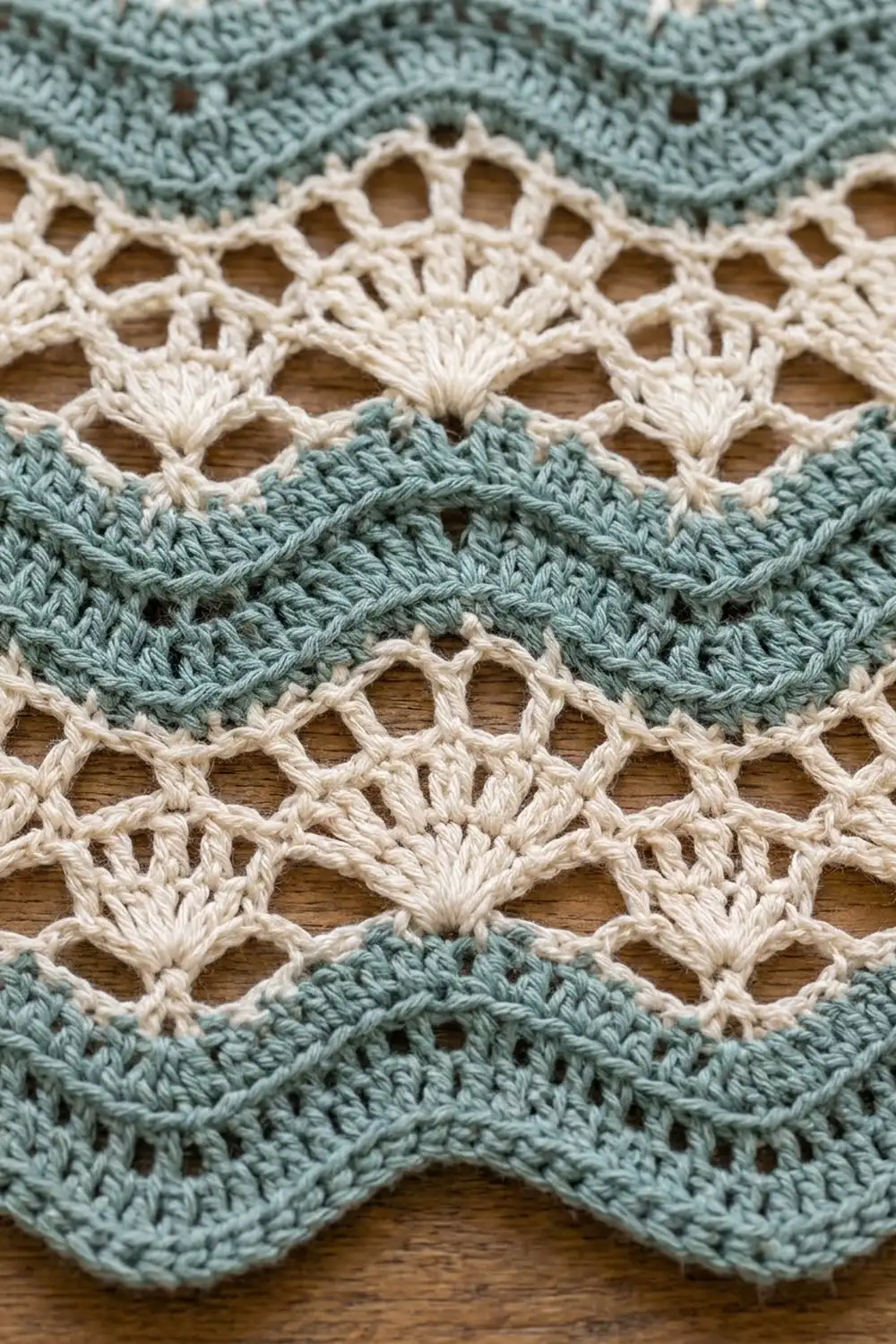
The Panel
Every row has 96 sts (8 repeats of 12). Change color in the last yarn over of the final st of the previous row. Each band is 4 rows, so the unused color is always waiting at the same edge when you need it again. Carry it loosely up the side, and the border will cover it.
For the first few rows, place a marker after every 12th st. This makes miscounts easy to spot.
Teal Band (Color A)
Foundation: With A, ch 98.
Row 1 (RS, ripple): Starting in 3rd ch from hook, *[dc2tog] twice, 2 dc in each of next 4 ch, [dc2tog] twice; rep from * 7 more times. Turn. (96 sts)
Each repeat uses 12 sts and makes 2 + 8 + 2 = 12 sts. The paired dc2togs form the valleys, and the 8 increase sts form the peaks.
Row 2 (ripple): Ch 2, *[dc2tog] twice, 2 dc in each of next 4 sts, [dc2tog] twice; rep from * 7 more times. Turn. (96 sts)
Row 3 (eyelet ripple): Ch 2, *[dc2tog] twice, (dc, ch 1) in each of next 4 sts, [dc2tog] twice; rep from * 7 more times. Turn. (96 sts: 64 sts + 32 ch-1 sps)
This row makes the line of small holes in each teal band.
Row 4 (ripple): Work as Row 2, treating each ch-1 sp as a st. Change to B in the last st. Turn. (96 sts)
Cream Lace Band (Color B)
Row 5 (ripple): With B, work as Row 2. Turn. (96 sts)
Row 6 (fan row): Ch 2, *dc2tog, ch 1, sk next 4 sts, 8 dc in the sp between the last skipped st and the next st, ch 1, sk next 4 sts, dc2tog; rep from * 7 more times. Turn. (96 sts: 8 fans of 8 dc, 16 dc2tog, 16 ch-1 sps)
Each repeat makes 1 + 1 + 8 + 1 + 1 = 12 sts. The fan sits exactly at the peak, between the 6th and 7th sts of the repeat. Each ch-1 bridges 4 skipped sts and leaves one of the open gaps you see in the photo.
Row 7 (ripple): Work as Row 2, treating each ch-1 sp as a st. Turn. (96 sts)
The 4 increase sts in this row land on the middle 4 dc of each fan, so the wave stays centered.
Row 8 (fan row): Work as Row 6. Change to A in the last st. Turn. (96 sts)
Continue the Stripes
Rows 9–120: Repeat Rows 1–8 fourteen more times. Each time, work the first teal row as Row 2, into the sts rather than a chain. You now have 15 stripe repeats, ending with a cream band. (96 sts)
Rows 121–124: With A, work Rows 2, 3, 2, 2 (ripple, eyelet ripple, ripple, ripple). Do not fasten off. (96 sts)
The panel now starts and ends with a teal band. To change the length, add or remove full 8-row repeats. Each repeat adds or removes 5 in (12.7 cm).
Make All Pieces
Make 2 panels exactly alike.
| Item | Color A | Color B |
|---|---|---|
| Per panel | 475 g / 903 m | 400 g / 760 m |
| Pair | 950 g / 1,805 m | 800 g / 1,520 m |
Layout when hung:
[ Panel 1 ]  [ window ]  [ Panel 2 ]
  8 tabs                   8 tabs
Use the same hook for both panels and try to keep a steady rhythm. Before you continue past Row 40 on the second panel, compare it with the first. The two should match within 0.5 in (1.3 cm).
Joining
No joining is needed. The two panels hang separately and share only the rod. Finish each panel completely, including the border and tabs, before you start the next.
Border
Border gauge: 13 sc = 4 in (10.2 cm), or 3.25 sc per inch.
The border is one round of sc with a ch-1 sp at each corner. The corner ch-1 sps are not counted in any side, so no corner is counted twice.
Round 1 (RS): Continuing with A, ch 1 and turn so the RS faces you.
- Top edge: sc in each st across. (96 sc) Ch 1 for the corner.
- First side: 2 sc in the end of each row down the side. (124 rows x 2 = 248 sc) Ch 1 for the corner.
- Bottom edge: sc in each unused loop of the foundation chain. (96 sc) Ch 1 for the corner.
- Second side: 2 sc in the end of each row. (248 sc) Ch 1.
- Join with a sl st to the first sc. (688 sc + 4 corner ch-1 sps)
Why the math works: Each dc row is 0.625 in (1.6 cm) tall, so 2 sc per row gives 3.2 sc per inch. That almost exactly matches the sc gauge of 3.25 per inch, so the sides lie flat without flaring or puckering. The top and bottom edges take 1 sc per ripple st because the ripple gauge (3.2 sts per inch) is nearly the same as the sc gauge. This lets the wavy edges keep their shape.
Tabs (Color A)
Count the 96 top sc in groups of 12, starting at the corner. Place a marker in sc 4 and sc 9 of each group. These 6 sc sit centered on each wave peak.
Row 1: With RS facing, join A in sc 4 of the first group. Ch 1, then sc in the same st and in each of the next 5 sc. Turn. (6 sc)
Rows 2–20: Ch 1, sc in each sc across. Turn. (6 sc)
Fasten off, leaving a 12 in (30.5 cm) tail. The tab measures about 1.8 in (4.6 cm) wide by 5 in (12.7 cm) long.
Repeat for the remaining 7 groups. (8 tabs)
Fold each tab to the WS and sew its last row to the WS of the panel, just below the border round. Check that the first loop fits your rod before sewing all 8.
Final Blocking
- Weave in all ends inside dc posts, each into a stripe of its own color.
- Soak each panel in cool water with a little mild soap for 20 minutes.
- Press out the water gently and roll the panel in towels. Do not wring.
- Lay the panel flat on a bed or a clean floor.
- Pin the side edges straight to 78 in (198.1 cm).
- Pin the width to 30.5 in (77.5 cm) at several points along the length.
- Pin each fan open and each bottom wave peak into a soft point.
- Let it dry fully, for at least 24 hours. Repeat for the second panel.
Final Quality-Control Checklist
- Each row has 96 sts, including ch-1 sps.
- Each panel has 16 teal bands and 15 cream bands.
- Every teal band has one eyelet row.
- Every fan sits centered on a peak.
- The border has 96 sc on the top and bottom and 248 sc on each side.
- Each panel has 8 tabs, each 6 sc wide and 20 rows long.
- Both panels measure 30.5 in (77.5 cm) x 78 in (198.1 cm).
- No carried strands show on the RS.
Troubleshooting
The waves drift sideways. You probably skipped or doubled a st at the end of a row. Count each repeat. The first and last sts of every row are dc2togs.
The fans tilt. Check that you skipped exactly 4 sts on each side of the fan.
The cream bands look dense. Your ch-1 bridges may be too tight. Pull each one up slightly so it spans the 4 skipped sts without pulling.
The side edges ruffle. Use 2 sc per row end, not 3. If the edges pull in instead, loosen your tension slightly.
The carried yarn shows. Carry it under the first st of each row, and keep the strand loose enough that the edge doesn’t pucker.
The panels differ in length. Re-block the longer panel with less vertical stretch. If the difference is more than 2 in (5.1 cm), remove one stripe repeat.
The tabs sag. Sew the end of each tab firmly across all 6 sts, not just at the corners.
Care
Hand wash, or machine wash on a cool, gentle cycle in a mesh bag. Lay flat to dry and reshape. Do not hang the panels while wet, because the weight will stretch the lace.

Final Notes
The measurements build on each other. 12 sts make 3.75 in (9.5 cm), so 8 repeats make 30 in (76.2 cm), and 8 rows make 5 in (12.7 cm). Fifteen stripe repeats plus a final teal band give 124 rows, or 77.5 in (196.9 cm). One round of sc brings each panel to 30.5 in (77.5 cm) x 78 in (198.1 cm), and 8 tabs hold it on the rod. Check your swatch and count your 96 sts, and the pair will hang evenly.
Happy crocheting!