

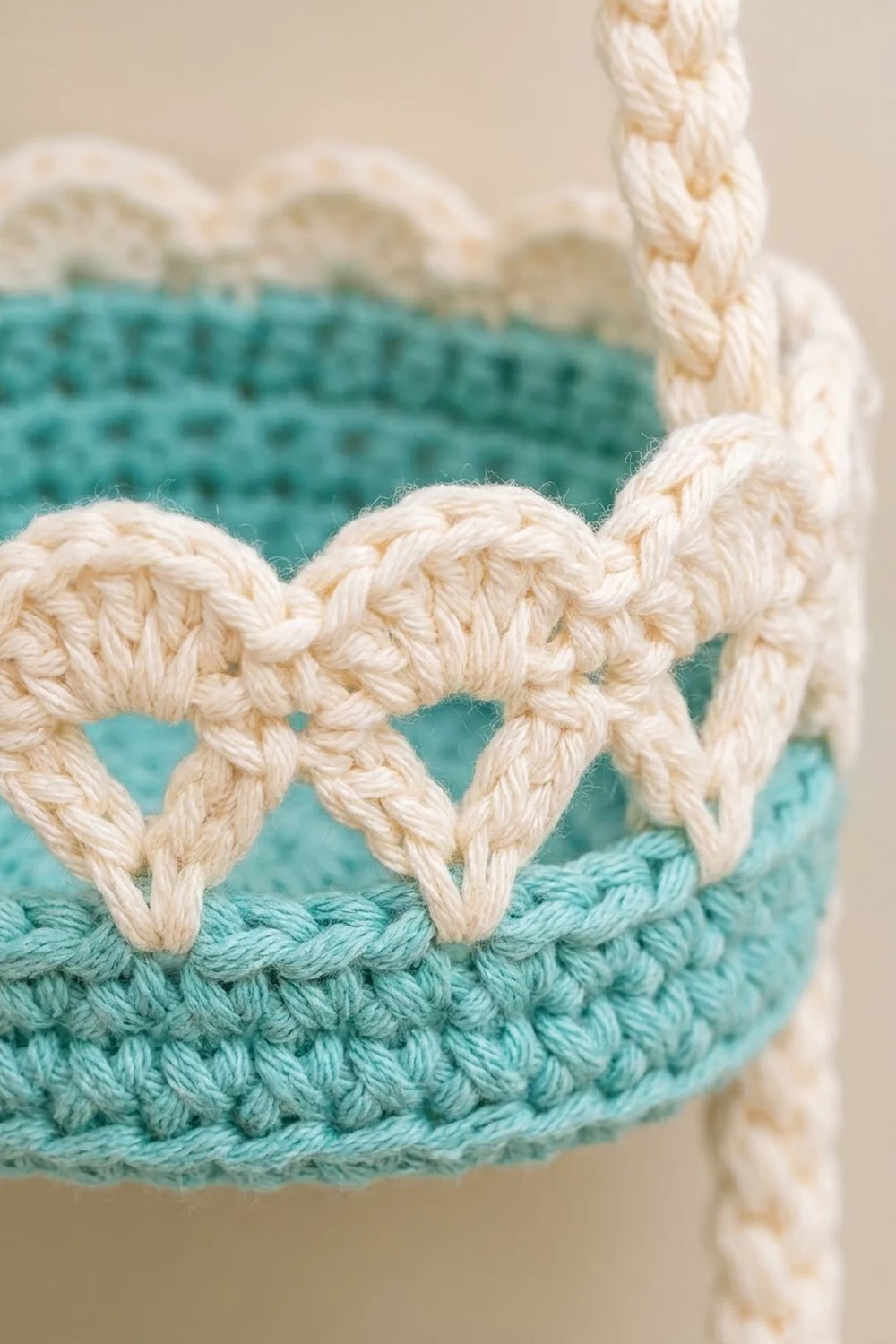
This hanging organizer stacks three small oval baskets on two cream cords, one above the other. It’s sized to hold a standard toilet paper roll in each basket, and it works just as well for washcloths, hair ties, or plant-shelf odds and ends. Each basket has a sturdy aqua single crochet body and a cream top band made of open V-stitches with a scalloped shell edge.
The palette is two colors: soft aqua for the bases and walls, cream for the edging and hanging cords. The look is fresh and cottage-style, and it suits a bathroom, laundry room, or nursery.
This pattern uses US crochet terms. Each basket measures about 6 in (15.2 cm) long, 5.25 in (13.3 cm) wide, and 3 in (7.6 cm) tall. The assembled organizer hangs about 25.5 in (64.8 cm) from the hanger tip to the bottom of the lowest basket.
Construction is simple. You crochet each oval base in joined rounds and turn up the walls with a back-loop round. Then you add the cream V-stitch and shell band. You make two long slip-stitch cords and whipstitch them to the narrow ends of all three baskets, and the two cord tops are sewn together to form the hanger.
Finished Size and Construction
- Finished size (each basket): 6 in (15.2 cm) long x 5.25 in (13.3 cm) wide x 3 in (7.6 cm) tall
- Finished size (assembled): 25.5 in (64.8 cm) tall overall
- Skill level: Easy / advanced beginner
- Terminology: US
- Yarn weight: Worsted (#4), 100% cotton
- Hook: 4.5 mm (US 7) for baskets; 5.5 mm (US I-9) for cords
- Number of pieces: 5 (3 identical baskets + 2 cords)
- Layout: 3 baskets stacked vertically, 4 in (10.2 cm) apart, hung from 2 cords
- Piece size before edging: 6 x 5.25 in (15.2 x 13.3 cm) base, 1.75 in (4.4 cm) aqua wall
- Edging (border) depth: 1.25 in (3.2 cm)
Materials
Use a smooth, firm worsted-weight cotton. Cotton holds its shape, doesn’t stretch much under the weight of a roll, and survives humid bathrooms. Avoid acrylic blends, which sag.
- Aqua (Color A): 110 g / 185 m (202 yd)
- Cream (Color B): 60 g / 100 m (109 yd)
Quantities include a margin of roughly 25% over the measured use.
Tools:
- 4.5 mm (US 7) crochet hook
- 5.5 mm (US I-9) crochet hook
- Tapestry needle
- 4 locking stitch markers
- Scissors
- Measuring tape
- Rustproof pins and a towel or blocking board
Abbreviations (US Terms)
- ch: chain
- sl st: slip stitch
- sc: single crochet
- dc: double crochet
- BLO: back loop only
- st(s): stitch(es)
- sp: space
- rep: repeat
- rnd: round
Special stitch: V-stitch (V-st). (dc, ch 1, dc) in the same stitch.
Special stitch: Shell. 5 dc in the same stitch.
Back bump: the small horizontal bar on the back of a foundation chain.
Gauge and Checkpoints
Gauge: 16 sc x 18 rnds = 4 in (10.2 cm) with a 4.5 mm hook.
Cord gauge: 3 ch = 1 in (2.5 cm) with two strands held together and a 5.5 mm hook.
Make one complete basket before starting the others. It’s your gauge swatch, and it tells you whether a roll fits.
Checkpoints:
- After Rnd 11 (base): 6 in (15.2 cm) long x 5.25 in (13.3 cm) wide, lying flat with no ruffling or cupping.
- After Rnd 19 (walls): the aqua wall stands 1.75 in (4.4 cm) tall.
- After the cream band: total height is 3 in (7.6 cm), and the rim measures about 18 in (45.7 cm) around.
- Cord: 27 in (68.6 cm) long, relaxed.
If your base is too big, go down 0.5 mm in hook size. If it’s too small or the roll doesn’t fit, go up 0.5 mm. If the base ruffles, your increases are working up too loose, so go down a hook size. If it cups, go up a size. Don’t change the stitch counts, because the edging repeat depends on exactly 72 stitches.
Basket Base (Make 3)
With Color A and a 4.5 mm hook, ch 6.
The base has four sections: End A, Side 1, End B, and Side 2. Each side stays 3 sts wide. The ends grow by 3 sts each round, so every round adds 6 sts in total. Place a marker in the first st of each end on Rnd 1 and move the markers up as you go.
Rnd 1: 3 sc in 2nd ch from hook (End A), sc in next 3 ch (Side 1), 3 sc in last ch (End B). Rotate to work along the bottom of the chain. Sc in next 3 ch (Side 2). Sl st to first sc. (12 sts)
Rnd 2: Ch 1 (doesn’t count as a st here or on any later round). [2 sc in next st] 3 times, sc in next 3, [2 sc in next st] 3 times, sc in next 3. Sl st to first sc. (18 sts)
Rnd 3: Ch 1. [Sc in next st, 2 sc in next st] 3 times, sc in next 3, [sc in next st, 2 sc in next st] 3 times, sc in next 3. Sl st to first sc. (24 sts)
Rnds 4–11: Ch 1. [Sc in next X sts, 2 sc in next st] 3 times, sc in next 3, [sc in next X sts, 2 sc in next st] 3 times, sc in next 3. Sl st to first sc. X is the round number minus 2, so X = 2 on Rnd 4 and X = 9 on Rnd 11.
Round totals:
- Rnd 4: 30 sts
- Rnd 5: 36 sts
- Rnd 6: 42 sts
- Rnd 7: 48 sts
- Rnd 8: 54 sts
- Rnd 9: 60 sts
- Rnd 10: 66 sts
- Rnd 11: 72 sts
On Rnd 11, each end holds 33 sts and each side holds 3 sts: 33 + 3 + 33 + 3 = 72. Check the base against Checkpoint 1.
Basket Walls (Make 3)
Rnd 12: Ch 1, sc in BLO of each st around. Sl st to first sc. (72 sts)
This round leaves a crisp ridge on the outside and makes the wall stand up.
Rnds 13–19: Ch 1, sc in each st around. Sl st to first sc. (72 sts each round)
You now have 8 wall rounds, 1.75 in (4.4 cm) tall. Fasten off Color A and weave in the end on the inside.
To prepare for joining, fold the basket flat so the two sides line up. The two fold points are the centers of End A and End B. Mark each one with a stitch marker on Rnd 19. The cords go here.
Border: Cream V-Stitch and Scallop Edging
The edging is the border of each basket. It’s worked straight onto the 72 wall stitches with no added stitches.
Border gauge: 1 repeat = 4 sts = 1 in (2.5 cm). That gives 18 repeats around the 18 in (45.7 cm) rim. Each long half of the oval (front and back) carries 9 repeats.
Rnd C1 (V-stitch round): Join Color B with a sl st in any st. Ch 4 (counts as dc + ch 1), dc in same st (first V-st made), ch 1, skip next 3 sts. V-st in next st, ch 1, skip next 3 sts. Rep from * 16 more times. Sl st to 3rd ch of beginning ch-4. (18 V-sts and 18 ch-1 sps between them = 18 x 4 = 72 sts and chs)
The V-sts point downward, and the aqua inside the basket shows through the triangular gaps between them. That’s what creates the open zigzag look.
Rnd C2 (trim round): Sl st into first V-st ch-1 sp. Ch 1, 3 sc in same sp, sc in next ch-1 sp between V-sts. 3 sc in next V-st sp, sc in next ch-1 sp. Rep from * 16 more times. Sl st to first sc. (18 x 3 sc in V-sps + 18 x 1 sc in gaps = 54 + 18 = 72 sts)
Rnd C3 (scallop round): Ch 1, sc in same st as join. Skip next st, Shell in next st, skip next st, sc in next st. Rep from * around. On the last repeat, work “skip next st” after the shell, then sl st to the first sc instead of working a final sc. (18 shells + 18 sc)
Each shell lands over a V-st, so the scallops line up with the cream points below. Fasten off and weave in the ends.
Why the math works: 72 = 18 x 4. Rnd C1 uses exactly 4 wall sts per V-st (1 worked into, 3 skipped), and each V-st plus its ch-1 gap takes up 4 positions. Rnd C2 turns those 4 positions back into 4 sc. Rnd C3 uses 4 sc per scallop. The rim never gains or loses stitches, so it keeps the same circumference as the wall and doesn’t flare or pucker.
Hanging Cords (Make 2)
With two strands of Color B held together and a 5.5 mm hook:
Row 1: Ch 82. Sl st in back bump of 2nd ch from hook and in each back bump across. (81 sl sts)
Fasten off, leaving a 12 in (30.5 cm) tail for sewing.
The front of the cord shows a raised braid of chain loops. Lay the cord out and measure it. It should be 27 in (68.6 cm). If it’s off by more than 1 in (2.5 cm), remake it, adding or removing 3 ch for each 1 in (2.5 cm).
Make All Pieces
- Color A: 3 bases with walls (Rnds 1–19), one per basket
- Color B: 3 edgings (Rnds C1–C3), plus 2 cords (double strand)
Layout grid (front view):
            /\            <- apex: cords overlap 1 in (2.5 cm)
           /  \
          /    \          <- hanger slopes, 9 in (22.9 cm) each
     cord|      |cord
         [Basket 1]       <- top, 3 in (7.6 cm)
         |  4 in  |       <- gap, 10.2 cm
         [Basket 2]       <- middle, 3 in (7.6 cm)
         |  4 in  |       <- gap, 10.2 cm
         [Basket 3]       <- bottom, 3 in (7.6 cm)
Joining
Each cord is divided into sections by stitch count, measured from the starting end (3 sts = 1 in):
- Sts 1–9: sewn to bottom basket, 3 in (7.6 cm)
- Sts 10–21: free gap, 4 in (10.2 cm)
- Sts 22–30: sewn to middle basket, 3 in (7.6 cm)
- Sts 31–42: free gap, 4 in (10.2 cm)
- Sts 43–51: sewn to top basket, 3 in (7.6 cm)
- Sts 52–81: hanger, 10 in (25.4 cm), with sts 79–81 overlapping the other cord
Check: 9 + 12 + 9 + 12 + 9 + 30 = 81.
Mark the start of each basket section on both cords with locking markers or scrap yarn.
Method: Place the cord on the outside of the bottom basket over the End A marker, braid side facing out. Line up st 1 with the bottom ridge (Rnd 12), and pin st 9 level with the top of the shells. Whipstitch the cord to the center column of the end with matching cream yarn, catching one sl st of the cord and one wall stitch on each pass. For extra hold, also catch one wall stitch on each side of center at the bottom, middle, and top. Repeat with the second cord on End B, then sew on the middle and top baskets the same way.
Tension: Sew firmly, but don’t cinch. The cord should lie flat against the wall without gathering it. Across each 3 in (7.6 cm) section, the cord and wall should end up the same length.
Apex: Bring the two hanger sections together. Lay sts 79–81 of both cords side by side so they overlap, and sew through both thicknesses several times. Weave in all tails.
Size checkpoint: Hang the organizer from a peg. Each free gap should measure 4 in (10.2 cm), and the full drop should be 25.5 in (64.8 cm).
Final Blocking
- Wet each basket in cool water and gently squeeze it out. Don’t wring it.
- Roll it in a towel to remove excess water.
- Fill each basket with a toilet roll wrapped in a plastic bag, or a folded towel, to set the oval shape.
- Pin each scallop slightly outward so the shells open evenly.
- Lay the cords straight and pin them flat at their full 27 in (68.6 cm) length.
- Let everything dry completely before hanging. Cotton takes about 24 hours.
Final Quality-Control Checklist
- [ ] Each base measures 6 x 5.25 in (15.2 x 13.3 cm) and lies flat
- [ ] Each wall round has 72 sts
- [ ] Every basket has 18 V-sts and 18 shells
- [ ] Shells sit over the V-sts
- [ ] All baskets are the same height, 3 in (7.6 cm)
- [ ] Both cords are 27 in (68.6 cm), with 81 sl sts each
- [ ] Cords are centered on the narrow ends of each basket
- [ ] Gaps are 4 in (10.2 cm), and the baskets hang level
- [ ] The apex is sewn securely through both cords
- [ ] All ends are woven in on the inside
Troubleshooting
Base ruffles: Your increases are probably too loose. Go down a hook size, and check that each side is only 3 sts.
Base cups before Rnd 12: Your increases are too tight. Go up a hook size.
Walls lean outward: Check that Rnd 12 was worked in BLO, and keep the wall rounds snug.
V-sts don’t come out even: Recount Rnd 19. You need exactly 72 sts.
Basket tilts when hanging: One cord is sewn higher than the other. Re-sew it so st 1 sits on the Rnd 12 ridge at both ends.
Roll won’t fit: Go up 0.5 mm in hook size for all three baskets.
Cord has stretched: Cotton relaxes over time. Re-block the cord, or shorten it by unpicking the apex and overlapping the cords further.
Care
Hand wash in cool water with mild soap, reshape, and dry flat. Don’t put it in the dryer, because heat can shrink cotton unevenly.

Final Notes
The measurement chain is straightforward. A gauge of 16 sc per 4 in gives a 72-stitch base of 6 x 5.25 in (15.2 x 13.3 cm). Eight wall rounds add 1.75 in (4.4 cm). The 72-stitch, 18-repeat cream edging adds 1.25 in (3.2 cm), for a basket 3 in (7.6 cm) tall. Two 81-stitch cords, each 27 in (68.6 cm) long, join the three baskets with 4 in (10.2 cm) gaps, for 25.5 in (64.8 cm) overall. If each checkpoint measures correctly, the next one will too.
Happy crocheting!