

This hanging holder keeps three spare toilet rolls in sight and within reach. A firm cream back panel hangs from a wooden ring, and three rounded pockets are stacked down the front. Each pocket has an airy mesh crossed by a teal wave band.
The palette is calm and coastal: warm cream cotton for structure and a soft teal for the wave. The look is relaxed, a little farmhouse and a little beach, and it suits most bathrooms.
The pattern uses US crochet terms. The finished holder measures 7 in (17.8 cm) wide and about 27.75 in (70.5 cm) long, not counting the ring. Each pocket sticks out about 3.1 in (7.9 cm) from the panel.
Construction is simple. You crochet one back panel in rows and shape the top into a tab. Then you make three pockets, each starting with a flat base and a wall worked around three sides of it. Sew the pockets to the panel, add a one-row border, wrap the tab around the ring, and block.
Finished Size and Construction
- Finished size: 7 in × 27.75 in (17.8 × 70.5 cm), plus the ring
- Skill level: Easy intermediate
- Terminology: US crochet terms
- Yarn weight: Worsted (#4) cotton
- Hook: 5.0 mm (H-8)
- Number of pieces: 4 (1 back panel and 3 pockets)
- Layout: 1 column, with 3 pockets stacked vertically
- Panel size before border: 6.5 in (16.5 cm) wide × 26 in (66.0 cm) from the bottom edge to the base of the tab
- Pocket size: base 6.25 × 3.1 in (15.9 × 7.9 cm); wall 4.25 in (10.8 cm) tall
- Border depth: about 0.25 in (0.6 cm), 1 row of single crochet
Materials
Use a smooth worsted-weight cotton or cotton blend. Cotton holds its shape in a damp bathroom and makes the pocket walls stand up well. Avoid acrylic here, because it stretches when it holds heavy rolls.
- Color A, Cream: 230 g, about 391 m (428 yd)
- Color B, Teal: 40 g, about 68 m (74 yd)
These amounts assume yarn at about 170 m per 100 g. They include a margin of about 15–20% for your gauge swatch and seaming.
Tools:
– 5.0 mm (H-8) crochet hook
– Wooden ring, 3 in (7.6 cm) outside diameter
– Tapestry needle
– Locking stitch markers (at least 8)
– Measuring tape
– Rustproof blocking pins and a blocking mat
– Scissors
Abbreviations (US Terms)
- ch: chain
- sc: single crochet
- hdc: half double crochet
- dc: double crochet
- tr: treble crochet
- sc2tog: single crochet 2 together
- sk: skip
- sp: space
- st(s): stitch(es)
- tch: turning chain
- RS / WS: right side / wrong side
Special stitch: Wave row. A sequence of graded stitches (sc, hdc, dc, tr, dc, hdc, sc) worked over 6 stitches. This makes a wavy top edge. The inverse wave row puts the tall stitches where the short ones were and makes the edge flat again.
Gauge and Checkpoints
Gauge: 16 sc × 18 rows = 4 in (10.2 cm) in single crochet. That works out to 4 sc and 4.5 rows per 1 in (2.5 cm).
In the mesh rows, every dc and every ch-1 space counts as one stitch. Their width should match the single crochet: 10 sts = 2.5 in (6.4 cm).
Make one pocket first as your test piece. It is small, and it covers every stitch in the pattern.
Checkpoints:
– Pocket base after Row 14: 6.25 × 3.1 in (15.9 × 7.9 cm)
– Pocket wall Row 1, laid flat: 12.25 in (31.1 cm) long
– Finished pocket wall: 4.25 in (10.8 cm) tall
– Panel after Row 99: 6.5 × 22 in (16.5 × 55.9 cm)
– Taper, Rows 100–117: 4 in (10.2 cm) tall
– Tab, Rows 118–131: 3.1 in (7.9 cm) long
– Panel after the border: 7 in (17.8 cm) wide
If your piece is too big, go down 0.5 mm in hook size. If it is too small, go up 0.5 mm. Get the width right before the height, because the pocket width has to match the panel width.
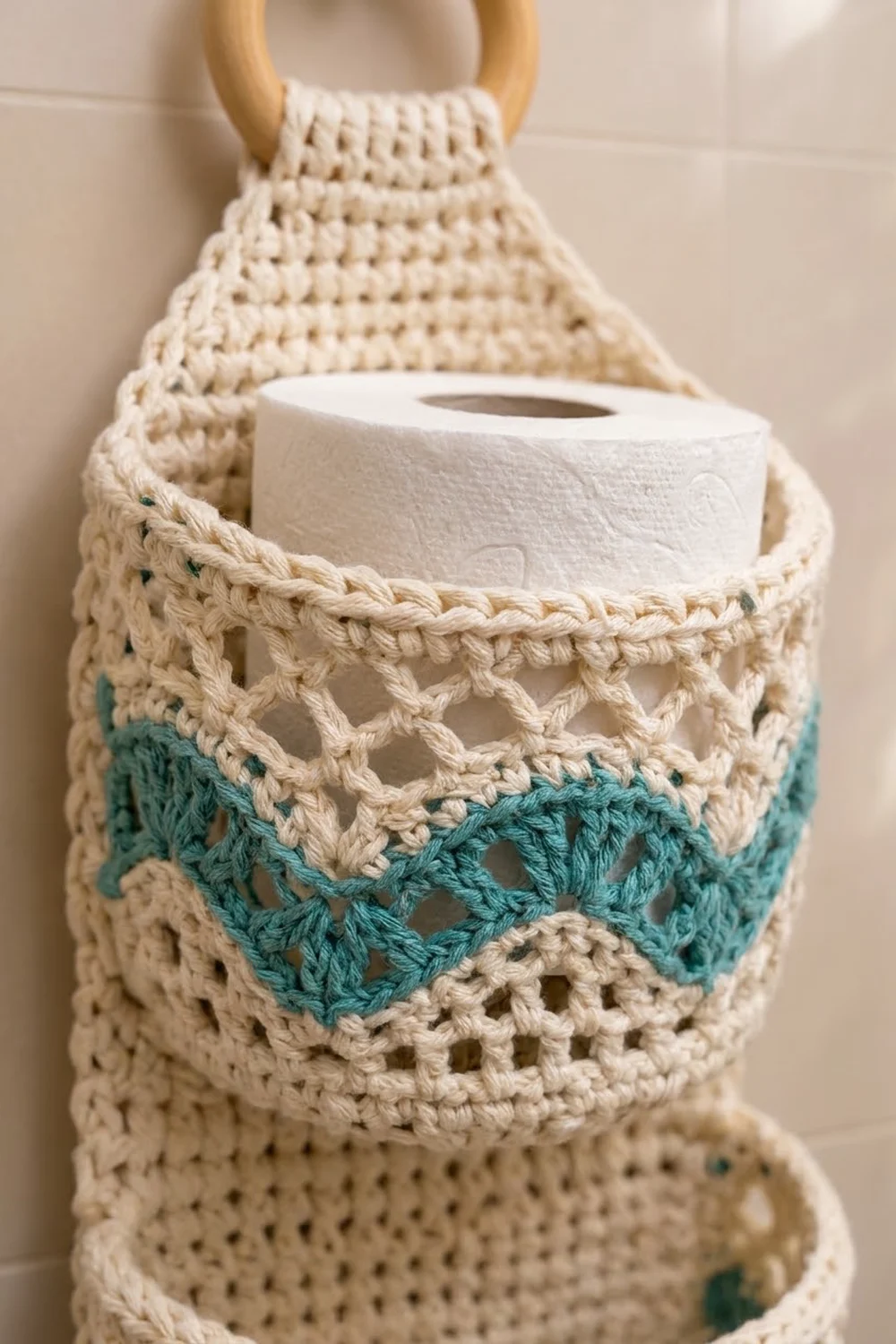
Pocket (Make 3)
Base
With Color A, ch 26.
Row 1: Sc in 2nd ch from hook and in each ch across, turn. (25 sc)
Rows 2–14: Ch 1, sc in each st across, turn. (25 sc)
Fasten off. Row 14 is the front edge of the pocket. The foundation chain is the back edge, which you will sew to the panel later.
Checkpoint: 6.25 × 3.1 in (15.9 × 7.9 cm).
Wall
The wall is worked in rows across the two short sides and the front edge of the base. The back edge stays open.
Row 1 (Color A): Join A at the back corner of one short side. Work along the row ends of that side toward the front: sc in each of the next 6 row ends, sk 1 row end, sc in each of the next 6 row ends, sk 1 row end (12 sc). Then sc in each st of Row 14 (25 sc). Then work along the row ends of the other short side toward the back: sc in each of the next 6 row ends, sk 1, sc in each of the next 6 row ends, sk 1 (12 sc). Turn. (12 + 25 + 12 = 49 sc)
Row 2: Ch 1, sc in each st across, turn. (49 sc) The wall now folds up from the base.
Row 3 (mesh): Ch 4 (counts as dc and ch 1), sk next st, dc in next st, ch 1, sk next st; repeat from * 23 times, dc in last st, turn. (25 dc and 24 ch-1 sps = 49 sts)
Row 4 (mesh): Ch 4 (counts as dc and ch 1), sk first ch-1 sp, dc in next dc, ch 1, sk next ch-1 sp; repeat from * 23 times, dc in 3rd ch of tch, turn. (49 sts)
Row 5 (wave): Ch 1, sc in first dc. Hdc in next ch-1 sp, dc in next dc, tr in next ch-1 sp, dc in next dc, hdc in next ch-1 sp, sc in next dc; repeat from * 8 times. The last sc goes into the 3rd ch of the tch. Turn. (1 + 48 = 49 sts) The top edge now has 8 peaks, one at each tr.
Fasten off A.
Row 6 (Color B): Join B in the first st. Ch 1, sc in each st across, turn. (49 sc)
Row 7: Ch 1, sc in first st, ch 1, sk next st, sc in next st; repeat from * 24 times, turn. (25 sc and 24 ch-1 sps = 49 sts)
Row 8: Ch 1, sc in each sc and in each ch-1 sp across, turn. (49 sc)
Fasten off B. These three rows follow the curve from Row 5, so the teal band forms an even wave.
Row 9 (inverse wave, Color A): Join A in the first st. Ch 4 (counts as tr). Dc in next st, hdc in next st, sc in next st, hdc in next st, dc in next st, tr in next st; repeat from * 8 times, turn. (1 + 48 = 49 sts) The tr stitches fill the dips of the wave, so the top edge is level again.
Row 10 (mesh): Ch 4 (counts as dc and ch 1), sk next st, dc in next st, ch 1, sk next st; repeat from * 23 times, dc in top of tch, turn. (49 sts)
Row 11: Ch 1, sc in each dc and in each ch-1 sp across, turn. (49 sc)
Rows 12–13 (rim): Ch 1, sc in each st across, turn. (49 sc)
Fasten off and leave a 24 in (61.0 cm) tail for sewing.
The wall has 8 short rows (Rows 1, 2, 6, 7, 8, 11, 12, 13) and 5 tall rows (Rows 3, 4, 5, 9, 10). Checkpoint: 4.25 in (10.8 cm) tall.
Back Panel
With Color A, ch 27.
Row 1: Sc in 2nd ch from hook and in each ch across, turn. (26 sc)
Rows 2–99: Ch 1, sc in each st across, turn. (26 sc)
Checkpoint: 6.5 × 22 in (16.5 × 55.9 cm).
Taper
Row 100 (decrease): Ch 1, sc2tog, sc in each st to last 2 sts, sc2tog, turn. (24 sc)
Row 101: Ch 1, sc in each st across, turn. (24 sc)
Repeat the last 2 rows 8 more times. Each even row is a decrease row: Row 102 (22 sc), Row 104 (20), Row 106 (18), Row 108 (16), Row 110 (14), Row 112 (12), Row 114 (10), Row 116 (8). Row 117 is worked even. (8 sc)
Checkpoint: the taper is 4 in (10.2 cm) tall and ends 2 in (5.1 cm) wide.
Tab
Rows 118–131: Ch 1, sc in each st across, turn. (8 sc)
Fasten off and leave a 12 in (30.5 cm) tail. Checkpoint: the tab is 3.1 in (7.9 cm) long.
Make All Pieces
- Back panel: 1, all Color A
- Pockets: 3, each with a Color A base and a wall in Colors A and B
Layout, front view (panel row numbers, counted from the bottom):
        [ wooden ring ]
          [ tab 118-131 ]
        /  taper 100-117  \
  | plain panel, rows 84-99   |
  | POCKET 3  sides 65-83     |
  | ---- base on top of 64 ---|
  | plain panel, rows 53-63   |
  | POCKET 2  sides 34-52     |
  | ---- base on top of 33 ---|
  | plain panel, rows 22-32   |
  | POCKET 1  sides 3-21      |
  | ---- base on top of 2 ----|
  | rows 1-2                  |
The pockets are 31 rows apart, which is 6.9 in (17.5 cm). Their bases sit at 0.4 in (1.0 cm), 7.3 in (18.5 cm), and 14.2 in (36.1 cm) above the bottom edge of the panel.
Joining
Use a whipstitch with Color A, sewing through both loops of each stitch.
1. Base to panel. Lay the panel with its RS facing up. Pin the foundation chain of Pocket 1 along the top of panel Row 2, with the pocket wall facing up. The base has 25 sts and the panel row has 26. Match them one to one from each edge toward the center. When you reach the middle, sew panel sts 13 and 14 to base st 13. Every stitch is caught, and the seam lies flat.
2. Sides to panel. Stand the wall up. Sew each open side edge of the wall up the outermost column of panel stitches (st 1 on one side and st 26 on the other), from Row 3 to Row 21. Match each short wall row to 1 panel row. Match each tall wall row (3, 4, 9, 10) to 2 panel rows, and the wave row (Row 5) to 3 panel rows. That gives 8 + 8 + 3 = 19 panel rows, which equals 4.25 in (10.8 cm).
3. Repeat for Pocket 2 (base on top of Row 33, sides on Rows 34–52) and Pocket 3 (base on top of Row 64, sides on Rows 65–83).
Tension: Pull each stitch snug, but don’t pull so hard that the panel puckers. The seam should be about as firm as one row of single crochet.
Size checkpoint: After joining, the panel should still measure 6.5 in (16.5 cm) wide at every pocket. If it draws in, loosen and resew that side seam.
Border
Border gauge: 4 sc per 1 in (2.5 cm). Along the straight side edges, work 8 sc for every 9 row ends.
Border row (Color A, RS facing): Join A at the end of Row 117 on the left side, where the tab meets the taper. Work down the left side:
- Left taper: 1 sc in each row end of Rows 117–100. (18 sc)
- Left side: sc in each of the next 8 row ends, sk 1 row end; repeat from * 11 times. (88 sc)
- Bottom: 3 sc in the first foundation st, sc in each of the next 24 sts, 3 sc in the last st. (26 worked one per st + 4 extra = 30 sc)
- Right side: work as for the left side, going up. (88 sc)
- Right taper: 1 sc in each row end of Rows 100–117. (18 sc)
Fasten off. Total: 18 + 88 + 30 + 88 + 18 = 242 sc.
Why the math works: 99 rows divided by 4.5 rows per inch is 22 in. And 88 sc divided by 4 sc per inch is also 22 in, so the sides stay flat. The bottom has one sc per foundation stitch, plus 2 extra at each corner so the corners can turn. Each taper edge slants about 4.6 in (11.7 cm), and 18 sc covers that at border gauge. The tab is left without a border because it folds over the ring.
The border adds 0.25 in (0.6 cm) to each edge. The finished width is 6.5 + 0.5 = 7 in (17.8 cm).
Attach the Ring
Wrap the tab around the wooden ring, from the front to the back. Whipstitch Row 131 to the back of Row 117 using the tab tail. The doubled tab stands about 1.5 in (3.8 cm) above the taper, so the total length is 26.25 + 1.5 = 27.75 in (70.5 cm).
Final Blocking
- Weave in all ends along seams or inside solid sc rows.
- Soak the holder in cool water for 15 minutes. Press the water out gently and don’t wring it.
- Roll it in a towel to remove excess moisture.
- Lay the panel flat and pin it to 7 × 26.25 in (17.8 × 66.7 cm), measured below the tab.
- Put a rolled towel into each pocket so the walls form round curves.
- Pin the wave peaks so they are evenly spaced, and open the mesh spaces with your fingertips.
- Let it dry completely, which takes 24–48 hours. Then remove the towels.
Final Quality-Control Checklist
- [ ] Panel measures 7 in (17.8 cm) wide from the bottom to the taper
- [ ] Each pocket wall has 49 sts and 8 even wave peaks
- [ ] Teal band forms a smooth, unbroken wave
- [ ] Pocket bases are 31 rows apart and level
- [ ] Side seams are the same length on both sides of each pocket
- [ ] Border lies flat with no rippling or cupping
- [ ] Ring is sewn firmly, and the tab is centered
- [ ] A standard roll fits each pocket easily
- [ ] All ends are secure
Troubleshooting
The wave looks flat. Make sure the tr in Row 5 goes into the ch-1 sp above the center of each repeat. Pull up the tr loops to full height.
The rim flares. Your rim tension is looser than your gauge. Rework Rows 12–13 with a hook 0.5 mm smaller.
The panel is ruffled along the border. You have too many stitches on the sides. Check that you skip every 9th row end.
The pocket sags forward. The side seams are too short or too loose. Resew them across the full 19 panel rows.
The mesh is lopsided. Count to 49 sts after every mesh row. A missed tch is the usual cause.
The panel stretches when the rolls are in. Use 100% cotton, or work the panel with a hook 0.5 mm smaller.
Care
Hand wash in cool water with a mild detergent, then reshape and dry flat. Keep the holder away from direct steam so it doesn’t stretch over time.

Final Notes
Every measurement depends on the one before it. A gauge of 16 sc per 4 in (10.2 cm) gives a 25-st pocket base of 6.25 in (15.9 cm) and a 49-st wall of 12.25 in (31.1 cm). The 26-st panel is 6.5 in (16.5 cm) wide, and the border brings it to exactly 7 in (17.8 cm). Nineteen panel rows hold each 4.25 in (10.8 cm) wall, and the 31-row spacing leaves room to take out each roll. If you check your gauge on the first pocket, the rest of the holder will fit.
Happy crocheting!