

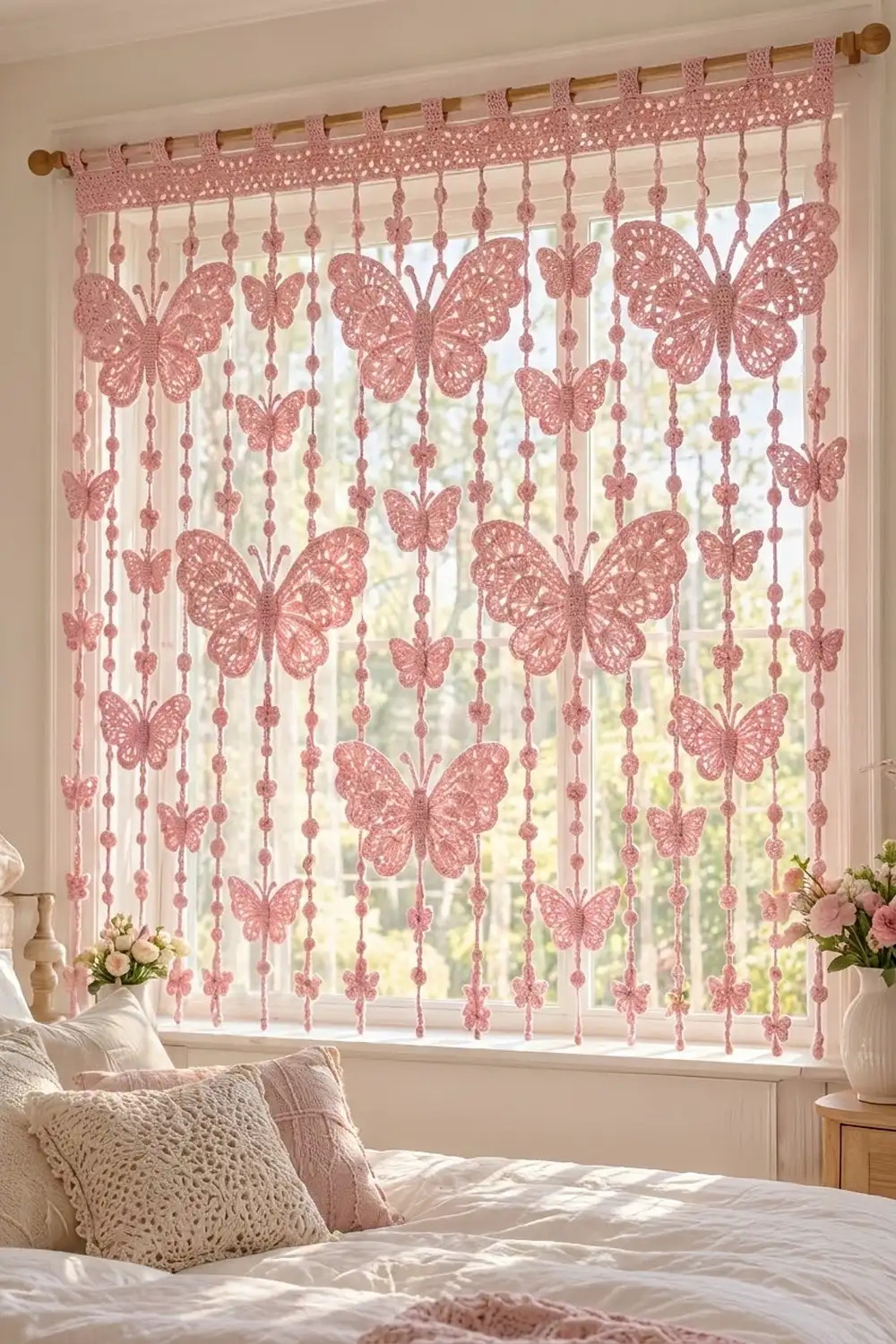
This curtain is a soft wall of pink butterflies. Large lace butterflies and small fan-winged butterflies sit on hanging strands. Little bobbles dot each strand, and a tiny flower finishes each strand at the bottom. A lacy header band with tabs slides onto a curtain rod.
Everything is worked in one rose-pink cotton, so texture does all the work: starburst wing centers, shell rings, fan edges, and a ribbed body. The style is romantic and airy, so light still comes through.
The pattern uses US crochet terms. The finished curtain is 41 in (104.1 cm) wide. The header band is 2.25 in (5.7 cm) deep, and the strands hang 48 in (121.9 cm) below it. That gives a total drop of 50.25 in (127.6 cm) under the tabs.
Construction is modular. You crochet the butterflies, flowers, and strands separately, then sew the butterflies onto the strands. Last, you work the header band. Its final row crochets the strands in.
Finished Size and Construction
- Finished size: 41 in (104.1 cm) wide x 50.25 in (127.6 cm) long, plus tabs
- Skill level: Intermediate
- Terminology: US terms
- Yarn weight: DK (#3) cotton
- Hook: 3.5 mm (E-4)
- Number of pieces: 1 header band, 17 strands, 6 large butterflies, 19 small butterflies, 17 flower beads
- Layout: 17 strands spaced 2.4 in (6.1 cm) apart, with butterflies in 5 tiers
- Piece size: Large butterfly 8 in (20.3 cm) x 6.5 in (16.5 cm); small butterfly 3.75 in (9.5 cm) x 3 in (7.6 cm)
- Size before border: 17 strands, each 48 in (121.9 cm) long
- Border (header band) depth: 2.25 in (5.7 cm), plus 8 folded tabs
Materials
Use a smooth, combed or mercerized DK cotton. It shows stitch detail and keeps the fans crisp. Avoid fuzzy or very stretchy yarns, because the strands carry weight.
- Rose Pink: 350 g / 784 m (857 yd), about 7 balls of 50 g / 112 m (122 yd)
These quantities include a margin of about 20 percent for swatching and tails.
Tools:
– 3.5 mm (E-4) hook
– Tapestry needle
– Stitch markers
– A little fiberfill
– Rustproof pins and a blocking board
– Measuring tape
– Curtain rod up to 1 in (2.5 cm) thick
Abbreviations (US Terms)
- ch: chain
- sl st: slip stitch
- sc: single crochet
- hdc: half double crochet
- dc: double crochet
- tr: treble crochet
- sc2tog: single crochet 2 together
- MR: magic ring
- sp(s): space(s)
- st(s): stitch(es)
Special stitches:
– Shell: (2 dc, ch 1, 2 dc) in the same space.
– 5-dc bobble: [Yarn over, insert hook, pull up a loop, yarn over, pull through 2 loops] 5 times in the same stitch. Yarn over and pull through all 6 loops.
– 3-dc cluster: Work it like the bobble with 3 repeats, then pull through all 4 loops.
– Strand bobble (sb): Ch 3, work a 5-dc bobble in the 3rd ch from the hook, then ch 1 tightly to lock it.
Gauge and Checkpoints
- Fabric gauge: 20 sc and 22 rows = 4 in (10.2 cm)
- Chain gauge: 5 ch = 1 in (2.5 cm), relaxed
Make one large upper wing first. It uses every wing stitch, so it works as your test piece.
Upper wing checkpoints:
– After Round 1: 1.25 in (3.2 cm) across
– After Round 2: 2 in (5.1 cm) across
– After Round 3: 2.75 in (7.0 cm) across
– After Round 5: 3.75 in (9.5 cm) wide x 4.25 in (10.8 cm) long
If the wing is more than 0.25 in (0.6 cm) too big, go down half a hook size. If it is too small, go up half a size. Also check one strand repeat (ch 12 plus 1 sb). It should hang at 3 in (7.6 cm).
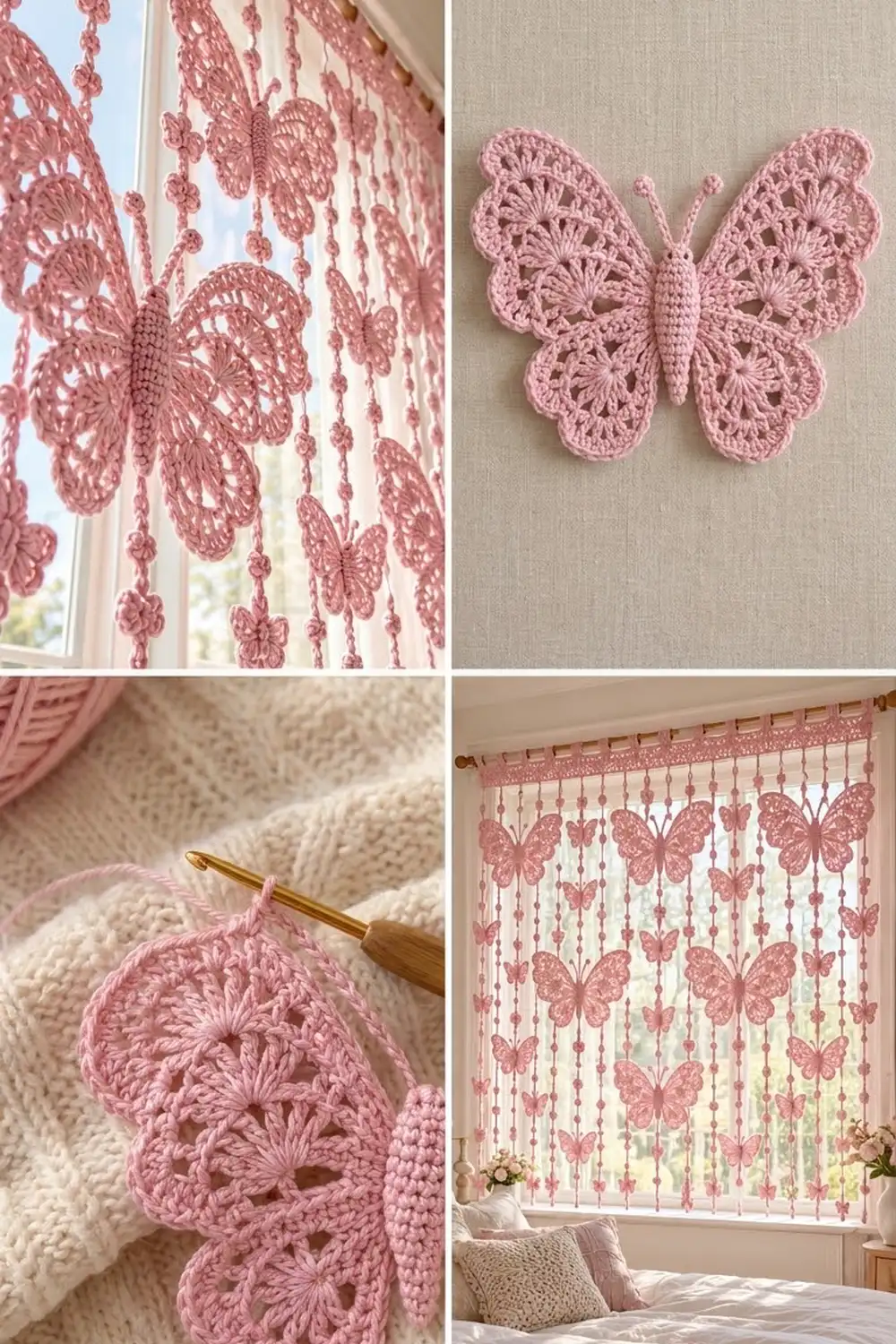
Large Butterfly
Upper Wing (make 2 per butterfly)
Round 1: MR, ch 3 (counts as dc), 15 dc in ring, sl st to top of ch-3. (16 dc) This makes the starburst center.
Round 2: Ch 1, sc in same st, ch 3, skip next dc. Sc in next dc, ch 3, skip next dc. Repeat from * 6 more times, then sl st to first sc. (8 sc, 8 ch-3 sps)
Round 3: Sl st into first ch-3 sp. Ch 3 (counts as dc), then (dc, ch 1, 2 dc) in same sp. Work a shell in each of the next 7 ch-3 sps, then sl st to top of ch-3. (8 shells: 32 dc, 8 ch-1 sps)
Round 4 (teardrop shaping): Ch 1, sc in the gap at the join, between Shell 8 and Shell 1. Then work in each shell’s ch-1 sp as follows:
– Shells 1–2: 7 dc in ch-1 sp, sc in next gap
– Shells 3–5: 7 tr in ch-1 sp, sc in next gap
– Shells 6–7: 7 dc in ch-1 sp, sc in next gap
– Shell 8: 3 hdc in ch-1 sp, then sl st to first sc
The round has 8 sc and 52 fan sts, for 60 sts. The tr fans form the wide outer lobe, and the hdc fan forms the narrow inner point.
Round 5 (solid rim): Ch 1, sc in each st around. Work 2 sc in the center (4th) tr of each tr fan. Sl st to first sc. (60 + 3 = 63 sc)
Fasten off and leave an 8 in (20.3 cm) tail.
Lower Wing (make 2 per butterfly)
Round 1: MR, ch 3, 11 dc in ring, sl st to top of ch-3. (12 dc; 1 in / 2.5 cm across)
Round 2: Ch 1, sc in same st, ch 3, skip 1. Sc in next, ch 3, skip 1. Repeat from * 4 more times, then sl st to first sc. (6 sc, 6 ch-3 sps)
Round 3: Sl st into first sp. Ch 3, then (dc, ch 1, 2 dc) in same sp. Work a shell in each of the next 5 sps, then sl st to top of ch-3. (6 shells: 24 dc, 6 ch-1 sps; 2.25 in / 5.7 cm across)
Round 4: Ch 1, sc in the gap at the join. Then:
– Shells 1–2: 7 dc in ch-1 sp, sc in next gap
– Shells 3–4: 7 tr in ch-1 sp, sc in next gap
– Shell 5: 7 dc in ch-1 sp, sc in next gap
– Shell 6: 3 hdc in ch-1 sp, then sl st to first sc
The round has 6 sc and 38 fan sts, for 44 sts.
Round 5: Ch 1, sc in each st around, with 2 sc in the center tr of each tr fan. Sl st to first sc. (44 + 2 = 46 sc)
The lower wing measures 3 in (7.6 cm) x 3.25 in (8.3 cm). Fasten off with an 8 in (20.3 cm) tail.
Body (make 1 per butterfly)
Work in a continuous spiral and mark the first st of each round.
- Rnd 1: 6 sc in MR. (6)
- Rnd 2: 2 sc in each st. (12)
- Rnd 3: Sc in each st. (12)
- Rnd 4: [Sc 2, sc2tog] 3 times. (9) This forms the neck.
- Rnd 5: [Sc 2, 2 sc in next] 3 times. (12)
- Rnds 6–14: Sc in each st. (12) Then stuff lightly.
- Rnd 15: [Sc 2, sc2tog] 3 times. (9)
- Rnd 16: Sc in each st. (9)
- Rnd 17: [Sc 1, sc2tog] 3 times. (6)
- Rnd 18: Sc2tog 3 times. (3)
Close the end and fasten off. The body is 3.25 in (8.3 cm) long and 0.75 in (1.9 cm) wide.
Antennae (make 2 per butterfly)
Ch 10. Work a 3-dc cluster in the 4th ch from the hook, then sl st in each of the remaining 6 ch. Each antenna is 1.5 in (3.8 cm) long with a knob tip.
Assembly
- Place the two upper wings with their hdc points touching at the center.
- Tuck the hdc points of the lower wings under the upper points, so the upper wings overlap the lower wings by 0.5 in (1.3 cm).
- Whipstitch all four points together.
- Sew the body down the center over the join.
- Sew the antennae to the head in a V.
The finished large butterfly is 8 in (20.3 cm) x 6.5 in (16.5 cm).
Small Butterfly
Upper wing (make 2): MR, ch 3, 11 dc in ring, sl st to top of ch-3. (12 dc)
Next round: Ch 1, sc in same st. Skip 1, 5 dc in next, skip 1, sc in next. Skip 1, 5 tr in next, skip 1, sc in next. Skip 1, 5 dc in next, skip 1, then sl st to first sc. (3 sc + 15 fan sts = 18 sts)
The wing is 1.75 in (4.4 cm) x 2 in (5.1 cm). The first sc is the inner point.
Lower wing (make 2): MR, ch 3, 7 dc in ring, sl st to top of ch-3. (8 dc)
Next round: Ch 1, sc in same st. Skip 1, 5 dc in next, skip 1, sc in next. Skip 1, 5 dc in next, skip 1, then sl st to first sc. (2 sc + 10 dc = 12 sts; 1.25 in / 3.2 cm)
Body: 6 sc in MR. Work 6 rounds of 6 sc. Next round: sc2tog 3 times. (3) The body is 1.5 in (3.8 cm) long and needs no stuffing.
Antennae (make 2): Ch 7. Work a 3-dc cluster in the 4th ch from the hook, then sl st in the remaining 3 ch. (0.75 in / 1.9 cm)
Assemble the small butterfly like the large one. It measures 3.75 in (9.5 cm) x 3 in (7.6 cm).
Flower Bead
MR, [ch 2, 3-dc cluster in ring, ch 2, sl st in ring] 5 times. Close the ring. (5 petals; 1 in / 2.5 cm)
Strand
Work each strand from the bottom up.
1 sb, then [ch 12, sb] 15 times. Ch 12 and fasten off, leaving an 8 in (20.3 cm) tail.
Each strand has 16 bobbles and 16 chain segments: 16 x 3 in = 48 in (121.9 cm). Number the segments from the top, so Segment 1 touches the header. The middle of Segment k hangs (3k − 1.8) in below the band.
Sew a flower bead under the bottom bobble of each strand.
Make All Pieces
All pieces are Rose Pink:
– Large butterflies: 6
– Small butterflies: 19
– Flower beads: 17
– Strands: 17
Layout grid (L = large body, w = strand behind a large wing, s = small butterfly, · = bobbles only):
             S1 S2 S3 S4 S5 S6 S7 S8 S9 S10 S11 S12 S13 S14 S15 S16 S17
Seg 3  7.2"  ·  w  L  w  ·  s  ·  w  L  w   ·   s   ·   w   L   w   ·
Seg 6  16.2" s  ·  ·  ·  s  ·  s  ·  ·  ·   s   ·   s   ·   ·   ·   s
Seg 9  25.2" ·  ·  s  ·  w  L  w  ·  s  ·   w   L   w   ·   s   ·   ·
Seg 11 31.2" s  ·  ·  s  ·  ·  ·  ·  ·  ·   ·   ·   ·   s   ·   ·   s
Seg 14 40.2" ·  ·  s  ·  s  ·  ·  w  L  w   ·   ·   s   ·   s   ·   ·
In centimeters, the depths are 18.3, 41.1, 64.0, 79.2, and 102.1 cm. The grid has 6 L and 19 s, and it mirrors around S9.
Joining
Method: Sew the butterflies to the strands before you work the header.
Stitch-to-stitch logic: Lay the strand behind the body, centered on its grid segment. Each tack passes through one back loop of a body sc and one back bump of a chain. Tack at the head, the middle, and the tail. On large butterflies, also tack each of the four wings at one Round 5 sc to the neighboring strand, 2.4 in (6.1 cm) away.
Tension: Pull only until the pieces touch. Tight tacks pucker the wings and shorten the chain.
Size checkpoint: Each strand still hangs at 48 in (121.9 cm), and each large butterfly is still 8 in (20.3 cm) wide.
Border: Header Band
Border gauge: 20 sc = 4 in (10.2 cm), so 205 sts = 41 in (104.1 cm).
Ch 206.
- Row 1: Sc in 2nd ch from hook and in each ch across. Turn. (205 sc)
- Row 2 (mesh): Ch 4 (counts as dc + ch 1), skip 1, dc in next. Ch 1, skip 1, dc in next. Repeat across. Turn. (103 dc + 102 ch-1 sps = 205)
- Row 3: Ch 1, sc in each dc and each ch-1 sp across. End with sc in the turning-ch sp and in the 3rd ch of the turning ch. Turn. (205 sc)
- Row 4 (fans): Ch 1, sc in first st. Skip 2, 5 dc in next, skip 2, sc in next. Repeat from * 34 times in total. Turn. (170 dc + 35 sc = 205)
- Row 5: Ch 1, sc in each st. Turn. (205)
- Rows 6–7: Repeat Rows 2–3. (205 each)
- Row 8 (strand join): Ch 1, sc in each st. At sts 7, 19, 31, and every 12th st through st 199, insert the hook through both the stitch and a strand’s top chain, then work the sc. (205 sc, 17 strands)
Checkpoints: The band is 1.25 in (3.2 cm) deep after Row 4 and 2.25 in (5.7 cm) after Row 8.
Side counts: Along each short end, work 11 sc: 1 per sc row and 2 per mesh or fan row. The long edges stay at 205 sts each.
Tabs: Work into the free loops of the foundation chain at sts 1, 29, 57, 85, 113, 141, 169, and 197. For each tab, work 15 rows of 9 sc (2.75 in / 7.0 cm). Fold the tab to the back and whipstitch it to Row 2. Each tab is 1.8 in (4.6 cm) wide, with 3.8 in (9.7 cm) gaps between tabs.
Why the math works: 17 strands x 12 + 1 = 205, and 6 x 34 + 1 = 205. That means every strand lands on a fan-row sc, centered in a valley between fans, with 6 sts to spare at each end. For the tabs, 7 even spaces of 28 cover 196 sts. The last tab ends exactly on st 205.
Final Blocking
- Wet the header and butterflies, then roll them in a towel.
- Pin the header to 41 in x 2.25 in (104.1 cm x 5.7 cm).
- Pin each large wing with the tr lobe open and every rim point pinned.
- Pin the small wings so the fans spread.
- Dry completely.
- Hang for 24 hours, then re-measure and even out the strands.
Final Quality-Control Checklist
- Every header row has 205 sts.
- There are 17 strands, 12 sts apart.
- Each strand has 16 bobbles and measures 48 in (121.9 cm).
- The butterflies match the grid: 6 large, 19 small.
- Wing points are hidden under the bodies.
- All 8 tabs fit the rod.
- Tails are woven in twice.
Troubleshooting
- Wings cup: Round 5 is too tight. Loosen up or go up 0.5 mm.
- Wings ruffle: Check that every fan has exactly 7 sts.
- Strands too long: Remove 1 ch per segment.
- Header flares: Go down half a hook size for the mesh rows.
- Butterfly tilts: Add a tack at a lower wing.
Care
Hand wash in cold water, roll in a towel, and dry flat. Re-pin the wings if needed, and hang the curtain only when it is fully dry.
Final Notes
The measurement chain starts with 20 sc = 4 in (10.2 cm), so 205 sts = 41 in (104.1 cm). Strands sit every 12 sts, or 2.4 in (6.1 cm). With 5 ch = 1 in (2.5 cm), each repeat hangs 3 in (7.6 cm), and 16 repeats make 48 in (121.9 cm). Check gauge at every stage and the curtain will hang straight.
Happy crocheting!