

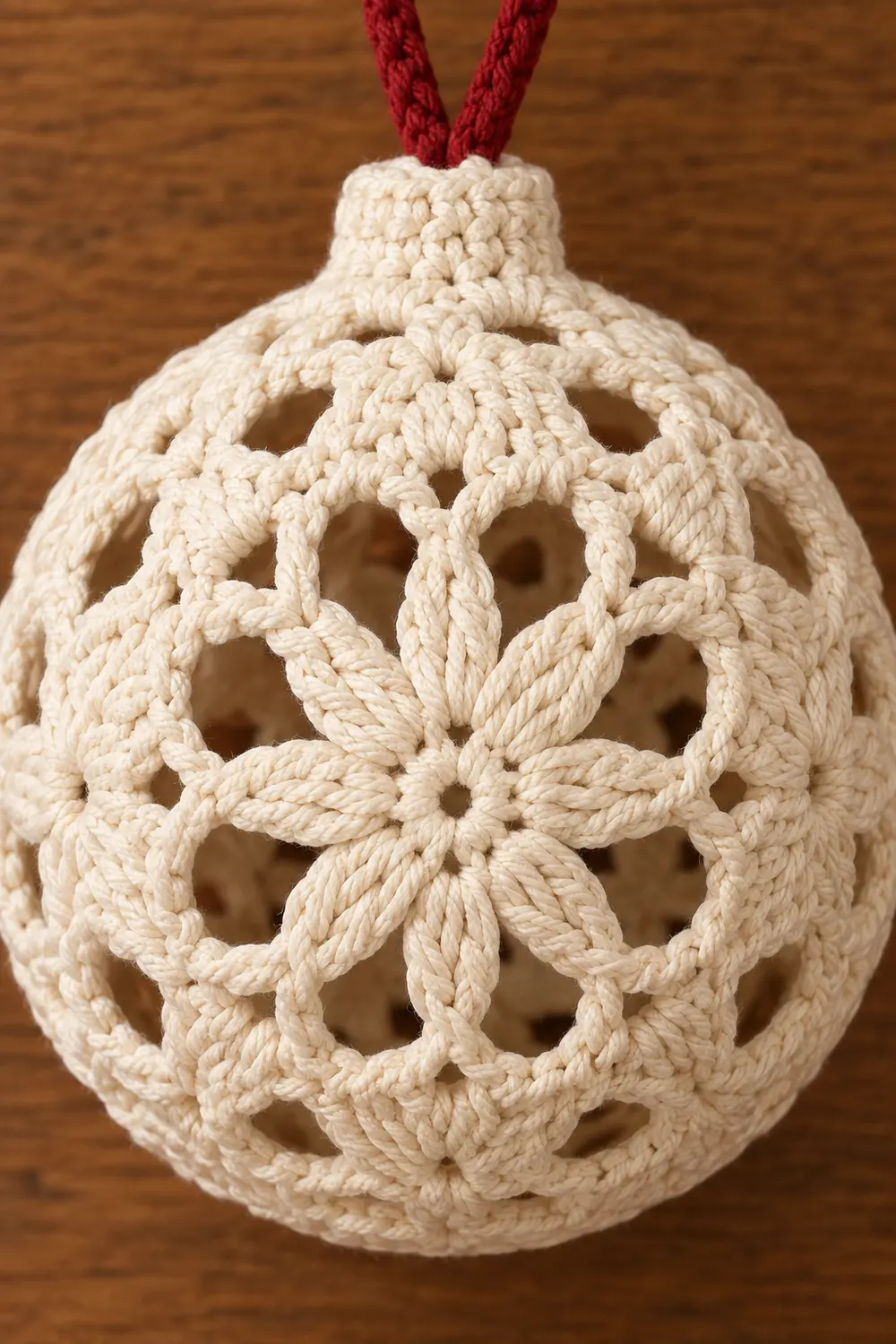
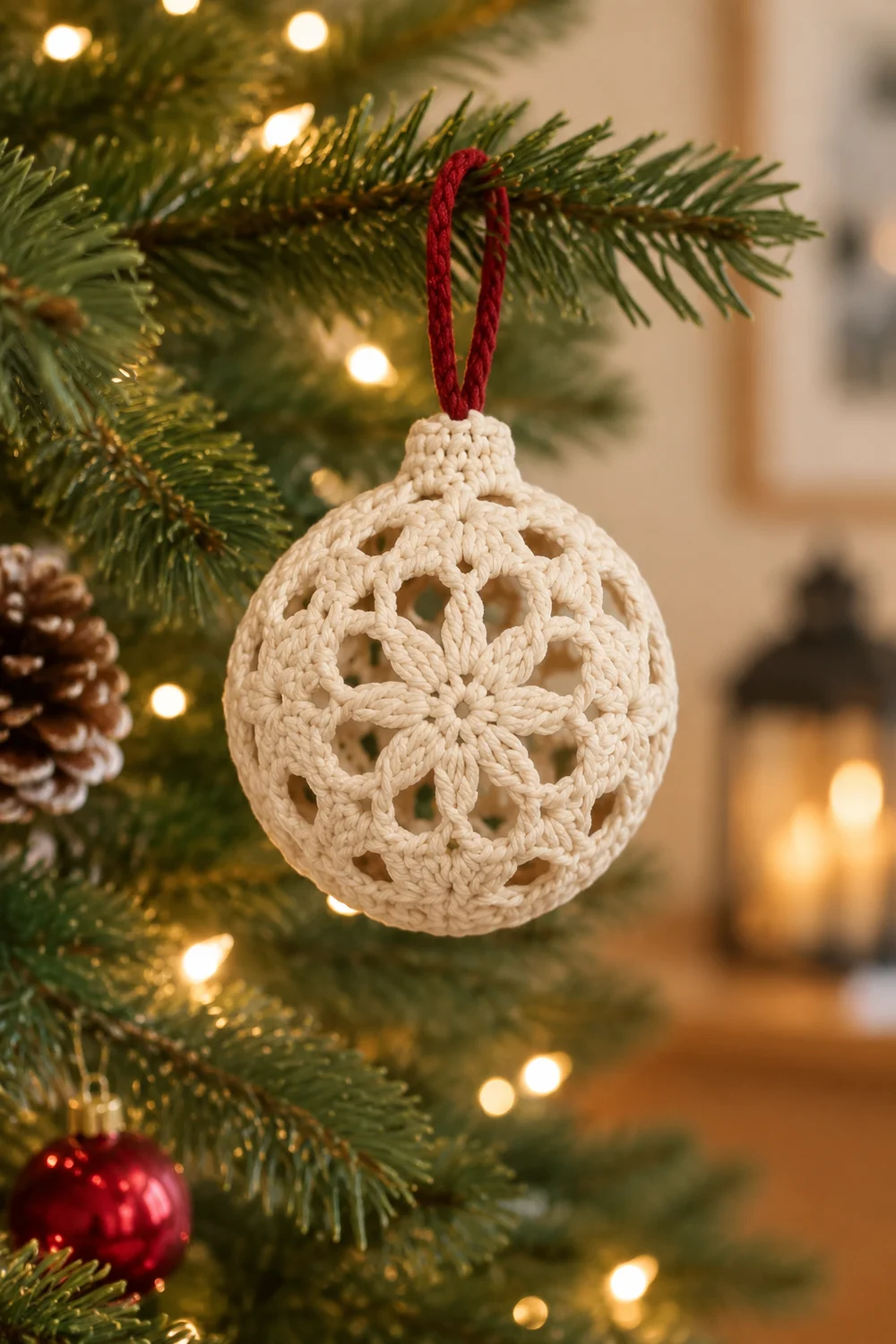
This lacy ornament ball is covered in six-petaled flowers, with open chain spaces between each flower cluster. The result looks airy and a little like a snowflake. It is worked in cream yarn and hangs from a dark red loop at the top.
The style is classic and quiet. One soft cream lace shell sits over a cream ball insert, so the openings read as texture rather than holes. The red loop adds one warm accent that ties it to traditional holiday colors.
The pattern uses US crochet terms. The finished ornament is 3.5 in (8.9 cm) in diameter. With the collar it stands about 4 in (10.2 cm) tall, and the loop adds 1.5 in (3.8 cm) more.
The ornament is worked in one continuous piece from the bottom up. A six-petaled flower forms the base. A band of six six-petaled flowers wraps the equator. The lace then narrows into a ring of six crown petals and a small solid collar. The red hanging loop is made separately and sewn to the top.
Finished Size and Construction
- Finished size: 3.5 in (8.9 cm) diameter; about 4 in (10.2 cm) tall including collar
- Skill level: Intermediate (clusters, multi-leg decrease)
- Terminology: US
- Yarn weight: DK (#3) cotton
- Hook: 3.5 mm (E-4)
- Number of pieces: 1 ornament body worked in one piece, plus 1 attached hanging loop
- Layout: Six-fold radial. There is 1 bottom flower, 6 equator flowers, and a 6-petal crown ring around the collar.
- Piece size: 3.5 in (8.9 cm) ball
- Size before border (collar): Lace body fits the 3.5 in (8.9 cm) ball and ends in a 1.1 in (2.8 cm) opening
- Border (collar) depth: 0.5 in (1.3 cm), then closed
Materials
Use a smooth, mercerized DK cotton. Cotton holds the cluster shapes crisply and does not fuzz over the lace. Avoid fluffy or brushed yarns, because they blur the petals.
- Cream (main): 15 g, about 33 m
- Dark red (loop): 3 g, about 7 m
Tools:
– 3.5 mm (E-4) crochet hook
– 3.5 in (8.9 cm) cream or white plastic or foam ball (stays inside)
– Tapestry needle
– Scissors
– 1 stitch marker
– Small pinch of fiberfill (for the collar)
– Spray bottle with water (optional: light spray starch)
Quantities include a margin of about 25% for gauge swatching and tails.
Abbreviations (US Terms)
- ch – chain
- sl st – slip stitch
- sc – single crochet
- sc2tog – single crochet 2 together
- dc – double crochet
- tr – treble crochet
- sp(s) – space(s)
- st(s) – stitch(es)
- FLO – front loop only
Special stitches:
- Cluster (cl): 3-dc cluster. Yo, insert hook, pull up a loop, yo, pull through 2 loops; repeat 2 more times in the same place. Yo and pull through all 4 loops.
- Beginning cluster (beg cl): Ch 2, then work a 2-dc cluster in the same place.
- Petal: 2-tr cluster. Yo twice, insert hook, pull up a loop, (yo, pull through 2) twice; repeat once in the same place. Yo and pull through all 3 loops.
- Beginning petal (beg petal): Ch 3, then tr in the same place.
- Lower half-flower (LHF): A 6-leg tr decrease. Work an unfinished tr (yo twice, insert, pull up a loop, (yo, pull through 2) twice) as 2 legs in the next ch-sp, 2 legs in the next sc, and 2 legs in the following ch-sp. You now have 7 loops on the hook. Yo and pull through all 7. Ch 1 tightly to close; this ch-1 is the eye. The three leg pairs fan downward as the lower 3 petals of a flower.
Gauge and Checkpoints
There is only one piece, so test with the first two rounds. Work Rnds 1–2 before you commit.
- Sc gauge (collar): 5 sc = 1 in (2.5 cm); 6 rounds = 1 in (2.5 cm)
- After Rnd 2: bottom flower measures 1.5 in (3.8 cm) across
- After Rnd 4: piece measures 3 in (7.6 cm) across when flattened
- After Rnd 6: equator circumference about 11 in (27.9 cm) when eased around the ball
- After Rnd 9 (on the ball): top opening about 2.25 in (5.7 cm) across
- After Rnd 11: opening 1.1 in (2.8 cm) across
If too big: Go down to a 3.25 mm hook. Lace that is too large will sag and slide around the ball.
If too small: Go up to a 3.75 mm hook. Lace that is too small will distort the flowers and won’t close evenly at the top.
Recheck the Rnd 2 flower after any hook change.
Pattern: Bottom Flower
Work in joined rounds. Do not turn. Place a marker in the first stitch of each round.
Rnd 1: Make a magic ring. Ch 1, 12 sc into the ring. Pull the ring tight and join with a sl st to the first sc. (12 sc)
The ring should be about 0.5 in (1.3 cm) across.
Rnd 2: Beg cl in the same st, ch 3, skip next st. Cl in next st, ch 3, skip next st; repeat from * 4 more times. Join to the top of the beg cl. (6 cl, 6 ch-3 sps)
Math check: 6 cl + 6 skipped sts = 12 sts, which matches Rnd 1. This is the six-petaled bottom flower.
Pattern: Lower Mesh
Rnd 3: Sl st into the first ch-3 sp. Ch 1, sc in the same sp, ch 5, sc in the top of the next cl, ch 5. Sc in next ch-3 sp, ch 5, sc in top of next cl, ch 5; repeat from * 4 more times. Join to the first sc. (12 sc, 12 ch-5 sps)
Rnd 4: Sl st into the first ch-5 sp. Ch 1, sc in the same sp, ch 6. Sc in next ch-5 sp, ch 6; repeat from * 10 more times. Join to the first sc. (12 sc, 12 ch-6 sps)
Checkpoint: the piece measures 3 in (7.6 cm) across and begins to cup.
Pattern: Equator Flowers
These two rounds build six six-petaled flowers. Rnd 5 makes the 3 lower petals of each flower. Rnd 6 makes the 3 upper petals from the same eye.
Rnd 5: Ch 1, sc in the same st as the join. Ch 4, LHF (legs in next ch-6 sp, next sc, next ch-6 sp), ch 1 to close the eye, ch 4, sc in next sc. Repeat from * 5 more times. On the last repeat, replace the final sc with a sl st into the first sc.
(6 sc, 6 LHF with eyes, 12 ch-4 sps)
Math check: each repeat uses 2 sc and 2 ch-6 sps from Rnd 4. Six repeats use 12 sc and 12 sps, which is all of them.
Rnd 6: Sl st in each of the next 4 ch, then sl st into the first eye.
Work the first fan in this eye: beg petal, ch 3, petal, ch 3, petal. Then ch 4, dc in the next sc from Rnd 5, ch 4.
Work a fan in the next eye: (petal, ch 3, petal, ch 3, petal). Ch 4, dc in next sc, ch 4. Repeat from * 4 more times. Join to the top of the beg petal.
(18 petals, 12 ch-3 sps, 6 dc, 12 ch-4 sps)
Each eye now has 3 petals below it and 3 above it, making 6 complete six-petaled flowers. The ch-4 spaces and dc between the flowers form the open windows.
Pattern: Upper Mesh
Rnd 7: Ch 1, sc in the top of the same petal. Ch 4, sc in the top of the next petal, ch 4, sc in the top of the next petal, ch 5, sc in the next dc, ch 5.
(Sc in top of next petal, ch 4) twice, sc in top of next petal, ch 5, sc in next dc, ch 5; repeat from * 4 more times. Join to the first sc.
(24 sc, 12 ch-4 sps, 12 ch-5 sps)
Insert the ball now. Ease the 3.5 in (8.9 cm) ball into the lace. Center the bottom flower on the base, and keep the six equator flowers evenly spaced.
Rnd 8: Sl st in each of the next 4 ch, then sl st in the next sc (the middle-petal sc). Ch 1, sc in the same sc, ch 5, skip the next sc, sc in the next sc (above the dc), ch 5, skip the next sc.
Sc in next sc (middle petal), ch 5, skip next sc, sc in next sc (above dc), ch 5, skip next sc; repeat from * 4 more times. Join to the first sc.
(12 sc, 12 ch-5 sps)
This is a decrease round. Each ch-5 now spans two Rnd 7 spaces, which draws the lace in over the top of the ball.
Rnd 9: Sl st into the first ch-5 sp. Ch 1, sc in the same sp, ch 4. Sc in next ch-5 sp, ch 4; repeat from * 10 more times. Join to the first sc.
(12 sc, 12 ch-4 sps)
Checkpoint: the opening is about 2.25 in (5.7 cm) across on the ball.
Pattern: Crown Petals
Rnd 10: Sl st into the first ch-4 sp. Beg cl in the same sp, ch 2, sc in the next ch-4 sp, ch 2.
Cl in next ch-4 sp, ch 2, sc in next ch-4 sp, ch 2; repeat from * 4 more times. Join to the top of the beg cl.
(6 cl, 6 sc, 12 ch-2 sps)
The six clusters point up toward the collar. Seen from above, they form a six-petaled flower around the collar, mirroring the bottom flower.
Rnd 11 (conversion round): Ch 1, sc in the top of the first cl, sc in the next ch-2 sp, skip the sc, sc in the next ch-2 sp. Sc in top of next cl, sc in next ch-2 sp, skip next sc, sc in next ch-2 sp; repeat from * 4 more times. Join.
(18 sc)
Count: 6 cl tops × 1 sc + 12 ch-2 sps × 1 sc = 18 sc. The 6 Rnd 10 sc are skipped. There are 3 sc per repeat.
Border: Collar and Cap
The collar is the ornament’s only solid edge.
Border gauge: 5 sc = 1 in (2.5 cm); 6 rounds = 1 in (2.5 cm). This is the same sc gauge as your gauge check.
Rnd 12: Ch 1, sc in each st around. Join. (18 sc: 18 worked 1-per-existing-st, 0 added; 3 per repeat)
Rnd 13: Repeat Rnd 12. (18 sc)
Rnd 14: Repeat Rnd 12. (18 sc)
The collar now stands 0.5 in (1.3 cm) tall. Tuck a small pinch of fiberfill into it so the cap stays round.
Rnd 15: Sc in next st, sc2tog; repeat from * 5 more times. (12 sc; 2 per repeat)
Rnd 16: Sc2tog 6 times. (6 sc; 1 per repeat)
Fasten off, leaving an 8 in (20.3 cm) tail. Weave the tail through the FLO of the 6 sts, pull tight, and secure.
Why the math works: 18 is divisible by 6, so each crown petal repeat feeds exactly 3 collar stitches. At 5 sc per inch, 18 sc make a 3.6 in (9.1 cm) circumference, which is about 1.1 in (2.8 cm) across. That matches the narrow top of the ball. The cap decreases by 6 sts per round (18, 12, 6), or 1 st per repeat, so it closes flat without puckering.
Hanging loop (dark red): Ch 20, about 3 in (7.6 cm). Sl st in the back bump of the 2nd ch from the hook and in each ch across. (19 sl st)
Fasten off, leaving a 6 in (15.2 cm) tail. Fold the cord in half and sew both ends to the center of the cap. The loop hangs 1.5 in (3.8 cm) above the collar.
Final Blocking
- Weave in all cream ends inside the collar or along chain spaces. Do not weave through clusters.
- Lightly mist the whole ornament with water, or with diluted spray starch for a crisper finish.
- Ease each equator flower so its eye sits on the widest part of the ball.
- Spread each fan so the three upper petals sit evenly, with the ch-3 spaces open.
- Center the bottom flower over the base and straighten the crown petals so they point to the collar.
- Roll the collar between your fingers so it stands straight.
- Let it dry fully, about 4 hours, hanging by the loop.
Final Quality-Control Checklist
- Diameter is 3.5 in (8.9 cm) all around
- There is 1 bottom flower with 6 even petals
- There are 6 equator flowers, each with 3 lower and 3 upper petals
- All 6 eyes are closed tightly and have no gaps
- Chain spaces are open and similar in size
- There are 6 crown petals, evenly spaced
- Collar is 0.5 in (1.3 cm) tall with a closed, flat cap
- Red loop is centered and sewn securely
- No visible ends
Troubleshooting
Flowers spiral around the ball: Your joins are drifting. Always join into the stated stitch, and recount each round’s repeats.
Eye has a hole: Pull the closing ch-1 snug, then tighten it from inside with the tail or a nearby end.
Lace is too loose over the ball: Remake with a 3.25 mm hook, or shorten the Rnd 4 chains from ch 6 to ch 5.
Lace won’t reach the top: Your chains are tight. Go up a hook size for the mesh rounds only.
Collar flares: Your sc tension is loose. Work Rnds 12–14 with a hook 0.25 mm smaller.
Ball shows through the cap: Add a little more fiberfill before Rnd 15.
Loop tilts: Re-sew both loop ends into the same center stitches.
Care
Spot clean with a damp cloth. If needed, hand wash in cool water with the ball inside, reshape, and hang to dry.
Final Notes
The measurement chain runs as follows:
- Rnd 2 flower: 1.5 in (3.8 cm)
- Rnd 4, flattened: 3 in (7.6 cm)
- Rnd 6 equator: 11 in (27.9 cm) around a 3.5 in (8.9 cm) ball
- Rnd 9 opening: 2.25 in (5.7 cm)
- Rnd 11: 18 sc and a 1.1 in (2.8 cm) collar, 0.5 in (1.3 cm) tall
- Red loop: 1.5 in (3.8 cm)
If each checkpoint matches, the flowers will land exactly where they belong.
Optional: make several in different yarn colors for a matching set.
Happy crocheting!