

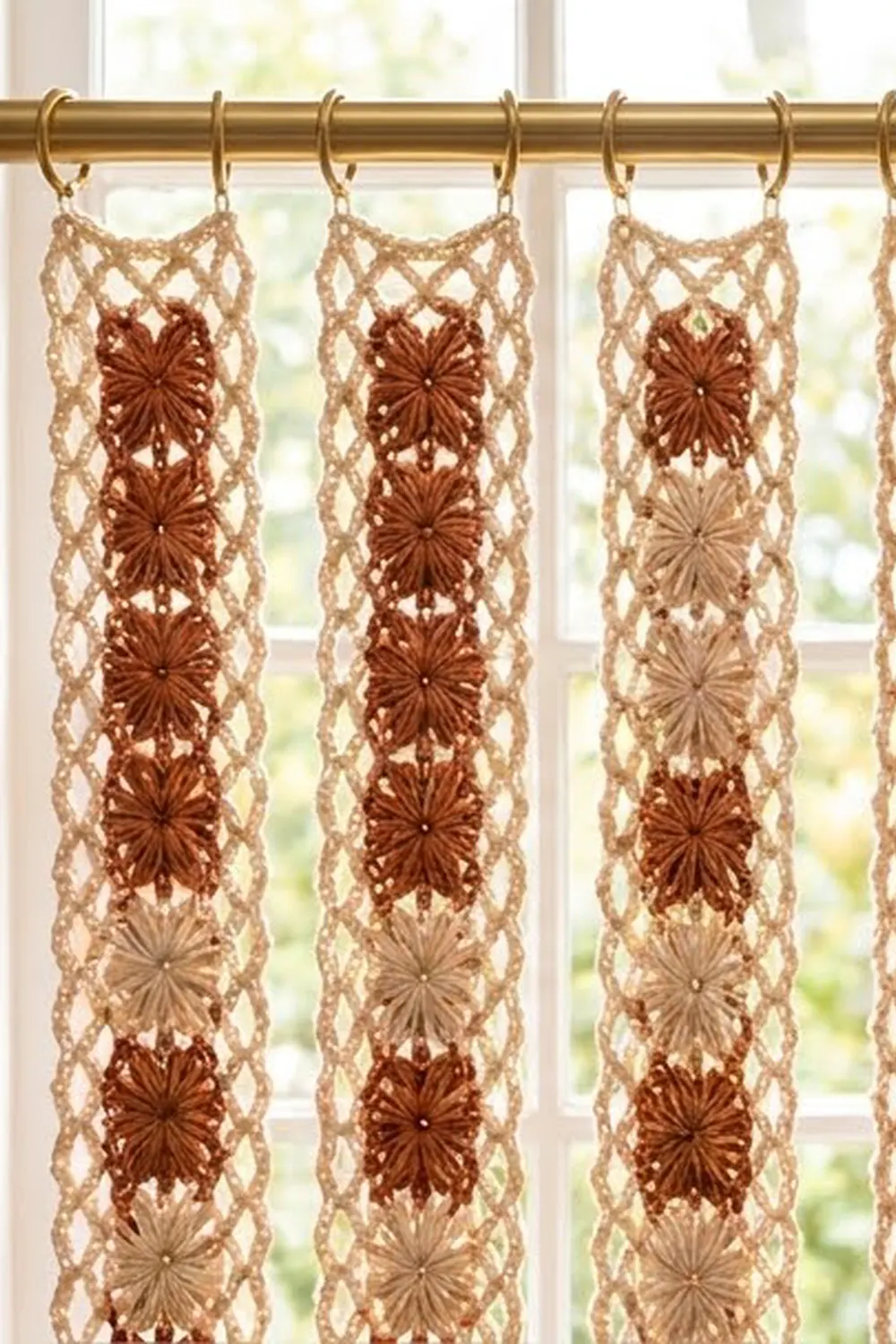
The Starlight Lattice Curtain is a light, open curtain built from vertical flower strips. Each strip has a column of star-shaped puff flowers in a cream frame, with a cream diamond lattice running down both sides. The strips are joined with a chain zigzag that keeps the mesh open, so daylight filters through the gaps.
The palette is warm terracotta and natural cream. Four strips have all-terracotta flowers. Three strips alternate terracotta and cream flowers. The strips are set side by side in alternation, which gives the curtain a soft striped rhythm.
The pattern uses US crochet terms. The finished curtain measures about 47.5 in wide × 67 in long (120.7 cm × 170.2 cm), a good size for a standard window or a café-style door panel.
Here is how it’s built. You make small square flower motifs, join them into columns of 21, and work two lattice rounds around each column to make a strip. Then you join the 7 strips with a zigzag chain and finish with a 2-round border.
Finished Size and Construction
- Finished size: 47.5 in × 67 in (120.7 cm × 170.2 cm)
- Skill level: Intermediate
- Terminology: US crochet terms
- Yarn weight: Worsted (#4) cotton
- Hook: 4.5 mm (US 7)
- Number of pieces: 147 flower motifs, joined into 7 strips
- Layout: 7 strips side by side; each strip is 1 motif wide × 21 motifs tall
- Motif size: 3 in (7.6 cm) square
- Strip size (after lattice): 6 in × 66 in (15.2 cm × 167.6 cm)
- Size before border: 46.5 in × 66 in (118.1 cm × 167.6 cm)
- Border depth: 0.5 in (1.3 cm) per side
Materials
Use a smooth, mercerized or matte worsted-weight cotton. Cotton hangs straight, holds the puff texture well, and doesn’t stretch much under its own weight. Acrylic tends to sag over a long drop like this one.
- Color A – Cream: about 1,250 g / 1,940 m (motif frames, cream flowers, lattice, joins, border)
- Color B – Terracotta: about 280 g / 435 m (flower centers)
Tools:
– 4.5 mm (US 7) crochet hook
– Tapestry needle
– Stitch markers
– Measuring tape
– Blocking mats and rust-proof pins
– Spray bottle
– About 15 curtain clip rings for hanging
Quantities include a margin of about 15% for gauge swatches and differences in tension.
Abbreviations (US Terms)
- ch – chain
- sl st – slip stitch
- sc – single crochet
- dc – double crochet
- sp(s) – space(s)
- st(s) – stitch(es)
- BLO – back loop only
- puff – puff stitch (see below)
Special stitch – Puff: (Yo, insert hook into ring, yo, pull up a loop to about 0.75 in / 1.9 cm tall) 4 times. You now have 9 loops on the hook. Yo and pull through all 9 loops, then ch 1 to lock. The ch 1 doesn’t count as a stitch.
Gauge and Checkpoints
Gauge: 11 sc = 3 in (7.6 cm). One finished motif measures 3 in (7.6 cm) square.
Make one complete motif before anything else, and measure it after a light steam or spritz.
- After Round 1: the flower is about 2.25 in (5.7 cm) across.
- After Round 2: the motif is about 2.75 in (7.0 cm) square.
- After Round 3: the motif is 3 in (7.6 cm) square.
If your motif is larger than 3 in (7.6 cm), go down a hook size. If it’s smaller, go up a hook size. Even an extra 0.1 in (0.3 cm) per motif adds 2.1 in (5.3 cm) to each 21-motif strip, so get gauge right now.
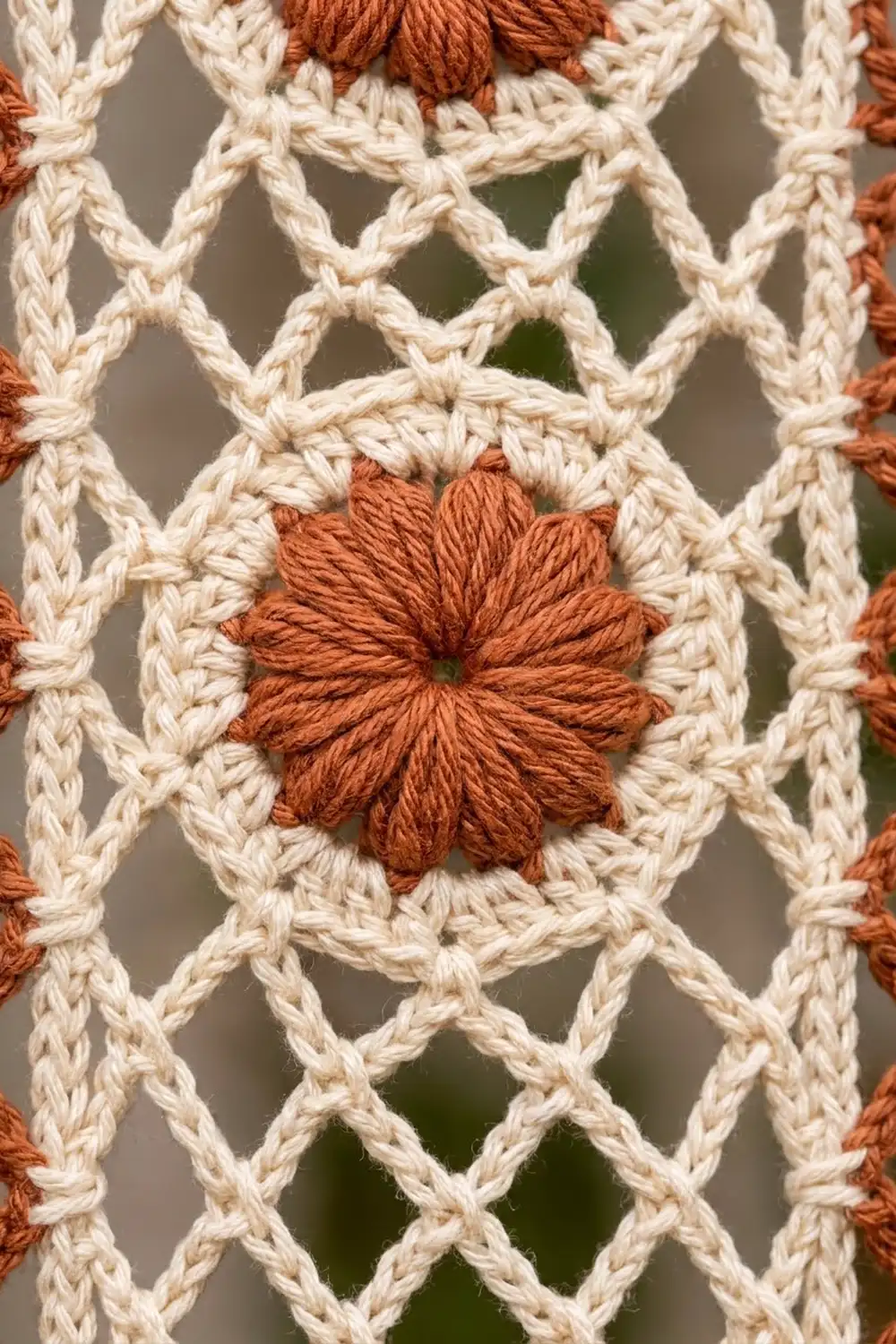
Flower Motif
The flower round is worked in the flower color: Color B for terracotta flowers, Color A for cream flowers. Rounds 2 and 3 are always worked in Color A.
Round 1 (flower color): Make a magic ring. Ch 2, then work a puff into the ring. Ch 2, puff into ring; repeat from * to * 6 more times, then ch 2. Sl st to the top of the first puff. Pull the ring tight. (8 puffs, 8 ch-2 sps) Fasten off.
The 8 tall puffs fan out evenly to make the star-shaped flower.
Round 2 (Color A): Join with a sl st in any ch-2 sp. Ch 3 (counts as dc). In the same sp work (dc, ch 2, 2 dc) for the first corner. 3 sc in the next ch-2 sp; (2 dc, ch 2, 2 dc) in the next ch-2 sp; repeat from * to * 2 more times. 3 sc in the last ch-2 sp. Sl st to the top of the beginning ch 3.
(28 sts: 7 sts per side + 4 corner ch-2 sps)
The dc corners square off the round flower, and the 3-sc groups sit flat against the middle of each side.
Round 3 (Color A): Ch 1. Sc in each st around, working 3 sc in each corner ch-2 sp. Sl st to the first sc.
(40 sts)
The middle sc of each 3-sc group is that side’s corner stitch. Each side has 11 sts, counting both corner sts. Check: 4 sides × 11 − 4 shared corners = 40. ✓
Fasten off and weave in the ends.
Make All Pieces
Make 147 motifs:
- Terracotta-flower motifs: 117 (84 for the four A strips + 33 for the three B strips)
- Cream-flower motifs: 30 (for the three B strips)
Strip A (make 4): 21 terracotta-flower motifs.
Strip B (make 3): 21 motifs, alternating terracotta and cream flowers, starting and ending with terracotta (11 terracotta + 10 cream).
Layout (T = terracotta flower, C = cream flower; the pattern repeats to 21 rows):
Strip:  1  2  3  4  5  6  7
        A  B  A  B  A  B  A
Row 1   T  T  T  T  T  T  T
Row 2   T  C  T  C  T  C  T
Row 3   T  T  T  T  T  T  T
Row 4   T  C  T  C  T  C  T
...
Row 21  T  T  T  T  T  T  T
Joining Motifs into Columns
Hold two motifs right sides together. With Color A, sl st through the back loops of both layers, matching stitch to stitch along one side: 11 sts to 11 sts, corner sts included. Join all 21 motifs of a strip into one straight column.
Column checkpoint: 3 in × 63 in (7.6 cm × 160.0 cm).
Each long edge of the column has 21 × 11 = 231 sts. Each short edge has 11 sts.
Lattice Rounds (Each Strip)
Lattice Round 1: With Color A, join in the top right corner st of the column. Work (sc, ch 5, sc) in the corner st. Along the side, (ch 5, skip 4 sts, sc in the next st) until you reach the next corner st, making your last sc of the side in that corner st as the first sc of its corner group.
- Long sides: 1 + (5 × 46) = 231, so you get 46 loops per long side.
- Short sides: 1 + (5 × 2) = 11, so you get 2 loops per short side.
Sl st to the first sc.
(100 loops: 46 + 46 + 2 + 2 + 4 corner loops)
Lattice Round 2: Sl st into the center of the next loop. Ch 5, sc in the next loop, and in each corner loop work (sc, ch 5, sc). Ch 5 and sl st to the start.
(104 loops: 47 on each long side, 3 on each short side, 4 corner loops)
Each Round 2 loop sits over a gap between two Round 1 loops, which forms the diamond mesh. On each long edge the loops step out into two rows of diamonds.
Strip checkpoint: 6 in × 66 in (15.2 cm × 167.6 cm).
For joining and the border, count each long edge as 47 loops and each short edge as 5 loops (1 corner + 3 + 1 corner). Check: 47 + 47 + 5 + 5 = 104. ✓
Joining
Lay the strips flat in order, A-B-A-B-A-B-A, right sides up, with the long edges side by side.
Zigzag join: With Color A, join with sc in the bottom corner loop of the left strip. Ch 3 and sc in the bottom corner loop of the right strip. Ch 3, sc in the next loop of the left strip; ch 3, sc in the next loop of the right strip. Repeat from * to * up the edge until all 47 long-edge loops on each strip are joined. Finish with ch 3, sc in the top corner loop of the left strip, ch 3, sc in the top corner loop of the right strip. Fasten off.
Stitch-to-stitch logic: Each strip has 49 joined loops along the seam: 1 corner + 47 + 1 corner. Each loop on one strip lines up with the matching loop on the other strip, so the strips stay level from bottom to top. There are 97 ch-3 segments per seam. No loops are added or skipped.
Tension: Keep the ch-3 segments relaxed and even, about the same height as one lattice loop. If they’re too tight, the seams will pucker. If they’re too loose, the strips will droop apart.
Make 6 seams in total.
Size checkpoint: 7 strips × 6 in + 6 gaps × 0.75 in = 46.5 in × 66 in (118.1 cm × 167.6 cm).
Border
Border gauge: 5 sc worked into one ch-5 loop measures about 1.36 in (3.5 cm). That matches the 5-stitch spacing of the lattice, so the edge lies flat without rippling or pulling in.
Starting loop counts per side:
– Top and bottom: 7 strips × 5 loops = 35 loops each. This includes each strip’s corner loops; no loops are added at the seams.
– Long sides: 47 loops each (the outer edges of strips 1 and 7).
The 4 corner loops at the outer corners of the curtain become the curtain’s corners.
Border Round 1: With Color A, join in any loop. Work 5 sc in each loop around. In each of the 4 curtain corner loops, work (3 sc, ch 2, 3 sc) instead. Where a strip’s corner loop already holds a join sc, work over that sc into the loop as usual. Sl st to the first sc.
For the border, side counts are defined to exclude the corner ch-2 sps:
– Top and bottom: 3 + (33 × 5) + 3 = 171 sc each
– Long sides: 3 + (47 × 5) + 3 = 241 sc each
– Total: 824 sc. Check: 160 regular loops × 5 + 4 corner loops × 6 = 824. ✓
Border Round 2: Ch 1. Sc in each sc around, working (sc, ch 2, sc) in each corner ch-2 sp. Sl st to the first sc.
– Top and bottom: 171 + 2 = 173 sc each
– Long sides: 241 + 2 = 243 sc each
– Total: 832 sc (824 + 8). ✓
Fasten off and weave in the ends.
Why the math works: At gauge, 171 sc ÷ 3.67 sc per in ≈ 46.6 in, which matches the 46.5 in (118.1 cm) width. On the long sides, 241 sc ≈ 65.7 in, which matches the 66 in (167.6 cm) length. Because the border follows the lattice measurements, the edges stay flat. The 2 rounds add 0.5 in (1.3 cm) on every side.
Final size: 47.5 in × 67 in (120.7 cm × 170.2 cm).
Final Blocking
- Lay the curtain flat on blocking mats, or on clean towels on the floor.
- Spritz evenly until the yarn is damp, not soaked.
- Pin the four outer corners to 47.5 in × 67 in (120.7 cm × 170.2 cm).
- Pin along the long sides every 6 in (15.2 cm), keeping each strip straight.
- Gently open the lattice diamonds with your fingers so each loop forms a clear point.
- Shape each puff flower so its petals fan out evenly.
- Let it dry completely, then unpin.
- Clip the rings to the top border, one at each outer corner and the rest spaced evenly, about every 3.4 in (8.6 cm).
Final Quality-Control Checklist
- Every motif measures 3 in (7.6 cm) square, with 11 sts per side.
- Each strip has 21 motifs, and the flower colors match the layout chart.
- Each strip measures 6 in × 66 in (15.2 cm × 167.6 cm).
- Each long edge has 47 lattice loops and each short edge has 5.
- All 6 seams use the zigzag join with even ch-3 segments.
- The border counts are 173 sc top and bottom and 243 sc on each long side.
- The finished curtain measures 47.5 in × 67 in (120.7 cm × 170.2 cm).
- All ends are woven in securely.
Troubleshooting
- Puffs look flat: Pull each loop up taller, to the full 0.75 in (1.9 cm).
- Motif is cupping: Round 2 is too tight. Loosen the dc corners or go up a hook size.
- Strips are different lengths: Recount each strip’s motifs (there should be 21) and check the motif size.
- Lattice twists: Make sure each sc goes into the center of the loop, not around the chain.
- Seams gape or pucker: Adjust the ch-3 segments to match the height of the lattice loops.
- Border ripples: Check your border gauge. Work 4 sc per loop only if your loops are noticeably shorter.
Care
Hand wash in cool water and lay flat to dry. Don’t hang the curtain while it’s wet, because the weight will stretch it.
Final Notes
The size of the whole curtain comes from one measurement: the 3 in (7.6 cm) motif. Twenty-one motifs make a 63 in (160.0 cm) column. Two lattice rounds bring each strip to 6 in × 66 in (15.2 cm × 167.6 cm). Seven joined strips measure 46.5 in (118.1 cm) across, and the 2-round border finishes the curtain at 47.5 in × 67 in (120.7 cm × 170.2 cm). Check your counts at each stage and every later stage will fit.
Happy crocheting!