

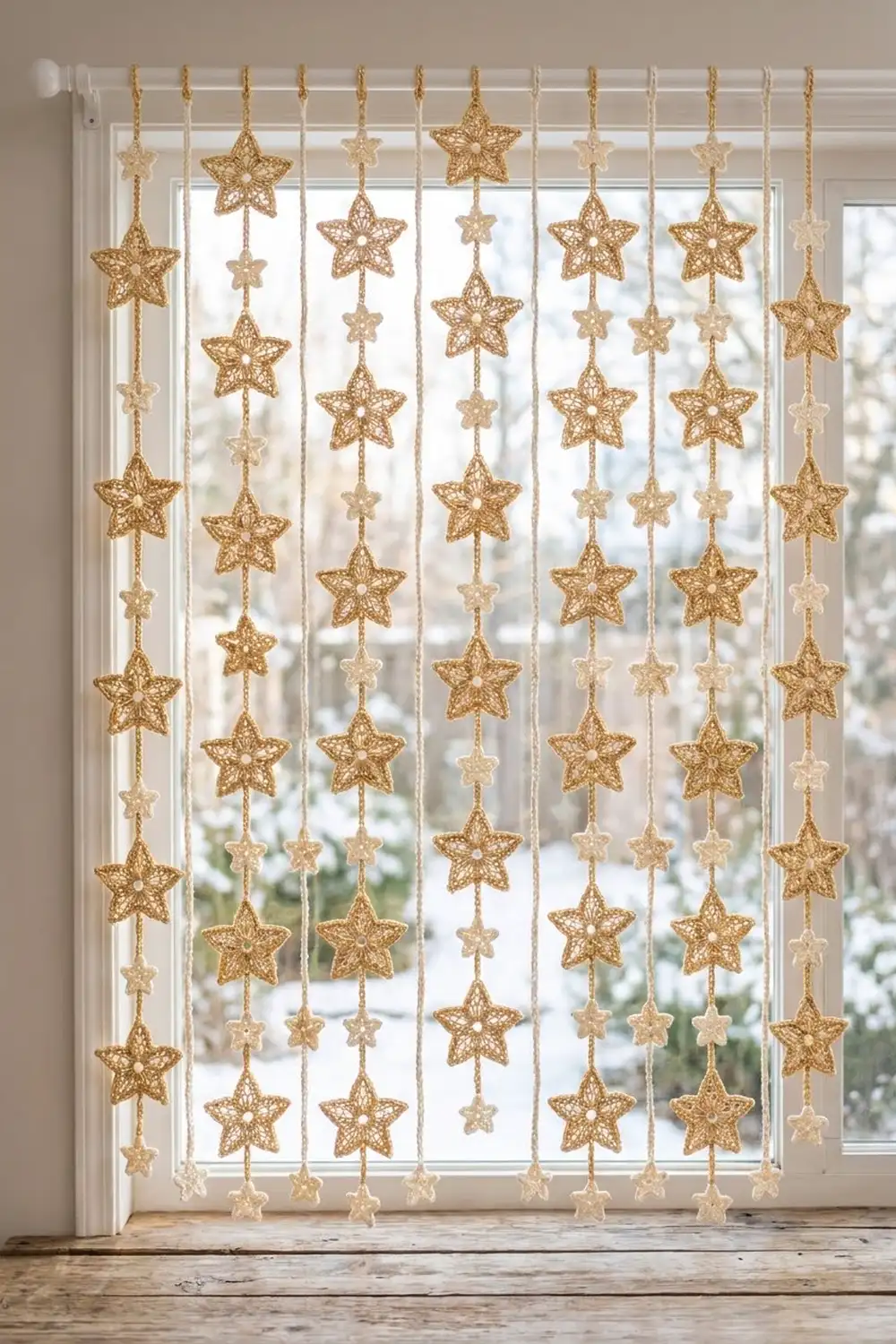
This window curtain is made of hanging chain strands. Each strand carries lacy gold stars and small solid cream stars that alternate down its length. Light comes through the open centers and eyelets of the big stars, and the little cream stars sit between them, so the whole panel twinkles without blocking the view.
The palette is just two colors: a warm gold and a soft cream. The style is light, a bit Scandinavian, and suits a Christmas window, though it can stay up all winter. Everything uses US crochet terms.
The finished panel is about 36 in (91.4 cm) wide on the rod. Each strand hangs 49.6 in (126.0 cm) below its loop. Large stars measure 4.5 in (11.4 cm) across the widest points, and small stars measure 2 in (5.1 cm).
Construction is modular. You crochet the stars separately, chain 12 gold cords, tack the stars onto the cords in a staggered order, and then finish the top of each cord with a reinforced hanging loop.
Finished Size and Construction
- Finished panel: about 36 in (91.4 cm) wide x 49.6 in (126.0 cm) long, plus hanging loops
- Skill level: Easy-Intermediate
- Terminology: US
- Yarn weight: DK (light worsted, #3)
- Hook: 3.5 mm (E-4)
- Number of pieces: 12 cords, 72 large stars, 72 small stars
- Layout: 12 strands spaced 3 in (7.6 cm) apart, with 6 large and 6 small stars per strand
- Piece size: large star 4.5 in (11.4 cm); small star 2 in (5.1 cm)
- Size before top edge: each cord is 248 chains, 49.6 in (126.0 cm)
- Top edge depth: a 25-chain loop, 5 in (12.7 cm) around, reinforced with 30 sc
Materials
Choose a smooth cotton or cotton-blend DK yarn with about 230 m per 100 g. Cotton holds the star points crisply and doesn’t stretch much when the strands hang for weeks. A slight sheen on the gold helps it catch the light.
- Gold: 245 g (about 564 m) for the large stars and all 12 cords
- Cream: 55 g (about 127 m) for the small stars
Each large star uses about 6 m of yarn, each small star about 1.5 m, and each cord with its loop about 4.5 m. The quantities above include a margin of roughly 15% for swatching and tails.
Tools:
- 3.5 mm (E-4) crochet hook
- Tapestry needle
- Locking stitch markers (about 30)
- Scissors and a tape measure
- Blocking mat, rust-proof pins, and a spray bottle
- A curtain rod up to 1.25 in (3.2 cm) in diameter
Abbreviations (US Terms)
- ch – chain
- sl st – slip stitch
- sc – single crochet
- hdc – half double crochet
- dc – double crochet
- tr – treble crochet (yarn over twice)
- dtr – double treble crochet (yarn over 3 times)
- sc2tog – single crochet 2 together
- sp – space
- st(s) – stitch(es)
Special stitch – sc2tog across the valley: Insert hook in the last hdc of one point, yarn over, and pull up a loop. Insert hook in the first hdc of the next point, yarn over, and pull up a loop. Yarn over and pull through all 3 loops. This skips the sc between the two hdc and pulls the valley inward.
Gauge and Checkpoints
Before anything else, make one large star, one small star, and a 50-chain test cord. These three samples tell you everything you need.
- Chain gauge: 5 ch = 1 in (2.5 cm), so 50 ch = 10 in (25.4 cm), measured with light tension.
- Large star, after Round 1: 1.5 in (3.8 cm) across, with a center hole of about 0.5 in (1.3 cm).
- Large star, after Round 2: about 2.75 in (7.0 cm) across the ch-5 loops.
- Large star, after Round 3: about 4 in (10.2 cm) from tip to tip.
- Large star, finished: 4.5 in (11.4 cm) across the widest points, after blocking.
- Small star, finished: 2 in (5.1 cm) across, with Round 1 measuring 1 in (2.5 cm).
If your stars are more than 0.2 in (0.5 cm) too big, go down half a hook size. If they’re too small, go up half a size. If only the chain gauge is off, keep your star hook and chain the cords with a hook one size different. Cord length matters most for keeping the strands even, so check it carefully.
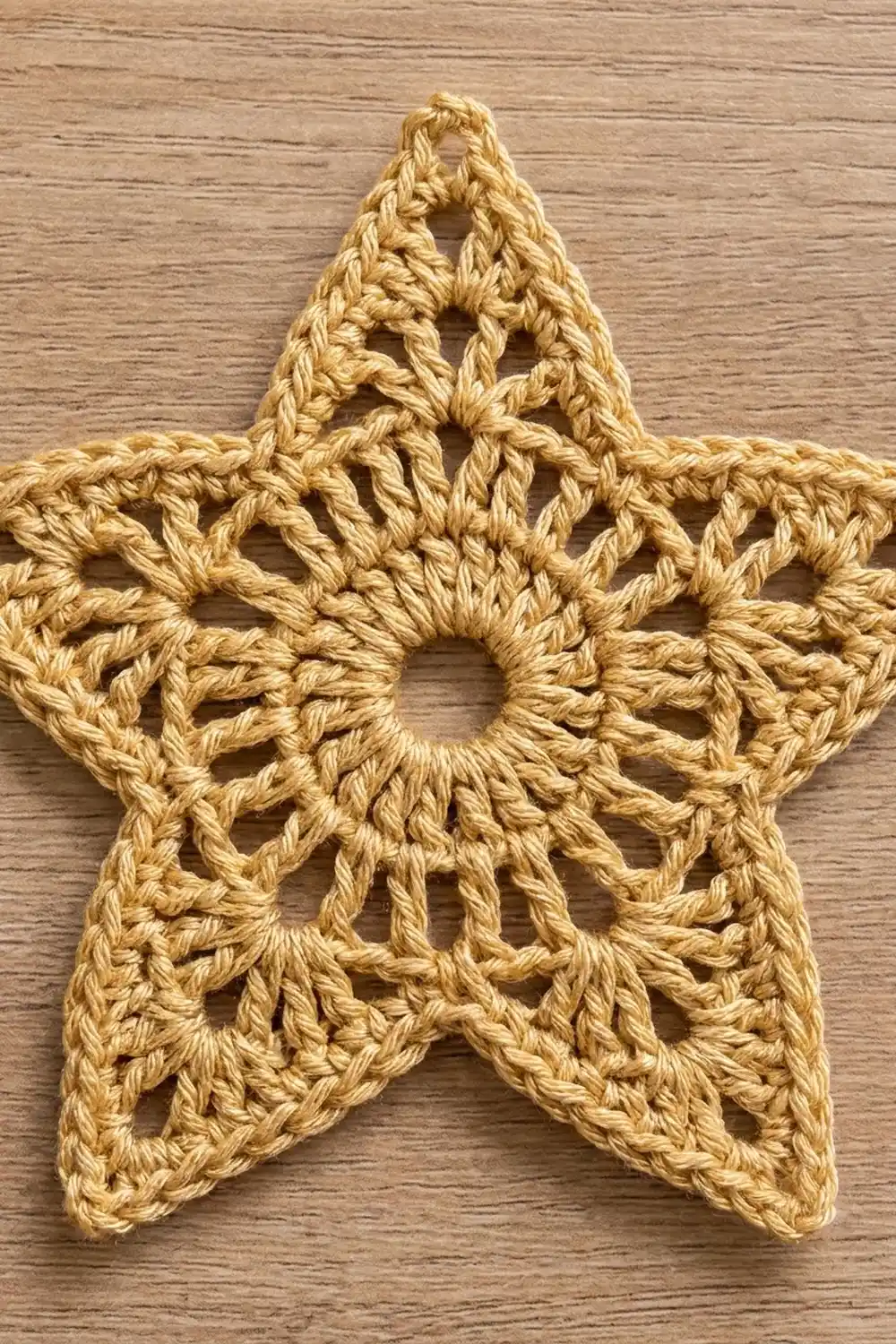
Large Gold Star (make 72)
With gold, ch 6 and sl st in the first ch to form a ring.
Round 1: Ch 3 (counts as dc), 14 dc in ring; join with sl st to top of ch-3. (15 dc)
The ring stays open and forms the visible center hole. Think of this round as 5 groups of 3 dc.
Round 2: Ch 1, sc in same st, ch 5, skip next 2 dc, sc in next dc, ch 5, skip next 2 dc; repeat from * 3 more times; join with sl st to first sc. (5 sc, 5 ch-5 loops)*
Each ch-5 loop becomes the base of one point.
Round 3 (lacy points): Sl st in first ch-5 loop. In the same loop work (hdc, ch 1, dc, ch 1, tr, ch 1, dtr, ch 3, dtr, ch 1, tr, ch 1, dc, ch 1, hdc), sc in next sc; repeat from * 4 more times. The last sc lands in the first sc of Round 2. Join. (Per point: 8 sts, 6 ch-1 sps, 1 ch-3 tip. Round total: 40 point sts + 5 sc = 45 sts, plus 30 ch-1 sps and 5 ch-3 tips)*
The stitches grow from hdc to dtr and back again, which builds a tapered point. The ch-1 spaces form the open eyelets inside each point.
Round 4 (solid outline): Ch 1, skip the first hdc. Sc in next ch-1 sp, sc in dc, sc in ch-1 sp, sc in tr, sc in ch-1 sp, sc in dtr; in ch-3 tip work (2 sc, ch 2, 2 sc); sc in dtr, sc in ch-1 sp, sc in tr, sc in ch-1 sp, sc in dc, sc in ch-1 sp; sc2tog across the valley; repeat from * 4 more times. The final sc2tog uses the last hdc of point 5 and the skipped first hdc of point 1. Join to the first sc. Fasten off, leaving a 10 in (25.4 cm) tail for tacking. (Per point: 6 + 4 + 6 = 16 sc, plus 1 sc2tog = 17 sts and 1 ch-2 tip. Round total: 85 sts and 5 ch-2 tips)*
This round gives the star its firm outline and sharp tips, with the lace sitting inside.
Small Cream Star (make 72)
With cream, make a magic ring.
Round 1: Ch 2 (does not count), 10 hdc in ring. Pull the ring closed, leaving only a tiny opening, and join to the first hdc. (10 hdc)
Round 2 (points): Ch 4, sc in 2nd ch from hook, hdc in next ch, dc in next ch, skip next hdc, sl st in next hdc; repeat from * 4 more times. The last sl st lands in the first hdc. Fasten off, leaving an 8 in (20.3 cm) tail. (5 points with 3 sts each; all 10 hdc of Round 1 used, 5 skipped and 5 slip-stitched)*
The small stars are solid and slightly puffy, which contrasts nicely with the lace of the gold stars.
Gold Cord (make 12)
Each cord is worked from the bottom up. The counts below place each star at a known chain, so mark as you go.
Leave a 6 in (15.2 cm) tail and chain 248 in total, following one of the sequences below. Place a marker in the first and last chain of every star span.
Strand A (strands 1, 3, 5, 7, 9, 11), counted from the bottom: Ch 6 (tail gap), ch 8 (small-star span), ch 6 (gap), ch 18 (large-star span), ch 6 (gap). Repeat from * 5 more times, but work the very last 6-ch gap as a 20-ch top drop instead.
Count check: 6 + (8 + 6 + 18 + 6) x 6 − 6 + 20 = 6 + 228 − 6 + 20 = 248 ch.
Strand B (strands 2, 4, 6, 8, 10, 12): Work as for Strand A, but swap the spans. Use ch 18 for the first star span in each repeat and ch 8 for the second. The total is still 248 ch.
Lengths at 5 ch per inch:
- Large-star span: 18 ch = 3.6 in (9.1 cm)
- Small-star span: 8 ch = 1.6 in (4.1 cm)
- Each gap: 6 ch = 1.2 in (3.0 cm)
- One repeat: 38 ch = 7.6 in (19.3 cm)
- Six repeats: 228 ch = 45.6 in (115.8 cm)
- Full cord: 248 ch = 49.6 in (126.0 cm)
Don’t fasten off. Keep the last loop live on a marker for the top edge.
Make All Pieces
- Gold: 72 large stars and 12 cords
- Cream: 72 small stars
Here is the layout from the top of the panel (L = large star, S = small star), with strands numbered 1 to 12 from left to right:
Strand:  1  2  3  4  5  6  7  8  9 10 11 12
Row 1:   L  S  L  S  L  S  L  S  L  S  L  S
Row 2:   S  L  S  L  S  L  S  L  S  L  S  L
Row 3:   L  S  L  S  L  S  L  S  L  S  L  S
Row 4:   S  L  S  L  S  L  S  L  S  L  S  L
...      (pattern continues to Row 12)
Each strand carries 6 L and 6 S, and each row across the panel holds 6 of each. Strand A starts with L at the top, and Strand B starts with S. This checkerboard stagger keeps the large stars on neighboring strands from overlapping.
Joining
The stars are tacked onto the front of each cord, so the cord runs straight down behind them.
- Lay the cord flat with the top drop at the top.
- Place each star face up over its marked span. A large star’s top tip sits on the upper marked chain, and the valley between its two lower points sits on the lower marked chain. Small stars line up the same way.
- Using the star’s own tail, sew through the tip space and the upper marked chain with 2 small stitches. Run the tail inside the outline to the bottom valley, then tack it to the lower marked chain with 2 more stitches.
- On large stars, add one stitch through Round 1 at the center top, catching the cord behind. This stops the star from tilting.
- Weave the tails into the back of the outline and trim.
Keep the tacking stitches snug but not tight. If you pull hard, the cord bunches up and the strand gets shorter. After joining, each strand should still measure 49.6 in (126.0 cm), and all strands should be within 0.5 in (1.3 cm) of each other.
Border: Top Hanging Loops
On this curtain, the “border” is the top edge: one reinforced loop on each cord.
Border gauge: 6 sc worked over a chain loop = 1 in (2.5 cm).
Round 1: From the live loop at the top of the cord, ch 25 and sl st in the 248th (last) chain of the cord. (25-ch loop)
Round 2: Ch 1, work 30 sc into the loop (around the chain, not into individual chains), and sl st in the first sc. Fasten off and weave in the ends. (30 sc)
Why the math works: At 5 ch per inch, 25 ch make a loop 5 in (12.7 cm) around. At 6 sc per inch, 30 sc also cover 5 in (12.7 cm), so the sc round fits the loop exactly without ruffling or pulling. A 1.25 in (3.2 cm) rod is about 3.9 in (9.9 cm) around, which leaves 1.1 in (2.8 cm) of ease so the loop can slide.
Thread the 12 loops onto the rod and space them 3 in (7.6 cm) apart. That gives 11 gaps x 3 in = 33 in (83.8 cm) between the first and last strands. Add 1.5 in (3.8 cm) at each side for a total width of 36 in (91.4 cm).
Final Blocking
- Draw a 4.5 in (11.4 cm) star and a 2 in (5.1 cm) star on paper. Slip them under a sheet of plastic on your blocking mat.
- Pin each large star at its 5 tips and 5 valleys over the template. Pin the small stars at their tips.
- Mist until damp, not soaked.
- Use a pin to open each ch-1 eyelet and the center ring.
- Let the stars dry completely, for at least 6 hours.
- Hang the finished strands for a day so the cords relax. If any cord is still more than 0.5 in (1.3 cm) off, mist it and gently stretch it to match.
If you can, block the stars before joining. It’s much easier than blocking them once they’re on the cords.
Final Quality-Control Checklist
- 72 large stars at 4.5 in (11.4 cm), each with 85 outline sts and 5 tips
- 72 small stars at 2 in (5.1 cm), each with 5 even points
- 12 cords of 248 ch, each 49.6 in (126.0 cm) long
- Strand A and Strand B alternating across the panel
- Every star tacked at its top tip and bottom valley, facing forward
- Every loop has 30 sc and slides freely on the rod
- All tails woven in, with none showing through the eyelets
Troubleshooting
- Points curl or cup: The outline round is too tight. Go up half a hook size for Round 4 only.
- Points look rounded: Make sure you worked the ch-3 tip in Round 3 and the ch-2 tip in Round 4. Pin the tips sharply when blocking.
- Star ruffles: You may have added stitches in Round 4. Recount to 17 per point.
- Strands hang at different lengths: Recount the chains, and check that the tacking stitches aren’t pulled too tight.
- Stars spin or face backward: Add the center tack, or a second stitch at the valley.
- Small star center gapes: Pull the magic ring tighter before joining Round 1.
Care
Hand wash in cool water with mild soap, roll in a towel, and dry flat, pinning the stars back into shape. Store the strands loosely coiled in tissue paper so they don’t tangle.
Final Notes
Here is how the measurements fit together. At 5 ch per inch, a 248-ch cord is 49.6 in (126.0 cm) long. Each 4.5 in (11.4 cm) large star sits on an 18-ch span and each 2 in (5.1 cm) small star sits on an 8-ch span, with 6-ch gaps between them. Twelve strands spaced 3 in (7.6 cm) apart fill a 36 in (91.4 cm) window, and 30 sc over 25 ch make a firm 5 in (12.7 cm) hanging loop. If your gauge matches at each checkpoint, the panel will hang evenly.
Happy crocheting!