

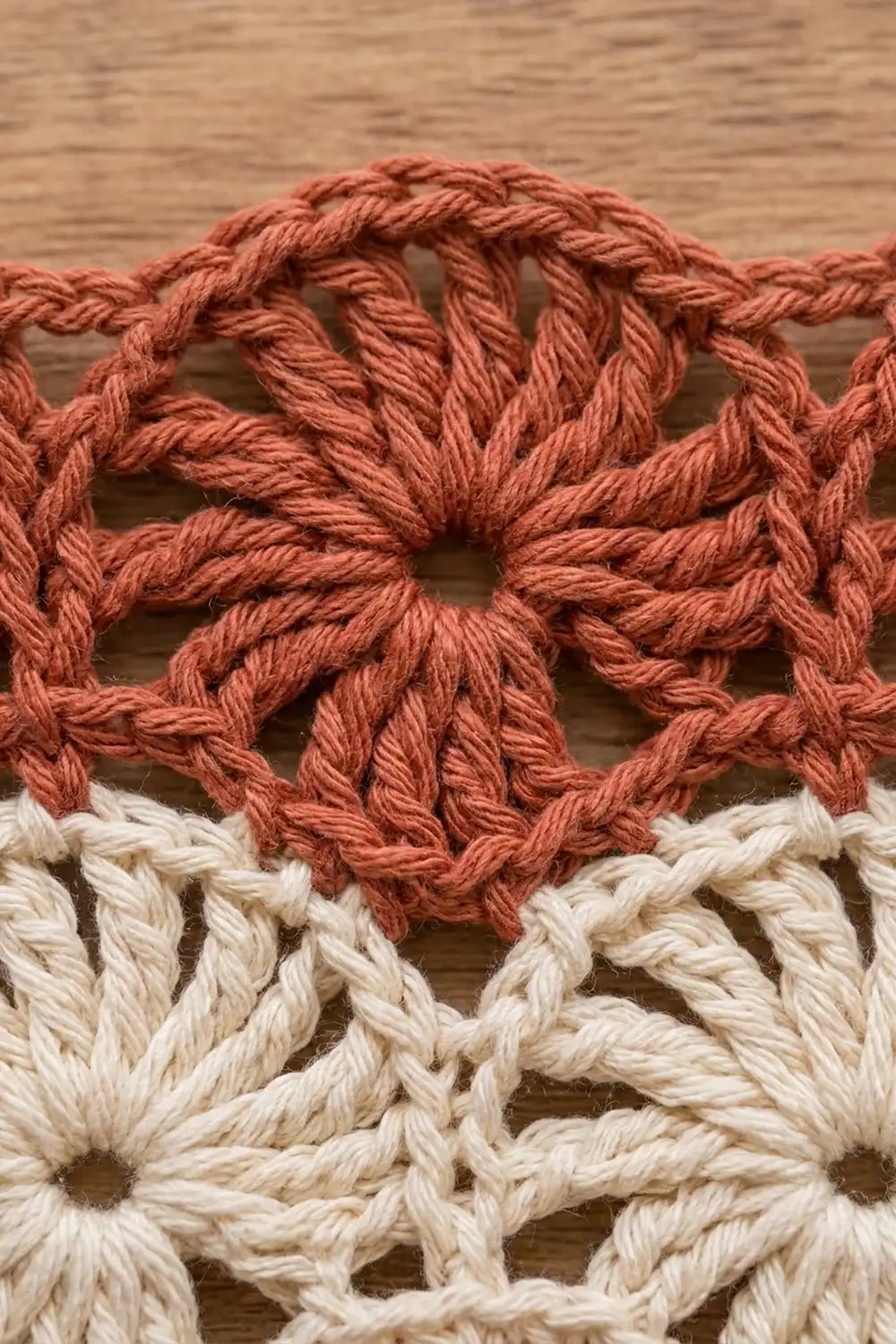
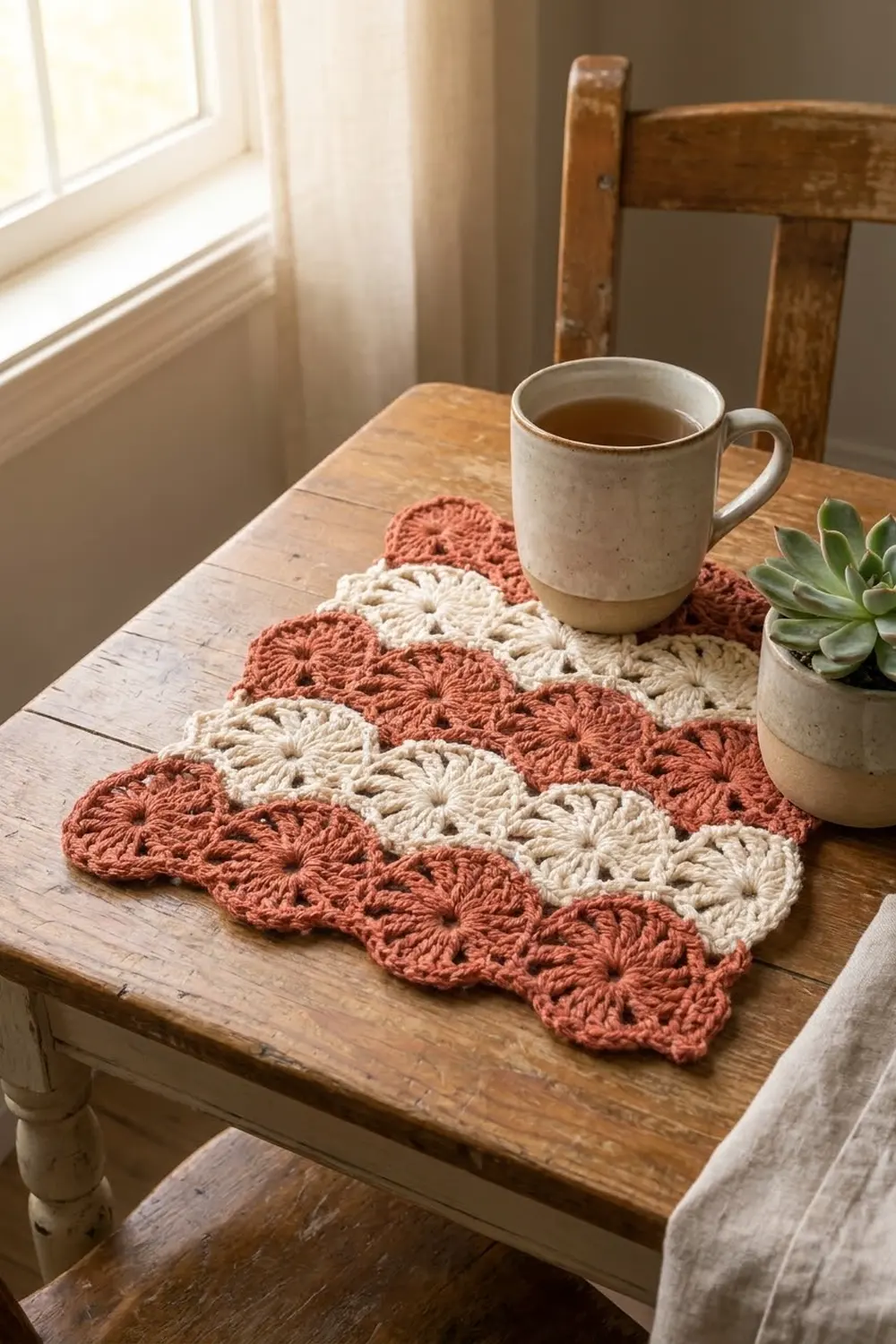
The Sunwheel Stripe Mat is a small rectangular crochet piece made of stacked wheels. Each wheel has a tiny open center with tall stitches fanning out around it, like a sunburst. The rows of wheels form neat stripes, and both short edges end in soft scallops.
This version uses two warm, earthy colors: rust for the first, third, and fifth stripes, and cream for the second and fourth. The result looks cozy and a little vintage. It works as a table mat, a plant mat, a dresser accent, or a large test swatch for the stitch.
The pattern uses US crochet terms. The finished mat measures 7.5 in (19.1 cm) wide by 10 in (25.4 cm) tall after blocking.
You make the mat in one piece, in rows, from a short foundation chain. Each stripe is two rows: a cluster row that forms the bottom half of each wheel and a shell row that forms the top half. The first stripe is finished last, when a scallop border worked into the underside of the foundation chain adds the bottom halves of its wheels.
Finished Size and Construction
- Finished size: 7.5 x 10 in (19.1 x 25.4 cm)
- Skill level: Intermediate (you need clusters and tall stitches)
- Terminology: US
- Yarn weight: Worsted (#4), cotton or cotton blend
- Hook: US H-8 (5 mm)
- Number of pieces: 1
- Layout: 3 wheels across x 5 wheel stripes tall
- Piece size before border: 7.5 x 9 in (19.1 x 22.9 cm)
- Border depth: 1 in (2.5 cm), bottom edge only
- Wheel size: about 2.5 in (6.4 cm) wide x 2 in (5.1 cm) tall
Materials
Yarn: Use a smooth worsted-weight cotton, at roughly 2 m per gram (about 190 m per 100 g). Cotton shows the wheel spokes clearly and lies flat, which matters for a mat. Acrylic also works, but its stitches are softer and less defined.
- Color A (rust/terracotta): 35 g, about 70 m
- Color B (cream/ivory): 25 g, about 50 m
These amounts include a margin of about 15–20% for your gauge swatch, color-change tails, and small differences in tension.
Tools:
– US H-8 (5 mm) crochet hook
– Tapestry needle
– Scissors
– Stitch markers (2–3)
– Blocking mat and rustproof pins
– Spray bottle
– Ruler or tape measure
Abbreviations (US Terms)
- ch – chain
- sc – single crochet
- tr – treble crochet
- dtr – double treble crochet
- sk – skip
- sp – space
- st(s) – stitch(es)
- rep – repeat
- RS / WS – right side / wrong side
Special stitches:
Shell: 9 tr worked into the same stitch or space.
tr9tog (9-treble cluster): *Yarn over twice, insert hook in next st, yarn over and pull up a loop, [yarn over, pull through 2 loops] twice; rep from * 8 more times (10 loops on hook). Yarn over and pull through all 10 loops. The cluster’s 9 legs fan out at the bottom and meet at the top, forming the lower half of a wheel.
Eye: The ch 1 worked right after each tr9tog. It closes the cluster and becomes the wheel’s open center.
Gauge and Checkpoints
Gauge: One wheel repeat (8 sts of foundation) = 2.5 in (6.4 cm) wide. One row of tr shells or clusters = 1 in (2.5 cm) tall. One full stripe (2 rows) = 2 in (5.1 cm) tall.
Test first: Treat Rows 1–3 as your test piece. Before you go on, measure the width across the three shells of Row 3.
Checkpoints (measured flat, unstretched):
– After Row 1: 7.5 in (19.1 cm) wide, 1 in (2.5 cm) tall
– After Row 3: 3 in (7.6 cm) tall
– After Row 5: 5 in (12.7 cm) tall
– After Row 7: 7 in (17.8 cm) tall
– After Row 9: 9 in (22.9 cm) tall
– After the border: 10 in (25.4 cm) tall
If your piece is too big: Go down to a US G-6 (4 mm) hook, or chain more firmly.
If your piece is too small: Go up to a US I-9 (5.5 mm) hook. Also check that you are pulling each tr loop up to full height.
If the width is right but the rows are short: Your tall stitches are compressed. Lift each loop a little higher before you finish the stitch.
Pattern
You work the rows back and forth. Row 1 is the RS.
Color changes: Change colors on the last yarn over of the final stitch of the row before. Cut the old color, leaving a 6 in (15.2 cm) tail. Each stripe is exactly 2 rows, so you could carry the unused color up the edge instead. Cutting gives cleaner side edges for a mat.
Foundation and Row 1 (Color A, first wheel stripe, top halves)
With Color A, ch 26.
Row 1 (RS): Sc in 2nd ch from hook. *Sk 3 ch, shell in next ch, sk 3 ch, sc in next ch; rep from * 2 more times. Turn.
Stitch count: 31 sts (3 shells of 9 tr = 27 tr, plus 4 sc).
Row 1 uses 25 foundation chains (1 + 3 repeats x 8 ch). The 26th chain is the turning chain. The three chains holding the shells will later hold the bottom-border shells too, and they become the centers of the first-stripe wheels.
On the last sc, change to Color B.
Rows 2–3 (Color B, second wheel stripe)
Row 2 (WS, cluster row): Ch 5 (counts as first dtr) in the same sc. *tr9tog over the 9 tr of the next shell, ch 1 (eye made), dtr in next sc; rep from * 2 more times, so the last dtr lands in the final sc. Turn.
Stitch count: 4 dtr (including the turning ch), 3 clusters, and 3 ch-1 eyes.
The dtr stitches fill the dips between the Row 1 shells and level the row. Each cluster sits directly on top of the shell below, so this wheel lines up with the wheel underneath.
Row 3 (RS, shell row): Ch 1. Sc in first dtr. *Shell in next ch-1 eye (skip the cluster itself), sc in next dtr; rep from * 2 more times, working the last sc into the top of the turning ch-5. Turn.
Stitch count: 31 sts (27 tr + 4 sc). This matches Row 1 exactly.
You now have three complete cream wheels: a cluster below each eye and a shell above it. Change to Color A on the last sc.
Rows 4–5 (Color A, third wheel stripe)
Row 4: Repeat Row 2. Count: 4 dtr, 3 clusters, 3 eyes.
Row 5: Repeat Row 3. Count: 31 sts. Change to Color B on the last sc.
Rows 6–7 (Color B, fourth wheel stripe)
Row 6: Repeat Row 2. Count: 4 dtr, 3 clusters, 3 eyes.
Row 7: Repeat Row 3. Count: 31 sts. Change to Color A on the last sc.
Rows 8–9 (Color A, fifth wheel stripe)
Row 8: Repeat Row 2. Count: 4 dtr, 3 clusters, 3 eyes.
Row 9: Repeat Row 3. Count: 31 sts.
Fasten off. Row 9’s shells form the scalloped top edge, so the top needs no border.
The piece should now measure 7.5 x 9 in (19.1 x 22.9 cm). The top stripe has full wheels, and the bottom stripe has only its top halves.
Border (Bottom Scallops)
The border has one job: to finish the first rust stripe by adding the bottom half of each wheel. That gives the bottom edge the same scallops as the top.
Border gauge: Each border shell matches a Row 1 shell, 2.5 in (6.4 cm) wide and 1 in (2.5 cm) deep.
Border Row (Color A): Turn the piece upside down with the RS facing you. Join Color A in the free loop of the first foundation chain at the right-hand corner. This is the chain under the corner sc of Row 1.
Ch 1, sc in the same ch. *Sk 3 ch, shell in next ch, sk 3 ch, sc in next ch; rep from * 2 more times. Fasten off.
Stitch count, bottom edge: 31 sts (27 tr + 4 sc).
Counts by side:
– Bottom edge: 31 sts (3 shells, 4 sc)
– Top edge: 0 added sts (Row 9’s shells are the finished edge)
– Left and right sides: 0 added sts (the edge sc, dtr, and turning chains form the finished side)
Why the math works: Row 1 used 25 foundation chains, or 1 + (3 x 8). The border uses the same 25 chain loops with the same 8-chain repeat. Each border shell goes into the exact chain that holds a Row 1 shell, and each border sc goes into a chain that holds a Row 1 sc.
The chain layout is symmetrical: sc in chains 1, 9, 17, and 25, and shells in chains 5, 13, and 21. Because of that, the border lines up the same way whichever end you start from. Each shared chain becomes a wheel center, and 9 tr above plus 9 tr below make a full 18-spoke wheel. The border adds 1 in (2.5 cm), bringing the height from 9 in (22.9 cm) to 10 in (25.4 cm).
Final Blocking
- Weave in all ends along the stitches of their own color so nothing shows through the open wheels.
- Lay the mat RS up on a blocking mat.
- Spray it evenly until it is damp, but not soaking.
- Pin the four corners to a 7.5 x 10 in (19.1 x 25.4 cm) rectangle.
- Pin the tip of each top and bottom scallop. Space the tips 2.5 in (6.4 cm) apart.
- Pin the side edges straight, placing a pin at each stripe change, about every 1 in (2.5 cm).
- Use your fingertip to open each center eye and spread the spokes of each wheel evenly.
- Let it dry completely, usually 6–12 hours, before you unpin it.
Final Quality-Control Checklist
- [ ] Five stripes in order: rust, cream, rust, cream, rust
- [ ] Three full wheels in every stripe, stacked in straight columns
- [ ] Every shell has 9 tr, and every cluster has 9 legs
- [ ] Rows 1, 3, 5, 7, and 9 each have 31 sts
- [ ] Rows 2, 4, 6, and 8 each have 4 dtr, 3 clusters, and 3 eyes
- [ ] The bottom border has 31 sts and lines up with Row 1
- [ ] Finished size is 7.5 x 10 in (19.1 x 25.4 cm)
- [ ] Scallop tips are evenly spaced, 2.5 in (6.4 cm) apart
- [ ] All ends are woven in and hidden
Troubleshooting
The wheels look oval instead of round: Your tall stitches are too short. Pull each loop up fully, or try a slightly larger hook.
The cluster row pulls in: Your clusters are too tight. Keep each leg loose before closing the cluster. The ch-1 eye must not be pulled tight.
There are gaps or holes between the wheels: The dtr is too short for the dip. Make it a little looser, or work it firmly into both loops of the sc.
Row 3 comes out with fewer than 31 sts: You probably missed the final sc in the turning ch-5. Mark that chain on every cluster row.
The border shells don’t line up with the wheels: You started in the wrong chain. Count the free chain loops again from the slip-knot end.
The edges ruffle or wave: Block more firmly, or go down a hook size for the shell rows.
Care
Hand wash in cool water with mild soap, press out the water in a towel, and lay flat to dry. Reshape the wheels and scallops while the mat is still damp.
Final Notes
The whole mat follows one simple chain of measurements. Twenty-five foundation chains set three wheels at 2.5 in (6.4 cm) each, for a width of 7.5 in (19.1 cm). Nine rows at 1 in (2.5 cm) each give 9 in (22.9 cm). The 1 in (2.5 cm) scallop border finishes the first stripe and brings the mat to 10 in (25.4 cm).
Each shell row repeats the same 31-stitch count, so if your counts and checkpoints match, the finished size will too.
Happy crocheting!