

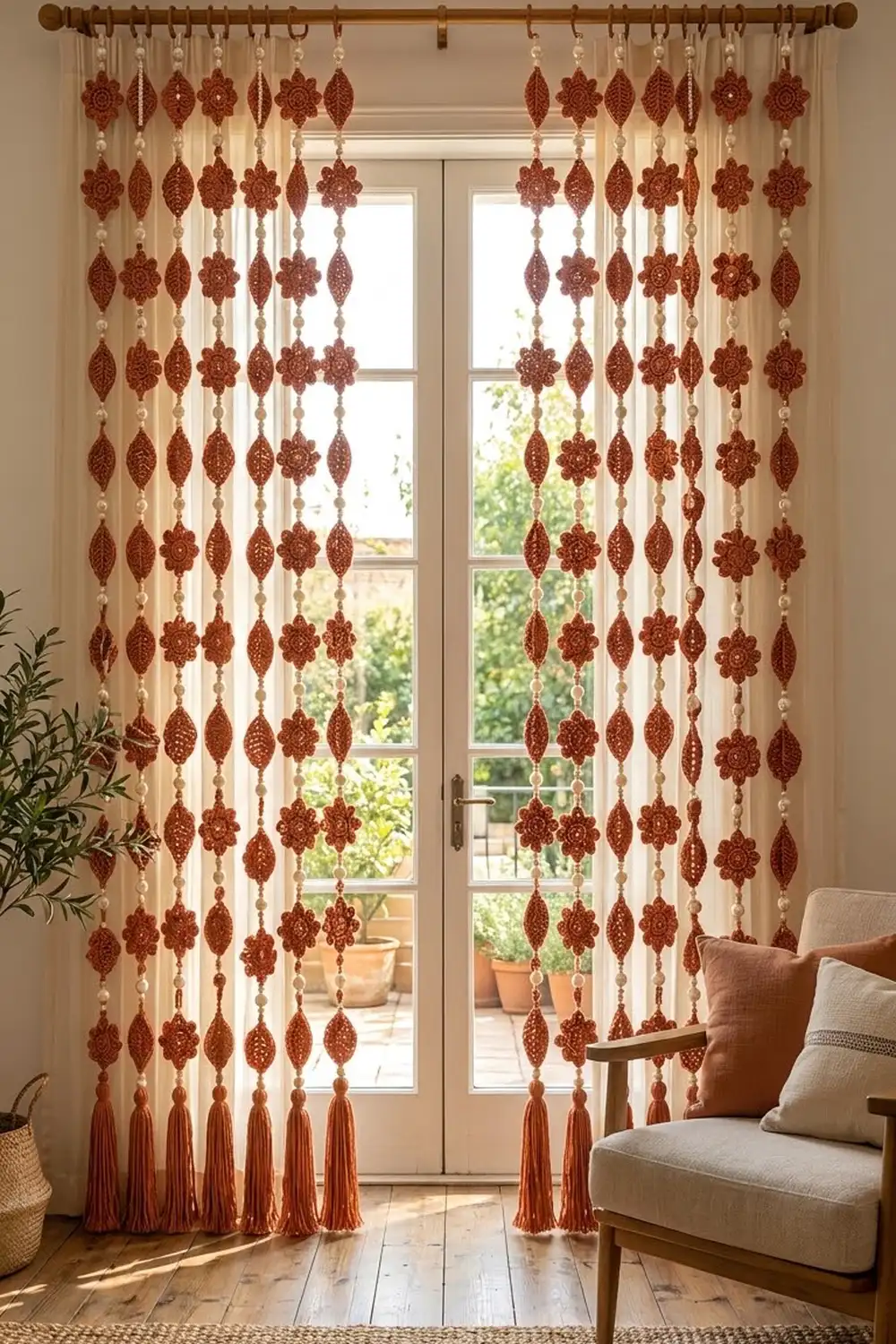
This curtain is made of long, airy strands. Each one alternates crochet flowers and leaves, separated by pairs of cream pearl beads, and ends in a full terracotta tassel. The light comes through the gaps, and the motifs make a soft boho pattern on a doorway or window.
Everything is crocheted in one warm terracotta (rust) cotton. Each flower has a ringed center and twelve pointed petals. Each leaf is a pointed oval with a raised central vein. The pearls and the cream beading cord are the only other colors. This pattern uses US crochet terms throughout.
One finished panel measures about 39.25 in (99.7 cm) wide and 68.25 in (173.4 cm) long from the rod to the tassel tips. The pair shown is 2 panels, 78.5 in (199.4 cm) wide in total.
Construction is simple. You crochet the flowers and leaves in rounds, string them on cord with pearls between, add a crocheted hanging tab at the top and a tassel at the bottom, and then slide the tabs onto a rod.
Finished Size and Construction
- Finished size (one panel): 39.25 in (99.7 cm) wide x 68.25 in (173.4 cm) long
- Finished size (pair): 78.5 in (199.4 cm) wide x 68.25 in (173.4 cm) long
- Skill level: Easy to intermediate
- Terminology: US crochet terms
- Yarn weight: DK / light (#3) cotton
- Hook: 3.5 mm (E-4)
- Number of pieces: 140 flowers, 140 leaves, 20 hanging tabs, 20 tassels (20 strands total)
- Layout: 2 panels of 10 strands each, strands spaced 4 in (10.2 cm) apart on center, motifs staggered
- Piece size: flower 3.25 in (8.3 cm) tip to tip; leaf 3.5 in (8.9 cm) long x 1.5 in (3.8 cm) wide
- Size before border: flower center disc 1.75 in (4.4 cm) before the petal round; leaf 3.25 in x 1.25 in (8.3 cm x 3.2 cm) before the edging round
- Border depth: hanging tab drop 2 in (5.1 cm) at the top; tassel 4 in (10.2 cm) at the bottom
Materials
Yarn: Choose a smooth, mercerized or combed DK cotton. Cotton holds the petal points crisply and does not stretch much when the strands hang. Avoid fuzzy or very stretchy yarns, which blur the ringed centers and can make the strands grow longer over time.
- Terracotta / rust: about 900 g (approx. 2,070 m), for example 18 balls of 50 g / 115 m (125 yd)
Tools and notions:
- 3.5 mm (E-4) crochet hook
- 650 cream glass pearl beads, 10 mm, with holes large enough for the cord
- Cream nylon beading cord, 0.8 mm, about 55 yd (50.3 m), cut into 20 lengths of 90 in (228.6 cm)
- Large-eye blunt yarn needle and a fine beading needle
- Stiff card, 4.25 in (10.8 cm) tall, for tassels
- Scissors, stitch markers, tape measure, clear fabric glue
- Wooden curtain rod, up to 1.25 in (3.2 cm) diameter
- Blocking mats and rust-proof pins
All quantities include a margin of about 15% for gauge differences, test swatches, and spare pearls.
Abbreviations (US Terms)
- ch – chain
- sl st – slip stitch
- sc – single crochet
- hdc – half double crochet
- dc – double crochet
- tr – treble crochet
- BLO – back loop only
- sp – space
- st(s) – stitch(es)
Special stitch – picot point: ch 2, sl st in 2nd ch from hook. This forms the sharp tip of each petal and is not counted as a stitch.
Gauge and Checkpoints
Gauge: 20 sc = 4 in (10.2 cm) with a 3.5 mm hook.
Make one flower and one leaf before anything else. Block them lightly and measure. These two test pieces control the size of every strand.
Checkpoints:
- Flower Round 1: 0.75 in (1.9 cm) diameter
- Flower Round 2: 1.25 in (3.2 cm) diameter
- Flower Round 3: 1.75 in (4.4 cm) diameter
- Flower Round 4: 3.25 in (8.3 cm) tip to tip
- Leaf Round 1: 3.25 in x 1.25 in (8.3 cm x 3.2 cm)
- Leaf Round 2: 3.5 in x 1.5 in (8.9 cm x 3.8 cm)
If your pieces are too big, go down to a 3.25 mm hook. If they are too small, go up to a 3.75 mm hook. Small differences add up: a flower that is 0.25 in (0.6 cm) too long, repeated 7 times, makes a strand 1.75 in (4.4 cm) longer, before you count the leaves.
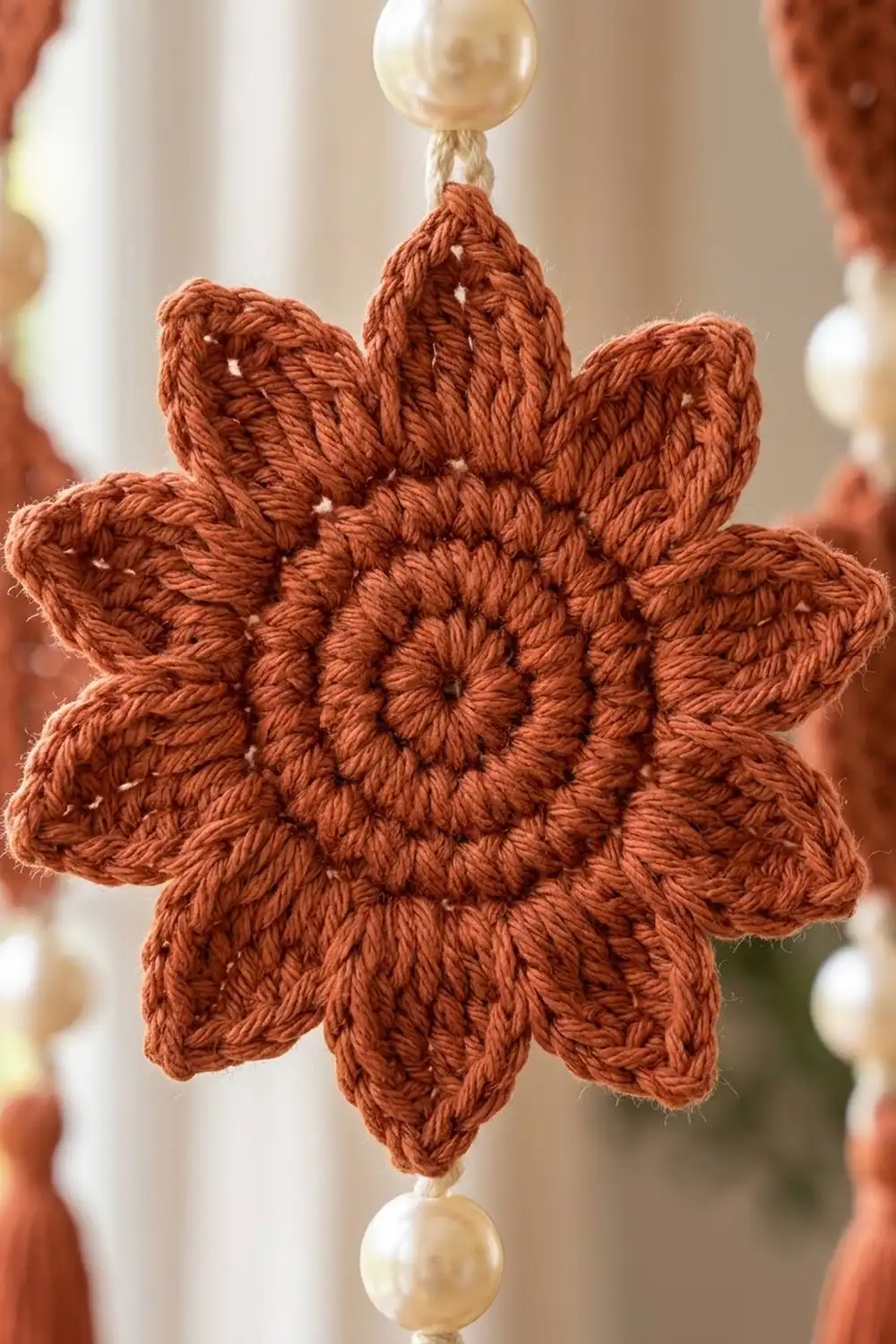
Flower Motif (make 140)
The center is worked in rounds of hdc. Rounds 2 and 3 are worked in the back loop only, so the unused front loops sit on the surface as concentric rings. Do not turn between rounds.
Round 1: Make a magic ring. Ch 2 (does not count as a st), 12 hdc in ring. Pull the ring closed and sl st to the first hdc to join. (12 sts)
Round 2 (BLO): Ch 2, 2 hdc in each st around. Join with sl st to first hdc. (24 sts)
Round 3 (BLO): Ch 2, hdc in next st, 2 hdc in next st; repeat from * around. Join. (36 sts)*
Check: the disc should lie flat and measure 1.75 in (4.4 cm). If it cups, your tension is too tight. If it ruffles, it is too loose.
Round 4 (petals, both loops): Each petal uses 3 sts of Round 3.
Sc in next st, (dc, tr) in next st, picot point, (tr, dc) in next st; repeat from * 11 more times. Sl st to the first sc to join. (12 petals: 12 sc, 48 dc/tr, 12 picot points; 12 x 3 = 36 sts of Round 3 used)*
Fasten off and weave in the ends. Petals 1 and 7 are directly opposite each other. Use these two tips as the top and bottom of the flower when stringing.
Leaf Motif (make 140)
The leaf is worked around both sides of a foundation chain. Where the two halves meet, the chain forms the raised center vein.
Round 1: Ch 16.
Sc in 2nd ch from hook, hdc in next ch, dc in next 10 ch, hdc in next ch, sc in next ch, 3 sc in last ch (tip). This uses 15 chains.
Rotate and work along the opposite side of the foundation chain: sc in next ch, hdc in next ch, dc in next 10 ch, hdc in next ch, sc in the last ch (the same ch as the first sc).
Ch 2 and sl st to the first sc. (31 sts: 14 + 3 + 14; plus 1 ch-2 sp at the stem end)
The middle sc of the 3-sc tip is st 16. There are 15 sts on each side of it.
Round 2 (BLO): Ch 1, sc in sts 1–15, 3 sc in st 16, sc in sts 17–31, (sc, ch 3, sc) in the ch-2 sp. Join with sl st to the first sc. (15 + 3 + 15 + 2 = 35 sc, plus 1 ch-3 loop)
Fasten off, leaving a 6 in (15.2 cm) tail. Weave it in along the vein. The ch-3 loop at the stem is where the cord enters the leaf. The 3-sc tip is where it leaves.
Make All Pieces
There is only one yarn color, so the quantities are per motif type:
- Flowers: 140 (7 per strand x 20 strands), about 3 g each
- Leaves: 140 (7 per strand x 20 strands), about 2 g each
- Hanging tabs: 20, about 1 g each
- Tassels: 20, about 2.5 g each
Strands come in two versions so that the motifs stagger across the panel. Strand A starts with a flower. Strand B starts with a leaf. Each panel alternates A and B.
Layout of one panel (F = flower, L = leaf, read top to bottom):
Strand:  1  2  3  4  5  6  7  8  9  10
         A  B  A  B  A  B  A  B  A  B
Row 1:   F  L  F  L  F  L  F  L  F  L
Row 2:   L  F  L  F  L  F  L  F  L  F
Row 3:   F  L  F  L  F  L  F  L  F  L
Row 4:   L  F  L  F  L  F  L  F  L  F
...continue alternating to Row 14
Bottom:  tassel on every strand
Make 2 panels: 10 Strand A and 10 Strand B in total.
Joining (Stringing the Strands)
The motifs are joined by cord, not by stitches. Each strand is one continuous 90 in (228.6 cm) length of beading cord, woven vertically through each motif. Pearl pairs sit between the motifs.
Spacing logic: 2 pearls plus a locking knot take up 1 in (2.5 cm). One flower-and-leaf repeat is 3.25 + 1 + 3.5 + 1 = 8.75 in (22.2 cm). A strand has 7 repeats = 61.25 in (155.6 cm). Each strand has 15 pearl gaps: 1 below the tab and 1 below each of the 14 motifs. That is 15 x 2 = 30 pearls per strand and 600 pearls for 20 strands.
Stringing a Strand A:
- Leave a 6 in (15.2 cm) tail for tying to the tab. Thread 2 pearls and tie an overhand knot below them.
- Flower: Enter through the picot of petal 1. Weave the cord down through the back loops of the center, behind the rings so the cord does not show from the front. Exit through the picot of petal 7.
- Thread 2 pearls and tie a knot snug below them.
- Leaf: Enter through the ch-3 stem loop. Weave down the back of the vein and exit through the middle sc of the 3-sc tip.
- Thread 2 pearls and knot.
- Repeat steps 2–5 six more times, for 7 flowers and 7 leaves.
- Leave the remaining cord for attaching the tassel.
Strand B: Work the same steps, but use a leaf in step 2 and a flower in step 4.
Tension: Each motif should hang flat, with no puckering along the cord. Before knotting, lay the strand on the table and slide each pearl pair snug, but not tight.
Size checkpoint: From the top of the first pearl pair to the last knot, the strand should measure 62.25 in (158.1 cm), which is the 61.25 in (155.6 cm) repeat section plus the first 1 in (2.5 cm) gap.
Border: Hanging Tabs and Tassel Edge
This curtain has no fabric border. Its top edge is a row of crocheted hanging tabs, and its bottom edge is a fringe of tassels.
Border gauge: the same 20 sc = 4 in (10.2 cm).
Hanging tab (make 20):
Row 1: Ch 25. Sc in 2nd ch from hook and in each ch across. (24 sc)
At this gauge, 24 sc = 4.8 in (12.2 cm). That is enough to wrap a 1.25 in (3.2 cm) rod, whose circumference is about 3.9 in (9.9 cm), with room to slide. Fold the strip in half and sew the short ends together. The loop then hangs 2 in (5.1 cm) below the top of the rod. Tie the cord tail securely around the seam with a square knot, dab with clear glue, and trim.
Tassel (make 20): Wrap yarn 30 times around the 4.25 in (10.8 cm) card. Tie the top with the strand’s lower cord end. Cut the bottom loops. Wrap a separate 12 in (30.5 cm) piece of yarn tightly 6 times around the tassel, 0.5 in (1.3 cm) below the top, and tie off inside. Trim the tassel to 4 in (10.2 cm).
Edge counts per panel: top edge = 10 tabs x 24 sc = 240 sc; bottom edge = 10 tassels x 30 wraps = 300 wraps.
Why the math works: The strand length is 2 (tab) + 1 (first gap) + 61.25 (repeats) + 4 (tassel) = 68.25 in (173.4 cm). The panel width is 9 spaces x 4 in + one flower width of 3.25 in = 39.25 in (99.7 cm). The strands are 4 in (10.2 cm) apart on center, and the widest motif is 3.25 in (8.3 cm), so neighboring flowers never touch. The stagger then fills the gaps visually.
Final Blocking
- Block the motifs before stringing.
- Spray each flower and leaf with water until damp.
- Pin each flower to a 3.25 in (8.3 cm) circle, with one pin through every picot point.
- Pin each leaf to 3.5 in x 1.5 in (8.9 cm x 3.8 cm). Pin both tips so the vein runs straight.
- Let them dry completely. Pinned in batches, they take about 6 hours.
- After stringing, hang the strands and steam the tassels lightly. Comb the fibers straight and re-trim them to 4 in (10.2 cm).
Final Quality-Control Checklist
- Every flower has 12 petals and measures 3.25 in (8.3 cm).
- Every leaf has 35 sc in Round 2 and measures 3.5 in (8.9 cm).
- The front-loop rings are visible on Rounds 2 and 3 of every flower.
- Every strand has 7 flowers, 7 leaves, and 30 pearls.
- Strands alternate A and B across each panel.
- Every strand hangs at 68.25 in (173.4 cm).
- All knots are glued and all tails are trimmed or hidden.
- The tabs slide freely on the rod.
Troubleshooting
- Flower center cups: Your Round 3 tension is too tight. Loosen it or go up one hook size.
- Petals are floppy: Your yarn is too soft, or your tension is loose. Use mercerized cotton and block firmly.
- Leaf vein twists: You are working the second side into the wrong chain loops. Work into the unused bottom loops consistently.
- Strands are different lengths: Your pearl gaps are uneven. Remeasure each knot at 1 in (2.5 cm).
- Cord shows on the front: Weave the cord through back loops only.
- Tassels splay: Tighten the neck wrap and steam them.
Care
Hand wash in cool water with mild soap. Lay each strand flat to dry, and do not wring.
Final Notes
The measurement chain is simple. A 1.75 in (4.4 cm) disc becomes a 3.25 in (8.3 cm) flower. A 3.5 in (8.9 cm) leaf, two 1 in (2.5 cm) gaps, and that flower make an 8.75 in (22.2 cm) repeat. Seven repeats plus the tab, the first gap, and the tassel give 68.25 in (173.4 cm) strands. Ten strands at 4 in (10.2 cm) spacing make a 39.25 in (99.7 cm) panel. Check each link as you go, and the curtain will hang straight.
Happy crocheting!