

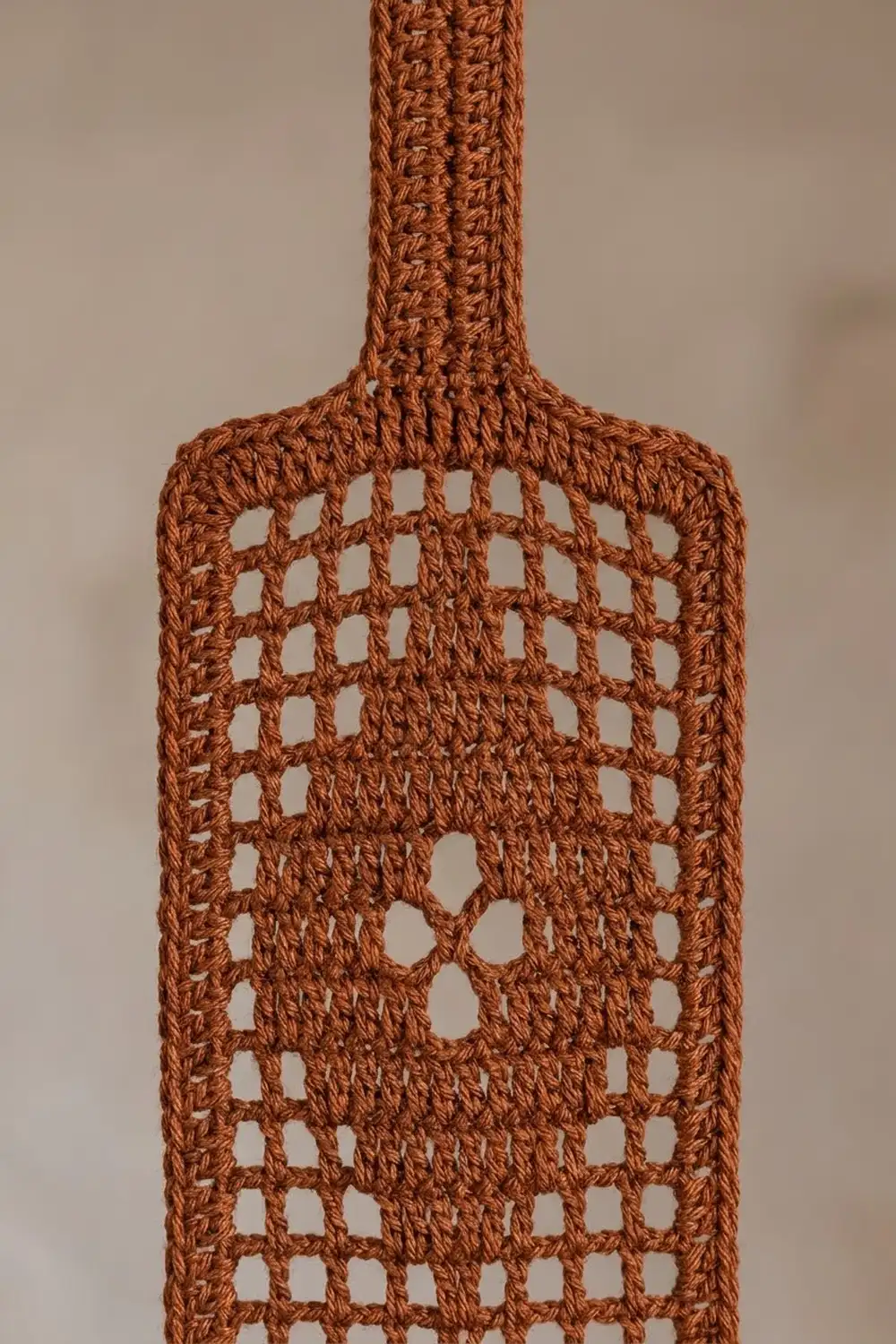
The Terracotta Diamond Door Curtain is a set of nine separate filet crochet strips. Each strip hangs from its own loop tab on a wooden rod. When light comes through the open mesh, the stacked diamonds glow, which makes this a good curtain for a sunny doorway, a patio entrance, or a room divider.
The strips alternate warm rust and natural cream. Each one has solid double crochet side bars, an open filet mesh in the middle, and a column of solid diamonds. Every diamond has a small four-window center. The style is relaxed and boho with a Mediterranean feel, and the cotton keeps it crisp and light.
This pattern uses US crochet terms. Each finished strip measures 4.7 in (11.9 cm) wide and 78.8 in (200.2 cm) long, not counting the tab. With the folded tab, it hangs about 80.8 in (205.2 cm) from the top of the rod.
Each strip is worked flat from the bottom up in filet rows. Next come three single crochet shoulder rows, then one round of single crochet edging, and finally a center tab that folds over the rod. The strips are never sewn to each other. The rod is the only thing holding them together.
Finished Size and Construction
- Finished strip size: 4.7 in x 78.8 in (11.9 cm x 200.2 cm), plus a 2 in (5.1 cm) folded tab
- Skill level: Intermediate (simple stitches, but the chart needs careful counting)
- Terminology: US crochet terms
- Yarn weight: DK (#3) cotton
- Hook: 3.5 mm (E-4)
- Number of pieces: 9 separate strips (5 rust, 4 cream)
- Layout: 9 strips side by side on one rod, alternating colors, 0.5 in (1.3 cm) apart
- Strip size before border: 4.4 in x 78.5 in (11.2 cm x 199.4 cm)
- Border depth: 0.15 in (0.4 cm), one round of single crochet
- Total curtain span: 46.3 in (117.6 cm)
Materials
Use a smooth, mercerized or combed DK cotton of about 230 m per 100 g. Cotton holds the square filet shape and drapes straight without much fuzz. Avoid acrylic: it stretches lengthwise over time and blurs the diamonds.
- Color A, rust brown: 750 g (about 1,725 m) for 5 strips
- Color B, natural cream: 600 g (about 1,380 m) for 4 strips
Each strip uses about 135 g (310 m). These quantities include a margin of about 10% for swatching, tabs, and weaving in ends.
Tools:
– 3.5 mm (E-4) crochet hook
– Tapestry needle
– Stitch markers (4–6)
– Measuring tape
– Rust-proof pins and a long blocking surface
– Spray bottle
– Wooden curtain rod up to 1.25 in (3.2 cm) across, at least 50 in (127.0 cm) long
Abbreviations (US Terms)
- ch – chain
- sl st – slip stitch
- sc – single crochet
- dc – double crochet
- sc2tog – single crochet 2 together
- st(s) – stitch(es)
- sp – space
- RS / WS – right side / wrong side
Filet blocks:
– Solid block (S): dc in each of the next 3 sts. When you work over a ch-2 space, make 2 dc in the space and 1 dc in the next dc.
– Open block (O): ch 2, skip the next 2 sts (or the ch-2 space), dc in the next dc.
– Row start: ch 3, which counts as the first dc. The first block of every row is a solid side bar: ch 3, then dc in each of the next 3 sts. That gives 4 sts, and every block after it adds 3 sts.
Every filet row has 1 + (11 x 3) = 34 sts.
Gauge and Checkpoints
Gauge: 1 filet block = 0.4 in (1.0 cm) wide and 0.4 in (1.0 cm) tall.
Make one test piece before committing to nine strips. Work Rows 1–15 (three open rows, one diamond, and one connector). Then check:
- Width: 4.4 in (11.2 cm) across the 11 blocks
- Height: 6.0 in (15.2 cm) for 15 rows
- Diamond: 3.6 in (9.1 cm) both tall and wide
If your piece is too big, go down to a 3.25 mm hook. If it is too small, go up to a 3.75 mm hook. If the width is right but the rows are too tall, wrap the yarn a little more snugly around the hook on each dc. Square blocks keep the diamonds from looking stretched.
Checkpoints for the full strip:
– After Row 15: 6.0 in (15.2 cm)
– After Row 99: 39.6 in (100.6 cm)
– After Row 195: 78.0 in (198.1 cm)
– After the shoulders: 78.5 in (199.4 cm)
– After the border: 78.8 in (200.2 cm)
Measure each strip flat, never while it hangs.
Block Row Key
Read each row from left to right as a list of blocks. The design is symmetrical, so RS and WS rows read the same way. Every row has 11 blocks and 34 sts.
- Open row: S, 9 O, S
- D1: S, 4 O, S, 4 O, S
- D2: S, 3 O, 3 S, 3 O, S
- D3: S, 2 O, 5 S, 2 O, S
- D4: S, O, 3 S, O, 3 S, O, S
- D5: 4 S, O, S, O, 4 S
- D6: same as D4
- D7: same as D3
- D8: same as D2
- D9: same as D1
- Connector row: same as D1 (a single center spine block)
The open blocks in D4, D5, and D6 sit above, beside, and below the solid center block of D5. That places the four small windows in a diamond shape.
Strip Pattern
Make 5 strips in Color A and 4 strips in Color B.
Foundation: Ch 36.
Row 1 (RS): Dc in the 4th ch from the hook and in the next 2 ch (side bar made). Ch 2, skip 2 ch, dc in the next ch; repeat 8 more times (9 open blocks). Dc in each of the last 3 ch. Turn. (34 sts: S, 9 O, S)
Rows 2–3: Work an open row. Turn. (34 sts)
Rows 4–12 (Diamond 1): Work D1 through D9, one row each. Turn at the end of each row. (34 sts per row)
Rows 13–15 (Connector): Work a connector row 3 times. (34 sts per row)
Place a marker here, then check your gauge against the swatch measurements.
Rows 16–183: Repeat Rows 4–15 fourteen more times. Diamond k always starts on Row 12k − 8, so Diamond 2 starts on Row 16 and Diamond 15 starts on Row 172. Rows 181–183 are the last connector rows.
Rows 184–192 (Diamond 16): Work D1 through D9.
Rows 193–195: Work an open row 3 times. Do not fasten off.
Checkpoint: 195 rows, 16 diamonds, 15 connectors. The strip should be 4.4 in x 78.0 in (11.2 cm x 198.1 cm).
Rounded Shoulders
These rows ease the top corners into the soft curve you see at the top of each strip.
Row 196: Ch 1. Sc2tog over the first 2 sts. Sc in each dc and 2 sc in each ch-2 space until 2 sts remain, then sc2tog. Turn. (32 sts: 34 positions worked, minus 2)
Row 197: Ch 1, sc2tog, sc in the next 28 sts, sc2tog. Turn. (30 sts)
Row 198: Ch 1, sc2tog, sc in the next 26 sts, sc2tog. Do not turn. (28 sts)
Checkpoint: Total length is 78.5 in (199.4 cm), and the top edge is about 3.7 in (9.4 cm) wide.
Make All Pieces
- Color A (rust): 5 strips
- Color B (cream): 4 strips
Arrange them as follows (A = rust, B = cream), from left to right on the rod:
A  B  A  B  A  B  A  B  A
1  2  3  4  5  6  7  8  9
Put the edging and tab on all nine strips before you hang any of them, so every strip finishes at the same length.
Joining (Hanging the Strips)
The strips are not seamed together. Each one hangs separately, which lets you walk through the curtain and lets the strips move in a breeze. The only joining is the stitch-to-stitch closing of each tab loop, described below under Tab.
Tension advice: Sew the tab closed with matching yarn, using even, firm whipstitches. A tight seam bunches the tab, and a loose one lets it slide over the rod.
Spacing: Hang the strips 0.5 in (1.3 cm) apart, so their centers are 5.2 in (13.2 cm) apart.
Size checkpoint: 9 strips x 4.7 in + 8 gaps x 0.5 in = 46.3 in (117.6 cm) of rod. Allow at least 1.2 in (3.0 cm) of bare rod on each side for the brackets.
Border
Border gauge: 5 sc per inch (2.54 cm) along the long sides. That is 2 sc per dc row end, because each row is 0.4 in (1.0 cm) tall.
Round 1 (RS): Do not turn after Row 198. Work around the whole strip:
- Top edge: 3 sc in the first st of Row 198, sc in the next 26 sts, 3 sc in the last st. (32 sc = 28 sts worked 1-per-stitch + 4 extra corner sts)
- Left side: 1 sc in the end of each of Rows 197 and 196, then 2 sc in the end of each dc row from 195 down to 1. (2 + 390 = 392 sc between the corner groups)
- Bottom edge: working into the remaining foundation chain loops, 3 sc in the first ch, sc in the next 32 ch, 3 sc in the last ch. (38 sc = 34 sts worked 1-per-stitch + 4 extra corner sts)
- Right side: 2 sc in the end of each dc row from 1 up to 195, then 1 sc in the end of each of Rows 196 and 197. (392 sc)
Join with a sl st to the first sc. Round total: 32 + 392 + 38 + 392 = 854 sc. Fasten off.
Why the math works: Two sc per 0.4 in (1.0 cm) row end matches the 5 sc per inch edging gauge, so the long sides stay flat without rippling or pulling in. The sc shoulder rows are shorter, so they get one sc each. The top and bottom are worked one stitch for each existing stitch. The 3-sc corners add just enough to turn the corner without cupping.
Tab
With the RS facing, skip the first 13 sc of the 32-sc top edge and join the yarn in the 14th sc.
Tab Row 1: Ch 1, sc in the same st and in the next 5 sts. Turn. (6 sc; 13 skipped + 6 + 13 left = 32)
Tab Row 2 onward: Ch 1, sc in each st across. Turn. (6 sc)
Repeat until the tab is 4.0 in (10.2 cm) long, about 26 rows. The tab should be 0.8 in (2.0 cm) wide. Fasten off, leaving a 12 in (30.5 cm) tail.
Fold the tab toward the WS. Whipstitch each of its 6 last-row sts to the matching st of Row 198 on the back. This makes a loop that stands about 2.0 in (5.1 cm) tall and fits a rod up to 1.25 in (3.2 cm) across.
Final Blocking
- Weave in all ends along the solid side bars, where they won’t show through the mesh.
- Lay the strip flat on a long blocking surface. You can block it in two halves if space is short.
- Spray it evenly until damp, but not dripping.
- Pin the side edges straight at 4.7 in (11.9 cm) wide, placing a pin every 4 in (10.2 cm).
- Ease the length to 78.8 in (200.2 cm) without stretching it.
- Nudge each open block until it is square, especially the four windows in each diamond.
- Let it dry completely before you unpin it.
- Block all nine strips to the same measurements.
Final Quality-Control Checklist
- Every filet row has 34 sts and 11 blocks.
- Each strip has 16 diamonds, each with 4 visible windows.
- Every connector spine is one block wide and 3 rows tall.
- The shoulders taper evenly on both sides (32, 30, then 28 sts).
- The border round has exactly 854 sc.
- The tab is centered, with 13 sc on each side of it.
- All strips match in length to within 0.5 in (1.3 cm).
- The colors alternate A, B, A, B across the rod.
Troubleshooting
- The strip is skewing into a slant. Check that you end each row with a dc into the top of the turning ch-3.
- The diamond looks off-center. Recount the open blocks on each side. Both sides of every row must match.
- The windows are closing up. You may have worked a solid block where an open block belongs in D4–D6. Rip back and recheck the key.
- The long edges ripple. You have more than 2 sc per row end. Rework those sections at exactly 2.
- The edges cup inward. You may be skipping row ends. Count 392 sc on each long side.
- The strips hang at different lengths. Re-block the short ones and ease them to 78.8 in (200.2 cm).
- The tab slips on the rod. Tighten the whipstitching, or add 2 more tab rows on any new strips.
Care
Hand wash in cool water with mild soap, press out the water in a towel, and dry flat with the strips pinned to size. Do not tumble dry, because the long filet strips can stretch and tangle.

Final Notes
Everything in this curtain follows from one measurement: a 0.4 in (1.0 cm) square block. Eleven blocks give a 4.4 in (11.2 cm) strip. 195 rows give 78.0 in (198.1 cm). The shoulders bring it to 78.5 in (199.4 cm), and the 854-sc edging finishes it at 4.7 in x 78.8 in (11.9 cm x 200.2 cm). Nine strips with 0.5 in (1.3 cm) gaps fill 46.3 in (117.6 cm) of rod. If your swatch matches, every strip will hang straight and even.
Happy crocheting!