

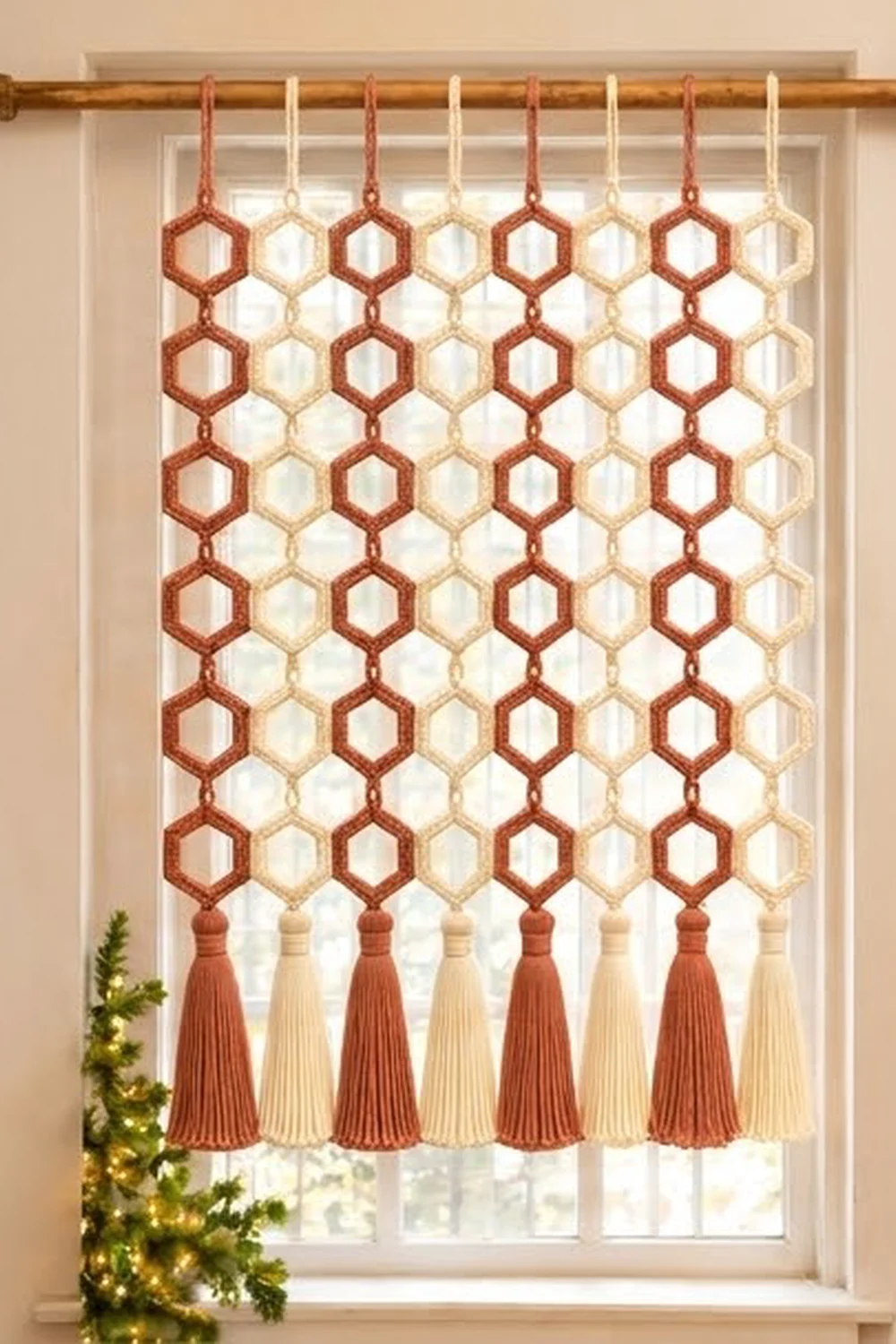
This hanging curtain is made from small, open hexagon frames linked into long vertical strands. Each strand ends in a full, swingy tassel and hangs from a wooden rod. Light passes through every hexagon, so the whole piece reads like a soft honeycomb screen.
The sample uses two colors: a warm terracotta and a soft cream. The strands alternate color across the rod, four of each, for a calm, cozy, boho look. It works for a window, a doorway nook, or a seasonal backdrop.
The pattern is written in US crochet terms. The finished curtain measures about 31.5 in (80.0 cm) wide and 41 in (104.1 cm) long, including hanging loops and tassels. Each hexagon is about 4 in (10.2 cm) point to point.
Construction is simple and repetitive. You make 56 hexagons, each with one round of double crochet over a chain ring and then a single crochet edge round. During that edge round, you link each new hexagon to the one above it, so each strand grows as you go. The top hexagon gets a hanging loop and the bottom hexagon gets a tassel.
Finished Size and Construction
- Finished curtain: 31.5 in (80.0 cm) wide x 41 in (104.1 cm) long
- Skill level: Easy
- Terminology: US crochet terms
- Yarn weight: Worsted (#4), cotton or cotton blend
- Hook: US H-8 (5.0 mm)
- Number of pieces: 56 hexagons (28 terracotta, 28 cream), 8 tassels
- Layout: 8 strands x 7 hexagons, strands alternating terracotta and cream
- Piece size: 4 in (10.2 cm) point to point, 3.5 in (8.9 cm) flat to flat
- Size before edge round (border): 3.5 in (8.9 cm) point to point, 3 in (7.6 cm) flat to flat
- Border depth: 0.25 in (0.6 cm), one round of single crochet
- Strand length (hexagons and links only): 32.5 in (82.6 cm)
- Gap between strands on the rod: 0.5 in (1.3 cm)
Materials
Choose a smooth, round worsted-weight cotton or cotton blend with good stitch definition. Cotton keeps the hexagons flat and crisp and gives the tassels a heavy, straight drape. The sample matches a yarn of about 170 m per 100 g (186 yd per 3.5 oz).
Yarn:
- Color A, terracotta: 150 g, about 255 m (279 yd)
- Color B, cream: 150 g, about 255 m (279 yd)
Each color covers 28 hexagons, 4 hanging loops, and 4 tassels. These amounts include a margin of about 25 percent, so a small gauge difference won’t leave you short.
Tools:
- US H-8 (5.0 mm) crochet hook
- Tapestry needle
- Scissors
- Stitch markers (2 or 3)
- Stiff card cut to 6.5 in (16.5 cm) tall, for tassels
- Ruler or measuring tape
- Blocking mat and rust-proof pins
- Wooden rod or dowel, about 36 in (91.4 cm) long
Abbreviations (US Terms)
- ch – chain
- sl st – slip stitch
- sc – single crochet
- dc – double crochet
- st(s) – stitch(es)
- rep – repeat
- RS – right side
Special technique – Link: Ch 3. Insert the hook from front to back into the center sc of the named corner on the hexagon above, and sl st. Then sl st into each of the 3 ch you just made, working back toward your current hexagon. This doubles the chain into a firm, slightly twisted link about 0.75 in (1.9 cm) long.
Gauge and Checkpoints
Gauge matters here because each strand stacks 7 hexagons, and small differences add up.
Make one complete hexagon before you start the curtain, then check it at each stage:
- Foundation ring: each 5-ch side measures about 1.25 in (3.2 cm) when gently stretched.
- After Round 1: 3.5 in (8.9 cm) point to point, 3 in (7.6 cm) flat to flat. The dc band is about 0.5 in (1.3 cm) tall.
- After Round 2: 4 in (10.2 cm) point to point, 3.5 in (8.9 cm) flat to flat. The open center is about 2 in (5.1 cm) flat to flat.
- Border gauge: about 4.5 sc per inch (1.8 sc per cm) along the outer edge.
If your hexagon is too big, go down one hook size to US 7 (4.5 mm). If it is too small, go up to US I-9 (5.5 mm). If the center puckers or the ring won’t lie flat, loosen your foundation chain. You can also make the chain with a hook one size larger, then switch back for Round 1.
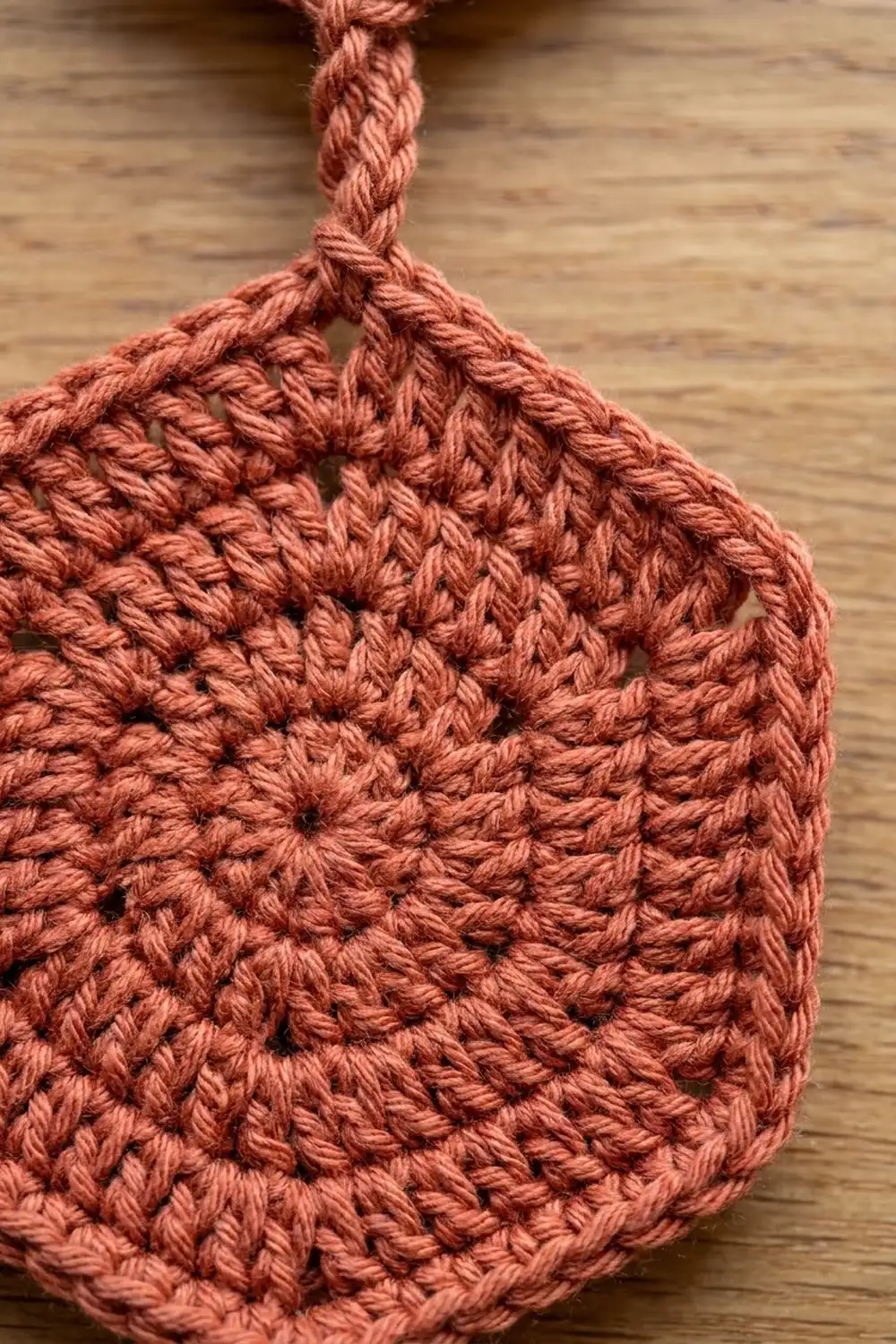
Hexagon Pattern
Work every hexagon the same way. Don’t turn between rounds; keep the RS facing you throughout.
Foundation: Ch 30, sl st in first ch to form a ring. Be careful not to twist the chain. (30 ch = 6 sides of 5 ch)
Round 1 (growth round): Ch 3 (counts as dc), dc in next 3 ch, 3 dc in next ch (corner), [dc in next 4 ch, 3 dc in next ch (corner)] 5 times, sl st in top of beginning ch-3. (42 dc: 4 straight dc per side and 3 dc per corner, 6 sides)
The 3-dc corners turn the round chain into a true hexagon. The center dc of each corner group is the corner stitch for Round 2. Place a marker in the center dc of the first corner; this will be the top corner of the hexagon.
Measure now: 3.5 in (8.9 cm) point to point.
Next, work Round 2 as written in the Border section. Use the hanging-loop version for Hexagon 1 of each strand and the link version for Hexagons 2 to 7.
Make All Pieces
Finish each hexagon with Round 2 before you start the next one, so the strands build as you go:
- Color A, terracotta: 28 hexagons (4 strands of 7)
- Color B, cream: 28 hexagons (4 strands of 7)
- Tassels: 4 in Color A, 4 in Color B
Layout grid (strands left to right, hexagons top to bottom):
        S1  S2  S3  S4  S5  S6  S7  S8
Loop    A   B   A   B   A   B   A   B
Hex 1   A   B   A   B   A   B   A   B
Hex 2   A   B   A   B   A   B   A   B
Hex 3   A   B   A   B   A   B   A   B
Hex 4   A   B   A   B   A   B   A   B
Hex 5   A   B   A   B   A   B   A   B
Hex 6   A   B   A   B   A   B   A   B
Hex 7   A   B   A   B   A   B   A   B
Tassel  A   B   A   B   A   B   A   B
Each strand is a single color. Every strand uses 7 hexagons, 6 links, 1 hanging loop, and 1 tassel.
Joining
The hexagons in a strand are joined corner to corner, top point to bottom point, using the Link technique. The strands are not joined to each other; they hang side by side from the rod.
Method: join as you go during Round 2 (the border round). Hexagon 1 of each strand gets a hanging loop at its top corner. Hexagons 2 through 7 each get a link at their own top corner, attached to the bottom corner of the hexagon above.
Stitch-to-stitch logic: each corner in Round 2 has 3 sc, and the middle one is the corner’s center sc. The top corner is the first 3-sc corner you work in Round 2 (Corner 1). The bottom corner is the fourth one (Corner 4), directly opposite. A link always runs from the center sc of Corner 1 on the new hexagon to the center sc of Corner 4 on the hexagon above. The link is made only of chains and slip stitches, so it adds no sc to either hexagon: both still finish with 54 sc.
Tension advice: keep each link chain at the same tension as your foundation chain. Lay the hexagon above flat, RS up, with its Corner 4 pointing down toward your work so the strand doesn’t twist. Always insert the hook from front to back, so all links show the same face.
Size checkpoint: after linking 2 hexagons, measure from top point to bottom point: 4 + 0.75 + 4 = 8.75 in (22.2 cm). A finished strand of 7 hexagons and 6 links measures 32.5 in (82.6 cm).
Border (Round 2 Edge, Hanging Loop, and Links)
The border is the single sc round that frames every hexagon. It firms the edge, sharpens the corners, and carries the joins.
Border gauge: about 4.5 sc per inch (1.8 sc per cm). Each finished side spans 2 in (5.1 cm) from corner point to corner point.
Round 2, standard version (conversion round): Ch 1, sc in same st as join and in next 3 dc, sc in next dc, 3 sc in next dc (Corner 1), [sc in next 6 dc, 3 sc in next dc] 5 times (Corners 2 to 6), sc in last dc, sl st in first sc. Fasten off and weave in ends.
Count: 42 sc worked 1 per existing dc + 12 extra sc (2 extra at each of 6 corners) = 54 sc.
Each side has 6 straight sc plus a 3-sc corner group: 6 sides x (6 + 3) = 54. The 6 straight sc come from that side’s 4 straight dc in Round 1 plus the corner dc on each end of that side.
Round 2, Hexagon 1 version (with hanging loop): Work as the standard version, but at Corner 1:
- Work 2 sc in the corner dc.
- Ch 14, then sl st in the top of the sc you just made.
- Work 18 sc into the ch-14 loop, then sl st in the top of that same sc again.
- Work 1 sc in the same corner dc.
Continue the round as written. The round itself still has 54 sc; the loop’s 18 sc sit on the separate ch-14 loop. The padded loop stands about 1.75 in (4.4 cm) tall.
Round 2, Hexagons 2 to 7 (with link): Work as the standard version, but at Corner 1 work 2 sc in the corner dc, make a Link to the center sc of Corner 4 on the hexagon above, then work 1 sc in the same corner dc. Continue the round. Count: 54 sc.
Why the math works: Round 1 has 42 dc, 7 per side. Round 2 covers every dc once and adds 2 sc at each corner to turn the point, for 54. That extra pair per corner is what a flat hexagon needs for a 0.25 in (0.6 cm) round, so the edges stay straight and don’t ruffle or cup. Loops and links are built on chains, so they never change the 54-sc count or the 4.5 sc per inch gauge.
Tassels
- Wrap matching yarn 30 times around the 6.5 in (16.5 cm) card.
- Slide a 10 in (25.4 cm) tie strand under the wraps at the top and knot it tightly.
- Cut the wraps at the bottom.
- Wrap a second strand 8 times around the bundle, 0.75 in (1.9 cm) below the top. Knot it and bury the ends inside the tassel.
- Trim the tassel to 6 in (15.2 cm).
To attach, thread the tie strand through the center sc of Corner 4 on Hexagon 7. Knot it so the tassel top sits about 0.75 in (1.9 cm) below the point, then weave the ends into the tassel.
Final Blocking
- Lay each strand flat on a blocking mat, RS up.
- Gently straighten all links so the hexagons sit point to point in one straight line.
- Pin each hexagon at its 6 corners to 4 in (10.2 cm) point to point and 3.5 in (8.9 cm) flat to flat.
- Pin the open center to about 2 in (5.1 cm) across so it looks evenly hexagonal.
- Spray lightly with water until damp, not soaked. Don’t wet the tassels heavily.
- Let dry completely, which takes at least several hours.
- Unpin. Smooth the tassels with damp fingers and trim any long ends to 6 in (15.2 cm).
- Slide the 8 hanging loops onto the rod, alternating A and B. Space the strands 0.5 in (1.3 cm) apart for a width of 31.5 in (80.0 cm).
Final Quality-Control Checklist
- There are 56 hexagons in total: 28 terracotta and 28 cream.
- Every hexagon has 42 dc in Round 1 and 54 sc in Round 2.
- Each hexagon measures 4 in (10.2 cm) point to point.
- All links are the same length, 0.75 in (1.9 cm), and face the same way.
- Each strand measures 32.5 in (82.6 cm) from the top point of Hexagon 1 to the bottom point of Hexagon 7.
- Hanging loops are firm and about 1.75 in (4.4 cm) tall.
- There are 8 tassels, each 6 in (15.2 cm) long and tied securely.
- All ends are woven in and hidden from both sides.
- The finished curtain hangs at 31.5 in (80.0 cm) wide and 41 in (104.1 cm) long.
Troubleshooting
The hexagon cups or curls. The foundation chain is too tight. Make the chain with a larger hook, or loosen your tension on Round 1.
The edges ruffle. Check that you worked exactly 3 sc per corner and 6 sc per side. Extra stitches cause waves.
The corners look round instead of sharp. Make sure all 3 dc of each Round 1 corner go into the same ch. In Round 2, all 3 sc of each corner go into the center dc.
The strand twists. A link was made from the back. Undo that link and insert the hook from front to back.
The strands are different lengths. Compare link tension and hexagon size. Block the longer strand slightly shorter, or redo the tightest links.
The tassel looks thin. Add 5 to 10 more wraps on the card, or use a slightly thicker yarn just for the tassels.
Care
Hand wash in cool water with mild soap, press the water out in a towel, and dry flat with light pinning. Shake and smooth the tassels before you hang the curtain again.
Final Notes
The whole curtain follows one chain of measurements:
- A 30-ch ring becomes a 3.5 in (8.9 cm) hexagon after Round 1, then a 4 in (10.2 cm) hexagon after the 54-sc border.
- Seven hexagons and six 0.75 in (1.9 cm) links make a 32.5 in (82.6 cm) strand.
- Add the 1.75 in (4.4 cm) loop, the 0.75 in (1.9 cm) tassel drop, and the 6 in (15.2 cm) tassel for 41 in (104.1 cm) of length.
- Eight strands 3.5 in (8.9 cm) wide with 0.5 in (1.3 cm) gaps give 31.5 in (80.0 cm) of width.
Check your first hexagon carefully, and the rest of the curtain will come together one link at a time.
Happy crocheting!