

These lacy curtain panels are made from a simple four-petal motif. It has a tiny center ring, four long oval petals with open centers, and an outer band shaped into four soft lobes. The motifs are linked only at their lobe tips, so light comes through the diamond-shaped gaps between them.
Two colors share the work. Terracotta motifs have cream petals and a rust-red outer band. Cream motifs are made in cream throughout. Arranged in a checkerboard, they give a warm, sunny look that suits patio doors, sunrooms, and boho interiors. Tassels in matching colors finish the bottom edge.
This pattern uses US crochet terms. Each panel is 41 in (104.1 cm) wide and 83 in (210.8 cm) long, not counting hanging loops and tassels. With the loops and tassels added, it drops 89.5 in (227.3 cm) from the top of the rod.
You make one motif in six rounds. Every motif after the first is joined to its neighbors during its last round (join-as-you-go). Hanging loops are built into the top row, and tassels are tied to the bottom row.
Finished Size and Construction
- Finished size (per panel): 41 in x 83 in (104.1 cm x 210.8 cm); total drop 89.5 in (227.3 cm)
- Skill level: Intermediate
- Terminology: US crochet terms
- Yarn weight: Worsted (#4)
- Hook: 5.0 mm (H-8)
- Number of pieces: 72 motifs per panel, 144 for the pair
- Layout: 6 motifs wide x 12 motifs tall per panel, checkerboard
- Piece size: 6 in (15.2 cm) lobe tip to lobe tip
- Motif spacing: 7 in (17.8 cm) center to center, with a 1 in (2.5 cm) link gap
- Size before border: 41 in x 83 in (104.1 cm x 210.8 cm)
- Border depth: hanging loops add 1.5 in (3.8 cm) at the top, and tassels add 5 in (12.7 cm) at the bottom
Materials
Choose a smooth worsted cotton or cotton blend at about 200 m per 100 g. Cotton holds the lobe shape well and doesn’t stretch much while it hangs. Avoid fuzzy yarns, because they blur the petal openings.
- Color A, Terracotta: 750 g (about 1,500 m)
- Color B, Cream: 1,250 g (about 2,500 m)
These amounts are for the pair of panels and include roughly a 15% margin. The estimate is 8 g of A and 3 g of B per terracotta motif, 11 g of B per cream motif, plus hanging loops and tassels.
Tools:
– 5.0 mm (H-8) crochet hook
– Tapestry needle
– Scissors
– Stitch markers
– A stiff card 5 in (12.7 cm) tall for tassels
– Blocking mats and rust-proof pins
– Measuring tape
Abbreviations (US Terms)
- ch – chain
- sl st – slip stitch
- sc – single crochet
- hdc – half double crochet
- dc – double crochet
- st(s) – stitch(es)
- rnd – round
- beg – beginning
- tr2tog – treble crochet 2 together
Special stitch: tr2tog across petals. Yarn over twice and insert the hook in the stated stitch of the current petal. Yarn over and pull up a loop, then [yarn over, pull through 2 loops] twice. Yarn over twice again and insert the hook in the stated stitch of the next petal. Yarn over and pull up a loop, then [yarn over, pull through 2 loops] twice. Yarn over and pull through all 3 loops on the hook. This counts as 1 stitch and pulls the two petals together at the valley.
Petal numbering: In Round 3 each petal is covered with 20 sc. Count them 1–20 from the base, going in the working direction. You’ll need these numbers in Round 4.
Gauge and Checkpoints
Make one complete terracotta motif before you start the panels. Gauge here is checked in stages:
- After Rnd 1: the ring is 0.75 in (1.9 cm) across.
- After Rnd 3: the petals measure 4 in (10.2 cm) from tip to opposite tip.
- After Rnd 4: 4.5 in (11.4 cm)
- After Rnd 5: 5.25 in (13.3 cm)
- After Rnd 6: 6 in (15.2 cm) from lobe tip to lobe tip, not counting the ch-5 tip loops.
- Two joined motifs: 7 in (17.8 cm) center to center.
If your motif is bigger than 6 in (15.2 cm), go down to a 4.5 mm hook. If it’s smaller, go up to a 5.5 mm hook. Even 0.25 in (0.6 cm) per motif adds up to 3 in (7.6 cm) over the 12 rows of a panel, so get the gauge right before going further.
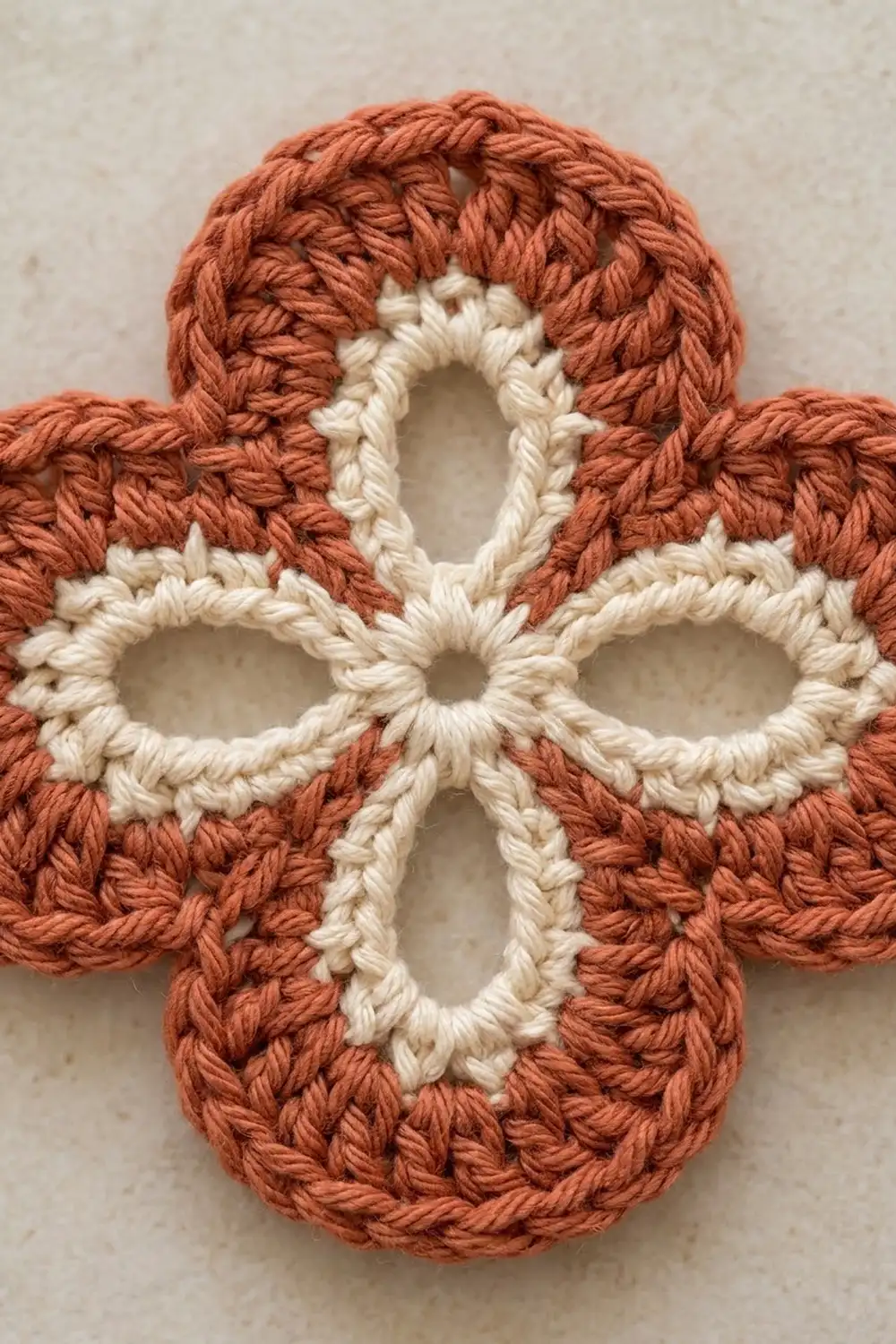
Terracotta Motif (Motif T)
Rnds 1–3 use Color B and Rnds 4–6 use Color A.
Rnd 1 (B): Ch 4 and sl st in the first ch to form a ring. Ch 1 and work 8 sc in the ring. Join with sl st to the first sc. (8 sc)
Rnd 2 (B): Sl st in the first sc. Ch 12 and sl st in the same sc to make a petal loop. Sl st in each of the next 2 sc. Repeat from * 2 more times. Ch 12, sl st in the same sc, then sl st in the next sc. (4 ch-12 loops; each petal starts from every other sc)
Rnd 3 (B): Work 20 sc into the next ch-12 loop, then sl st in the sc between petals. Repeat from * 3 more times. (80 sc, 20 per petal, plus 4 sl sts) Fasten off B.
This makes the four cream oval petals. Each loop is covered with sc and stays open in the middle.
Rnd 4 (A): Join A with sl st in st 4 of any petal and ch 3 (counts as dc). In the same petal, work hdc in st 5, sc in sts 6–15, hdc in st 16, and dc in st 17. Then tr2tog across st 18 of this petal and st 3 of the next petal.
Dc in st 4, hdc in st 5, sc in sts 6–15, hdc in st 16, dc in st 17, tr2tog across st 18 of this petal and st 3 of the next petal. Repeat from * 2 more times. The last tr2tog ends in st 3 of the first petal. Join to the top of the beg ch-3.
Count: 15 sts per petal (1 dc + 1 hdc + 10 sc + 1 hdc + 1 dc + 1 tr2tog) x 4 = 60 sts. Sts 1–2 and 19–20 of each petal are skipped and stay hidden near the center.
Rnd 5 (A, growth round): Ch 2 (counts as hdc) in the same st. Dc in the next hdc, then over the next 10 sc work [dc in next sc, 2 dc in next sc] 5 times. Dc in the next hdc, hdc in the next dc, and sc in the tr2tog.
Hdc in the next dc, dc in the next hdc, [dc in next sc, 2 dc in next sc] 5 times, dc in the next hdc, hdc in the next dc, sc in the tr2tog. Repeat from * 2 more times. Join to the top of the beg ch-2.
Count: 20 sts per lobe (1 hdc + 1 dc + 15 dc + 1 dc + 1 hdc + 1 sc) x 4 = 80 sts.
Rnd 6 (A, growth round): Ch 1. Sc in the same st and hdc in the next dc. Then work the lobe crest over the next 15 dc:
- [dc in next 2 dc, 2 dc in next dc] twice
- dc in next 2 dc
- (dc, ch 5, dc) in next dc
- [dc in next 2 dc, 2 dc in next dc] twice
Finish the lobe with hdc in the next dc and sc in the next hdc, then sl st in the valley sc. Repeat this lobe sequence (sc, hdc, crest, hdc, sc, sl st) 3 more times. Join to the first sc and fasten off.
Count: 25 sts per lobe (1 sc + 1 hdc + 20 dc + 1 hdc + 1 sc + 1 sl st) x 4 = 100 sts, plus 4 ch-5 tip loops.
The 20-dc crest makes each rounded lobe. The sl st in the valley sc keeps the deep notch between lobes, which gives the quatrefoil shape. Each ch-5 loop sits exactly at a lobe tip, and these loops are your joining points.
Cream Motif (Motif C)
Work exactly like Motif T, but use Color B for all six rounds. You can carry the yarn straight from Rnd 3 into Rnd 4: sl st across to st 4 of the first petal instead of fastening off. The stitch counts stay the same: 8, 80, 60, 80, and 100 sts.
Make All Pieces
With join-as-you-go, you work Rnds 1–5 of each motif on its own and join it during Rnd 6. Plan your colors like this:
- Per panel: 36 Motif T + 36 Motif C = 72 motifs
- Pair of panels: 72 Motif T + 72 Motif C = 144 motifs
Layout grid (each panel; T = terracotta, C = cream):
ROW 1:  T C T C T C   (top, hanging loops)
ROW 2:  C T C T C T
ROW 3:  T C T C T C
ROW 4:  C T C T C T
ROW 5:  T C T C T C
ROW 6:  C T C T C T
ROW 7:  T C T C T C
ROW 8:  C T C T C T
ROW 9:  T C T C T C
ROW 10: C T C T C T
ROW 11: T C T C T C
ROW 12: C T C T C T   (bottom, tassels)
Both panels use the same grid.
Joining
Motifs join only at their ch-5 tip loops, with no seams along the sides. Each new motif joins to at most two neighbors: the motif to its left and the one above it.
Join method: When you reach a lobe tip that needs to join, replace the “ch 5” with: ch 2, sl st into the matching ch-5 loop of the neighbor motif, ch 2. Then finish the (dc, ch 5, dc) group with its second dc and carry on as written. The stitch count is still 100 sts.
Stitch-to-stitch logic:
– Row 1, Motif 1: make it complete.
– Motifs 2–6 of Row 1: join the left tip to the right tip loop of the previous motif.
– First motif of each new row: join the top tip to the bottom tip loop of the motif above it.
– Motifs 2–6 of each new row: join the left tip first, then the top tip.
Diagonal neighbors never touch, which leaves the diamond-shaped openings.
Tension: Keep the ch-2 sections the same size as your regular chains. If the links are tight, the panel puckers. If they’re loose, it sags.
Size checkpoints:
– After Row 1, the strip should measure 41 in (104.1 cm), which is 6 x 6 in plus 5 gaps x 1 in.
– After Row 4, the panel should be 27 in (68.6 cm) long, which is 4 x 6 in plus 3 x 1 in.
– The finished panel should be 83 in (210.8 cm) long, which is 12 x 6 in plus 11 x 1 in.
The side tip loops on the outer motifs stay unjoined and act as small picots along the edges.
Border: Hanging Loops and Tassels
The edge treatment is done at the top and bottom only. Its “gauge” is the 7 in (17.8 cm) center-to-center spacing of the motifs.
Top edge, Round 1 (built in): On the 6 motifs of Row 1, work the top tip as (dc, ch 15, dc) instead of (dc, ch 5, dc). Use the same color as that motif’s Rnd 6. Per panel this gives 6 motifs x 1 top tip = 6 ch-15 loops: 3 in A and 3 in B.
Top edge, Round 2: Join matching yarn at the base of each ch-15 loop. Work 22 sc into the loop, sl st at the base, and fasten off. (22 sc per loop, 6 loops per panel, 132 sc total) Each finished loop stands 1.5 in (3.8 cm) tall and fits a rod up to 1.25 in (3.2 cm) across.
Bottom edge, tassels: Make 6 tassels per panel, one for each Row 12 motif. Row 12 runs C T C T C T, so you need 3 cream and 3 terracotta tassels per panel.
To make one tassel:
1. Wrap yarn 30 times around the 5 in (12.7 cm) card.
2. Slide a 10 in (25.4 cm) tie under the top of the wraps and knot it tightly.
3. Cut the strands open along the bottom edge.
4. Wrap a second strand tightly around the bundle 1 in (2.5 cm) below the top, making 6 turns, to form a round head.
5. Trim the ends to an even 5 in (12.7 cm).
6. Thread the top tie through the bottom ch-5 loop of the matching motif and knot it securely.
Why the math works: There’s one loop or tassel per motif tip. The first and last loops are 5 x 7 in = 35 in (88.9 cm) apart. Add the 3 in (7.6 cm) half-motif at each end and you get exactly 41 in (104.1 cm). Because the loops sit over the motif centers, the panel hangs straight with no pulling between columns.
Final Blocking
- Weave in all ends before blocking. Hide each one along the back of a sc band, not across a petal opening.
- Soak the panel in cool water for 15 minutes and press out the water gently. Don’t wring it.
- Lay it flat on mats in sections. Pin each lobe tip so motifs are 7 in (17.8 cm) apart center to center.
- Pin each petal opening into an oval with one pin through its center.
- Check the width at three places: it should be 41 in (104.1 cm) everywhere.
- Let it dry completely. Then unpin and block the next section.
- Brush the tassels straight while they’re damp and trim them evenly.
Final Quality-Control Checklist
- Every motif measures 6 in (15.2 cm) tip to tip.
- Each motif has 4 open, evenly shaped petal ovals.
- The checkerboard matches the grid, with no two motifs of the same color touching side by side.
- Every interior tip is joined and every diagonal is open.
- The panel is 41 in x 83 in (104.1 cm x 210.8 cm).
- There are 6 hanging loops at the top and 6 tassels at the bottom, colors matched.
- All ends are woven in and secure.
Troubleshooting
- Petals twist: Make sure all 20 sc go into the loop itself, not around the base stitch.
- Lobes look flat: Check the Rnd 6 crest. It should have 20 dc with the increases spaced evenly.
- Valleys are shallow: Use a sl st in the valley sc, not a sc.
- Panel leans to one side: Two motifs may be joined at the wrong tips. Check them against the grid.
- Gaps are uneven: Keep every ch-2 joining section the same size.
- Panel stretches while hanging: Use cotton, and block flat before hanging.
Care
Hand wash in cool water with mild soap and dry flat, reshaping the lobes as it dries. Shake out the tassels and steam them lightly if they start to separate.
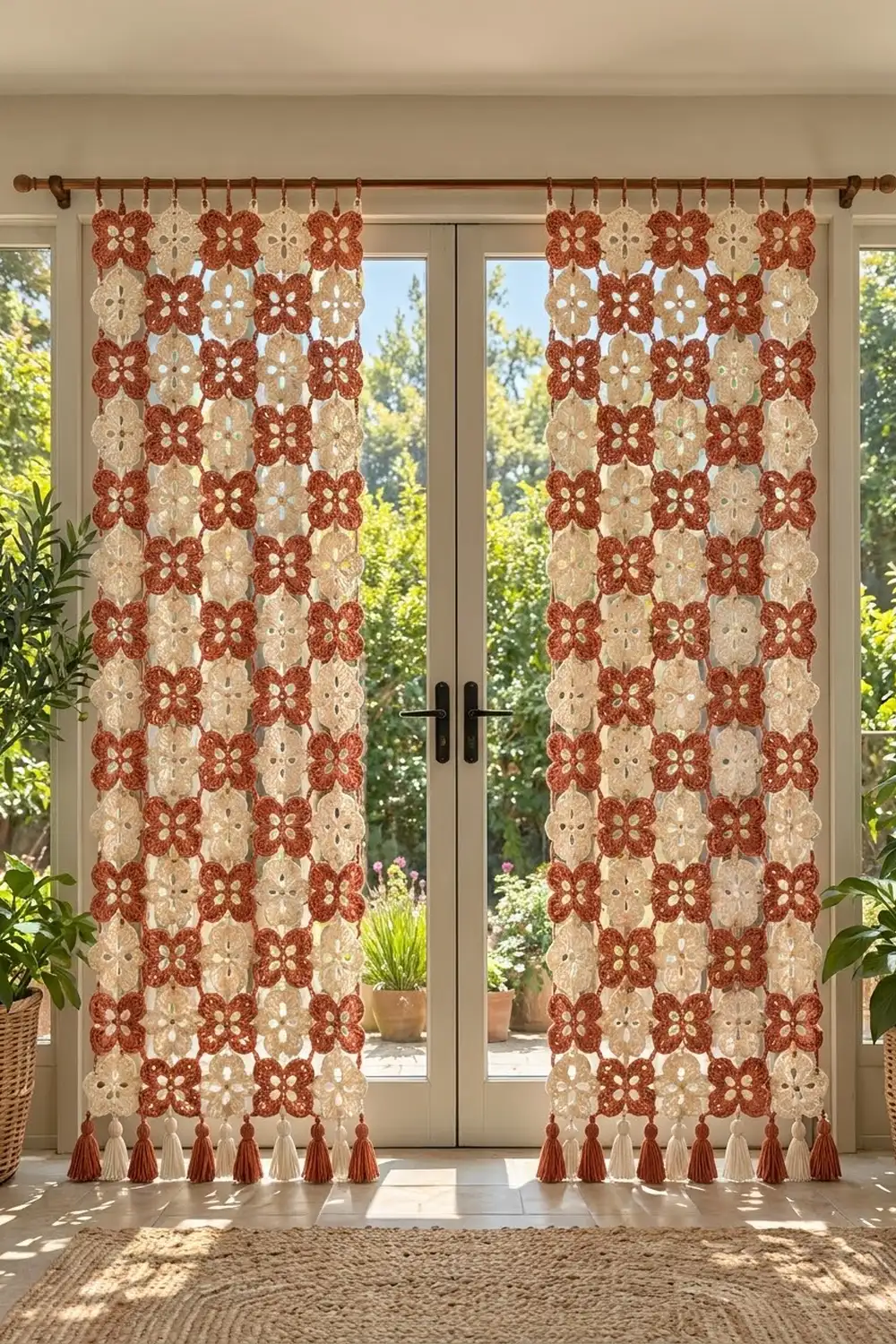
Final Notes
The measurements build on each other: 4 in (10.2 cm) petals become a 6 in (15.2 cm) motif. Motifs sit 7 in (17.8 cm) apart, making a 41 in (104.1 cm) row and an 83 in (210.8 cm) panel. With 1.5 in (3.8 cm) loops and 5 in (12.7 cm) tassels, the total drop is 89.5 in (227.3 cm). If each motif checkpoint is right, the whole curtain will come out right. Happy crocheting!