

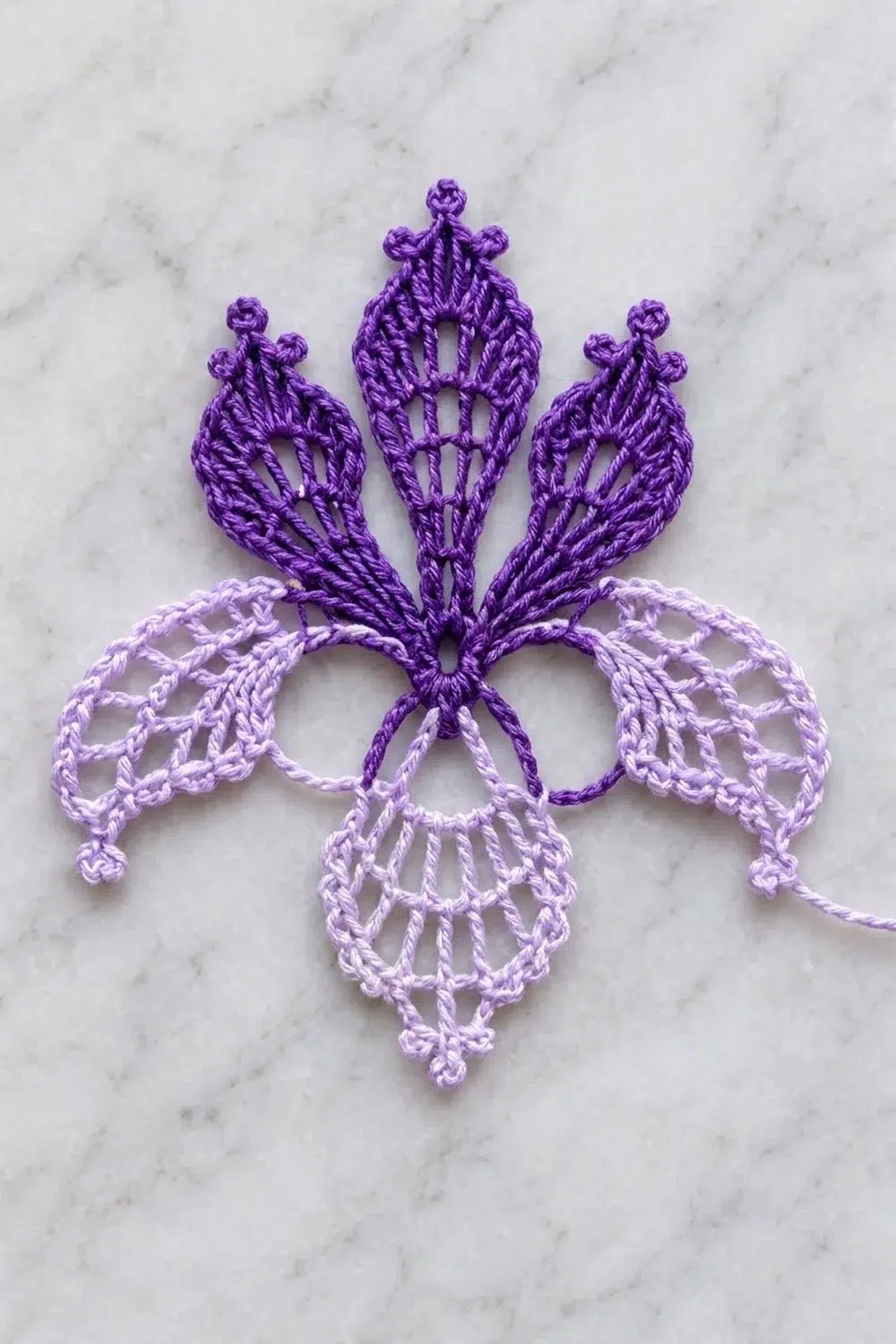
The Violet Iris is a single lace flower motif. It has three dark purple petals pointing upward and three soft lilac petals underneath. Every petal has a solid center, a ring of open double crochet “rungs,” and a firm single crochet outline. Each tip finishes with a small three-loop trefoil picot.
The two colors do most of the design work. The deep violet upper petals (the standards) fan out from a small purple hub. Below them, two curved lilac wings sweep out to the sides and a rounded lilac bowl petal hangs down. Two little lilac chain rings sit on either side of the hub. The style is airy and close to Irish crochet, but it needs no padding cord.
This pattern uses US crochet terms. The finished motif measures about 5.5 in (14.0 cm) wide and 6 in (15.2 cm) tall after blocking.
You make six small petals, each one worked in the round around a foundation chain. Next you work a picot outline on each petal and crochet a purple hub. A final lilac round around the hub joins every petal to the center and adds the two side rings. There is very little sewing; you only tack a few points at the end.
Finished Size and Construction
- Finished size: 5.5 in (14.0 cm) wide x 6 in (15.2 cm) tall
- Skill level: Intermediate
- Terminology: US crochet terms
- Yarn weight: Size 3 crochet cotton (Super Fine, category 1)
- Hook: 2.25 mm (B-1)
- Number of pieces: 1 finished motif, made from 6 petals and 1 hub joined by crochet
- Layout: 3 standards (Color A) above the hub; 2 wings, 1 bowl, and 2 rings (Color B) below and beside it
- Piece size: center standard 2.8 in (7.1 cm) long with picot; side standards 2.5 in (6.4 cm); wings 2.2 in (5.6 cm) measured straight; bowl 2.1 in (5.3 cm) plus picot
- Size before border: center standard 2.3 in (5.8 cm) long x 1.1 in (2.8 cm) wide after Rnd 2
- Border depth: the outline adds 0.15 in (0.4 cm) per edge, plus 0.25 in (0.6 cm) for each tip picot
Materials
Use a mercerized cotton thread in size 3. It holds the open rungs crisp and blocks well. A size 10 thread would give a motif about half this size. A softer, matte cotton will work too, but the picots will look rounder.
- Color A, dark violet: 12 g, 16 m (17.5 yd)
- Color B, light lilac: 12 g, 16 m (17.5 yd)
The motif itself uses about 9 m (9.8 yd) of each color. The quantities above include a margin for swatching and tails.
Tools:
- 2.25 mm (B-1) crochet hook
- Tapestry needle
- Small scissors
- Locking stitch markers (4)
- Blocking board or foam mat, rustproof pins
- Spray bottle with water; spray starch is optional
Abbreviations (US Terms)
- ch: chain
- sl st: slip stitch
- sc: single crochet
- hdc: half double crochet
- dc: double crochet
- sk: skip
- st(s): stitch(es)
- sp(s): space(s)
- Rnd: round
- beg: beginning
Trefoil picot (tp): Ch 4, sl st in 4th ch from hook (first loop made). [Ch 3, sl st in the same ch] twice. This gives three small loops on one short stem. A tp never counts as a stitch.
Base join point: On each petal, this is the sl st that closes the outline round (Rnd 3). It sits right at the base of the petal, and the hub round connects to it.
Gauge and Checkpoints
Gauge: 7 sc = 1 in (2.5 cm) in size 3 cotton with a 2.25 mm hook.
Make the center standard first and treat it as your gauge test. Measure it at each checkpoint:
- After Rnd 1: 2 in (5.1 cm) long
- After Rnd 2: 2.3 in (5.8 cm) long x 1.1 in (2.8 cm) wide
- After Rnd 3: 1.4 in (3.6 cm) wide, 2.8 in (7.1 cm) long including the picot
If your petal comes out more than 0.2 in (0.5 cm) too long, go down to a 2.0 mm hook. If it is too short, go up to a 2.5 mm hook. If the length is correct but the petal ruffles, make your ch-1 sps tighter. Don’t skip extra stitches to fix ruffling.
Center Standard (Color A, make 1)
With A, ch 15.
Rnd 1: Sc in 2nd ch from hook and in each of next 12 ch. Work 5 sc in last ch for the tip. Working along the opposite side of the foundation ch, sc in each of next 13 ch. Join with sl st in first sc. (31 sc)
The sts are numbered 1–31 from the first sc. Sts 1–13 are side A, 14–18 are the tip, and 19–31 are side B.
Rnd 2: Ch 4 (counts as dc and ch 1 throughout). Sk next sc. [Dc in next sc, ch 1, sk next sc] 4 times. Dc in next sc (st 11), ch 1, sk next sc, dc in next sc (st 13), ch 1. [Dc in next sc, ch 1] 5 times across the tip (sts 14–18). Sk next sc. [Dc in next sc, ch 1, sk next sc] 6 times. Join with sl st in 3rd ch of beg ch-4. (18 dc, 18 ch-1 sps)
The dc are numbered #1–#18, where the beg ch-4 is #1. The middle tip dc is #10. Do not fasten off. The outline (Rnd 3) is worked in the Border section.
Checkpoint: 2.3 in (5.8 cm) x 1.1 in (2.8 cm).
Side Standards (Color A, make 2)
With A, ch 13.
Rnd 1: Sc in 2nd ch from hook and in each of next 10 ch. Work 5 sc in last ch. Sc in each of next 11 ch along the opposite side. Join. (27 sc: side A sts 1–11, tip 12–16, side B 17–27)
Rnd 2: Ch 4. Sk next sc. [Dc in next sc, ch 1, sk next sc] 4 times. Dc in next sc (st 11), ch 1. [Dc in next sc, ch 1] 5 times (sts 12–16). Sk next sc. [Dc in next sc, ch 1, sk next sc] 5 times. Join in 3rd ch of beg ch-4. (16 dc, 16 ch-1 sps; the middle tip dc is #9)
Checkpoint: 2 in (5.1 cm) long x 1 in (2.5 cm) wide.
Wings (Color B, make 2)
The open rungs only run along the outer edge, and the inner edge stays solid sc. Because the outer edge is taller and longer than the inner one, the petal bends into a crescent.
With B, ch 15.
Rnd 1: Sc in 2nd ch from hook and in each of next 12 ch. Work 3 sc in last ch. Sc in each of next 13 ch along the opposite side. Join. (29 sc: outer side sts 1–13, tip 14–16, inner side 17–29)
Rnd 2: Ch 4. Sk next sc. [Dc in next sc, ch 1, sk next sc] 5 times. Dc in next sc (st 13), ch 1, dc in next sc (st 14), ch 1, hdc in next sc, sc in each of next 14 sc. Join in 3rd ch of beg ch-4. (8 dc, 8 ch-1 sps, 1 hdc, 14 sc)
Checkpoint: the wing curves gently, and its outer edge is about 2.2 in (5.6 cm) long.
Bowl (Color B, make 1)
The bowl uses ch-2 sps, which makes it wider and lacier than the standards.
With B, ch 11.
Rnd 1: Sc in 2nd ch from hook and in each of next 8 ch. Work 5 sc in last ch. Sc in each of next 9 ch along the opposite side. Join. (23 sc: side A sts 1–9, tip 10–14, side B 15–23)
Rnd 2: Ch 5 (counts as dc and ch 2). Sk next sc. [Dc in next sc, ch 2, sk next sc] 3 times. Dc in next sc (st 9), ch 2. [Dc in next sc, ch 2] 5 times (sts 10–14). Sk next sc. [Dc in next sc, ch 2, sk next sc] 4 times. Join in 3rd ch of beg ch-5. (14 dc, 14 ch-2 sps; the middle tip dc is #8)
Checkpoint: 1.8 in (4.6 cm) long x 1.3 in (3.3 cm) wide.
Hub (Color A)
With A, ch 6 and join with sl st to form a ring.
Rnd 1: Ch 1, 12 sc in ring. Join with sl st in first sc. (12 sc) Fasten off.
Checkpoint: 0.6 in (1.5 cm) across. Number the hub sc like a clock face, with 12 o’clock at the top.
Border: Picot Outline and Assembly
Border gauge: The outline is worked at the same 7 sc per 1 in (2.5 cm). A dc plus a ch-1 sp is about 2 sc wide, so 2 sc per ch-1 sp keeps each edge flat. A dc plus a ch-2 sp is about 3 sc wide, so the bowl takes 3 sc per sp. The tp goes on top of the middle tip dc, and it splits each outline into two equal halves.
Center standard, Rnd 3: Ch 1. Work 2 sc in each ch-1 sp until you have worked the sp after dc #9. Work tp at the top of dc #10. Work 2 sc in each remaining ch-1 sp. Join with sl st in first sc; this is the base join point. Count: 9 sps x 2 = 18 sc on each half, for 36 sc plus 1 tp. Fasten off with a 6 in (15.2 cm) tail.
Side standards, Rnd 3: Work as for the center standard, with the tp on top of dc #9. Count: 8 sps x 2 = 16 sc on each half, for 32 sc plus 1 tp.
Wings, Rnd 3: Ch 1. Work 2 sc in each of the 8 ch-1 sps (16 sc), then sc in the hdc. Work tp. Sc in each of the next 14 sc, then join. (31 sc plus 1 tp) Fasten off with an 8 in (20.3 cm) tail.
Bowl, Rnd 3: Ch 1. Work 3 sc in each ch-2 sp up to and including the sp after dc #7. Work tp on top of dc #8. Work 3 sc in each remaining sp, then join. Count: 7 sps x 3 = 21 sc on each half, for 42 sc plus 1 tp.
Hub Rnd 2 (joining round, Color B): Lay the pieces right side up around the hub. Join B with sl st in the 12 o’clock sc, then work around the hub as follows:
- 12: (sc, sl st in base join point of center standard, sc)
- 11: sc
- 10: (sc, sl st in base join point of side standard, sc)
- 9: sc, ch 12, sl st in same sc (ring made)
- 8: (sc, sl st in base join point of wing, sc), with the wing curving outward and down
- 7: sc
- 6: (sc, sl st in base join point of bowl, sc)
- 5: sc
- 4: (sc, sl st in base join point of second wing, sc). Turn this wing over so that it mirrors the first one.
- 3: sc, ch 12, sl st in same sc (ring made)
- 2: (sc, sl st in base join point of second side standard, sc)
- 1: sc
Join with sl st in first sc. (18 sc, 2 ch-12 rings, 6 joins) Count check: 6 join positions x 2 sc = 12 sc, plus 6 single sc = 18 sc.
Checkpoint: the hub is 0.9 in (2.3 cm) across, and each ring is a loop about 0.8 in (2.0 cm) long.
Tacking: Using the A tails, tack each side standard to the center standard at 0.4 in (1.0 cm) above the hub. This keeps the three standards fanned close together. Using the B tails, tack each wing to the edge of the nearest ring.
Final Blocking
- Weave in all the ends except the tacking tails, which you have already used.
- Soak the motif in cool water for 10 minutes, then roll it in a towel to press out the water.
- Pin the hub at the center of your board.
- Pin the center standard straight up, so its picot sits 3.25 in (8.3 cm) above the hub center.
- Pin the side standards at about 30 degrees from the center standard.
- Pin the bowl straight down, so its picot sits 2.75 in (7.0 cm) below the hub center. The full height should be 6 in (15.2 cm).
- Curve the wings outward and down, so the tip-to-tip width is 5.5 in (14.0 cm).
- Open each trefoil picot with one pin through each loop. Spread the rings into round shapes.
- Mist with water or starch and let the motif dry completely before you unpin it.
Final Quality-Control Checklist
- Center standard: 36 sc and 1 tp. Side standards: 32 sc and 1 tp each.
- Wings: 31 sc and 1 tp each, and they curve as mirror images.
- Bowl: 42 sc and 1 tp.
- Hub: 12 sc in A and 18 sc in B, with 2 rings.
- Every tp sits on the center line of its petal.
- No ch-1 sp is missing its 2 sc in the outline round.
- The finished motif is 5.5 in (14.0 cm) x 6 in (15.2 cm).
- All ends are hidden inside sc outlines, not in the open rungs.
Troubleshooting
- Petal cups: Rnd 1 is too tight at the tip. Make sure the tip has 5 sc (3 for wings), all worked into the single last ch.
- Petal ruffles: The ch-1 sps are too loose. Tighten them, or go down 0.25 mm in hook size.
- Wing is straight, not curved: Check that the inner edge is all sc and the outer edge is dc. If needed, block the wing over a curved pin line.
- Tp leans sideways: It was worked into a space rather than on top of the middle tip dc. Rework it.
- Gaps at hub: Each join position needs 2 sc. Recount: there should be 18.
- Lopsided motif: One wing was not turned over before joining.
Care
Hand wash in cool water with mild soap, press the water out in a towel, and dry the motif flat, pinned to shape. Re-starch lightly if it softens.

Final Notes
The measurement chain is short and easy to check. Your gauge of 7 sc per 1 in (2.5 cm) sets the length of each Rnd 1 spine. The checkpoints after Rnd 2 confirm the rungs. The outline round adds 0.15 in (0.4 cm) per edge and a 0.25 in (0.6 cm) picot. Hub joining then sets the petals into a motif 5.5 in (14.0 cm) wide x 6 in (15.2 cm) tall. If each petal matches its checkpoint, the finished iris will too.
Happy crocheting!