

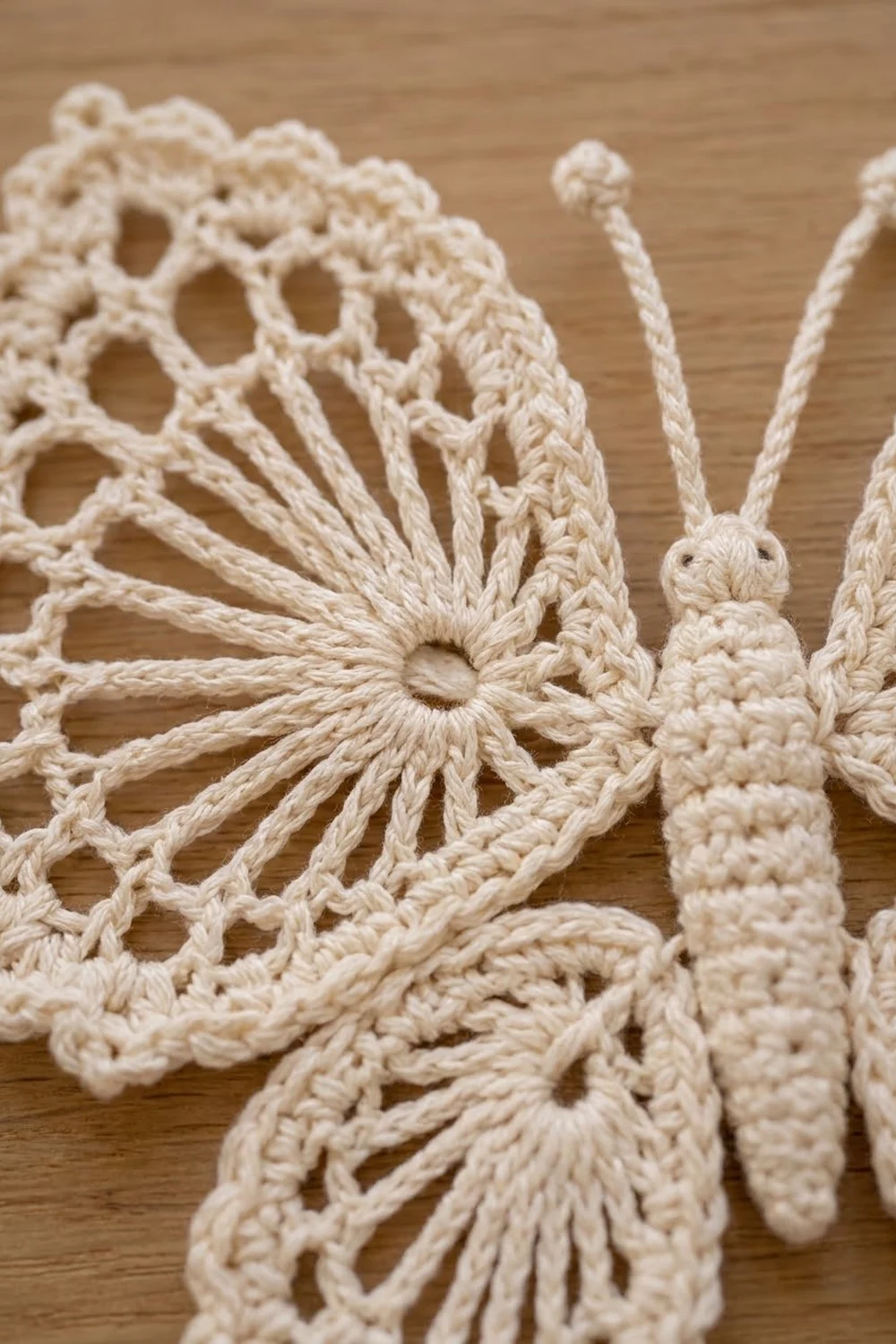
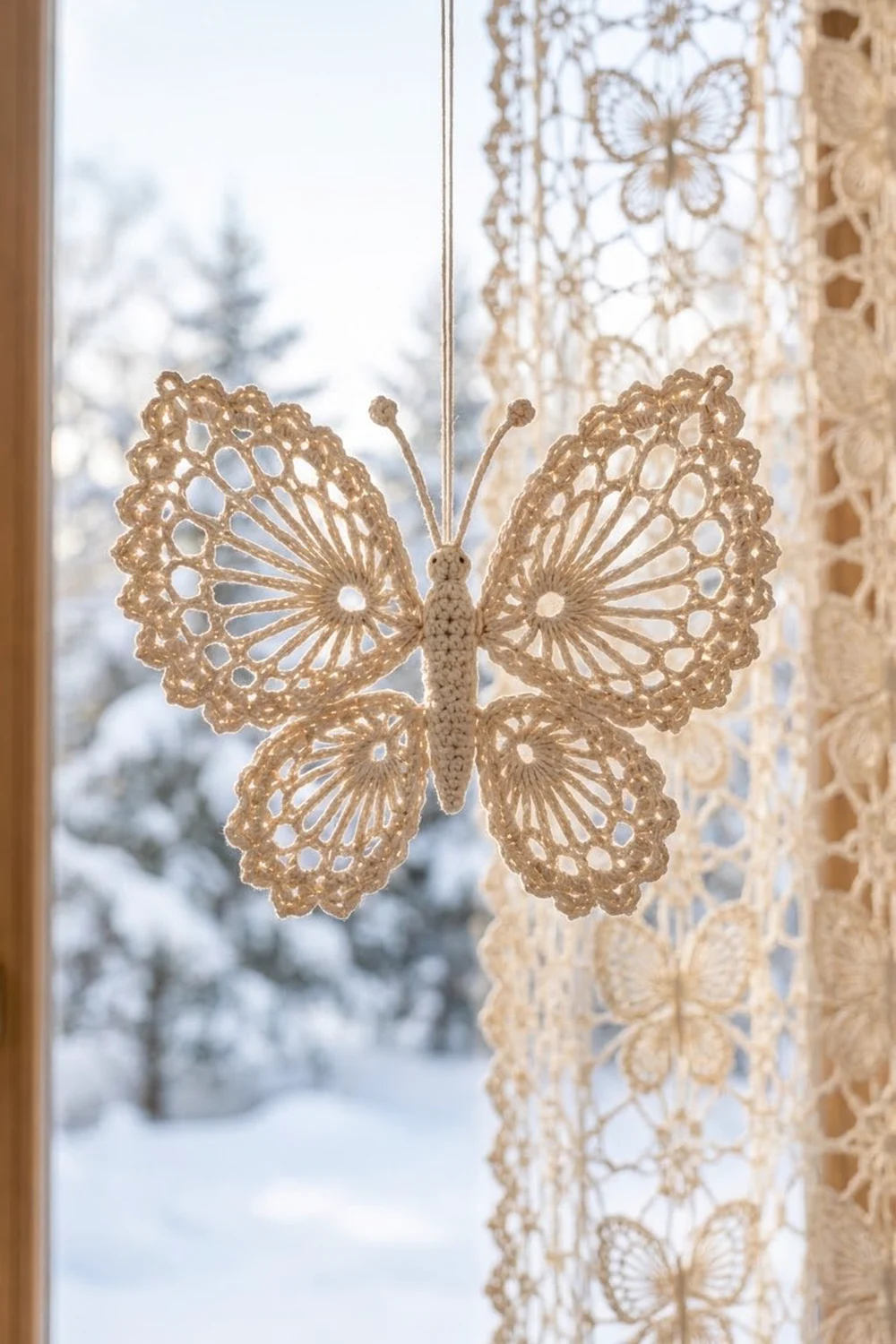
This lace butterfly is made in soft cream cotton. Each of its four wings is an open fan of long spokes coming out of a small ring. Around the spokes are mesh eyelets, a firm band of single crochet, and a beaded picot edge. A ridged body with a round head and knobbed antennae sits on top.
It’s worked in a single warm ivory, so the lace texture does the work. Use it on a winter window, a gift, a wreath, or as an appliqué.
The pattern uses US crochet terms. The finished butterfly is about 8.5 in (21.6 cm) wide and 7 in (17.8 cm) tall, antennae included.
You work two upper wings and two smaller lower wings flat in turned rows, each starting from a ring and finished with a two-round picot border. The body is worked in the round from the head down. To finish, you join the wing tips under the body and sew the body on top.
Finished Size and Construction
- Finished size: about 8.5 in (21.6 cm) wide x 7 in (17.8 cm) tall, including antennae
- Skill level: Intermediate
- Terminology: US crochet terms
- Yarn weight: Fingering-weight mercerized cotton (Super Fine, #1)
- Hook: 2.75 mm (US C-2)
- Number of pieces: 1 finished butterfly motif, built from 5 components (2 upper wings, 2 lower wings, 1 body with antennae)
- Layout: wings angle out from a center body
- Upper wing size: 3.3 in (8.4 cm) from ring to outer edge
- Lower wing size: 2.8 in (7.1 cm) from ring to outer edge
- Size before border: upper wing 3 in (7.6 cm), lower wing 2.5 in (6.4 cm)
- Border depth: about 0.3 in (0.8 cm)
- Body: about 4.5 in (11.4 cm) long x 0.6 in (1.5 cm) wide
Materials
Choose a smooth mercerized cotton in fingering weight. It gives you crisp spokes, open eyelets, and picots that hold their shape. Fuzzy yarns hide the lace.
- Cream / Ivory: 20 g, about 70 m (77 yd)
That amount already includes a safety margin of roughly 25%.
Tools:
- 2.75 mm (US C-2) crochet hook
- Tapestry needle
- A little fiberfill or cotton yarn scraps
- Stitch markers
- Blocking mat and rustproof pins
- Spray bottle with cool water
- Ruler or tape measure
- Scissors
Abbreviations (US Terms)
- ch – chain
- sl st – slip stitch
- sc – single crochet
- dc – double crochet
- tr – treble crochet
- inc – 2 sc in the same stitch
- sc2tog – single crochet 2 together
- BLO – back loop only
- MR – magic ring
- tch – turning chain
- sp(s) – space(s)
- st(s) – stitch(es)
- RS – right side
Special stitches:
- Picot: ch 3, sl st in 3rd ch from hook.
- Bobble: [yarn over, insert hook in st, yarn over, pull up a loop, yarn over, pull through 2 loops] 4 times in the same st, yarn over, pull through all 5 loops on hook.
Gauge and Checkpoints
Gauge: 26 sc and 26 rows = 4 in (10.2 cm). One tr row is about 0.45 in (1.1 cm) tall, and one dc row is about 0.33 in (0.8 cm) tall.
Make one lower wing first and use it as your gauge test. If it measures right, you can keep it.
- Upper wing, after Row 1: 0.65 in (1.7 cm) from ring center to tr tops
- Upper wing, after Row 4: 2 in (5.1 cm)
- Upper wing, after Row 8: 3 in (7.6 cm)
- Lower wing, after Row 3: 1.5 in (3.8 cm)
- Lower wing, after Row 7: 2.5 in (6.4 cm)
- Each wing after border: +0.3 in (0.8 cm)
Too big: go down to a 2.5 mm hook, or pull your tr loops snugger.
Too small: go up to a 3 mm hook. Don’t add spokes, because every count after that would change.
Upper Wing (Make 2)
Work the wing as a fan in turned rows. The ring becomes the wing’s point.
Row 1: Ch 5, sl st in first ch to form a ring. Ch 4 (counts as tr), 10 tr in ring. Turn. (11 tr)
Row 2: Ch 5 (counts as tr and ch 1), [tr in next tr, ch 1] 9 times, tr in top of tch. Turn. (11 tr, 10 ch-1 sps)
Row 3: Ch 6 (counts as tr and ch 2), [tr in next tr, ch 2] 9 times, tr in 4th ch of tch. Turn. (11 tr, 10 ch-2 sps)
Row 4: Ch 7 (counts as tr and ch 3), [tr in next tr, ch 3] 9 times, tr in 4th ch of tch. Turn. (11 tr, 10 ch-3 sps)
The 11 tr now form long, straight spokes. Checkpoint: 2 in (5.1 cm).
Row 5 (conversion row): Ch 1, 2 sc in first tr, [3 sc in next ch-3 sp, sc in next tr] 9 times, 3 sc in next ch-3 sp, 2 sc in 4th ch of tch. Turn. (43 sc = 11 sc worked 1 per tr + 30 sc in the spaces + 2 extra sc at the ends)
Row 6 (eyelet row): Ch 5 (counts as dc and ch 2), skip next 2 sc, [dc in next sc, ch 2, skip next 2 sc] 13 times, dc in last sc. Turn. (15 dc, 14 ch-2 sps)
Row 7: Ch 6 (counts as dc and ch 3), [dc in next dc, ch 3] 13 times, dc in 3rd ch of tch. Turn. (15 dc, 14 ch-3 sps)
Row 8: Ch 1, sc in first dc, [3 sc in next ch-3 sp, sc in next dc] 14 times, working the last sc in the 3rd ch of tch. (57 sc = 15 sc worked 1 per dc + 42 sc in the spaces)
Checkpoint: 3 in (7.6 cm). Don’t fasten off. Go straight to the border.
Lower Wing (Make 2)
Row 1: Ch 5, sl st to form a ring. Ch 4 (counts as tr), 8 tr in ring. Turn. (9 tr)
Row 2: Ch 5 (counts as tr and ch 1), [tr in next tr, ch 1] 7 times, tr in top of tch. Turn. (9 tr, 8 ch-1 sps)
Row 3: Ch 6 (counts as tr and ch 2), [tr in next tr, ch 2] 7 times, tr in 4th ch of tch. Turn. (9 tr, 8 ch-2 sps)
Checkpoint: 1.5 in (3.8 cm).
Row 4 (conversion row): Ch 1, 2 sc in first tr, [2 sc in next ch-2 sp, sc in next tr] 3 times, 2 sc in next ch-2 sp, 2 sc in next (center) tr, [2 sc in next ch-2 sp, sc in next tr] 3 times, 2 sc in next ch-2 sp, 2 sc in 4th ch of tch. Turn. (28 sc = 9 sc worked 1 per tr + 16 sc in the spaces + 3 extra sc in the first, center, and last tr)
Row 5 (eyelet row): Ch 5 (counts as dc and ch 2), skip next 2 sc, [dc in next sc, ch 2, skip next 2 sc] 8 times, dc in last sc. Turn. (10 dc, 9 ch-2 sps)
Row 6: Ch 6 (counts as dc and ch 3), [dc in next dc, ch 3] 8 times, dc in 3rd ch of tch. Turn. (10 dc, 9 ch-3 sps)
Row 7: Ch 1, sc in first dc, [3 sc in next ch-3 sp, sc in next dc] 9 times, working the last sc in the 3rd ch of tch. (37 sc = 10 sc worked 1 per dc + 27 sc in the spaces)
Checkpoint: 2.5 in (6.4 cm). Don’t fasten off.
Body and Antennae (Make 1)
Work in continuous rounds. Mark the first st of each round.
Rnd 1: 6 sc in MR. (6)
Rnd 2: Inc in each st around. (12)
Rnds 3–4: Sc in each st around. (12)
Rnd 5: Sc2tog 6 times. (6) Stuff the head firmly before it closes.
Rnd 6: [Sc in next st, inc] 3 times. (9)
Rnd 7: [Sc in next 2 sts, inc] 3 times. (12)
Rnds 8–29: Sc in BLO in each st around. (12)
The BLO rounds make the body’s segmented ridges. Stuff it lightly as you go.
Rnd 30: [Sc in next 2 sts, sc2tog] 3 times. (9)
Rnd 31: Sc in BLO in each st around. (9)
Rnd 32: [Sc in next st, sc2tog] 3 times. (6)
Rnd 33: Sc2tog 3 times. (3) Fasten off and close the tip.
Antennae (make 2): Join yarn with a sl st in a Rnd 2 st just to one side of the top center of the head. Ch 16, bobble in 4th ch from hook, sl st in each of the remaining 12 ch, sl st in the head. Fasten off. Make the second antenna 2 sts away on the other side of center. Each one is about 1.5 in (3.8 cm) long, not counting the knob.
Border
Both wings get the same two-round border. In Round 1, work 1 sc in each sc along the curve, plus 1 extra sc at each end to turn the corner. Along the straight sides, work into the row ends at a fixed ratio: 3 sc per tr row, 2 sc per dc row, and 1 sc per sc row.
Border gauge: each 2 sc plus a picot covers about 0.3 in (0.8 cm). The border adds about 0.3 in (0.8 cm) of depth.
Upper Wing Border
Round 1: Turn so the RS faces you. Ch 1, then work:
- Curve: 2 sc in first st, sc in next 55 sts, 2 sc in last st. (59 sc = 57 worked 1 per st + 2 extra)
- Side B: working down the row ends, 1 sc in Row 8, 2 sc in each of Rows 7 and 6, 1 sc in Row 5, 3 sc in each of Rows 4–1. (18 sc)
- Tip: 3 sc around the ring. (3 sc)
- Side A: work up the row ends, repeating Side B in reverse. (18 sc)
Sl st in first sc. (98 sc = 59 + 18 + 3 + 18)
Round 2: Ch 1, then work:
- Curve: [sc in next 2 sts, picot] 29 times, sc in next st. (59 sc, 29 picots)
- Side B: [sc in next 2 sts, picot] 9 times. (18 sc, 9 picots)
- Tip: sc in next 3 sts. (3 sc)
- Side A: [sc in next 2 sts, picot] 9 times. (18 sc, 9 picots)
Sl st in first sc and fasten off. (98 sc, 47 picots)
Lower Wing Border
Round 1: Turn so the RS faces you. Ch 1, then work:
- Curve: 2 sc in first st, sc in next 35 sts, 2 sc in last st. (39 sc = 37 worked 1 per st + 2 extra)
- Side B: 1 sc in Row 7, 2 sc in each of Rows 6 and 5, 1 sc in Row 4, 3 sc in each of Rows 3–1. (15 sc)
- Tip: 3 sc around the ring. (3 sc)
- Side A: repeat Side B in reverse. (15 sc)
Sl st in first sc. (72 sc = 39 + 15 + 3 + 15)
Round 2: Ch 1, then work:
- Curve: [sc in next 2 sts, picot] 19 times, sc in next st. (39 sc, 19 picots)
- Side B: [sc in next 2 sts, picot] 7 times, sc in next st. (15 sc, 7 picots)
- Tip: sc in next 3 sts. (3 sc)
- Side A: same as Side B. (15 sc, 7 picots)
Sl st in first sc and fasten off. (72 sc, 33 picots)
Why the math works: each curve count is the last row’s own count plus 2 corner increases (57 + 2 = 59 and 37 + 2 = 39). The row-end sc match the row heights. A 0.45 in (1.1 cm) tr row takes 3 sc of about 0.15 in (0.4 cm) each, so the sides lie flat. Round 2 adds no stitches, so every side keeps its Round 1 count.
Assembly
- Lay the blocked wings RS up. The fans are symmetrical, so just rotate each one into place.
- Point the upper wing tips toward the center, with the curves angled up and out. Angle the lower wings down and out just below.
- Whipstitch the four tips together through the Round 1 sc. Then tack each upper wing to the lower wing below it for 0.75 in (1.9 cm) out from the tips.
- Center the body on top, with the upper wing tips behind Rnds 10–14 and the lower wing tips behind Rnds 16–20.
- Sew the body down along both sides of its underside, hiding your stitches in the BLO ridges.
Final Blocking
- Mist the butterfly until it is damp all the way through.
- Pin it RS up on the mat. Pull each upper wing out to 3.3 in (8.4 cm) and each lower wing to 2.8 in (7.1 cm).
- Pin the eyelets open and pin every picot along the curves.
- Curve the antennae outward and pin the knobs.
- Check that it measures 8.5 in (21.6 cm) x 7 in (17.8 cm), then let it dry completely.
Final Quality-Control Checklist
- Upper wings: 11 spokes, 15 eyelets in each mesh row, 98 border sc, 47 picots
- Lower wings: 9 spokes, 10 eyelets in each mesh row, 72 border sc, 33 picots
- Wings in each pair match within 0.25 in (0.6 cm)
- The body is evenly ridged, and the antennae match
- No stuffing or sewing shows on the RS
Troubleshooting
Wing cups: the spokes are too tight. Loosen the chain spaces in Rows 2–4.
Edge ruffles: your sc is too wide. Go down a hook size for the sc rows and the border.
Spokes lean: you probably missed a tch. Count 11 (or 9) tr in every row.
Uneven eyelets: skip exactly 2 sc between dc.
Sides pucker: follow the 3-2-1 row-end ratio.
Care
Hand wash in cool water with mild soap. Roll it in a towel to remove water, then re-pin it to dry flat.
Final Notes
The upper wing measures 2 in (5.1 cm) at the spokes, 3 in (7.6 cm) at Row 8, and 3.3 in (8.4 cm) with the border. The lower wing measures 1.5 in (3.8 cm), 2.5 in (6.4 cm), and 2.8 in (7.1 cm) at the same stages. Along with the 4.5 in (11.4 cm) body, they make an 8.5 in (21.6 cm) by 7 in (17.8 cm) butterfly. If every checkpoint matches, the finished motif will match too.
Happy crocheting!