

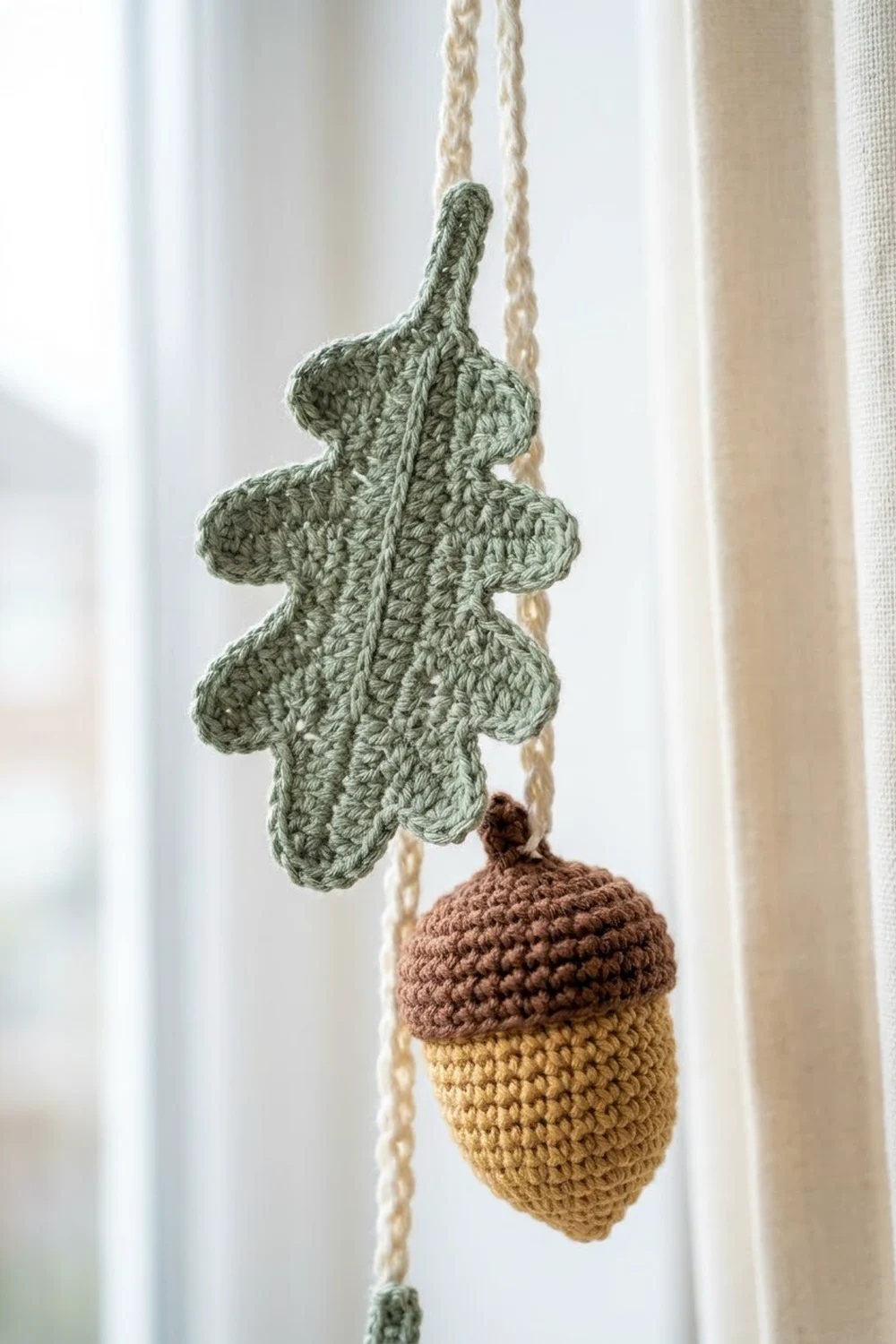
The Woodland Hollow Curtain brings an autumn woodland to your window. A lacy cream header with fan scallops hangs from a wooden rod on simple tab loops. Below it, 25 cream chain strands drop toward the sill, each carrying sage green oak leaves and little two-tone acorns.
The palette is soft and warm: cream for the header and strands, sage green for the leaves, chocolate brown for the textured acorn caps, and golden tan for the acorn bodies. The style is cottage-meets-woodland, with gentle stripes of light between the hanging strands.
This pattern uses US crochet terms. The finished curtain measures 42¼ in (107.3 cm) wide and about 64 in (162.6 cm) from the rod to the lowest leaf tip.
Construction is straightforward. You work the header flat in rows, add 12 tab loops along the top edge, then make the leaves and acorns separately. The strands are chained straight down from the header, picking up each ornament as you go. A picot border finishes the scallops.
Finished Size and Construction
- Finished size: 42¼ in (107.3 cm) wide x about 64 in (162.6 cm) long, rod to lowest leaf tip
- Skill level: Intermediate
- Terminology: US
- Yarn weight: Worsted (#4)
- Hooks: 5.0 mm (H-8) and 3.75 mm (F-5)
- Number of pieces: 1 header, 87 leaves, 75 acorns (bodies and caps), joined by 25 chain strands
- Layout: 25 strands across the header, alternating valley strands (13) and shell strands (12)
- Piece sizes: leaf 5½ in (14.0 cm) long x 2½ in (6.4 cm) wide; acorn 1¾ in (4.4 cm) long x 1¼ in (3.2 cm) wide
- Header size before border: 42¼ in (107.3 cm) wide x 3 in (7.6 cm) deep at the fan tips
- Border depth: ½ in (1.3 cm) including picots, for a finished header depth of 3½ in (8.9 cm)
Materials
Choose a smooth worsted cotton or cotton blend. Cotton holds the leaf lobes crisply and resists stretching on long strands. The quantities below assume about 200 m per 100 g.
- Color A, cream: 200 g (400 m) for header, tabs, strands, and border
- Color B, sage green: 400 g (800 m) for 87 leaves
- Color C, chocolate brown: 110 g (220 m) for 75 acorn caps
- Color D, golden tan: 160 g (320 m) for 75 acorn bodies
Tools:
- 5.0 mm (H-8) hook
- 3.75 mm (F-5) hook
- Polyester fiberfill, about 100 g
- Tapestry needle
- Stitch markers
- Measuring tape
- Blocking mats and rust-proof pins
- Scissors
All quantities include a margin of roughly 15 percent for swatching and tails.
Abbreviations (US Terms)
- ch – chain
- sl st – slip stitch
- sc – single crochet
- hdc – half double crochet
- dc – double crochet
- tr – treble crochet
- inc – 2 sc in the same stitch
- dec – sc2tog
- MR – magic ring
- BLO – back loop only
- sp – space
- st(s) – stitch(es)
- RS / WS – right side / wrong side
Special stitches:
- Picot: ch 3, sl st in 3rd ch from hook.
- V-st: (dc, ch 3, dc) in the same stitch.
- Fan: 11 dc in the ch-3 sp of a V-st.
Gauge and Checkpoints
Header gauge (5.0 mm hook): 16 dc and 8 dc rows = 4 in (10.2 cm).
Strand gauge (5.0 mm hook): 7 ch = 2 in (5.1 cm), so 28 ch = 8 in (20.3 cm).
Make one leaf and one acorn before anything else. They are your real gauge test.
- Leaf: 5½ in (14.0 cm) long x 2½ in (6.4 cm) wide, not counting the hanging loop.
- Acorn: 1¾ in (4.4 cm) long x 1¼ in (3.2 cm) wide.
- Header after Row 4: 42¼ in (107.3 cm) wide.
- First strand segment: 14 ch = 4 in (10.2 cm).
If your pieces are too big, go down 0.5 mm. If they are too small, go up 0.5 mm. For chains only, adjust your tension rather than the hook if the rest of your gauge is correct.
Header
With A and 5.0 mm hook, ch 170.
Row 1 (RS): Sc in 2nd ch from hook and in each ch across, turn. (169 sc)
Row 2: Ch 3 (counts as dc), dc in each st across, turn. (169 dc)
Row 3: Ch 4 (counts as dc + ch 1), sk next st, dc in next st, *ch 1, sk next st, dc in next st; rep from * across, turn. (85 dc + 84 ch-1 sps = 169 sts)
Row 4: Ch 3 (counts as dc), *dc in next ch-1 sp, dc in next dc; rep from * across, working the last dc in the 3rd ch of the turning ch, turn. (169 dc)
Checkpoint: the header should measure 42¼ in (107.3 cm) wide.
Row 5: Ch 1, sc in first st, *ch 5, sk 6 sts, V-st in next st, ch 5, sk 6 sts, sc in next st; rep from * 11 more times, turn. (13 sc, 12 V-sts, 24 ch-5 sps)
Each repeat uses 14 sts, and 1 + (12 x 14) = 169.
Row 6: Ch 1, sc in first sc, *sk ch-5 sp, fan in ch-3 sp of next V-st, sk ch-5 sp, sc in next sc; rep from * 11 more times. Fasten off. (12 fans of 11 dc + 13 sc = 145 sts)
The skipped ch-5 lengths stay visible as a lattice under each fan, giving the open lace look. The header should now be 3 in (7.6 cm) deep at the fan tips.
Tab Loops
Tabs are worked into the free loops of the foundation chain, centered over each fan.
With RS facing, count the free loops from the right edge. Tabs sit on loops 5–11, 19–25, 33–39, and so on, every 14 loops, ending on loops 159–165. This leaves 4 loops free at each end and 7 loops between tabs.
Row 1: Join A in the first loop of the tab, ch 1, sc in same loop and next 6 loops, turn. (7 sc)
Rows 2–22: Ch 1, sc in each st across, turn. (7 sc)
Fasten off, leaving a 12 in (30.5 cm) tail. Fold the tab to the WS and whipstitch Row 22 to the WS of header Row 2, directly behind the same 7 sts. Each tab is 1¾ in (4.4 cm) wide and 4.9 in (12.4 cm) long before folding, fitting rods up to 1⅜ in (3.5 cm) thick.
Make 12 tabs.
Oak Leaf
With B and 5.0 mm hook, ch 24.
Round 1, first side: Sl st in 2nd ch from hook (tip). Working toward the base:
- Sc in next ch.
- Small lobe: hdc in next ch, 3 dc in next ch, hdc in next ch, sl st in next ch.
- Large lobe: hdc in next ch, dc in next ch, 3 tr in next ch, dc in next ch, hdc in next ch, sl st in next ch.
- Large lobe: repeat the large lobe.
- Small lobe: repeat the small lobe.
This uses 21 ch and makes 29 sts (1 + 6 + 8 + 8 + 6).
Base: (Sc, ch 8, sc) in the last ch. The ch-8 is the hanging loop.
Second side: Rotate and work into the free loops of the foundation chain, mirroring the first side:
- Small lobe: sl st in next ch, hdc in next ch, 3 dc in next ch, hdc in next ch.
- Large lobe: sl st in next ch, hdc in next ch, dc in next ch, 3 tr in next ch, dc in next ch, hdc in next ch.
- Large lobe: repeat the large lobe.
- Small lobe: repeat the small lobe.
- Sc in next ch.
This again uses 21 ch and makes 29 sts (6 + 8 + 8 + 6 + 1).
Tip: Ch 3, sl st in the beginning sl st. Fasten off and weave in ends.
Round 1 totals 58 edge sts, 2 base sc, the ch-8 loop, and the ch-3 tip. The 3-tr groups form the deep lobes, the sl sts pull in the notches, and the foundation chain becomes a raised center vein. The leaf hangs stem-up from its loop.
Acorn
Work in continuous rounds with the 3.75 mm hook. Mark the first st of each round.
Body (D):
- Rnd 1: 6 sc in MR. (6)
- Rnd 2: (Sc, inc) 3 times. (9)
- Rnd 3: (Sc in next 2 sts, inc) 3 times. (12)
- Rnd 4: (Sc, inc) 6 times. (18)
- Rnds 5–8: Sc in each st. (18)
Sl st, fasten off with a 10 in (25.4 cm) tail. Stuff firmly. The slow increases make a softly pointed bottom.
Cap (C):
- Rnd 1: 6 sc in MR. (6)
- Rnd 2: Inc in each st. (12)
- Rnd 3 (BLO): (Sc, inc) 6 times. (18)
- Rnd 4 (BLO): (Sc in next 2 sts, inc) 6 times. (24)
- Rnds 5–6 (BLO): Sc in each st. (24)
- Rnd 7: (Sc in next 2 sts, dec) 6 times. (18)
Sl st, fasten off. The BLO rounds leave ridges of front loops that mimic the scaly texture of an acorn cup.
Assembly: Add a little stuffing to the cap. Fit it over the body so Rnd 7 of the cap meets Rnd 8 of the body. Using the body tail, whipstitch them together one stitch to one stitch (18 to 18).
Stem loop: Join C at the center of the cap MR, ch 6, sl st in same st. Fasten off.
Make All Pieces
- Leaves (B): 87 (48 for shell strands, 39 for valley strands)
- Acorns (C and D): 75 (36 for shell strands, 39 for valley strands)
- Header with 12 tabs (A): 1
Strand order across the header, left to right:
V S V S V S V S V S V S V S V S V S V S V S V S V
V = valley strand (13)   S = shell strand (12)
Ornament positions, measured down from each strand’s starting stitch:
Distance          Shell strand (S)   Valley strand (V)
4 in (10.2 cm)    Leaf               -
8 in (20.3 cm)    -                  Acorn
12 in (30.5 cm)   Acorn              -
16 in (40.6 cm)   -                  Leaf
20 in (50.8 cm)   Leaf               -
24 in (61.0 cm)   -                  Acorn
28 in (71.1 cm)   Acorn              -
32 in (81.3 cm)   -                  Leaf
36 in (91.4 cm)   Leaf               -
40 in (101.6 cm)  -                  Acorn
44 in (111.8 cm)  Acorn              -
48 in (121.9 cm)  -                  Leaf
52 in (132.1 cm)  Leaf               -
Each shell strand carries 4 leaves and 3 acorns. Each valley strand carries 3 acorns and 3 leaves.
Joining
The strands are chained straight down from Row 6 of the header, and each ornament is attached with a slip stitch. Before you start, hang the header from your rod or a skirt hanger so the strands can hang down naturally while you work.
Ornament join: Insert hook through the ornament’s hanging loop (the leaf’s ch-8 or the acorn’s ch-6), yo, and pull through the loop and the st on your hook. Then keep chaining.
Shell strands (12): With A and 5.0 mm hook, join with sl st in the 6th (center) dc of a fan. Ch 14, join leaf, *ch 28, join acorn, ch 28, join leaf; rep from * 2 more times. Fasten off. (182 ch = 52 in / 132.1 cm)
Valley strands (13): Join with sl st in a Row 6 sc between fans, including the 2 end sc. *Ch 28, join acorn, ch 28, join leaf; rep from * 2 more times. Fasten off. (168 ch = 48 in / 121.9 cm)
Each strand uses exactly one Row 6 st, so the strands land in an even rhythm about 1¾ in (4.4 cm) apart.
Tension: Chain at a relaxed, even pace. Tight chains shorten the strand and make it twist. Measure every 28 ch against 8 in (20.3 cm) and correct before you go further.
Checkpoint: The finished shell strands reach 52 in (132.1 cm) and the valley strands 48 in (121.9 cm), each measured from its own starting stitch, giving a staggered hem.
Border
Border gauge: 16 sc = 4 in (10.2 cm) along a straight edge. Picots add height but no width.
With RS facing and A, join at the top corner of the right edge. Work one continuous pass. The joined strands sit behind your work; insert your hook under both top loops of each Row 6 st as usual.
- Right side: Work 9 sc evenly down the row ends: 1 in Row 1, 2 in each of Rows 2–4, 1 in Row 5, 1 in Row 6. (9 sc)
- Bottom edge: Sc in first sc, *sc in next 2 dc, picot, (sc in next 2 dc, picot) 4 more times, sc in last dc of fan, sc in next sc; rep from * 11 more times. (145 sc + 60 picots)
- Left side: Work 9 sc up the row ends as on the right side. (9 sc)
Fasten off. (163 sc + 60 picots total)
Why the math works: Each fan has 11 dc and gets 11 sc. Each valley sc gets 1 sc. That gives (12 x 11) + 13 = 145, exactly the Row 6 count. Picots fall after the 2nd, 4th, 6th, 8th, and 10th dc. That makes them symmetrical, and the middle picot crowns the fan’s center stitch, right above its shell strand. No corner stitches are added because the bottom count already includes both end valley sc.
Final Blocking
- Lay the header flat, RS up, on blocking mats with strands spread straight below it.
- Pin the header to 42¼ in (107.3 cm) wide and 3½ in (8.9 cm) deep at the fan tips.
- Pin each picot into a crisp point and each fan into an even arc.
- Pin each leaf flat, opening every lobe point.
- Mist with water until damp, or hold a steam iron just above the work without touching it.
- Leave until completely dry, at least 12 hours.
- Hang the curtain and let the ornaments weigh the strands straight for a day.
Don’t block the acorns. Just reshape them with your fingers.
Final Quality-Control Checklist
- Header measures 42¼ in (107.3 cm) wide.
- Row 6 has 145 sts: 12 fans and 13 sc.
- 12 tabs, each 7 sts wide, all folded to the same depth.
- 25 strands: 12 from fan centers, 13 from valleys.
- Shell strands are 52 in (132.1 cm); valley strands are 48 in (121.9 cm).
- 87 leaves and 75 acorns attached in the correct order.
- Border has 145 sc and 60 picots along the bottom edge.
- All ends woven in securely, especially at ornament joins.
Troubleshooting
- Header ruffles at Row 6: Your fans are too loose. Go down 0.5 mm for Row 6 only.
- Header cups between fans: The ch-5 lengths are tight. Chain more loosely or add 1 ch to each (ch 6).
- Leaf curls: Block firmly while damp. Check that the sl sts in the notches are not pulled tight.
- Acorn stuffing shows: Use a smaller hook, or stuff a little less firmly.
- Strands twist: Your chain is tight. Relax your tension and let each strand hang free to untwist before fastening off.
- Tabs too snug: Add 2 rows to each tab.
Care
Hand wash in cool water with mild soap, roll in a towel, and dry flat with strands straight. Keep out of strong direct sun to protect the colors.

Final Notes
The whole curtain depends on a few linked measurements. Your 16-dc gauge sets the 169-st header at 42¼ in (107.3 cm). The 14-st repeat creates 12 fans and 145 sts in Row 6, which the border matches stitch for stitch. Your chain gauge turns 28 ch into 8 in (20.3 cm), which puts every leaf and acorn in the right place. Check each measurement as you go, and the finished curtain will hang as planned.
Happy crocheting!