

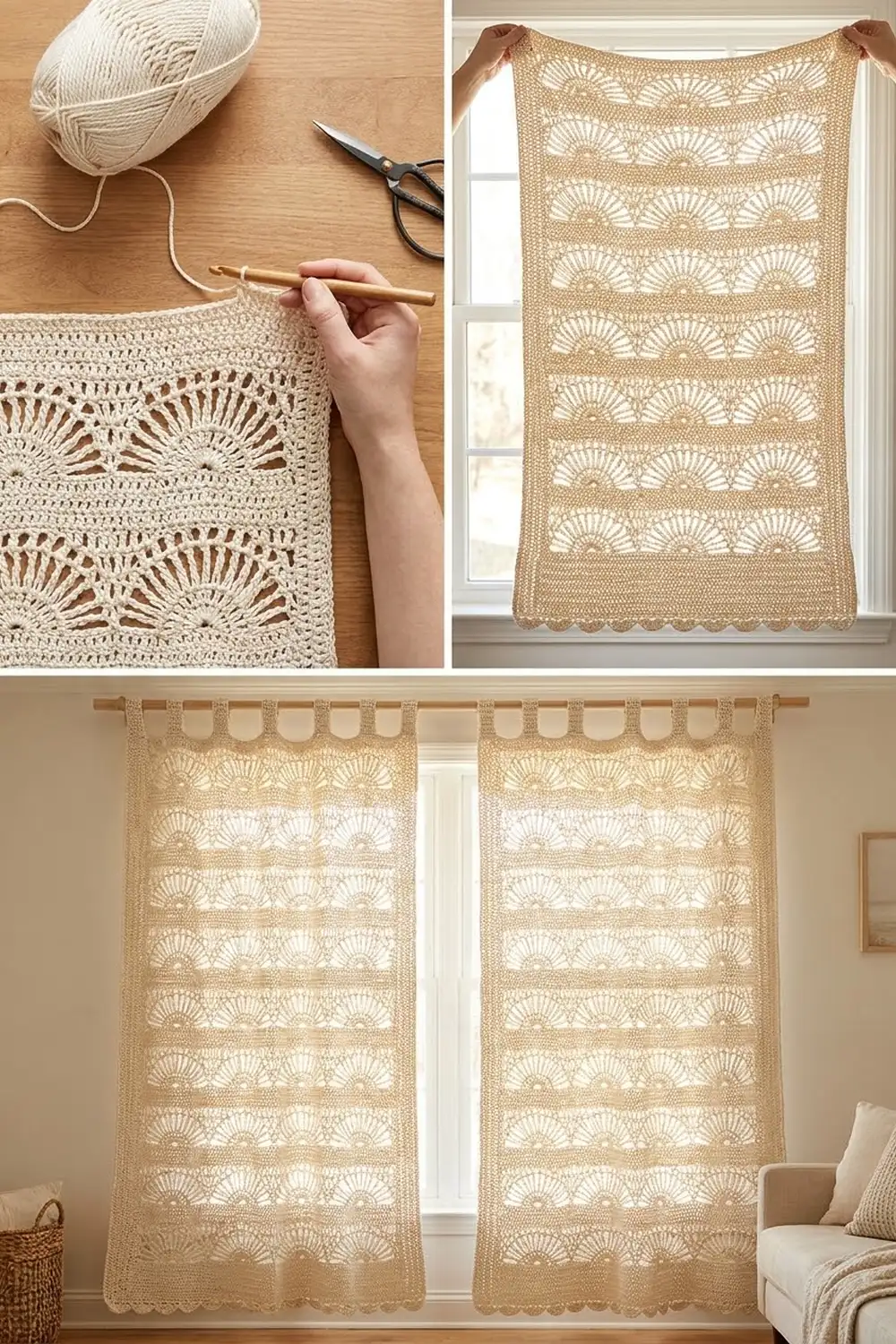
The Sunlit Fan Lace Curtain Panel is a long, airy curtain in one natural cream cotton. Wide bands of tall fans alternate with narrow bands of solid single crochet. Each fan is gathered into a small knot at the base and opens upward like a sunburst. Light pours through the fans, and the solid bands give the panel enough body to hang straight.
The look is soft and relaxed, and it suits linen sofas, wooden rods and morning sun. A scalloped hem finishes the bottom edge, a solid single crochet border frames the sides, and seven sturdy tabs at the top slide over a curtain rod.
This pattern uses US crochet terms. One finished panel measures 30.25 in (76.8 cm) wide and 84.5 in (214.6 cm) long, including the scalloped hem. The tab loops add about 3 in (7.6 cm) above the top edge.
You work the panel flat in one piece, from the bottom up, in rows. Then you add a four-round single crochet border all around, a scallop row along the bottom, and seven tabs along the top. For a pair of curtains, make a second identical panel. The two panels are never joined.
Finished Size and Construction
- Finished size: 30.25 in x 84.5 in (76.8 cm x 214.6 cm), plus 3 in (7.6 cm) tab loops
- Skill level: Intermediate (long stitches, careful counting)
- Terminology: US crochet terms
- Yarn weight: Worsted (#4) cotton
- Hook: 5.0 mm (US H-8)
- Number of pieces: 1 panel (make 2 separate panels for a pair)
- Layout: One vertical rectangle with 27 fan bands separated by solid bands
- Piece size before border: 28.25 in x 82 in (71.8 cm x 208.3 cm)
- Border depth: 1 in (2.5 cm) on all sides, plus a 0.5 in (1.3 cm) scallop on the bottom edge
Materials
Yarn: Choose a smooth worsted-weight cotton or cotton blend in natural, ecru or cream. Cotton gives the fans crisp definition and drapes well in a window. Avoid fuzzy or heavily textured yarns, which blur the long loops of the fans.
- Natural cream: about 1,300 g / 2,210 m (about 13 skeins of 100 g / 170 m) per panel
These quantities include a margin of about 15% for your gauge swatch and differences in tension. Buy all skeins from the same dye lot. For a pair of panels, double the amount.
Tools:
- 5.0 mm (US H-8) crochet hook
- Tapestry needle
- At least 10 stitch markers
- Tape measure
- Rust-proof pins and a large blocking surface (the floor covered with towels works)
- Scissors
Abbreviations (US Terms)
- ch: chain
- sl st: slip stitch
- sc: single crochet
- dc: double crochet
- trtr: triple treble crochet
- st(s): stitch(es)
- sk: skip
- RS / WS: right side / wrong side
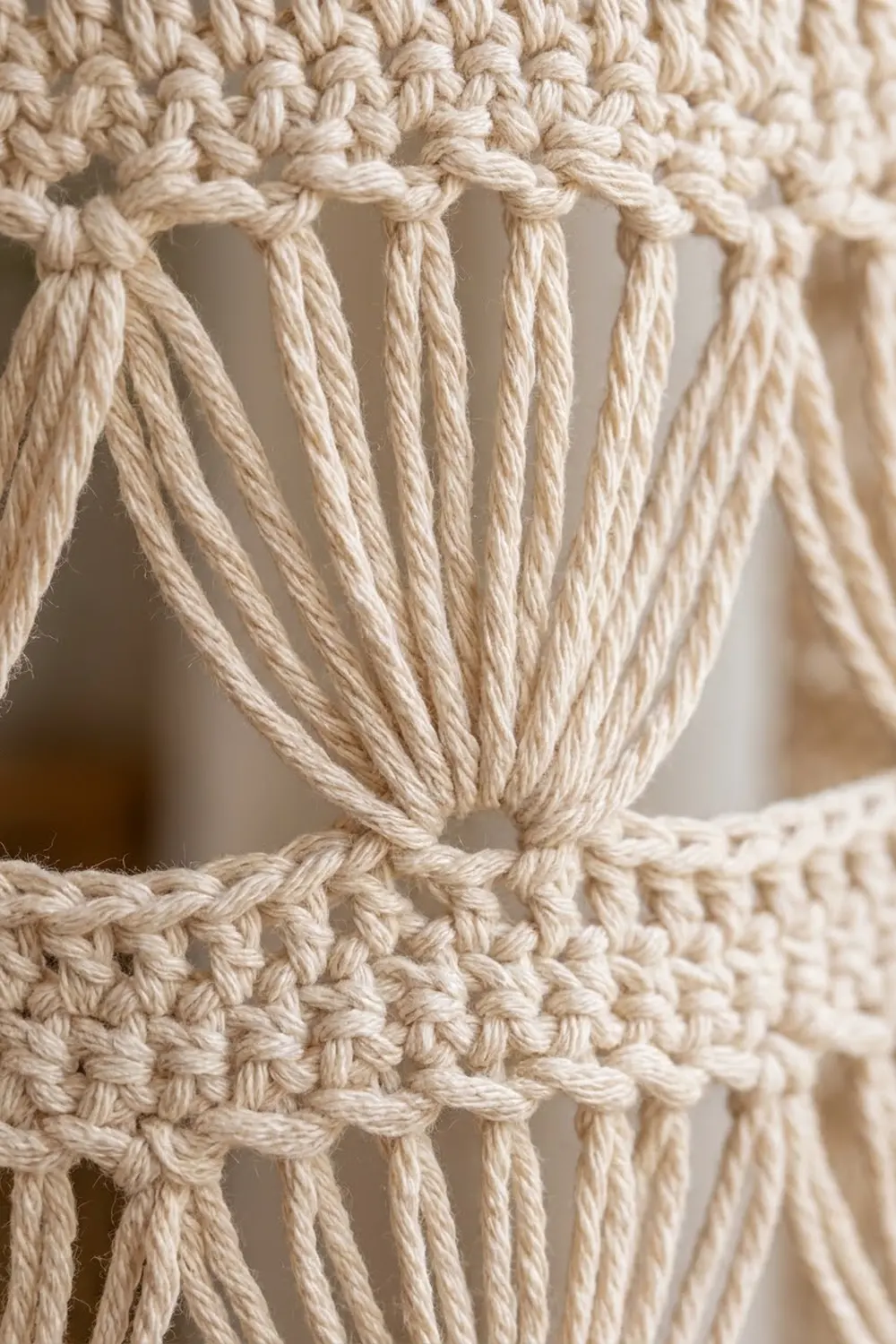
Special stitch: triple treble crochet (trtr). Yarn over 4 times and insert the hook in the stitch. Yarn over and pull up a loop (6 loops on hook). [Yarn over, pull through 2 loops] 5 times.
Fan: Work 7 trtr in the same stitch. Because all seven share one base, they gather into a small knot at the bottom and the fan opens upward.
Gauge and Checkpoints
Gauge: 16 sc and 16 rows = 4 in (10.2 cm) in single crochet. One fan repeat (8 sts) is 2 in (5.1 cm) wide, and the fan row is 2 in (5.1 cm) tall.
Test one piece first. Before you start a curtain this size, make a swatch in the exact stitch pattern:
- Ch 26. Work Rows 1–4 as written below (25 sc). Then work Rows 5–9 once, with 3 fans instead of 14.
- The swatch should measure 6.25 in (15.9 cm) wide and 4 in (10.2 cm) tall.
Checkpoints during the panel:
- After Row 4: 113 sts, 28.25 in (71.8 cm) wide, 1 in (2.5 cm) tall
- After Row 9 (first repeat): 4 in (10.2 cm) tall
- After Row 54 (10 repeats): 31 in (78.7 cm) tall
- After Row 139: 28.25 in x 82 in (71.8 cm x 208.3 cm)
- After border Round 4: 30.25 in x 84 in (76.8 cm x 213.4 cm)
If your swatch is too big, go down 0.5 mm in hook size. If it is too small, go up 0.5 mm. If the width is right but the fans are too short or too tall, change only how far you pull up the first loop of each trtr. Aim for 2 in (5.1 cm) fans.
Panel Pattern
The body is worked in rows from the bottom up. Every row has 113 stitches.
Foundation and bottom solid band
Row 1 (RS): Ch 114, sc in 2nd ch from hook and in each ch across, turn. (113 sc)
Rows 2–4: Ch 1 (does not count as a st), sc in each st across, turn. (113 sc)
The bottom solid band measures 1 in (2.5 cm).
Fan band repeat (Rows 5–9)
Row 5 (fan row): Ch 1, sc in first st, *sk 3 sts, 7 trtr in next st, sk 3 sts, sc in next st; repeat from * 13 more times, turn. (14 fans of 7 trtr + 15 sc = 113 sts)
Each fan is anchored in a single stitch, so its long loops gather into a knot at the bottom and spread out at the top. The sc between the fans sit low, which leaves tall open spaces.
Row 6 (closing row): Ch 6 (counts as the first trtr, worked in the first sc), *sc in each of next 7 trtr, trtr in next sc; repeat from * 13 more times, working the last trtr in the last sc, turn. (14 groups of 7 sc + 15 trtr = 113 sts)
The trtr between the fans reach the full height of the fans, so the top of this row is level. The trtr at each end also keep the side edges straight.
Row 7: Ch 1, sc in each st across, working the last sc in the top of the turning ch-6, turn. (113 sc)
Rows 8–9: Ch 1, sc in each st across, turn. (113 sc)
Rows 6–9 form the 1 in (2.5 cm) solid band above the fans. One full repeat (Rows 5–9) adds 3 in (7.6 cm).
Rows 10–139: Repeat Rows 5–9 another 26 times. (27 fan bands total; 113 sts in every row)
Do not fasten off. The body measures 28.25 in x 82 in (71.8 cm x 208.3 cm). That is the 1 in (2.5 cm) bottom band plus 27 repeats of 3 in (7.6 cm). Place a marker every 10 repeats. If the panel grows faster or slower than 3 in (7.6 cm) per repeat, check your gauge again.
Border
Border gauge: Same as the body: 16 sc = 4 in (10.2 cm), and 4 rounds = 1 in (2.5 cm).
Each corner of the border is a group of 3 sc. The center sc of that group is the corner stitch. Every per-side count below includes both corner stitches of that side.
Side-edge rate: Work into the row ends at the same 4 sc per inch as the body. Work 1 sc in the end of each sc row and 1 sc in the end of each fan row. Space 8 sc evenly along each closing-row trtr post. That makes 12 sc for each 3 in (7.6 cm) repeat (1 + 8 + 3).
Round 1: Continue from Row 139 without turning.
- Ch 1, then work 3 sc in the last st of Row 139 (corner).
- Down the first side, work 326 sc into the row ends: 3 for Rows 2–4, 12 for each of Repeats 1–26, and 11 for Repeat 27 (leave out Row 139).
- Work 3 sc in the first foundation ch (corner).
- Along the bottom, sc in each of the next 111 foundation ch, then 3 sc in the last foundation ch (corner).
- Up the second side, work 326 sc, then 3 sc in the first st of Row 139 (corner).
- Sc in each of the next 111 sts across the top. Join with a sl st to the first sc.
(886 sts)
Count check: (111 + 111 + 326 + 326 stitches worked 1-per-existing stitch or row end) + (4 corners x 3 sc) = 874 + 12 = 886. Per side, the top and bottom have 115 each and the sides have 330 each.
Round 2: Ch 1, sc in each st around, working 3 sc in each corner stitch. Join. (894 sts: 886 worked 1-per-stitch + 8 extra; top and bottom 117 each, sides 332 each)
Round 3: As Round 2. (902 sts: 894 + 8 extra; top and bottom 119 each, sides 334 each)
Round 4: As Round 2. (910 sts: 902 + 8 extra; top and bottom 121 each, sides 336 each) Fasten off.
Why the math works: The body edge is 113 sts across and 328 sts along each side (326 row ends plus the 2 corner rows). Each border round adds 1 st at each end of every side. After 4 rounds the width is 113 + 8 = 121 sts, or 30.25 in (76.8 cm). The length is 328 + 8 = 336 sts, or 84 in (213.4 cm). Each round adds 0.25 in (0.6 cm) at each end, which matches the border depth of 4 rounds = 1 in (2.5 cm).
Scalloped hem: With RS facing, join yarn in the bottom-right corner stitch of Round 4. Ch 1, sc in same st, *sk 2 sts, 5 dc in next st, sk 2 sts, sc in next st; repeat from * 19 more times, ending in the bottom-left corner stitch. Fasten off. (20 scallops of 5 dc + 21 sc = 121 sts)
Because 121 = 20 x 6 + 1, the scallops fit exactly from corner to corner. The hem adds 0.5 in (1.3 cm), which brings the length to 84.5 in (214.6 cm).
Hanging tabs (make 7): The top edge of Round 4 has 121 sts. With RS facing, number them 1–121 from right to left. Each tab is 7 sts wide, with 12 sts skipped between tabs. Work the tabs on sts 1–7, 20–26, 39–45, 58–64, 77–83, 96–102 and 115–121. (7 tabs x 7 sts + 6 gaps x 12 sts = 49 + 72 = 121)
For each tab, join yarn in the first st of the tab position.
- Row 1: Ch 1, sc in same st and in next 6 sts, turn. (7 sc)
- Rows 2–24: Ch 1, sc in each st across, turn. (7 sc)
Fasten off, leaving a 12 in (30.5 cm) tail. Each tab measures 1.75 in x 6 in (4.4 cm x 15.2 cm). Fold the tab to the WS and whipstitch its last row to the base of Round 1 on the WS. This makes a loop about 3 in (7.6 cm) tall, and the tabs sit 3 in (7.6 cm) apart.
Final Blocking
- Weave in all ends along the solid bands, never through the open fans.
- Soak the panel in cool water with a little mild soap for 15 minutes.
- Press out the water gently; do not wring. Roll the panel in towels to remove extra moisture.
- Lay the panel flat on towels, RS up.
- Pin the side edges straight at 30.25 in (76.8 cm) wide, measuring at several points.
- Pin the length to 84.5 in (214.6 cm), including the scallops.
- Open each fan with your fingers so the 7 loops spread evenly. Pin each scallop into a rounded curve.
- Let it dry completely. You can also hang the damp panel on its rod and gently pull the bottom straight; the weight of the cotton helps it settle.
Final Quality-Control Checklist
- Every body row has 113 sts, and all 27 fan bands are complete.
- Each fan has exactly 7 trtr gathered in one stitch.
- The closing-row trtr stand level with the fan tops.
- The side edges are straight, with no waves or pulling.
- Border Round 4 has 910 sts: 121 each on the top and bottom, 336 on each side.
- 20 scallops run from corner to corner.
- 7 tabs are evenly spaced, the same length and sewn on the WS.
- The panel measures 30.25 in x 84.5 in (76.8 cm x 214.6 cm) after blocking.
- If you made a pair, the panels match in length within 0.5 in (1.3 cm).
Troubleshooting
Fans look lopsided: Make sure you skipped exactly 3 sts on each side of every fan. Each repeat uses 8 sts.
Fans lean or twist: Work every trtr into the same loops of the base stitch, and pull each one up to the same height.
Gaps at the side edges: The closing row must start with ch 6 and end with a trtr in the last sc.
Side border ruffles: You added too many row-end stitches. Pull back and keep to 12 sc per repeat.
Side border pulls in: You added too few row-end stitches. Check that you placed 8 sc along each trtr post.
Panel too long after hanging: Cotton can stretch under its own weight. Hang the panel for 48 hours before you take final measurements, and make the second panel to match the first.
Scallops don’t end at the corner: Recount the bottom edge of Round 4. It must have exactly 121 sts.
Care
Hand wash, or machine wash cold on a gentle cycle in a mesh bag. Reshape the panel and dry it flat or hanging. Don’t tumble dry, because heat can shrink cotton and distort the fans.
Final Notes
The measurement chain starts with the gauge: 16 sc = 4 in (10.2 cm). The body is 113 sts, or 28.25 in (71.8 cm), wide. The 1 in (2.5 cm) bottom band plus 27 repeats of 3 in (7.6 cm) gives 82 in (208.3 cm) of length. Four border rounds add 1 in (2.5 cm) on every side, for 30.25 in x 84 in (76.8 cm x 213.4 cm). The scalloped hem brings the length to 84.5 in (214.6 cm), and the tabs add 3 in (7.6 cm) loops above the top edge. Check your gauge early and count every fan row, and the panel will hang straight and full of light.
Happy crocheting!