

Starlight Lace is a pair of airy curtain panels made from six-pointed star motifs joined tip to tip. Because the stars only touch at their points, you get a honeycomb of open hexagons and triangles that filter sunlight into soft star-shaped shadows.
Each panel is worked in one color, a warm cream or ivory cotton. That keeps the look calm and simple, and the stitch texture does the decorating. The style is Scandinavian-boho: light, natural and handmade.
This pattern uses US crochet terms. Each finished panel measures 43 x 79 in (109.2 x 200.7 cm), and you make two panels.
You crochet each star in the round from a center ring, then add six points in short rows and a single-crochet edging. From the second star onward, you join stars to their neighbors during that edging round. A three-round mesh border then follows the outline of the whole panel.
Finished Size and Construction
- Finished size (each panel): 43 x 79 in (109.2 x 200.7 cm)
- Skill level: Intermediate
- Terminology: US crochet terms
- Yarn weight: DK (light worsted, #3) cotton
- Hook: 3.5 mm (E-4)
- Number of pieces: 98 star motifs per panel, 196 for the pair
- Layout: 15 offset rows. The 8 odd rows (A rows) have 7 stars and the 7 even rows (B rows) have 6 stars.
- Piece size: 6 in (15.2 cm) from tip to opposite tip
- Size before border: 42 x 78 in (106.7 x 198.1 cm)
- Border depth: 0.5 in (1.3 cm)
Materials
Use a smooth mercerized or combed DK cotton of about 110 m per 50 g. Cotton holds the crisp points and hangs straight without stretching the way acrylic can. Buy all of your yarn from one dye lot.
- Cream/Ivory: 1,450 g (approx. 3,190 m), or 29 balls of 50 g
- Each motif uses about 6 g (13.2 m)
- Each border uses about 60 g (132 m)
These quantities include a margin of about 10%.
Tools:
– 3.5 mm (E-4) crochet hook
– Tapestry needle
– Stitch markers
– Rustproof pins and blocking mats
– Spray bottle
– Measuring tape
– 14 curtain clip rings per panel (28 total)
Abbreviations (US Terms)
- ch – chain
- sl st – slip stitch
- sc – single crochet
- dc – double crochet
- sp – space
- st(s) – stitch(es)
- RS / WS – right side / wrong side
- dc2tog – double crochet 2 together: [yarn over, insert hook in next st, pull up a loop, yarn over, pull through 2 loops] twice, then yarn over and pull through all 3 loops on the hook.
- dc4tog – double crochet 4 together: work as for dc2tog, but over 4 sts, then pull through all 5 loops on the hook.
- Tip join – work sc in the tip, ch 1, sl st into the ch-3 tip sp of the neighboring motif, ch 1, then sc in the same tip again.
Gauge and Checkpoints
Make one complete test star and block it before you start the panel. Every measurement in this pattern builds on this one motif.
Checkpoints:
– After Round 1: 1 in (2.5 cm) across
– After Round 2: 1.75 in (4.4 cm) across
– After Round 3: 2.4 in (6.1 cm) from corner to corner
– After the points: 5.75 in (14.6 cm) from tip to tip
– After the edging: 6 in (15.2 cm) from tip to tip
Adjacent tips on the finished star sit 3 in (7.6 cm) apart. This spacing matters for the border.
If your test star measures more than 6.2 in (15.7 cm), go down to a 3.25 mm hook. If it measures less than 5.8 in (14.7 cm), go up to a 3.75 mm hook. Being within 0.2 in (0.5 cm) is fine. Remember that small errors multiply: a star that is 0.2 in too big makes each A row 1.4 in (3.6 cm) wider.
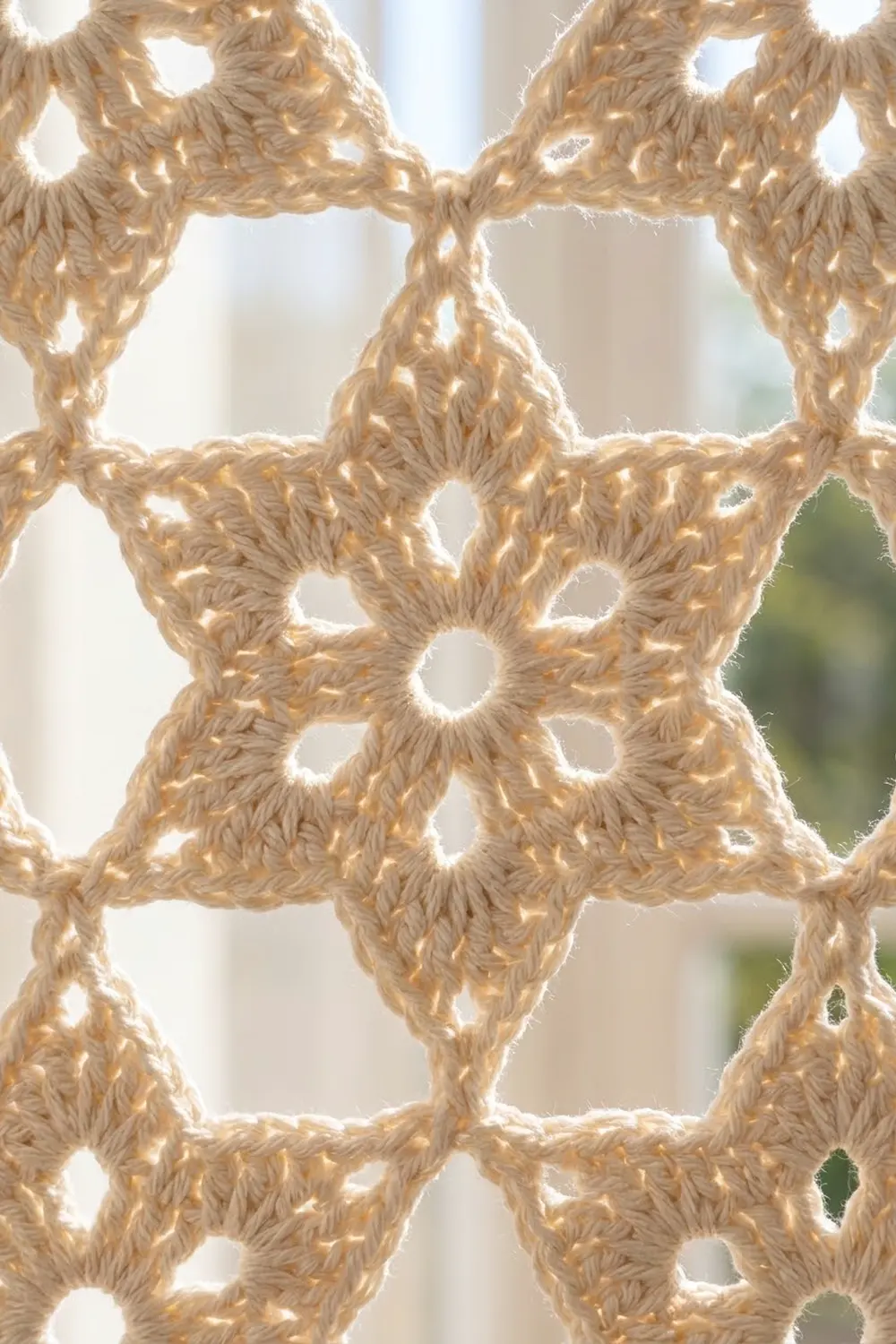
Star Motif
Ring: Ch 5 and join with a sl st to form a ring. This leaves the open center hole.
Round 1: Ch 3 (counts as dc), work 11 dc into the ring, and join to the top of the ch-3. (12 dc)
Round 2: Ch 3 (counts as dc), dc in the same st, 2 dc in the next st, ch 2.
2 dc in each of the next 2 sts, ch 2. Repeat from * 4 more times. Join to the top of the ch-3.
(24 dc in 6 groups of 4, plus 6 ch-2 sps)
The ch-2 sps are the six eyelets. Each one ends up at the base of a point.
Round 3: Ch 3 (counts as dc), dc in the next 3 sts, then (2 dc, ch 2, 2 dc) in the ch-2 sp.
Dc in the next 4 sts, (2 dc, ch 2, 2 dc) in the next ch-2 sp. Repeat from * 4 more times. Join to the top of the ch-3.
(48 dc, plus 6 ch-2 corner sps)
The piece is now a small hexagon. Between each pair of corner sps there are 8 dc.
Points
Each point is worked in rows over 8 dc: the 4 dc before a corner sp, the corner sp itself, and the 4 dc after it. The six points use all 48 dc.
To set up, sl st in each of the next 2 sts. You are now in the 3rd dc of the first 4-dc group.
Row 1 (RS): Ch 3 (counts as dc), dc in the next 3 sts, 2 dc in the ch-2 sp, dc in the next 4 sts. Turn. (10 dc)
Row 2 (WS): Ch 2 (does not count), dc2tog, dc in the next 6 sts, dc2tog. Turn. (8 sts)
Row 3: Ch 2, dc2tog, dc in the next 4 sts, dc2tog. Turn. (6 sts)
Row 4: Ch 2, dc2tog, dc in the next 2 sts, dc2tog. Turn. (4 sts)
Row 5: Ch 2, dc4tog. Do not turn. (1 st, the tip)
Move to the next point: Working down the left edge of the point, sl st once in the side of Row 5 and twice in the side of each of Rows 4 to 1. That is 9 sl sts. Sl st into the next unworked dc of Round 3.
Repeat Rows 1–5 and the move to the next point 5 more times, for 6 points in total. After the 6th point, you will be back at the base of the first point.
Edging Round
Ch 1. Then, for each point:
– Work 9 sc up the right edge: 2 sc in the side of each of Rows 1–4 and 1 sc in the side of Row 5.
– Work (sc, ch 3, sc) in the tip.
– Work 9 sc down the left edge in the same way.
Join to the first sc and fasten off. (120 sc, plus 6 ch-3 tip sps)
Each point has 20 sc. Keep the 2 sc that meet at each valley snug so the shape between points stays sharp.
Make All Pieces
Quantities (all Cream):
– One panel: 98 stars (8 A rows x 7 stars + 7 B rows x 6 stars = 56 + 42)
– Pair of panels: 196 stars
Make the first star in full. Every other star is made through Round 3 and the points, then joined to the panel as you work its edging round.
Layout of one panel (★ = star; each B row is shifted half a star inward):
Row 1  A:  ★ ★ ★ ★ ★ ★ ★
Row 2  B:   ★ ★ ★ ★ ★ ★
Row 3  A:  ★ ★ ★ ★ ★ ★ ★
Row 4  B:   ★ ★ ★ ★ ★ ★
   ... repeat ...
Row 14 B:   ★ ★ ★ ★ ★ ★
Row 15 A:  ★ ★ ★ ★ ★ ★ ★
Joining
Method: Join as you go during the edging round, using a tip join (see Abbreviations) wherever a tip touches a neighbor. Every tip touches at most one other tip, so you never have three stars meeting at one point.
To keep track of direction, hold each star so that two of its tips point straight left and right. Name the tips by their direction:
– E (right) and W (left)
– NE and NW (upper tips)
– SE and SW (lower tips)
A rows:
– Each star joins its W tip to the E tip of the star before it.
– In Rows 3–15, star k also joins its NW tip to the SE tip of B star k–1 above it, and its NE tip to the SW tip of B star k above it.
– The first and last stars in these rows have one free upper tip each. These free tips form the side edges.
B rows:
– Each star joins its W tip to the E tip of the star before it.
– Star k also joins its NW tip to the SE tip of A star k above it, and its NE tip to the SW tip of A star k+1 above it.
Stitch-to-stitch logic: A join replaces the ch 3 at a tip with ch 1, sl st, ch 1, so each star still has 20 sc per point. The two joined tips lock together at their centers without adding any width.
Tension: Keep the joining chains no tighter than your ch 3. If they are tight, the open hexagons pucker. If they are loose, the stars twist.
Size checkpoint:
– 3 stars joined in a row measure 18 in (45.7 cm) wide.
– 2 joined rows measure 10.4 in (26.4 cm) from the top tips to the bottom tips.
– Each new row adds 5.2 in (13.2 cm) of height.
– The completed panel measures 42 x 78 in (106.7 x 198.1 cm).
In each panel there are 251 joins. Those use 502 of the 588 tips, which leaves exactly 86 free tips around the edge.
Border
Border gauge: 10 sc per 3 in (7.6 cm) gap between tips.
There are 86 free tips around the panel. Every pair of neighboring free tips along the edge is 3 in (7.6 cm) apart, because adjacent tips on one star are also 3 in apart.
Sides of the panel:
– Top: the 14 upward tips of Row 1 (7 stars x 2 tips), which leaves 13 gaps.
– Bottom: 14 tips and 13 gaps, the same as the top.
– Left side: from the top-left NW tip down to the bottom-left SW tip there are 29 free tips in between, which gives 30 gaps.
– Right side: 30 gaps, the same as the left.
Total gaps: 13 + 13 + 30 + 30 = 86, one for each free tip.
Round 1: Join the yarn in the top-left NW tip sp. Ch 1, then work sc in the tip sp, ch 9 in every free tip around the panel. Join to the first sc.
(86 sc and 86 ch-9 sps: 13 sps on the top, 13 on the bottom and 30 on each side)
Round 2: Sl st into the first ch-9 sp, ch 1, and work 10 sc in each ch-9 sp around. Join to the first sc.
(860 sc: 130 on the top, 130 on the bottom and 300 on each side)
Round 3: Ch 1, sc in the first st, then ch 3, skip 1 st, sc in the next st around. To finish, ch 3, skip the last st and join to the first sc.
(430 ch-3 loops: 65 on the top, 65 on the bottom and 150 on each side)
Why the math works:
– A ch 9 plus its anchoring sc spans 3 in, which matches the 3 in between tips.
– 10 sc per gap fills each chain without ruffling.
– Every side count in Round 2 is even (130 and 300), so the skip-1 mesh in Round 3 comes out exactly on every side with no extra stitches.
Fasten off and weave in all ends.
Final Blocking
- Soak the panel in cool water for 15 minutes, then gently press out the water. Don’t wring it.
- Roll the panel in towels to remove more water.
- Lay it flat on mats in sections. Pin the first two rows to 42 in (106.7 cm) wide.
- Pin every free tip and the center of every border loop.
- Open each hexagon gap with your fingertips so that its points line up.
- Let each section dry completely, then move along to the next rows.
- At the end, check that the panel measures 43 x 79 in (109.2 x 200.7 cm).
Final Quality-Control Checklist
- Every star has 6 points, an open center and 6 eyelets.
- Every edging round has 120 sc.
- All 251 joins are secure, and no tips are left loose inside the panel.
- The B rows sit evenly inset at both side edges.
- The border has 86 anchoring sc, 860 sc in Round 2 and 430 loops in Round 3.
- The panel measures 43 x 79 in (109.2 x 200.7 cm).
- Both panels match within 0.5 in (1.3 cm).
- All ends are woven in along the backs of the points.
Troubleshooting
- Points curl: Your dc2tog stitches are too tight. Loosen the yarn-overs and block the points flat.
- The star cups: Round 3 is too tight. Go up a hook size for Rounds 1–3 only.
- The star ruffles: Check that you have exactly 24 dc in Round 2 and 48 in Round 3.
- A tip lands in the wrong place: Count again from the W tip and redo the join.
- The panel slants: Your B rows are joining to the wrong A stars. Check the star k rules.
- The border waves: Your ch 9 is too loose. Try ch 8 with 10 sc, and keep the count the same.
- The border pulls: Work 11 sc per loop, then skip 1 in Round 3 on even counts. Check that each side total stays even.
Care
Hand wash in cool water with a mild detergent and dry flat. Iron lightly through a cloth if needed. Don’t hang the panels to dry while wet, because the weight will stretch them.

Final Notes
Every measurement depends on the previous one:
– A 2.4 in (6.1 cm) Round 3 center grows into a 6 in (15.2 cm) star with tips 3 in (7.6 cm) apart.
– Rows of 7 stars measure 42 in (106.7 cm), and 15 rows stack to 78 in (198.1 cm).
– 86 border gaps of 3 in each add 0.5 in (1.3 cm) all around, for a finished panel of 43 x 79 in (109.2 x 200.7 cm).
Check your test star first and the whole panel will follow. Clip a ring to each of the 14 top tips, hang your curtains and enjoy the star shadows.
Happy crocheting!