

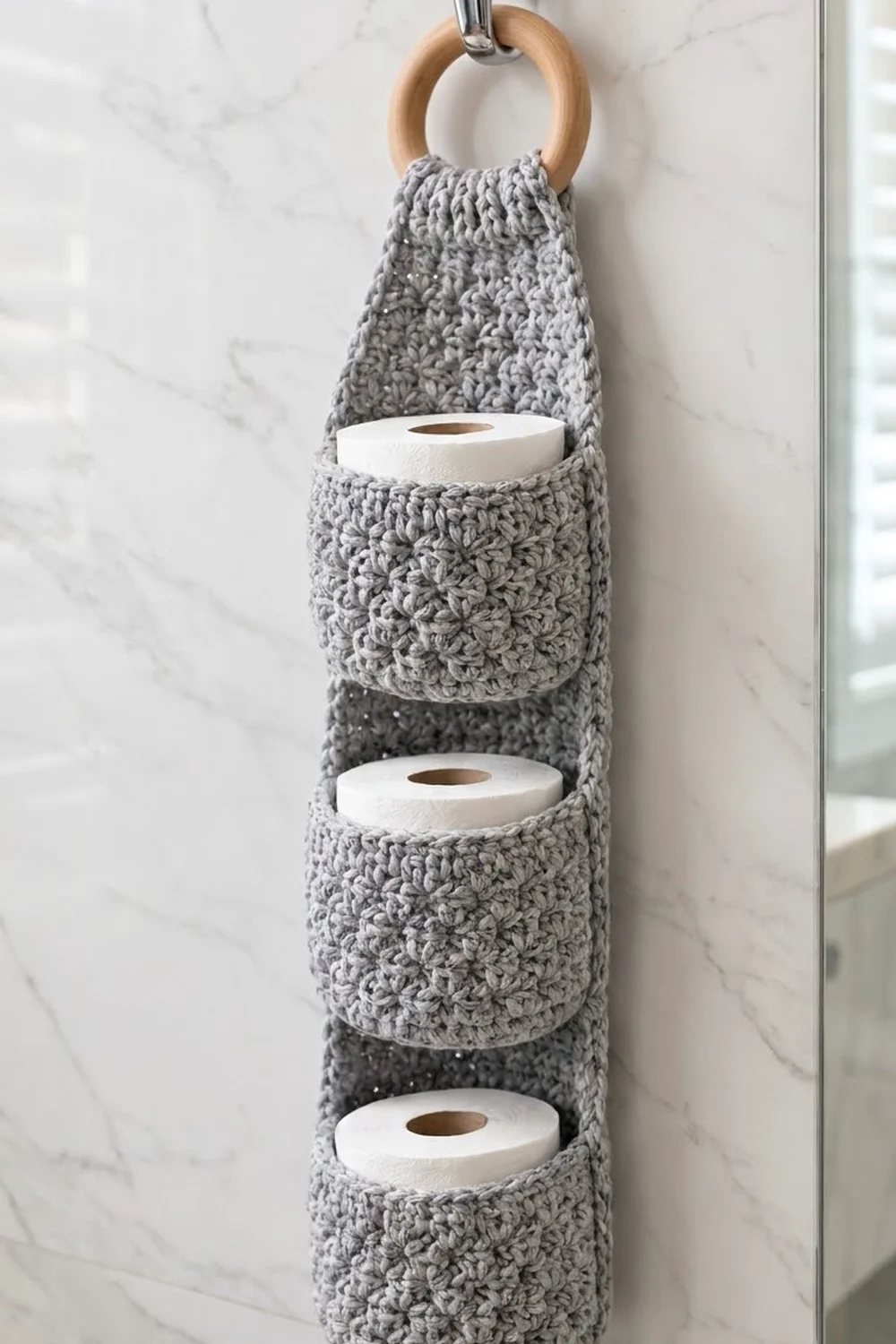
This hanging toilet paper holder keeps three spare rolls tidy and easy to reach. It has one long back panel, three deep cup pockets stacked down the front, and a strap that wraps around a wooden ring so you can hang it from a towel hook or a door hook.
The whole piece is one light heather gray. It’s worked in the suzette stitch, a simple pair of a single crochet and a double crochet that makes a dense, pebbly fabric. The texture looks good next to marble, white tile, and natural wood, and the fabric is firm enough that the pockets keep their shape.
This pattern uses US crochet terms. Hanging from the ring, the holder measures about 5.5 in (14.0 cm) wide and 22.75 in (57.8 cm) long, not counting the ring. Each pocket is about 5 in (12.7 cm) across and 3.5 in (8.9 cm) deep.
Construction is simple. You crochet the back panel flat from the bottom up, narrow it into a strap, and add a single-crochet border. Each pocket starts as a flat circle and then turns up into straight walls. Finally, you sew the three pockets onto the panel stitch by stitch and fold the strap over the ring.
Finished Size and Construction
- Finished size: 5.5 in (14.0 cm) wide × 22.75 in (57.8 cm) long when hanging
- Skill level: Easy to Intermediate
- Terminology: US crochet terms
- Yarn weight: Worsted (weight 4)
- Hook: 5.0 mm (H-8)
- Number of pieces: 4 (1 back panel + 3 pockets)
- Layout: 3 pockets stacked vertically on one panel
- Piece sizes: panel 5 in × 23.75 in (12.7 cm × 60.3 cm) before the border; each pocket 5 in (12.7 cm) across × 3.5 in (8.9 cm) deep
- Size before border: 5 in × 23.75 in (12.7 cm × 60.3 cm)
- Border depth: 0.25 in (0.6 cm), 1 round of sc
Materials
Yarn: Use a smooth worsted-weight cotton or cotton blend. Cotton holds its shape, doesn’t fuzz in a humid bathroom, and makes the clusters stand out clearly. Acrylic also works, but the pockets will be a bit softer.
- Light heather gray: 280 g, approx. 475 m
Quantities include a margin of about 10% for your gauge swatch, sewing, and weaving in ends. Rough breakdown: the panel with its border uses about 105 g (175 m), and each pocket uses about 50 g (85 m).
Tools:
- 5.0 mm (H-8) crochet hook
- 1 wooden ring, 3 in (7.6 cm) outside diameter
- Tapestry needle
- 6–8 locking stitch markers
- Sewing pins
- Measuring tape
- Scissors
- Blocking mat and rust-proof pins
- Spray bottle
Abbreviations (US Terms)
- ch – chain
- sl st – slip stitch
- sc – single crochet
- dc – double crochet
- inc – 2 sc in the same stitch
- sc2tog – single crochet 2 together
- BLO – back loop only
- FLO – front loop only
- sk – skip
- st(s) – stitch(es)
- rep – repeat
Special stitch – suzette pair: Work (sc, dc) in the same stitch. Each pair counts as 2 stitches. On the next row or round, skip each dc and work the new pair into each sc. The pairs stack into the pebbly texture.
Gauge and Checkpoints
Gauge: 16 sts and 16 rows = 4 in (10.2 cm) in suzette stitch. Single crochet is worked to the same gauge. That means every stitch is 0.25 in (0.6 cm) wide and every row or round is 0.25 in (0.6 cm) tall, which keeps all the measurements in this pattern easy to check.
Test one piece first. Make one pocket before you start the panel. It’s a good gauge swatch, and it tells you right away whether a roll fits.
Checkpoints:
- Pocket base after Rnd 10: 5 in (12.7 cm) across.
- Pocket after Rnd 24: walls 3.5 in (8.9 cm) tall; rim 15 in (38.1 cm) around.
- Panel after Row 8: 5 in (12.7 cm) wide × 2 in (5.1 cm) tall.
- Panel after Row 72: 18 in (45.7 cm) tall.
- Panel after Row 95: 23.75 in (60.3 cm) tall.
Too big? Go down half a hook size (4.5 mm) and check again. Too small? Go up to 5.5 mm. If only the row height is off, change how tightly you pull the dc rather than changing the hook. The pockets are sewn on row by row, so getting the row height right matters most.
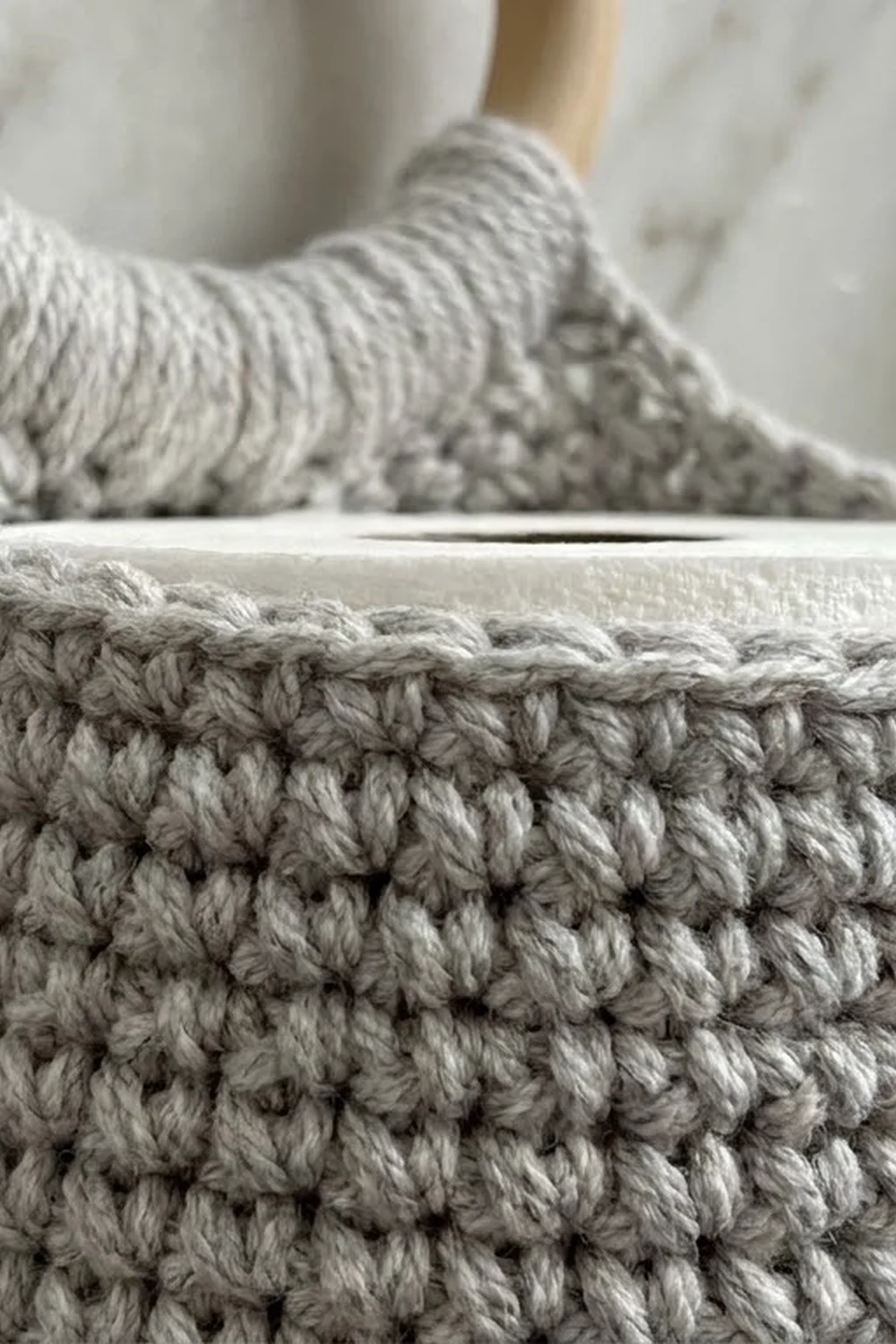
Pocket (Make 3)
Work in joined rounds and don’t turn. The ch-1 at the start of each round doesn’t count as a stitch. Keep the joins lined up, because that line will be the back of the pocket.
Base
- Rnd 1: Make a magic ring, ch 1, 6 sc in ring, sl st to first sc. (6)
- Rnd 2: Ch 1, inc in each st around, sl st to first sc. (12)
- Rnd 3: Ch 1, (sc in next st, inc) 6 times, join. (18)
- Rnd 4: Ch 1, (sc in next 2 sts, inc) 6 times, join. (24)
- Rnd 5: Ch 1, (sc in next 3 sts, inc) 6 times, join. (30)
- Rnd 6: Ch 1, (sc in next 4 sts, inc) 6 times, join. (36)
- Rnd 7: Ch 1, (sc in next 5 sts, inc) 6 times, join. (42)
- Rnd 8: Ch 1, (sc in next 6 sts, inc) 6 times, join. (48)
- Rnd 9: Ch 1, (sc in next 7 sts, inc) 6 times, join. (54)
- Rnd 10: Ch 1, (sc in next 8 sts, inc) 6 times, join. (60)
Checkpoint: the circle lies flat and measures 5 in (12.7 cm) across.
Walls
- Rnd 11 (turning round): Ch 1, sc BLO in each st around, join. (60 = 60 worked 1 per stitch + 0 added) Working in the back loops makes the firm ridge where the base meets the wall. The unused front loops of Rnd 10 are where you’ll sew the bottom seam later.
- Rnd 12 (setup round): Ch 1, (sc, dc) in first st, sk next st, (sc, dc) in next st 29 times, sk last st, sl st to first sc. (60 = 30 pairs)
- Rnds 13–23: Ch 1, (sc, dc) in first sc, sk next dc, (sc, dc) in next sc 29 times, sk last dc, sl st to first sc. (60 = 30 pairs)
- Rnd 24 (rim): Ch 1, sc in each st around, join. (60 = 60 worked 1 per stitch + 0 added)
Fasten off and leave a 36 in (91.4 cm) tail for sewing.
Checkpoint: Rnds 11–24 are 14 rounds, so the wall is 14 × 0.25 in = 3.5 in (8.9 cm) tall. The rim is 60 sts × 0.25 in = 15 in (38.1 cm) around.
Back Panel
Work flat in rows, from the bottom up. The ch-1 at the start of each row doesn’t count as a stitch.
Body
- Foundation: Ch 21.
- Row 1: (sc, dc) in 3rd ch from hook, sk next ch, (sc, dc) in next ch 9 times. (20 = 10 pairs)
- Rows 2–72: Ch 1, turn, sk next dc, (sc, dc) in next sc 10 times. (20 = 10 pairs)
Every row starts with a dc next to the hook, which you skip, and ends with a sc, which takes the last pair. That keeps the count at exactly 20.
Checkpoint: 5 in (12.7 cm) wide × 18 in (45.7 cm) tall.
Transition
- Row 73: Ch 1, turn, sc in each st across. (20 = 20 worked 1 per stitch + 0 added)
Taper
- Row 74: Ch 1, turn, sc2tog, sc in next 14 sts, sc2tog. (16 sc + 2 sc2tog = 18 sts)
- Row 75: Ch 1, turn, sc in each st across. (18)
- Row 76: Ch 1, turn, sc2tog, sc in next 12 sts, sc2tog. (16)
- Row 77: Ch 1, turn, sc in each st. (16)
- Row 78: Ch 1, turn, sc2tog, sc in next 10 sts, sc2tog. (14)
- Row 79: Ch 1, turn, sc in each st. (14)
- Row 80: Ch 1, turn, sc2tog, sc in next 8 sts, sc2tog. (12)
- Row 81: Ch 1, turn, sc in each st. (12)
- Row 82: Ch 1, turn, sc2tog, sc in next 6 sts, sc2tog. (10)
- Row 83: Ch 1, turn, sc in each st. (10)
The taper is Rows 74–83, 10 rows or 2.5 in (6.4 cm) tall, and it narrows the panel from 5 in (12.7 cm) to 2.5 in (6.4 cm).
Strap
- Rows 84–95: Ch 1, turn, sc in each st across. (10)
That’s 12 rows, or 3 in (7.6 cm). Don’t fasten off. Go straight into the border.
Checkpoint: 95 rows × 0.25 in = 23.75 in (60.3 cm) total length before the border.
Make All Pieces
| Piece | Quantity | Color | Stitches |
|---|---|---|---|
| 3 | Light heather gray | 60 per round | |
| Back panel | 1 | Light heather gray | 20 sts wide, narrowing to 10 |
Layout (front view, panel rows numbered from the bottom):
        [ ring ]
        | strap |      Rows 84–95
       /  taper  \     Rows 74–83
      |  open    |     Rows 59–73
      | POCKET C |     Rows 45–58
      |  gap     |     Rows 37–44
      | POCKET B |     Rows 23–36
      |  gap     |     Rows 15–22
      | POCKET A |     Rows 1–14
Each pocket covers 14 panel rows, which matches its 14 wall rounds. Each gap is 8 rows, or 2 in (5.1 cm), which leaves room to tilt a roll in and out.
Border
Work the border on the panel before you sew on the pockets.
Border gauge: 4 sc per 1 in (2.5 cm). Along the side edges, that works out to exactly 1 sc per row end, because each row is 0.25 in (0.6 cm) tall.
Rnd 1: Continuing from Row 95, ch 1. Do not turn.
- Top edge: 3 sc in first st, sc in next 8 sts, 3 sc in last st. (14 sc, which includes both top corners)
- Long side: sc in each row end down to the bottom: 95 row ends. (95 sc) Along the taper, also work 1 sc per row end. The slanted edge eases in neatly at this rate.
- Bottom edge: working into the free loops of the foundation chain, 3 sc in first ch, sc in next 18 ch, 3 sc in last ch. (24 sc, which includes both bottom corners)
- Second long side: sc in each row end up to the top. (95 sc)
- Sl st to first sc. (228 total = 14 + 95 + 24 + 95)
Fasten off and weave in ends.
Why the math works: The 20 bottom stitches get 1 sc each, plus 2 extra at each corner (20 + 4 = 24). The 10 top stitches get the same treatment (10 + 4 = 14). Each side has 95 sc for 95 rows, which is 23.75 in (60.3 cm) at 4 sc per inch, so the border lies flat without ruffling or pulling. One round adds 0.25 in (0.6 cm) on every side. The finished panel is 5.5 in × 24.25 in (14.0 cm × 61.6 cm).
Joining
Method: Whipstitch with the yarn tail and a tapestry needle. Go through both loops on the pocket and one full stitch of the panel fabric. Line the pocket’s join seam up with the panel.
For each pocket:
- Lay the panel flat with the right side up. Count rows from the bottom and place a marker at the pocket’s base row and another at its rim row (see the layout).
- Flatten the pocket so the joins are at the center back. Count 10 sts to each side of the join line and mark them. That gives you 20 back stitches, which matches the panel’s 20 stitches across.
- Rim seam: Sew the 20 back rim stitches to the 20 stitches of the rim row, matching 1 to 1.
- Side seams: Sew each side of the wall straight down along the panel’s edge, just inside the border. That’s 14 wall rounds to 14 panel rows, 1 to 1.
- Base seam: Sew 20 of the free front loops from Rnd 10 to the 20 stitches of the base row, 1 to 1.
The other 40 stitches of the pocket wall, 10 in (25.4 cm), curve out from the panel and make the cup. The round base squashes into a soft D shape against the panel, which is how it’s meant to look.
Tension: Pull each stitch snug but don’t pucker the fabric. Check it with a roll inside before you knot off.
Ring: Push the strap through the wooden ring from front to back. Fold the top 1.5 in (3.8 cm) down behind the strap. Whipstitch the top border edge straight across the back of the strap, through 1 layer only, so the seam doesn’t show on the front.
Size checkpoint: Hanging length is 24.25 in − 1.5 in = 22.75 in (57.8 cm), and the width is still 5.5 in (14.0 cm).
Final Blocking
- Before you add the ring, mist the panel lightly until it’s damp.
- Pin it to 5.5 in × 24.25 in (14.0 cm × 61.6 cm) with straight side edges.
- Push a toilet roll into each pocket so they dry round.
- Let everything dry completely, about 12 hours.
- Unpin, then attach the ring as described in Joining.
- Steam the strap lightly so it gathers evenly around the ring.
Final Quality-Control Checklist
- [ ] Each pocket has 60 sts and is 3.5 in (8.9 cm) deep
- [ ] The panel is 20 sts wide at the body and 10 sts at the strap
- [ ] The border is 228 sc and lies flat at all four corners
- [ ] The finished panel is 5.5 in × 24.25 in (14.0 cm × 61.6 cm)
- [ ] The pockets sit on Rows 1–14, 23–36, and 45–58
- [ ] All three pocket rims are level and parallel
- [ ] Each roll slides in and out without stretching the seams
- [ ] All ends are woven in on the back
Troubleshooting
- Panel too wide: Your stitches are loose. Go down a hook size, or check that you’re skipping each dc.
- Count drifts to 19 or 21: You’ve worked a pair into a dc or missed the last sc. Count the pairs: there should be 10.
- Pocket walls flare out: Your dc stitches are too tall. Pull up shorter loops, or go down half a hook size for the walls only.
- Rolls won’t fit: Some rolls are extra large. Add 1 more base round (Rnd 11: sc in next 9, inc, 6 times, for 70 sts). Then work 35 pairs in the walls and sew 24 back stitches to the panel.
- Border ruffles on the sides: You’ve worked more than 1 sc per row end. Take it out and redo it at exactly 1 sc per row end.
- Rims tilt: You’ve sewn into the wrong row. Count rows from the bottom edge, not from the border.
- Visible join seam: Turn the pocket so the join line sits against the panel.
Care
Hand-wash in cool water or use a gentle machine cycle in a mesh bag. Lay it flat to dry with rolls in the pockets so they keep their shape.
Final Notes
All the measurements come from one gauge: 4 stitches and 4 rows per inch (2.5 cm).
- Pockets: 60 stitches make a 5 in (12.7 cm) base and a 15 in (38.1 cm) rim, and 14 rounds make 3.5 in (8.9 cm) walls.
- Panel: 20 stitches make it 5 in (12.7 cm) wide. 95 rows make it 23.75 in (60.3 cm) long.
- Border: One round adds 0.25 in (0.6 cm) all around, for 5.5 in × 24.25 in (14.0 cm × 61.6 cm).
- Hanging: Folding 1.5 in (3.8 cm) over the ring gives a hanging length of 22.75 in (57.8 cm).
- Sewing: Each pocket is sewn on 1 to 1: 20 stitches to 20 stitches, and 14 rounds to 14 rows.
Check your gauge first and keep counting your pairs, and the three pockets will line up evenly.
Happy crocheting!