

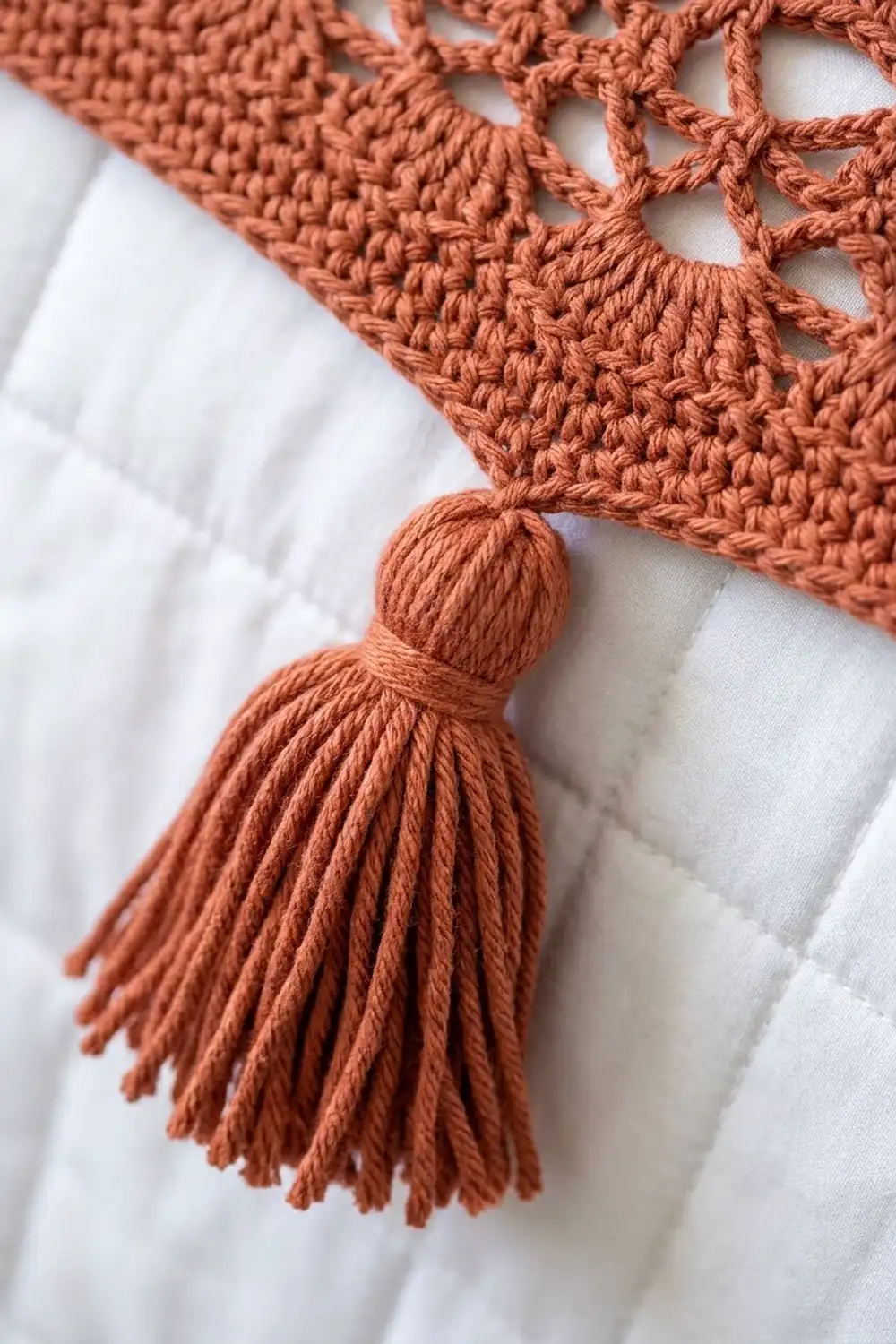
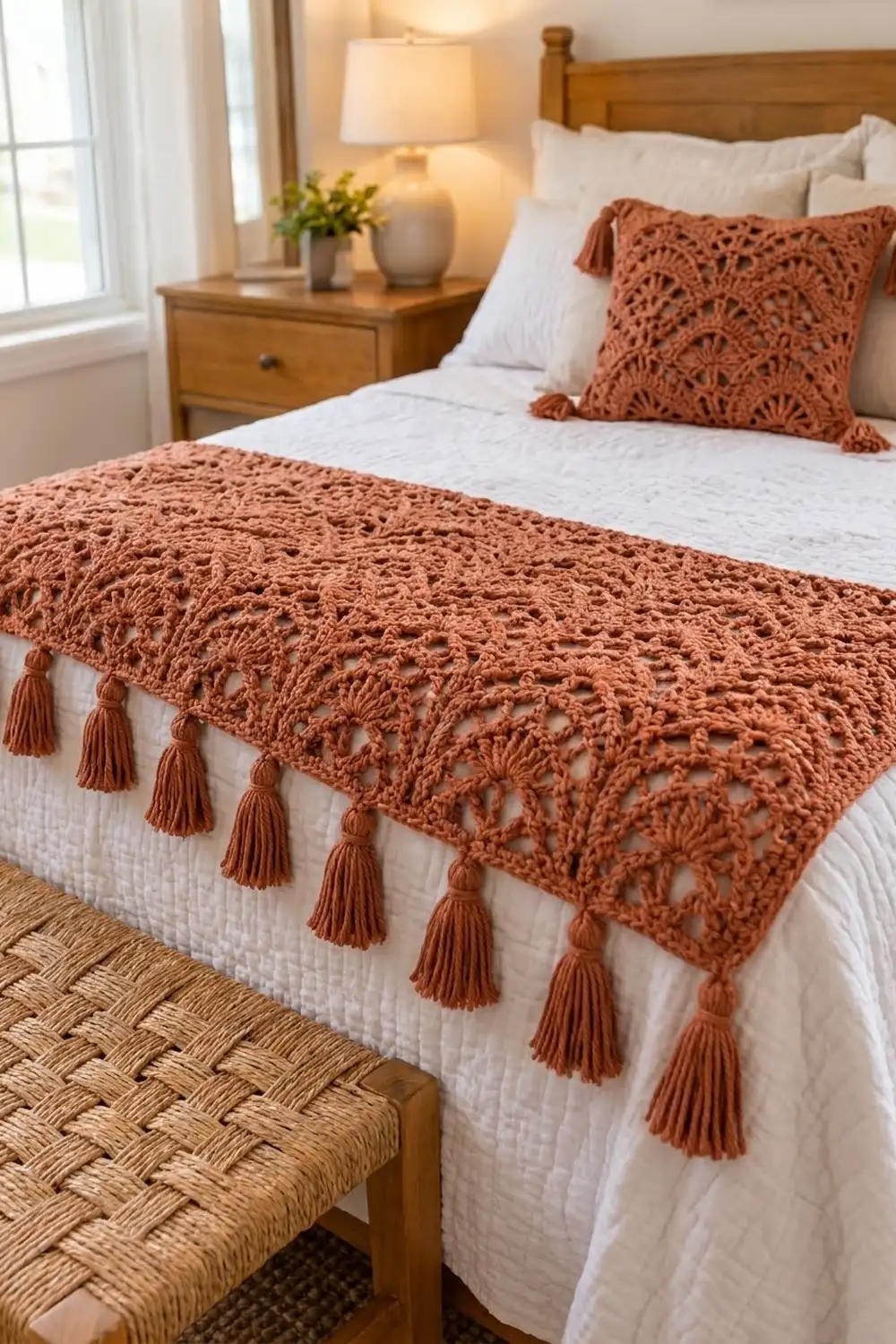
The Sedona Fan Lace Bed Runner is one long rectangle of terracotta lace. Rows of rounded fans alternate with chain arches, and each new row of fans sits halfway between the fans below it. The result is an open, scalloped texture that shows up well against a white bedspread. A neat single crochet border frames the lace, and a row of fat tassels hangs along the edge that falls over the foot of the bed.
The design uses one color: a warm, earthy terracotta. With just one shade, the stitch pattern and the tassels do all the decorating, so the runner suits boho, farmhouse, and modern bedrooms equally well.
The pattern is written in US crochet terms. The finished runner measures 85.5 in x 17 in (217.2 cm x 43.2 cm) after blocking, not counting tassels. That is the right length for a queen bed, with a short drop on each side.
You work the runner lengthwise in a single piece. Start with a long foundation chain, work rows of fans and arches until the piece is the right width, then add a three-round border and 22 tassels. There is no joining.
Finished Size and Construction
- Finished size: 85.5 in x 17 in (217.2 cm x 43.2 cm), excluding tassels
- Skill level: Intermediate
- Terminology: US crochet terms
- Yarn weight: Worsted / aran (#4 medium)
- Hook: 6.0 mm (US J-10)
- Number of pieces: 1
- Layout: One rectangle worked in rows along its length
- Piece size (body): 84 in x 15.5 in (213.4 cm x 39.4 cm)
- Size before border: 84 in x 15.5 in (213.4 cm x 39.4 cm)
- Border depth: 0.75 in (1.9 cm) on every side
- Tassels: 22 tassels, 4.5 in (11.4 cm) long, on one long edge
Materials
Yarn: Use a smooth worsted or aran yarn of about 182 m per 100 g. A cotton blend or soft acrylic gives the crisp fans you see in the photo. Avoid fuzzy yarns, because they blur the arches.
- Terracotta: 550 g, about 1,000 m (1,094 yd) in total
- Body: 440 g / 800 m
- Border: 40 g / 70 m
- Tassels: 70 g / 130 m
These quantities include a margin of roughly 10 percent. Buy every skein from the same dye lot.
Tools:
– 6.0 mm (US J-10) crochet hook
– Tapestry needle
– Scissors
– Stitch markers (at least 6)
– Tape measure
– Stiff card 5 in (12.7 cm) tall, for the tassels
– Blocking mats or towels, rust-proof pins, and a spray bottle
Abbreviations (US Terms)
- ch – chain
- sc – single crochet
- dc – double crochet
- sk – skip
- sp – space
- st(s) – stitch(es)
- rep – repeat
- RS / WS – right side / wrong side
- rev sc – reverse single crochet (crab stitch)
Special stitches:
– Fan: 9 dc worked into the same stitch.
– Half fan: 5 dc worked into the same stitch. At the start of a row, the turning ch-3 counts as the first of those 5 dc.
– Rev sc: Work from left to right (right-handed). Insert the hook into the next stitch to the right, yarn over, pull up a loop, then yarn over and pull through both loops.
Gauge and Checkpoints
Base gauge: 12 sc = 4 in (10.2 cm) in Row 1. One full pattern repeat of 12 stitches is also 4 in (10.2 cm) wide.
Row gauge: Rows 1–2 together = 1 in (2.5 cm). One set of Rows 3–6 = 2.25 in (5.7 cm).
Make a test piece first. Chain 38 and work Rows 1–6 below with k = 3 repeats. Row 1 then has 37 sc, and Row 2 has 3 fans. Lightly steam or wet the swatch and let it dry. It should measure 12 in (30.5 cm) wide and 3.25 in (8.3 cm) tall, within 0.25 in (0.6 cm).
- Swatch too big: Go down to a 5.5 mm hook.
- Swatch too small: Go up to a 6.5 mm hook.
- Width correct but height wrong: Check your dc height. Pull each dc up to its full height rather than tightening it.
Checkpoints on the runner itself:
– After Row 2: length 84 in (213.4 cm), height 1 in (2.5 cm)
– After Row 10: height 5.5 in (14.0 cm)
– After Row 18: height 10 in (25.4 cm)
– After Row 26: height 14.5 in (36.8 cm)
– After Row 28: 84 in x 15.5 in (213.4 cm x 39.4 cm)
If the length after Row 2 is off by more than 1 in (2.5 cm), change hooks and start over now. The width is set by the foundation, so it cannot be fixed later.
The Runner Body
The pattern uses 21 repeats (k = 21). Each repeat is 12 stitches wide.
Foundation: Ch 254.
Row 1 (WS): Sc in the 2nd ch from the hook and in each ch across. Turn. (253 sc = 12 x 21 + 1)
Optional: Instead of the chain and Row 1, you can work 253 foundation single crochet. This gives a stretchier bottom edge.
Place a stitch marker every 24 stitches. This makes recounting much easier.
Row 2 (RS, Fan Row A): Ch 1, sc in the first sc. Sk 5 sc, fan in the next sc, sk 5 sc, sc in the next sc. Rep from * 21 times. Turn.
(21 fans + 22 sc = 189 dc + 22 sc = 211 sts)
Each repeat uses exactly 12 sc of Row 1: 5 skipped + 1 fan stitch + 5 skipped + 1 sc. That is why the edges come out even.
Row 3 (WS, Arch Row A): Ch 7 (counts as dc + ch 4), sc in the 5th (center) dc of the first fan. Ch 4, dc in the next sc, ch 4, sc in the center dc of the next fan. Rep from * 20 times. Ch 4, dc in the last sc. Turn.
(22 dc including the turning chain, 21 sc, 42 ch-4 sps)
Row 4 (RS, Fan Row B, offset): Ch 3 (counts as dc), 4 dc in the first dc to make a half fan. Sk ch-4 sp, sc in the next sc, sk ch-4 sp, fan in the next dc. Rep from * 20 times. Sk sp, sc in the last sc, sk sp, then work 5 dc in the 3rd ch of the turning ch-7 to make a half fan. Turn.
(2 half fans + 20 fans = 190 dc, and 21 sc)
The new fans sit on the dc of Row 3, which are directly above the sc of Row 2. This creates the staggered, brick-like layout of fans.
Row 5 (WS, Arch Row B): Ch 1, sc in the first dc. Ch 4, dc in the next sc, ch 4, sc in the center dc of the next fan. Rep from * 20 times. Ch 4, dc in the last sc, ch 4, sc in the top of the turning ch-3. Turn.
(22 sc, 21 dc, 42 ch-4 sps)
Row 6 (RS, Fan Row A): Ch 1, sc in the first sc. Sk sp, fan in the next dc, sk sp, sc in the next sc. Rep from * 21 times. Turn.
(21 fans + 22 sc = 211 sts, matching Row 2)
Rows 7–26: Rep Rows 3–6 five more times, for six sets in total. Row 26 is a Fan Row A.
Row 27 (WS): Rep Row 3. (22 dc, 21 sc, 42 ch-4 sps)
Row 28 (RS, Closing Row): Ch 1, sc in the first dc. 5 sc in the next ch-4 sp, sc in the next sc, 5 sc in the next ch-4 sp, sc in the next dc. Rep from * 21 times. The final sc goes into the 3rd ch of the turning ch-7.
(22 + 21 + 42 x 5 = 253 sc)
Row 28 has exactly the same count as Row 1, so the top and bottom edges match. Do not fasten off. Continue straight into the border.
Border
Border gauge: 3 sc per inch (2.54 cm) on every side, which is the same as the body’s base gauge.
Each corner gets a 3-sc group. The center sc of that group is the corner stitch. In the counts below, “per side” includes both corner center stitches.
Round 1: Ch 1, then work 3 sc in the last sc of Row 28 for the corner.
- Short side: Work down the row-ends of Rows 27 to 2 like this:
- 1 sc in the end of Row 27
- For each of the six sets of Rows 3–6: 2 sc in the end of the Row 6 position, 1 sc in Row 5, 2 sc in Row 4, and 2 sc in Row 3 (7 sc per set)
- 2 sc in the end of Row 2
- That gives 1 + 42 + 2 = 45 sc between corners.
- Corner: 3 sc in the first st of Row 1.
- Long side: Sc in each of the 251 free loops of the foundation chain, up to the last st.
- Corner: 3 sc in the last foundation stitch.
- Second short side: Work as the first short side, in reverse order: 2 sc in Row 2, then 7 sc per set, then 1 sc in Row 27 (45 sc).
- Final side: Work 3 sc in the first st of Row 28 for the corner, sc in the next 251 sts, and sl st to the first sc.
Per side: long sides 253, short sides 47.
Total: 2 x 251 + 2 x 45 + 4 x 3 = 604 sc.
Round 2: Ch 1. Sc in each sc around, working 3 sc in each corner center stitch. Sl st to the first sc.
Per side: long sides 255, short sides 49. Total: 604 + 8 = 612 sc.
Round 3: Ch 1. Rev sc in each st around, with no corner increases. Sl st to the first st and fasten off. Total: 612 rev sc.
Why the math works: The long edges have 253 stitches over 84 in (213.4 cm), which is 3 per inch. The short edges have 47 stitches over 15.5 in (39.4 cm), which is also about 3 per inch. Because both directions use the same gauge, the border lies flat and the corners stay square. Each sc round adds about 0.25 in (0.6 cm). The three rounds add 0.75 in (1.9 cm) per side, which takes the runner from 84 x 15.5 in to 85.5 x 17 in (217.2 x 43.2 cm).
Tassels (make 22)
- Wrap yarn 20 times around the 5 in (12.7 cm) card.
- Slide a 10 in (25.4 cm) tie strand under the wraps at the top and knot it tightly. Leave both ends long for attaching.
- Cut the wraps along the bottom edge of the card.
- Wrap a separate strand 6 times around the bundle, 0.75 in (1.9 cm) below the top, to form the neck. Knot it and hide the ends inside the tassel.
- Trim the bottom so the tassel measures 4.5 in (11.4 cm) from the top to the ends.
Placement: Choose the long edge made from the foundation chain. On Round 3 of the border, count from the corner: place tassels at stitches 2, 14, 26, and so on, every 12 stitches, ending at stitch 254. This gives 22 tassels spaced 4 in (10.2 cm) apart, each lined up under the sc point between two fans. Pull the tie ends through the border, knot them on the WS, and weave them in.
Final Blocking
- Weave in every end before blocking. Do not attach tassels yet if you plan to wet-block.
- Soak the runner in cool water for 15 minutes. Press the water out gently without wringing.
- Roll the runner in towels to remove extra water.
- Lay it flat on mats or towels and pin it to 85.5 in x 17 in (217.2 cm x 43.2 cm).
- Pin the tip of each fan and arch so the scallops open evenly.
- Check that the corners are square by measuring both diagonals. They should match within 0.5 in (1.3 cm).
- Let it dry completely. Then attach the tassels and steam them lightly so they hang straight.
Final Quality-Control Checklist
- Row 1 and Row 28 each have 253 sc.
- Every Fan Row has 21 full fans, or 20 full fans plus 2 half fans.
- The fans stagger evenly, with no doubled or missing fan anywhere.
- Border Round 1 has 604 sts and Round 2 has 612 sts.
- The blocked runner measures 85.5 in x 17 in (217.2 cm x 43.2 cm), within 1 in (2.5 cm).
- There are 22 tassels, 4 in (10.2 cm) apart, all 4.5 in (11.4 cm) long.
- All ends are secured on the WS.
Troubleshooting
- The fan count is off on a Fan Row: Count the sc and dc in the Arch Row below. It should have 22 dc and 21 sc. Most errors come from skipping a dc or sc in that row.
- The edges slant inward: Check that each half fan has 5 dc including the turning ch-3, and that the turning ch-7 counts as a stitch.
- The arches sag: Work each ch-4 firmly, or change to ch-3 throughout. If you do, recheck your row gauge.
- The border ruffles: Your hook is too loose for the border. Rework it with a 5.5 mm hook.
- The border cups or pulls in: Add 1 sc per Rows 3–6 set on the short sides. Keep both short sides identical.
- The tassels look uneven: Trim them all together using a card as a guide.
Care
Hand wash in cool water with a mild detergent, then lay flat to dry and reshape while damp. Do not tumble dry, because the tassels will tangle and fray.
Final Notes
The whole runner follows one measurement chain. Base gauge of 12 sc to 4 in (10.2 cm) gives a body of 84 in (213.4 cm). Twenty-eight rows give a height of 15.5 in (39.4 cm). A border of 0.75 in (1.9 cm) brings the runner to 85.5 in x 17 in (217.2 cm x 43.2 cm), and the 22 tassels follow the same 4 in (10.2 cm) repeat as the fans. If you check your size at each checkpoint, the finished runner will lie flat and square.
Happy crocheting!