

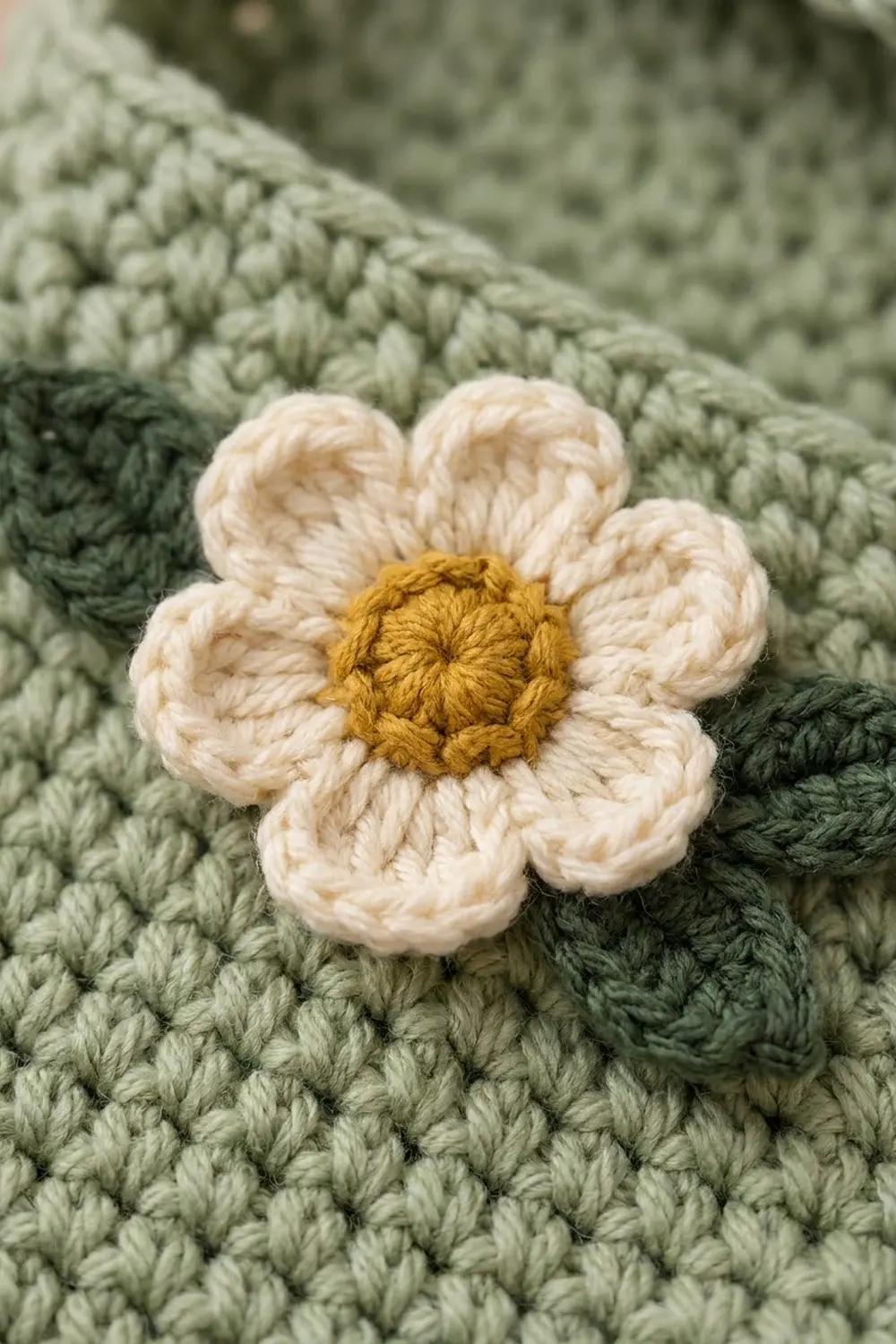
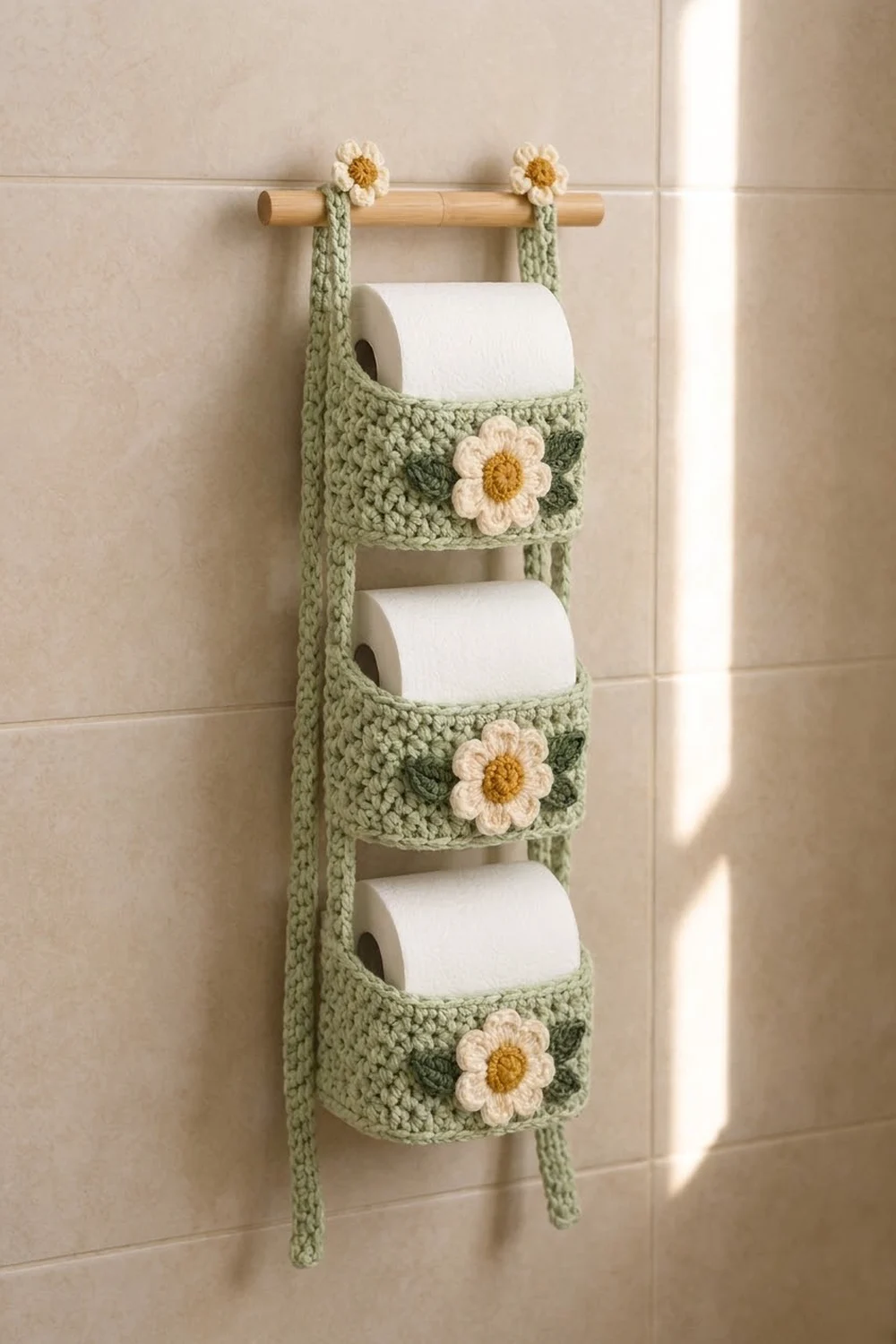
The Daisy Meadow holder keeps three spare rolls in sight and within reach. It has three soft sage-green pockets stacked between two slim straps, and it hangs from a wooden dowel. Each pocket has a cream daisy with a mustard center and two forest-green leaves on the front. Two small daisies sit at the top of the strap loops.
The look is calm and cottage-style. The pockets are worked in plain single crochet so the fabric is dense and holds its shape. A round of reverse single crochet gives each rim a neat, slightly rolled edge. This pattern uses US crochet terms throughout.
Each pocket is 5 in (12.7 cm) wide, 4 in (10.2 cm) deep and 3 1/4 in (8.3 cm) tall. The straps are 27 in (68.6 cm) long. The finished holder hangs about 24 1/2 in (62.2 cm) from the dowel to the strap tails.
Construction overview: For each pocket, you crochet a flat rectangular base in rows, then work the walls upward in joined rounds. You make the two straps as long flat strips. The flowers and leaves are worked separately and sewn on. Then you sew the pockets to the straps and fold the strap ends over the dowel.
Finished Size and Construction
- Finished hanging length: about 24 1/2 in (62.2 cm)
- Width (pockets): 5 in (12.7 cm)
- Skill level: Easy / advanced beginner
- Terminology: US
- Yarn weight: Worsted (#4), cotton or cotton blend
- Hook: 5.0 mm (H-8)
- Number of pieces: 3 pockets, 2 straps, 3 large flowers, 6 leaves, 2 small flowers
- Layout: 3 pockets stacked vertically between 2 straps
- Pocket size: 5 × 4 × 3 1/4 in (12.7 × 10.2 × 8.3 cm)
- Pocket wall height before rim edging: 3.1 in (7.9 cm)
- Rim edging depth: about 1/8 in (0.3 cm), one round of reverse single crochet
Materials
Use a smooth worsted-weight cotton or cotton blend. Cotton holds its shape, doesn’t stretch much under the weight of the rolls and copes well with bathroom humidity. The amounts below assume a yarn of about 170 m per 100 g.
- Sage green (pockets, straps): 200 g / about 340 m
- Cream (all flower petals): 25 g / about 43 m
- Mustard yellow (flower centers): 10 g / about 17 m
- Dark forest green (leaves): 10 g / about 17 m
Tools:
– 5.0 mm (H-8) crochet hook
– Tapestry needle
– Stitch markers (at least 4)
– Wooden dowel, 12 in (30.5 cm) long, 3/4 in (1.9 cm) in diameter
– Measuring tape
– Pins
– Scissors
All quantities include a margin of about 20% for your gauge swatch and any re-working.
Abbreviations (US Terms)
- ch – chain
- sl st – slip stitch
- sc – single crochet
- hdc – half double crochet
- dc – double crochet
- BLO – back loop only
- MR – magic ring
- st(s) – stitch(es)
- rnd – round
- rev sc – reverse single crochet (crab stitch)
Special stitch – Reverse single crochet (rev sc): Work from left to right (right to left if you crochet left-handed). Insert your hook into the next stitch to the right, yarn over, pull up a loop, yarn over, and pull through both loops. This makes a twisted, slightly rolled edge.
Gauge and Checkpoints
Gauge: 16 sc × 18 rows = 4 in (10.2 cm) in single crochet worked in rows with the 5.0 mm hook.
Your first pocket base works as a gauge test. It is 20 stitches wide and 18 rows tall, so it should measure exactly 5 × 4 in (12.7 × 10.2 cm). Measure it before you start the walls.
Checkpoints:
– Base after Row 18: 5 × 4 in (12.7 × 10.2 cm)
– Walls after Rnd 10: 2 in (5.1 cm) above the base edge
– Walls after Rnd 15: 3.1 in (7.9 cm)
– Pocket after Rnd 16 (rim): 3 1/4 in (8.3 cm) tall
– Strap after Row 1: 27 in (68.6 cm) long
If your base is too big: go down to a 4.5 mm hook. If it’s too small: go up to a 5.5 mm hook. Keep the stitch counts the same and change only the hook. All of the strap placements below are counted in stitches, so they still line up if your gauge is slightly off. Your overall length will just change in proportion.
Pocket (Make 3)
Base
With sage green, ch 21.
Row 1: Sc in 2nd ch from hook and in each ch across, turn. (20 sc)
Rows 2–18: Ch 1 (does not count as a stitch), sc in each st across, turn. (20 sc)
Checkpoint: 5 × 4 in (12.7 × 10.2 cm). Don’t fasten off.
Walls
You now work around the base in joined rounds without turning. Place the start of each round at the corner where Row 18 begins, which will be a back corner. The straps will cover this seam later.
Rnd 1: Ch 1. Work along the 4 edges of the base as follows:
– Top of Row 18: 20 sc, one in each st.
– First short edge (18 row ends): 16 sc. Work into row ends 1–8, skip row end 9, work into row ends 10–17, and skip row end 18.
– Underside of the foundation chain: 20 sc, one in each ch.
– Second short edge: 16 sc, using the same skip pattern.
Join with sl st to the first sc. (72 sc: 20 + 16 + 20 + 16)
The short edges get 16 sc because 16 stitches at 16 sts per 4 in equals 4 in, which matches the 18 rows of the base. This keeps the corners square.
Rnd 2: Ch 1, sc in BLO of each st around, join. (72 sc)
The unworked front loops make a crisp fold line, so the walls stand up from the base.
Rnds 3–15: Ch 1, sc in each st around, join. (72 sc in each round)
Checkpoint after Rnd 10: walls are 2 in (5.1 cm) tall. After Rnd 15: 3.1 in (7.9 cm).
Leave the hook in the loop and continue with the rim in the Border section. Then mark the back wall: it is the 20-stitch side that starts at the joining seam.
Straps (Make 2)
With sage green, ch 109.
Row 1: Sc in 2nd ch from hook and in each ch across, turn. (108 sc)
Rows 2–4: Ch 1, sc in each st across, turn. (108 sc)
Each strap is 27 in (68.6 cm) long and about 7/8 in (2.2 cm) wide. Number the stitches along Row 4 from 1 to 108, starting at the end you’ll use as the bottom. Place markers at stitches 7, 37, 67 and 98.
Large Daisy (Make 3)
Rnd 1: With mustard, MR, ch 2 (does not count), 12 hdc into the ring. Pull the ring closed and join with sl st to the first hdc. Fasten off. (12 hdc)
Rnd 2: Join cream in any st. In the next st work (hdc, 3 dc, hdc), then sl st in the next st. Repeat from * to * 5 more times. Join and fasten off.
You now have 6 petals: 6 × 5 petal stitches + 6 sl st = 36 sts.
The daisy measures about 2 3/4 in (7.0 cm) across. Leave a long cream tail for sewing.
Leaf (Make 6)
With dark green, ch 7.
Side 1: Sc in 2nd ch from hook, hdc in next ch, dc in each of the next 2 ch, hdc in next ch, sc in last ch. (6 sts)
Side 2: Ch 1. Rotate the piece and work along the other side of the foundation chain: sc in the first ch, hdc, dc, dc, hdc, sc. (6 sts)
Sl st into the tip and fasten off. Each leaf has 12 sts and is about 1 3/4 in (4.4 cm) long.
Small Daisy (Make 2)
Rnd 1: With mustard, MR, 5 sc into the ring, join. Fasten off. (5 sc)
Rnd 2: Join cream. In the next st work (sl st, ch 2, 2 dc, ch 2, sl st). Repeat from * to * 4 more times. Fasten off. (5 petals)
The small daisy is about 1 1/2 in (3.8 cm) across.
Make All Pieces
| Piece | Qty | Color(s) |
|---|---|---|
| 3 | Sage | |
| Strap | 2 | Sage |
| Large daisy | 3 | Mustard + cream |
| Leaf | 6 | Dark green |
| Small daisy | 2 | Mustard + cream |
Appliqué each pocket before assembly: Center one large daisy on the front wall, which is the 20-stitch side opposite the back wall. Place it between Rnds 4 and 14. Tuck one leaf under each side of the daisy with the tips pointing outward and slightly downward. Sew around the edges with matching yarn, catching only the outer layer of the wall.
Layout grid (front view, top to bottom):
 [sm daisy]==========dowel==========[sm daisy]
  strap st 98 (fold line)        strap st 98
  |  sts 80–97: open space, 4 3/4 in        |
  |[        POCKET 1  (sts 67–79)          ]|
  |  sts 50–66: gap, 4 1/4 in               |
  |[        POCKET 2  (sts 37–49)          ]|
  |  sts 20–36: gap, 4 1/4 in               |
  |[        POCKET 3  (sts 7–19)           ]|
  |  sts 1–6: tail, 1 1/2 in                |
Joining
Method: Whipstitch with sage yarn and a tapestry needle.
Placement: Lay a strap vertically against the outside of the pocket’s back wall. Line up its outer long edge with the back corner. Line up its bottom with the base fold (Rnd 2) and its top with the rim. Do the same with the second strap at the other back corner. Both straps sit inside the 20-stitch back wall: one covers wall stitches 1–4 and the other covers stitches 17–20.
Stitch-to-stitch logic: Each pocket covers 13 strap stitches, which is 3 1/4 in (8.3 cm). The back wall is 15 rounds tall (Rnds 2–16).
– Sew one whipstitch through each strap stitch and the matching wall round.
– At the bottom, catch Rnds 2 and 3 together with strap stitch 1 of that section.
– At the top, catch Rnds 15 and 16 together with the last strap stitch.
That spreads the 2 extra rounds out without puckering. Sew both long edges of each strap to the wall so the strap lies flat.
Section positions:
– Pocket 3: strap sts 7–19
– Pocket 2: strap sts 37–49
– Pocket 1: strap sts 67–79
The bottom of each pocket starts on a marked stitch (7, 37 or 67).
Tension: Pull each stitch just until the pieces meet. If you pull tighter, the strap gathers and the pockets tilt forward.
Size checkpoint: Lay the piece flat. Measure from the bottom of Pocket 3 (strap st 7) to the bottom of Pocket 2 (st 37). It should be 7 1/2 in (19.1 cm). Pocket 2 to Pocket 1 should be the same.
Top loops: Fold strap stitches 99–108 (2 1/2 in / 6.4 cm) over the dowel to the back, with the fold at the marker on st 98. Sew the end down across the full strap width, leaving a loop that just slides onto the dowel. Sew one small daisy to the front of each loop.
Border
The border has two parts: a reverse single crochet rim on each pocket and a slip-stitch edge on each strap. Work the pocket rims before assembly and the strap edges before joining.
Border gauge: The rim works one stitch into each existing stitch, at the same 16 sts per 4 in as the walls.
Pocket Rim:
Rnd 16: Continuing from Rnd 15, ch 1. Work rev sc in each st around: 20 along the back, 16 along the first side, 20 along the front and 16 along the second side. Join and fasten off. (72 rev sc)
Strap Edge: Join sage at one corner. Sl st loosely in each st along one long edge (108 sl st), then along the other long edge (108 sl st). Leave the short ends plain, because they’re hidden by the fold or hang free.
Why the math works: The walls have 72 stitches, which is 18 in (45.7 cm). That matches the base perimeter of 2 × (5 + 4) in. The rim adds no stitches (72 in, 72 out), so the opening doesn’t flare or pull in. The strap edge also works 1 stitch per stitch, so the straps stay 27 in long.
Final Blocking
- Weave in all ends inside the pockets or behind the straps.
- Mist the whole holder lightly with water until it’s damp but not soaked.
- Lay it flat on a blocking mat. Pin the straps straight, 5 in (12.7 cm) apart at their outer edges.
- Fill each pocket with a folded washcloth or a spare roll wrapped in a plastic bag so the walls dry square.
- Press the daisy petals flat with your fingers and pin the leaf tips if needed.
- Let it dry completely, usually 12–24 hours.
- Unpin it and slide the dowel through both loops.
Final Quality-Control Checklist
- Each pocket measures 5 × 4 × 3 1/4 in (12.7 × 10.2 × 8.3 cm).
- Every wall round has 72 sts and no stitches were lost.
- The round seams are hidden behind the straps.
- The gaps between pockets are equal at 4 1/4 in (10.8 cm).
- The strap tails are both 1 1/2 in (3.8 cm) long.
- The daisies are centered on each front wall.
- The leaves are level and mirrored.
- The loops slide onto the dowel without forcing.
- No ends are visible from the front.
Troubleshooting
- The walls flare outward: You probably added stitches at a corner. Recount to 72 per round.
- The walls lean inward: Your tension tightened as you went up. Relax your grip, or go up half a hook size for Rnds 3–15.
- The base corners bulge: You picked up 18 stitches along a short edge instead of 16. Redo Rnd 1.
- The pockets tilt forward when loaded: The whipstitching only goes through one strap edge. Sew both long edges.
- The daisy petals curl: Block them flat, or use a slightly larger hook for Rnd 2.
- The straps twist: Steam-block them flat before joining.
Care
Hand wash in cool water with mild soap, press out the water in a towel and dry flat. Remove the dowel before washing.
Final Notes
Everything in this holder follows from one measurement chain. With a gauge of 16 sc × 18 rows = 4 in (10.2 cm), a 20 × 18 base measures 5 × 4 in (12.7 × 10.2 cm), and 72 stitches around it make an 18 in (45.7 cm) wall. Fifteen rounds plus the rim give a 3 1/4 in (8.3 cm) pocket. A 108-stitch strap is 27 in (68.6 cm) long, which leaves room for three pockets spaced 7 1/2 in (19.1 cm) apart and a loop for the dowel. Check your gauge first and the rest will fit together.
Happy crocheting!