

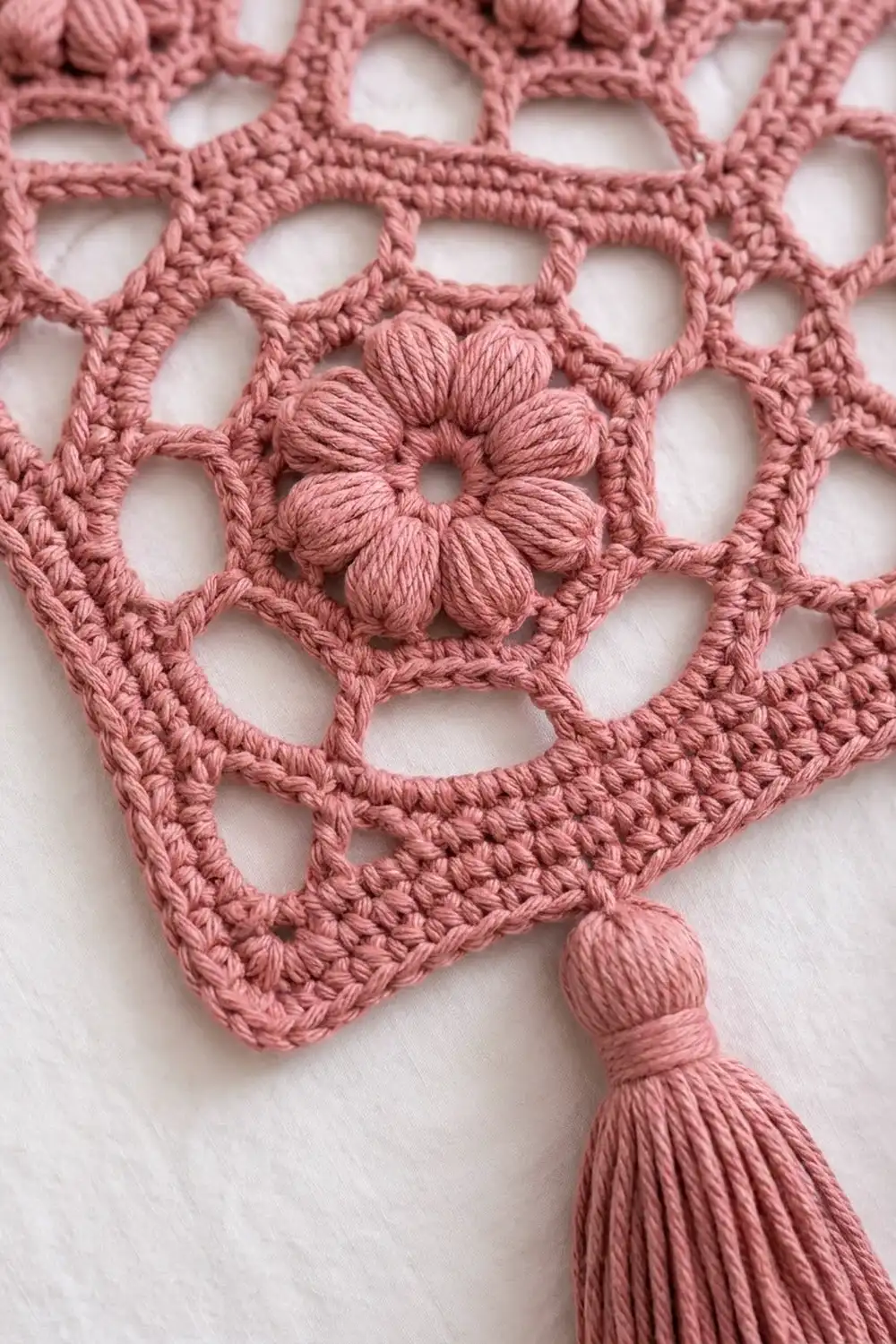
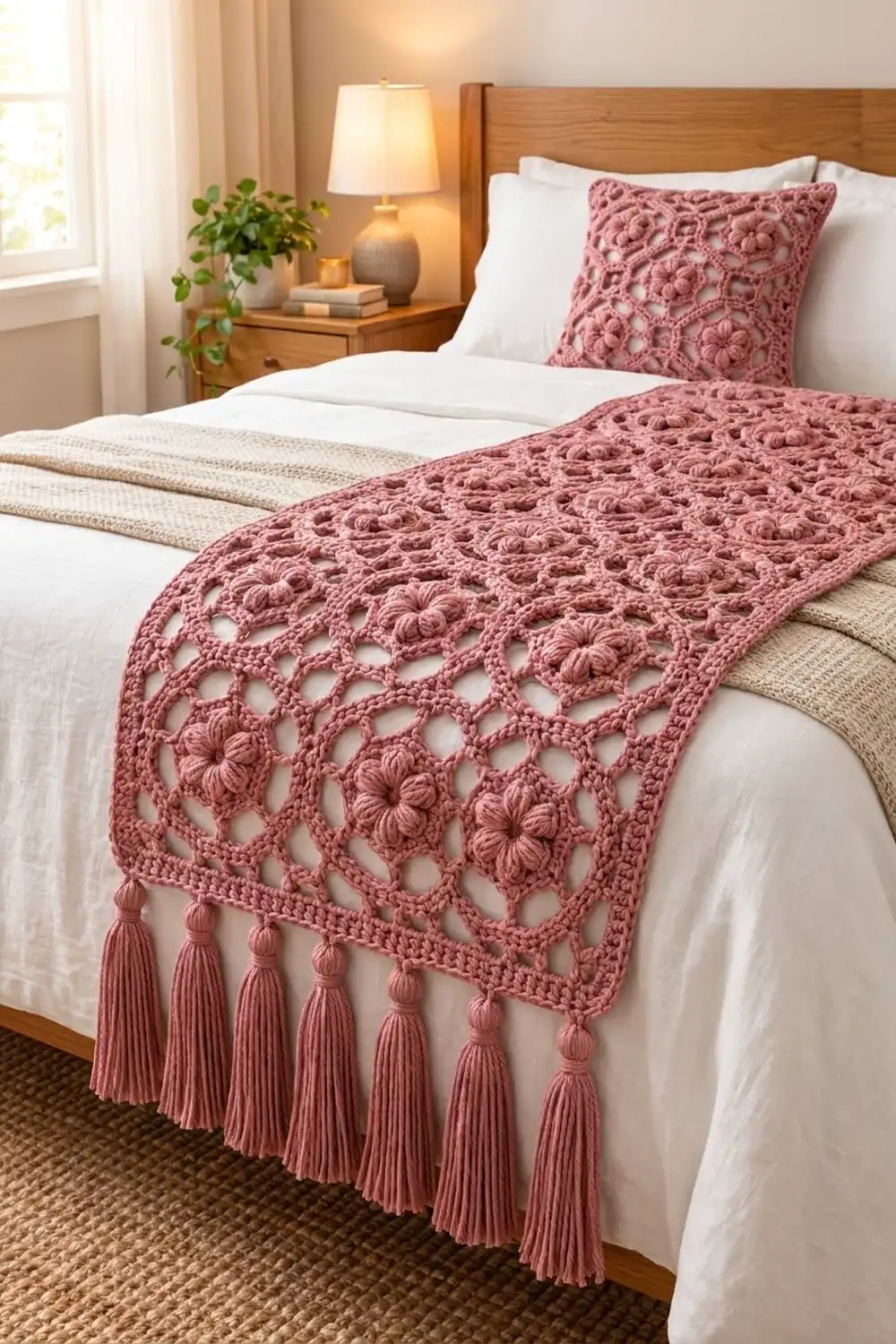
The Rosewood Honeycomb Bloom Bed Runner is a long lace runner made in one piece in a soft dusty rose. Solid stitch ridges frame staggered honeycomb cells, and a raised six-petal puff flower sits in the middle of each large cell. A dense border runs around the outside, and chunky tassels hang from one long edge.
The runner uses a single color, so all of the interest comes from texture. The puff flowers stand out against the open mesh. The solid bands give the lace enough structure to lie flat across the foot of a bed.
The pattern uses US crochet terms. Before tassels, the finished runner measures 23 in x 69 in (58.4 cm x 175.3 cm). The tassels hang 6 in (15.2 cm) below one long edge.
You work the body flat in rows, starting from a foundation chain along the short end. The flowers are built inside the rows, so you don’t sew anything on. A three-round border plus a slip-stitch finish goes around the body. Then you tie 16 tassels along one long side.
Finished Size and Construction
- Finished size: 23 in x 69 in (58.4 cm x 175.3 cm), plus 6 in (15.2 cm) tassels
- Skill level: Intermediate
- Terminology: US
- Yarn weight: Worsted (#4)
- Hook: 5.5 mm (I-9)
- Number of pieces: 1, worked in one piece
- Layout: Staggered flower cells, 5 across in Tier A and 4 across in Tier B, 26 tiers long
- Piece size before border: 20 in x 66 in (50.8 cm x 167.6 cm)
- Border depth: 1.5 in (3.8 cm) on every side
Materials
Choose a smooth worsted yarn with good stitch definition, such as an acrylic-wool blend or a soft acrylic. Avoid fuzzy or very splitty yarns, because the puffs and the flower centers lose their shape.
- Dusty rose, worsted weight (about 200 yd / 183 m per 100 g): 1,700 yd (1,554 m), about 850 g. Plan on 9 balls.
- Body and border: about 1,350 yd (1,234 m)
- Tassels: about 192 yd (176 m)
These amounts include a margin of roughly 10% for your gauge swatch and for differences in tension.
Tools:
– 5.5 mm (I-9) crochet hook
– Locking stitch markers
– Tapestry needle
– Sharp scissors
– Stiff card cut to 6.5 in (16.5 cm) tall, for tassels
– Tape measure, blocking mats, and rust-proof pins
– Spray bottle
Abbreviations (US Terms)
- ch – chain
- sl st – slip stitch
- sc – single crochet
- dc – double crochet
- tr – treble crochet
- sk – skip
- sp(s) – space(s)
- st(s) – stitch(es)
- RS / WS – right side / wrong side
Puff: [Yo, insert hook into ring, yo, pull up a loop to about 0.5 in (1.3 cm)] 3 times (7 loops on hook), yo, pull through all 7 loops.
Flower: Sc in the indicated st, ch 5, then sl st in the 5th ch from the hook to form a small ring. Working into the ring, [puff, ch 1] 6 times. Sl st in the first ch of the ring. The flower takes up 1 base stitch. The ring sits above its sc, so the ch-1 sp after the 3rd puff is at the very top of the flower. This is the “top ch-1 sp.”
Gauge and Checkpoints
Gauge: 12 sts = 4 in (10.2 cm) in the dc band rows. One 8-row pattern repeat is 5 in (12.7 cm) tall. Each flower is about 1.5 in (3.8 cm) across.
Make a test swatch first. Ch 26 and work Rows 1–10 below over 25 sts (2 repeats plus 1). Block the swatch lightly, then measure it. It should be 8 in (20.3 cm) wide and 6 in (15.2 cm) tall.
Checkpoints during the body:
– Row 1: 61 sts, 20 in (50.8 cm) wide
– After Row 2: 1 in (2.5 cm) tall
– After Row 42: 26 in (66.0 cm) tall
– After Row 82: 51 in (129.5 cm) tall
– After Row 106: 66 in (167.6 cm) tall
If your work is too big, go down half a hook size. If it is too small, go up half a size. If the width is right but the length is off, check your tr height first. Loose or tight lace rows change the length fastest.
Body
Foundation: Ch 62.
Row 1 (RS): Sc in the 2nd ch from the hook and in each ch across, turn. (61 sc)
Row 2 (WS, dc band): Ch 3 (counts as dc here and throughout), dc in each st across, turn. (61 dc)
Row 3 (RS, Tier A flower row): Ch 4 (counts as tr here and throughout), *ch 3, sk 2 sts, sc in next st, ch 2, sk 2 sts, Flower in next st, ch 2, sk 2 sts, sc in next st, ch 3, sk 2 sts, tr in next st; repeat from * 4 more times, turn. (6 tr, 10 sc, 5 flowers, 20 ch-sps)
Row 4 (WS, Tier A upper row): Ch 4, *ch 4, sc in top ch-1 sp of next flower, ch 4, tr in next tr; repeat from * 4 more times, working the last tr in the top of the turning ch, turn. (6 tr, 5 sc, 10 ch-4 sps)
Row 5 (RS, sc band): Ch 1, sc in first tr, *5 sc in next ch-4 sp, sc in next sc, 5 sc in next ch-4 sp, sc in next tr; repeat from * 4 more times, working the last sc in the top of the turning ch, turn. (1 + 5 x 12 = 61 sc)
Row 6 (WS, dc band): Ch 3, dc in each st across, turn. (61 dc)
Row 7 (RS, Tier B flower row): Ch 4, ch 2, sk 2 sts, sc in next st, ch 2, sk 2 sts, tr in next st (edge half-cell made); *ch 3, sk 2 sts, sc in next st, ch 2, sk 2 sts, Flower in next st, ch 2, sk 2 sts, sc in next st, ch 3, sk 2 sts, tr in next st; repeat from * 3 more times; ch 2, sk 2 sts, sc in next st, ch 2, sk 2 sts, tr in last st, turn. (7 tr, 10 sc, 4 flowers, 20 ch-sps)
These flowers sit above the Tier A tr columns, which staggers the cells into a honeycomb.
Row 8 (WS, Tier B upper row): Ch 4, ch 2, sc in next sc, ch 2, tr in next tr; *ch 4, sc in top ch-1 sp of next flower, ch 4, tr in next tr; repeat from * 3 more times; ch 2, sc in next sc, ch 2, tr in top of turning ch, turn. (7 tr, 6 sc, 4 ch-2 sps, 8 ch-4 sps)
Row 9 (RS, sc band): Ch 1, sc in first tr, 2 sc in next ch-2 sp, sc in next sc, 2 sc in next ch-2 sp, sc in next tr; *5 sc in next ch-4 sp, sc in next sc, 5 sc in next ch-4 sp, sc in next tr; repeat from * 3 more times; 2 sc in next ch-2 sp, sc in next sc, 2 sc in next ch-2 sp, sc in top of turning ch, turn. (7 + 48 + 6 = 61 sc)
Rows 10–105: Repeat Rows 2–9 twelve more times. You have now worked the 8-row repeat 13 times in total, and Row 105 is an sc band. (61 sc)
Row 106 (WS): Work as for Row 2. (61 dc) Don’t fasten off.
The body now has 26 flower tiers: 13 Tier A and 13 Tier B. It starts and ends with a matching sc-plus-dc band and should measure 20 in x 66 in (50.8 cm x 167.6 cm).
Border
Border gauge: 3 sts per inch (12 sts = 4 in / 10.2 cm), the same as the body.
Each side count below runs from one corner center stitch to the next, counting both. Neighboring sides share their corner stitches, so each round total is the four side counts minus 4.
Round 1 (RS, sc): Ch 1, turn.
– Top edge: 3 sc in the first st, sc in the next 59 sts, 3 sc in the last st.
– First long side (row ends): 1 sc in each sc-band row and 2 sc in each dc-band row. Work 4 sc across each Tier A pair of lace rows (2 per row). Work 5 sc across each Tier B pair (2 in the upper row, 3 in the flower row).
– Foundation edge: 3 sc in the first ch, sc in the next 59 chs, 3 sc in the last ch.
– Second long side: Work as for the first long side.
Sl st to the first sc.
- Long side row ends: 27 + 54 + 52 + 65 = 198 sc
- Short sides: 63 sts each, including corners. Long sides: 202 sts each.
- Total: 526 sc
Round 2 (dc): Sl st in the next sc (the corner center). Ch 3, 2 dc in the same st. *Dc in each st to the next corner center, 3 dc in the corner center; repeat from * 2 more times. Dc in each remaining st, then sl st to the top of the ch-3. (526 + 8 = 534 sts; short sides 65, long sides 204)
Round 3 (dc): Sl st in the next dc (the corner center). Repeat Round 2. (534 + 8 = 542 sts; short sides 67, long sides 206)
Round 4 (sl st): Sl st loosely in each st around, with no corner increases. (542 sl sts) Fasten off and weave in the ends.
Why the math works: The long side is 66 in (167.6 cm), so at 3 sts per inch it needs 66 x 3 = 198 sts. Each 8-row repeat is 5 in and gets 3 + 4 + 3 + 5 = 15 sts, and the closing band adds 3 more: 13 x 15 + 3 = 198. The short side uses all 61 body sts. Each round adds 2 sts at every corner, which keeps the corners square as the border grows 1.5 in (3.8 cm).
Tassels (make 16)
- Wrap the yarn 30 times around the 6.5 in (16.5 cm) card.
- Slide a 12 in (30.5 cm) strand under the wraps at the top and tie it tightly. Leave the ends long.
- Cut the loops at the bottom.
- Wrap a separate strand tightly around the tassel 5–6 times, 0.75 in (1.9 cm) below the top. Knot it and bury the ends inside the tassel.
- Trim the tassel to 6 in (15.2 cm).
Placement: Choose one long side and count its 206 Round 3 sts, starting with a corner center as st 1. Attach a tassel at st 6 and then at every 13th st: sts 6, 19, 32 and so on, ending at st 201. This leaves 5 sts beyond each end tassel. The tassels are about 4 1/3 in (11.0 cm) apart, with about 1 2/3 in (4.2 cm) left at each corner.
To attach a tassel, pull both tie ends through the st from front to back. Knot them securely on the WS and weave the tails into the border.
Final Blocking
- Lay the runner on the mats, RS up.
- Pin the corners first, to 23 in x 69 in (58.4 cm x 175.3 cm).
- Pin the long edges straight, then the short edges.
- Shape each flower with your fingers so the petals spread evenly around the center hole.
- Gently open each chain arc.
- Spray until damp but not soaked.
- Let it dry completely before you remove the pins.
- Comb out the tassels and steam them lightly so they hang straight.
Final Quality-Control Checklist
- The runner measures 23 in x 69 in (58.4 cm x 175.3 cm).
- The long sides are straight, with no waves.
- The corners are square and lie flat.
- Every flower has 6 puffs and an open center.
- The flower rows alternate 5 and 4 across and are fully staggered.
- The tassels are evenly spaced, the same length, and firmly knotted.
- All ends are woven in invisibly.
Troubleshooting
Flowers flop forward. In the upper row that follows, the sc must go into the top ch-1 sp (after the 3rd puff), not into a side space.
Edges pull in. Your tr columns are too tight. Loosen your tension or use a taller turning chain.
The long side ripples. You may have added extra stitches along the row ends. Recount against 198.
Corners cup. Make sure every corner center gets 3 sts in Rounds 2 and 3.
Puffs look uneven. Pull each loop to the same 0.5 in (1.3 cm) height before you close the puff.
Tassels look thin. Add 5–10 wraps to each tassel and use the same number for all of them.
Care
Hand wash in cool water and dry flat, reshaping the flowers while the runner is damp. Don’t wring or hang it, because the lace will stretch.
Final Notes
The measurements build on each other. At 12 sts = 4 in, 61 sts give a width of 20 in (50.8 cm). Each 8-row repeat is 5 in, so 13 repeats plus the closing band give a length of 66 in (167.6 cm). The 1.5 in (3.8 cm) border brings the runner to 23 in x 69 in (58.4 cm x 175.3 cm), and 16 tassels finish the foot edge. Check your swatch and count your stitches at every band row, and the runner will come out to size.
Happy crocheting!