

The Oat Milk Mandala Bed Runner is a calm, textured accent for the foot of a bed. Each square motif has a ring of plump puff petals in the center, framed by solid and lacy rounds. When the squares are joined, small lace stars appear wherever four corners meet.
The whole runner is worked in one shade, a warm oatmeal beige. A single color lets the texture carry the design, and the runner suits boho, farmhouse and minimalist bedrooms. A full fringe on the front long edge gives a relaxed, handmade finish.
This pattern uses US crochet terms. The finished runner measures 16″ x 65″ (40.6 x 165.1 cm) before fringe. With the 4.5″ (11.4 cm) fringe, the front-to-back depth is 20.5″ (52.1 cm).
Construction is simple and modular. You make 18 identical 7″ (17.8 cm) square motifs and join them into a grid 2 motifs wide and 9 motifs long. Then you work a three-round border around the whole runner and knot fringe onto one long edge.
Finished Size and Construction
- Finished size: 16″ x 65″ (40.6 x 165.1 cm), plus 4.5″ (11.4 cm) fringe
- Skill level: Intermediate
- Terminology: US crochet terms
- Yarn weight: Worsted (#4), cotton or cotton blend
- Hook: 5.0 mm (H-8)
- Number of pieces: 18 square motifs
- Layout: 2 motifs wide x 9 motifs long
- Motif size: 7″ x 7″ (17.8 x 17.8 cm)
- Size before border: 14″ x 63″ (35.6 x 160.0 cm)
- Border depth: 1″ (2.5 cm) on every side
Materials
Yarn: Choose a smooth worsted cotton or cotton blend with about 190 m per 100 g. Cotton shows off the puff petals and blocks crisply. Avoid fuzzy yarns, because they blur the lace.
- Oatmeal / natural beige: 500 g (about 950 m / 1,040 yd)
- Motifs: about 330 g
- Joining and border: about 75 g
- Fringe: about 40 g
These quantities include a margin of about 10%. Buy all the yarn from one dye lot.
Tools:
– 5.0 mm (H-8) crochet hook
– Tapestry needle
– Scissors
– Locking stitch markers
– Measuring tape
– Blocking mats and rust-proof pins
– Spray bottle
– A stiff card 5″ (12.7 cm) wide, for cutting fringe
Abbreviations (US Terms)
- ch – chain
- sl st – slip stitch
- sc – single crochet
- hdc – half double crochet
- dc – double crochet
- tr – treble crochet
- sk – skip
- sp(s) – space(s)
- st(s) – stitch(es)
- RS / WS – right side / wrong side
Special stitch – Puff: (Yarn over, insert hook in the stitch, pull up a loop to the height of a dc) 3 times. Yarn over and pull through all 7 loops on the hook. Ch 1 to close the puff; this closing chain does not count as a stitch.
Gauge and Checkpoints
Make one complete motif before you start the rest. Block it lightly and measure it. Your gauge is correct if the motif measures 7″ (17.8 cm) square and the last round has 25 sc per side, about 3.6 sts per inch.
Check the flat diameter at these stages:
- After Round 1: 1.5″ (3.8 cm)
- After Round 3: 3.75″ (9.5 cm)
- After Round 5: 5″ (12.7 cm)
- After Round 6: 6″ (15.2 cm)
- After Round 8: 7″ (17.8 cm) square
If the motif is too big, go down a half or full hook size. If it is too small, go up a size. Do not add or remove stitches, because the joining and border counts depend on exactly 25 stitches per side.
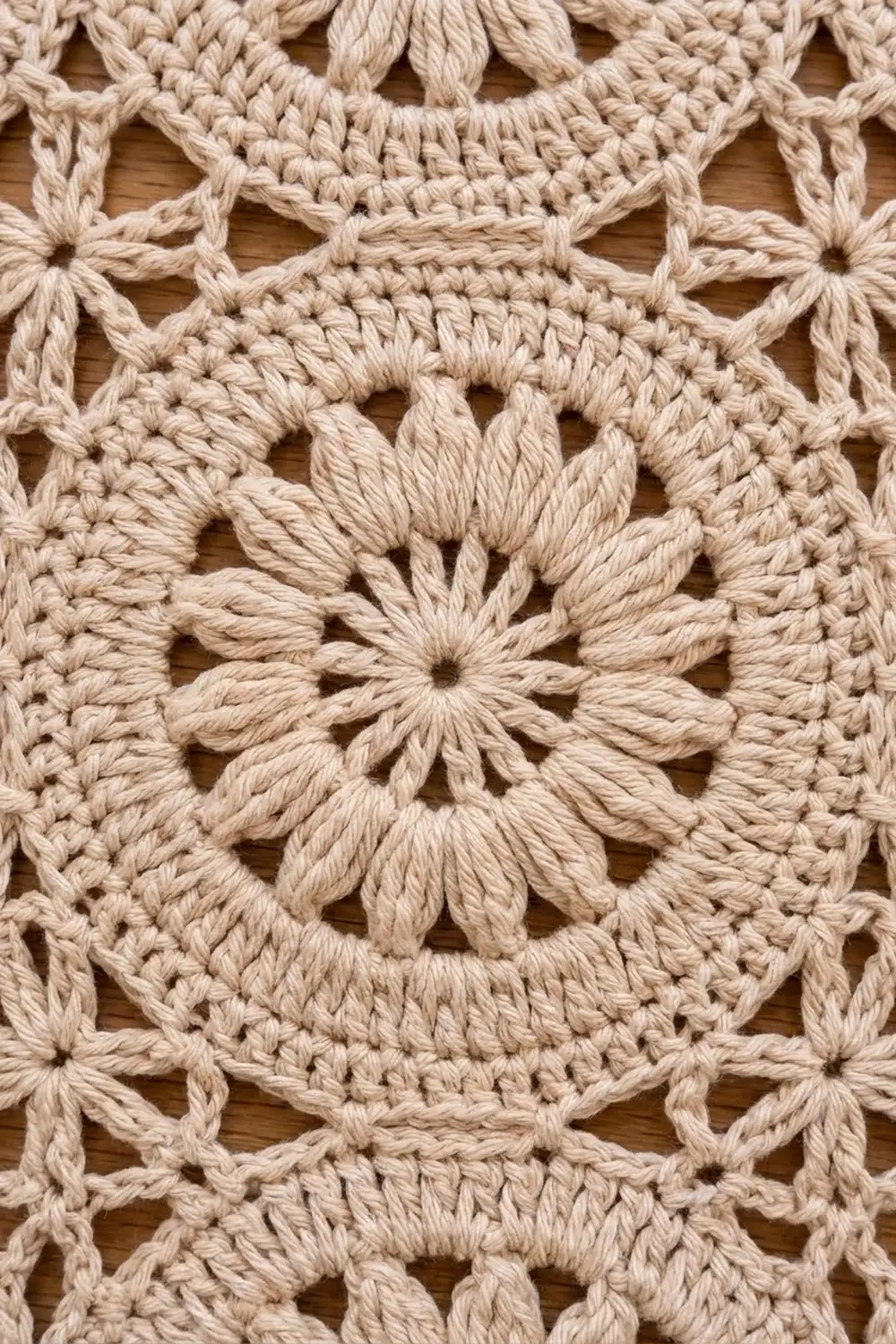
Motif (Make 18)
Round 1: Make a magic ring. Ch 3 (counts as dc), then work 15 dc in the ring. Join with a sl st to the top of the beginning ch-3. Pull the ring closed. (16 dc)
Round 2: Ch 2 (does not count as a stitch). Work a Puff in the same st, then ch 2. Puff in the next st, ch 2, and repeat from * 14 more times. Join with a sl st to the top of the first Puff. (16 puffs, 16 ch-2 sps)
These 16 puffs form the long petals of the mandala.
Round 3: Sl st into the next ch-2 sp. Ch 3 (counts as dc) and work 2 dc in the same sp. Work 3 dc in each remaining ch-2 sp around. Join to the top of the beginning ch-3. (48 dc: 16 groups of 3)
Round 4: Sl st into the next dc, which is the center dc of the first group. Ch 5 (counts as dc + ch 2). Dc in the center dc of the next group, ch 2, and repeat from * 14 more times. Join to the 3rd ch of the beginning ch-5. (16 dc, 16 ch-2 sps)
This round makes the spaced ring of open “windows” that sits just outside the petals.
Round 5: Ch 1. Sc in the same st, then work 3 sc in the next ch-2 sp. Sc in the next dc, 3 sc in the next ch-2 sp, and repeat from * 14 more times. Join to the first sc. (64 sc: 16 sc worked 1 per dc + 48 sc worked into the spaces)
This round is the solid ring that frames the mandala.
Round 6: Ch 1. Sc in the same st. Ch 5, sk 3 sts, sc in the next st, and repeat from * 14 more times. Ch 2, then dc in the first sc. The ch-2 and dc together make the 16th loop and leave your hook at the center of it. (16 sc, 16 ch-5 loops)
Round 7 (squaring round): In this round, loops 1, 5, 9 and 13 become corners. The three loops between each pair of corners become a side.
- Ch 4 (counts as tr) and work 2 tr in the loop you are in.
- Work 5 dc in the next loop, 5 hdc in the next loop, then 5 dc in the next loop.
- Work (3 tr, ch 3, 3 tr) in the next loop. Work 5 dc in the next loop, 5 hdc in the next loop, then 5 dc in the next loop. Repeat from * 2 more times.
- Work 3 tr in the first loop, then ch 3. Join to the top of the beginning ch-4.
(84 sts and 4 corner ch-3 sps. Each side has 21 sts between corner spaces: 3 tr + 5 dc + 5 hdc + 5 dc + 3 tr.)
The tr groups at the corners push them out to make the square. The hdc groups in the middle of each side keep the edges straight.
Round 8: Ch 1. Sc in the same st and in each of the next 20 sts. Work 3 sc in the corner ch-3 sp. Sc in each of the next 21 sts, 3 sc in the next corner sp, and repeat from * 2 more times. Join to the first sc and fasten off. (96 sc: 84 sc worked 1 per st + 12 sc worked in the corner sps)
Per-side count: Counting from one corner center to the next and including both corner centers, each side has 25 sts (1 + 1 + 21 + 1 + 1). Each corner center is shared by two sides, so the total is 4 x 24 = 96, which matches the round count.
Weave in the ends on the WS of each motif as you finish it.
Make All Pieces
You need 18 motifs, all in oatmeal (about 18 g each). Block all of them to 7″ (17.8 cm) square before joining.
Layout grid (2 wide x 9 long):
[M][M][M][M][M][M][M][M][M]
[M][M][M][M][M][M][M][M][M]
Because every motif is identical, you don’t need to worry about which way each one is turned. Try to keep the joining tails at the same corner on each motif, for a neat back.
Joining
Method: Slip-stitch seam through the back loops only, worked on the WS.
- Build two strips. Hold two motifs RS together. Starting in the matching corner center sts, sl st through the back loop of each motif together. Work 25 sl sts, one in each matched pair of sts, ending in the opposite corner centers. Join 9 motifs into a strip this way (8 seams), then make a second strip.
- Join the strips. Hold the two strips RS together and work one long seam through 225 pairs of sts (9 motifs x 25 sts).
Stitch-to-stitch logic: Each side has exactly 25 sts, so every stitch has one partner. Corner centers always meet corner centers. This lines up the Round 6–7 lace at each four-corner meeting point and forms the small lace star.
Tension: Work the slip stitches loosely, at about the same height as your sc. If the seams pucker, go up one hook size for joining only.
Size checkpoint: Lay the joined panel flat. It should measure 14″ x 63″ (35.6 x 160.0 cm).
Border
Border gauge: The border matches the motif edge, about 3.6 sts per inch, with 25 sts = 7″ (17.8 cm).
Starting count:
– Each long edge has 9 motifs x 25 sts = 225 sts, including the runner’s two outer corner centers.
– Each short edge has 2 motifs x 25 sts = 50 sts, including the same corners.
– The 4 outer corner sts are shared between a long and a short edge, so there are 2 x 225 + 2 x 50 − 4 = 546 sts around.
– No stitches are added at the seams. Where two motifs meet, both of their corner-center sts stay on the edge, and both are already counted in their motif’s 25.
Round 1 (sc): With the RS facing, join yarn in any st on a long edge. Ch 1, then work 1 sc in each st around. Work 3 sc in each of the 4 outer corner sts. Join to the first sc.
(554 sc total = 546 worked 1 per st + 8 extra at the corners)
Between corner-center sc: 225 sc on each long side and 50 sc on each short side.
Round 2 (dc): Ch 3 (counts as dc). Dc in each st around, working 3 dc in each corner-center sc. Join to the top of the beginning ch-3.
(562 dc total = 554 worked 1 per st + 8 extra)
Between corner-center dc: 227 on each long side and 52 on each short side.
Round 3 (sc): Ch 1. Sc in each st around, working 3 sc in each corner-center dc. Join and fasten off.
(570 sc total = 562 worked 1 per st + 8 extra)
Between corner-center sc: 229 on each long side and 54 on each short side.
Why the math works: Each round is worked 1 stitch per stitch, so the straight edges keep the same length as the joined panel and do not ruffle or pull in. The only increases are 2 per corner per round. That is just enough for the corners to turn 90 degrees as the border grows outward about 1/3″ per round. Three rounds (sc, dc, sc) add 1″ (2.5 cm) per side. That brings the runner from 14″ x 63″ (35.6 x 160.0 cm) to 16″ x 65″ (40.6 x 165.1 cm).
Fringe
- Wrap yarn around the 5″ (12.7 cm) card and cut along one edge. This gives strands 10″ (25.4 cm) long.
- Cut 282 strands (47 tassels x 6 strands).
- Choose one long edge as the front. It has 231 sts from corner center to corner center (229 + 2).
- Attach a tassel in the first corner center and then in every 5th st: sts 1, 6, 11 and so on, ending with st 231. That gives 47 tassels.
- For each tassel, fold 6 strands in half. Insert the hook from the WS through the st, pull the fold through to make a loop, then pull the tails through the loop and tighten. This is a lark’s head knot.
- After blocking, trim the fringe evenly to 4.5″ (11.4 cm).
Final Blocking
- Weave in all remaining ends along the seams on the WS.
- Lay the runner RS up on blocking mats.
- Pin the four outer corners first to 16″ x 65″ (40.6 x 165.1 cm).
- Pin along each seam line so the motifs sit square, and check that each motif measures 7″ (17.8 cm).
- Mist the runner thoroughly until it is damp but not soaked.
- Gently open the puff petals and Round 6 lace loops with your fingertips.
- Comb the fringe straight and mist it.
- Leave the runner to dry completely, which usually takes 12–24 hours.
- Unpin it and trim the fringe to 4.5″ (11.4 cm).
Final Quality-Control Checklist
- [ ] All 18 motifs measure 7″ (17.8 cm) square, with 96 sts in Round 8.
- [ ] Every motif has 16 puff petals.
- [ ] All seams run corner center to corner center, with 25 sts per motif side.
- [ ] Lace stars line up at every four-corner meeting point.
- [ ] The panel measured 14″ x 63″ (35.6 x 160.0 cm) before the border.
- [ ] Border Round 3 has 570 sts, with 229 per long side and 54 per short side.
- [ ] The runner lies flat with no ruffling or cupping.
- [ ] There are 47 evenly spaced tassels, all trimmed to 4.5″ (11.4 cm).
- [ ] All ends are woven in securely on the WS.
Troubleshooting
The motif cups like a bowl: Your tension is too tight in Rounds 3–5. Go up a hook size, or loosen your dc.
The motif ruffles: Your puffs or dc are too loose. Go down a hook size, or pull up the puff loops less tall.
The corners look rounded: Make sure the corner loops get tr, not dc. Block the corners to sharp points.
The sides bow outward: You may have used dc instead of hdc in the middle loop of each side. Check Round 7.
The seams don’t match: Count 25 sts per side and place markers at the corner centers before you join.
The border waves: You added stitches at the seams. Rework Round 1 with exactly 1 sc per st.
The border pulls in: Your border tension is too tight. Use one hook size larger for the border.
The fringe is uneven: Trim it after blocking, laying the fringe flat against a straight edge.
Care
Hand wash in cool water with a mild detergent and press out the water in a towel. Dry flat, reshaping the runner to 16″ x 65″ (40.6 x 165.1 cm). Don’t hang it, because the cotton will stretch.

Final Notes
Each measurement builds on the one before. Every motif grows from 1.5″ (3.8 cm) to 3.75″ (9.5 cm), then 5″ (12.7 cm) and 6″ (15.2 cm), and is squared to 7″ (17.8 cm) with exactly 25 sts per side. Eighteen motifs joined 2 x 9 give a 14″ x 63″ (35.6 x 160.0 cm) panel. Three border rounds add 1″ (2.5 cm) per side for a finished size of 16″ x 65″ (40.6 x 165.1 cm), and the 4.5″ (11.4 cm) fringe adds the final soft finish.
If each checkpoint is right, the whole runner will be right.
Happy crocheting!