

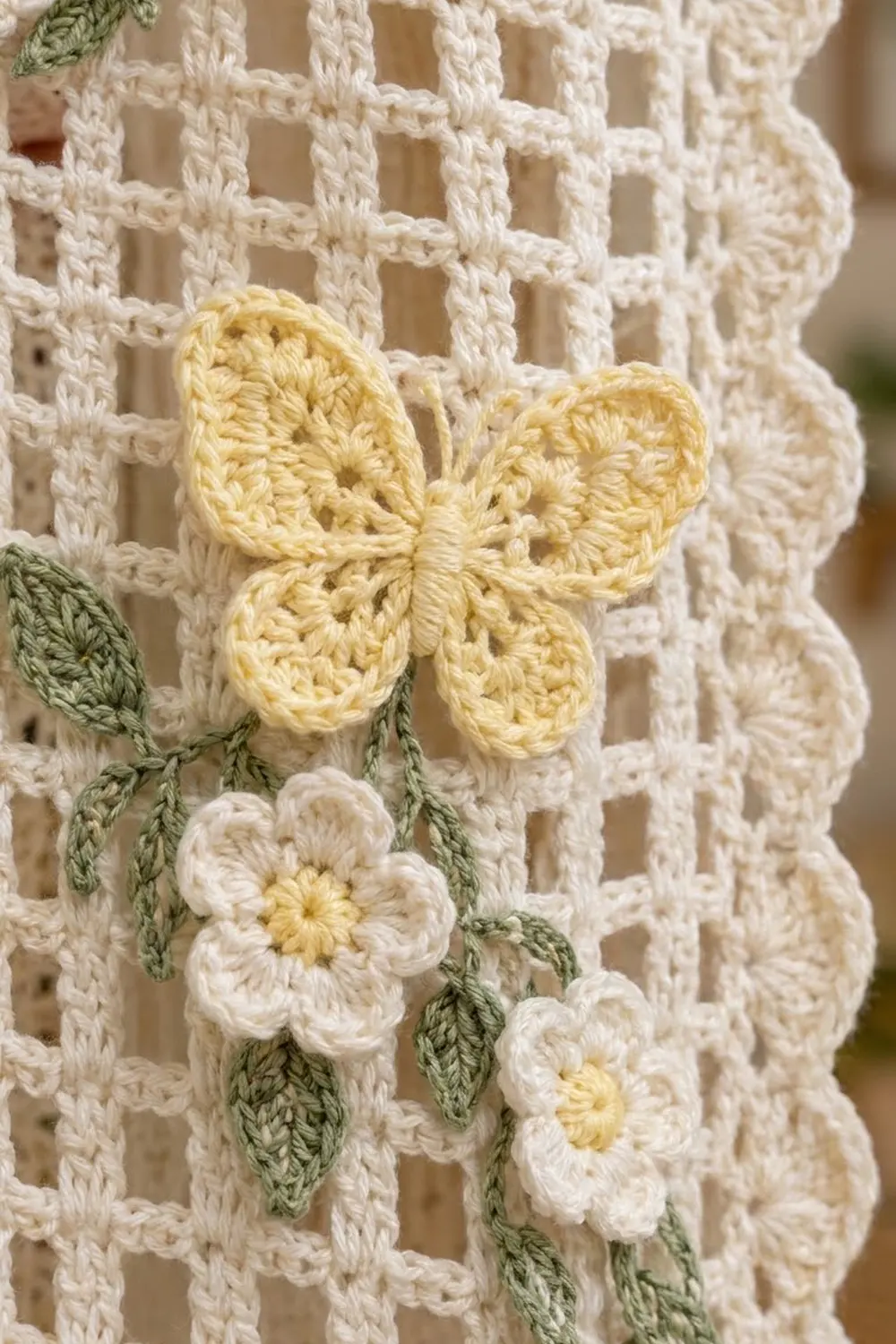
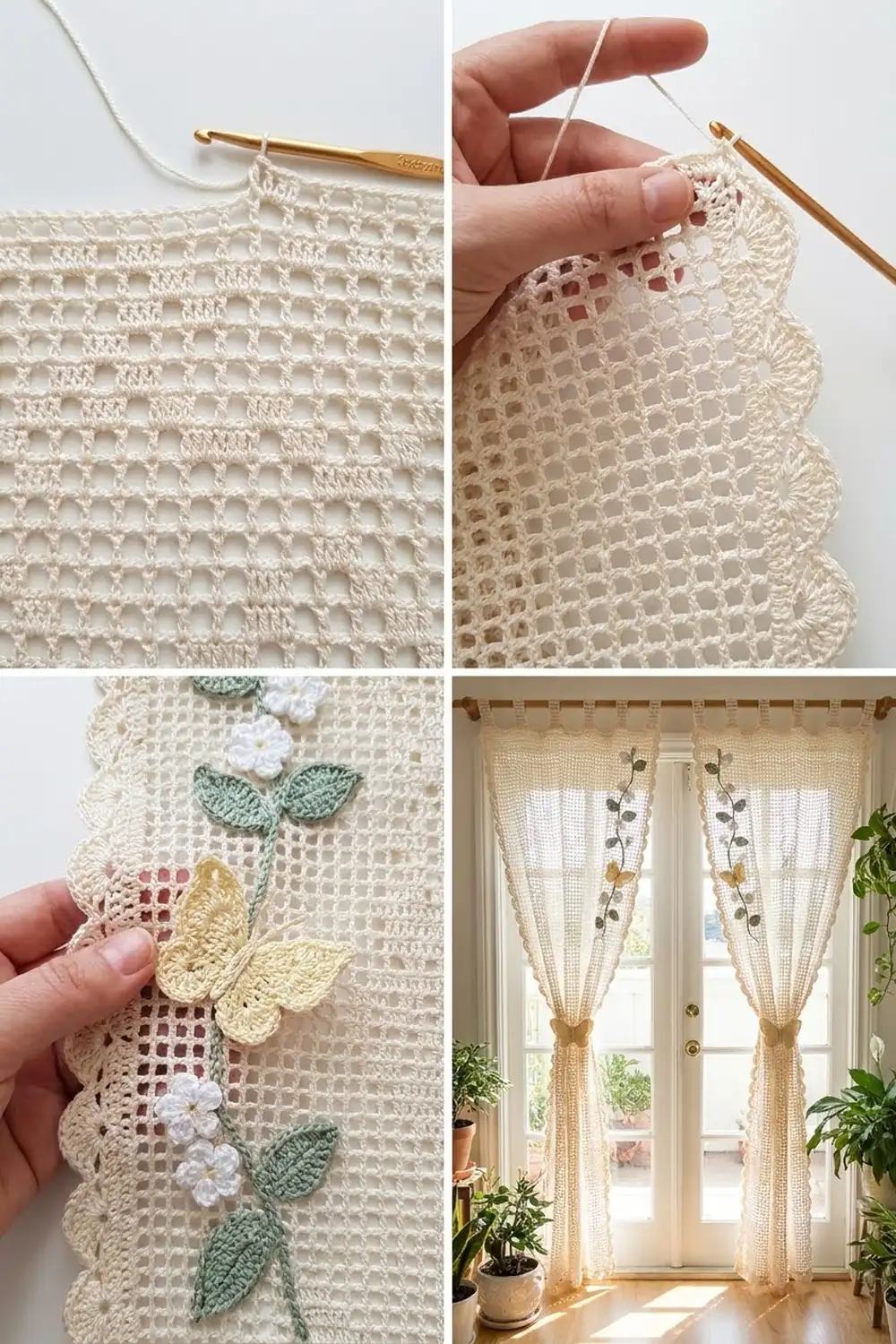
This filet curtain panel is light and airy. It pairs an open cream mesh with a soft scalloped border and a trailing vine of sewn-on butterflies, flowers and leaves. Sunlight comes through the square mesh, and the appliqués add just enough color to look like a spring meadow climbing up your window.
The colors are gentle. Cream is used for the mesh, border and tabs, pale yellow for the butterflies and flower centers, bright white for the petals, and sage green for the leaves and stems. The style is romantic cottage, but the construction is simple filet.
This pattern uses US crochet terms. One finished panel measures 28.5 in (72.4 cm) wide and 78 in (198.1 cm) long from the bottom scallops to the top edge. The tab loops add 3.5 in (8.9 cm), so the panel hangs about 81.5 in (207.0 cm) below the rod.
Each panel is one single piece: a rectangular mesh body, a shell border on three sides, a top edge row and six tabs. The appliqués are made separately and sewn on. For a pair, make two panels and mirror the appliqué placement.
Finished Size and Construction
- Finished panel size: 28.5 in x 78 in (72.4 cm x 198.1 cm), plus 3.5 in (8.9 cm) tab loops
- Skill level: Easy-Intermediate
- Terminology: US
- Yarn weight: DK (light worsted) cotton, category 3
- Hook: 4.0 mm (G-6)
- Number of pieces: 1 mesh panel per curtain, plus separate appliqués and 1 tieback
- Layout: 52 mesh squares wide x 153 rows tall
- Mesh body size (before border): 26 in x 76.5 in (66.0 cm x 194.3 cm)
- Border depth: 1.25 in (3.2 cm) on the sides and bottom
Materials
Choose a smooth mercerized or combed DK cotton, about 120 m per 50 g. Cotton keeps the square mesh crisp and drapes well when hung. Avoid fuzzy or very stretchy yarns, because they blur the holes and stretch badly in length.
Per panel (double these for a pair):
- Cream: 650 g (1,560 m) for the mesh, border, top edge, tabs and tieback
- Pale yellow: 60 g (144 m) for the butterflies and flower centers
- Bright white: 40 g (96 m) for the flower petals
- Sage green: 60 g (144 m) for the leaves and vine stems
All quantities include a margin of about 15% for swatching and tension differences.
Tools:
- 4.0 mm (G-6) crochet hook
- Tapestry needle
- Stitch markers (at least 10)
- Measuring tape
- Rustproof pins and a large flat surface
- Spray bottle
Abbreviations (US Terms)
- ch – chain
- sl st – slip stitch
- sc – single crochet
- hdc – half double crochet
- dc – double crochet
- tr – treble crochet
- sk – skip
- sp – space
- st(s) – stitch(es)
- RS – right side
Mesh square: one dc plus the ch-2 space beside it. A row of 52 squares has 53 dc (the turning chain counts as the first dc) and 52 ch-2 spaces.
Shell: 9 dc worked into one stitch.
Gauge and Checkpoints
Mesh gauge: 10 squares and 10 rows = 5 in (12.7 cm). Each square is 0.5 in (1.3 cm) wide and tall.
Border gauge: 6 sc = 1 in (2.5 cm).
Test first. Chain 41 and work 12 squares for 12 rows using the pattern below, then measure 10 squares and 10 rows in the center. If 10 squares measure more than 5 in (12.7 cm), go down a hook size. If they measure less, go up a size. Row height matters as much as width, because 153 rows multiply any error.
Checkpoints:
- After Row 1: width 26 in (66.0 cm)
- After Row 20: length 10 in (25.4 cm)
- After Row 80: length 40 in (101.6 cm)
- After Row 153: 26 in x 76.5 in (66.0 cm x 194.3 cm)
- After the border and top edge: 28.5 in x 78 in (72.4 cm x 198.1 cm)
While you work, measure the panel lying flat, not hanging.
Mesh Body
With cream, ch 161.
Row 1 (RS): Dc in the 8th ch from hook (the skipped chs count as dc, ch 2 and 2 skipped base chs), *ch 2, sk 2 ch, dc in next ch; rep from * across. (52 squares: 53 dc, 52 ch-2 sps)
Chain check: 7 skipped + 1 dc + 51 repeats x 3 chs = 161.
Row 2: Ch 5 (counts as dc and ch 2), turn, sk first ch-2 sp, dc in next dc, *ch 2, dc in next dc; rep from * across, working the last dc in the 3rd ch of the turning chain. (52 squares)
Rows 3–153: Rep Row 2. (52 squares each row)
Fasten off.
Border (Sides and Bottom)
The border runs down the left side, across the bottom and up the right side. You work it in rows, not rounds, because the top edge is finished separately.
Row 1 (RS): Join cream at the top left corner (side of Row 153) and ch 1.
- Down the left side, work 3 sc in each row end (459 sc).
- Work 3 sc in the bottom left corner.
- Along the foundation chain, work 1 sc in the base of each dc and 2 sc in each ch-2 sp (157 sc).
- Work 3 sc in the bottom right corner.
- Up the right side, work 3 sc in each row end (459 sc).
Total: 459 + 3 + 157 + 3 + 459 = 1,081 sc. Place a marker in the center sc of each corner group.
Row 2: Ch 1, turn, sc in first sc, *sk 3, 9 dc in next sc, sk 3, sc in next sc; rep from * across. When a shell falls on a marked corner sc, work 11 dc instead of 9.
Count: 136 sc and 135 shells. That is 57 shells on each side, 1 corner shell at each bottom corner and 19 shells across the bottom. The total is 1,355 sts (136 sc + 133 x 9 dc + 2 x 11 dc).
Row 3: Ch 1, turn, sl st in first sc, *sc in each dc of the shell, sl st in next sc; rep from * across. (1,355 sts)
Fasten off.
Why the math works: Each shell repeat uses 8 sts, so a row of 8 x 135 + 1 = 1,081 sts starts and ends on a sc. The corner centers are stitch 461 (459 + 2) and stitch 621 (459 + 3 + 157 + 2). Both leave a remainder of 5 when divided by 8, which is exactly where every shell lands. The 153-row length and 52-square width were chosen so that a shell always falls on each corner. At 6 sc per inch, 459 sc = 76.5 in and 157 sc ≈ 26 in, so the border lies flat.
Top Edge and Tabs
Top Edge Row: With RS facing, join cream at the top right corner of the border and ch 1. Work 7 sc evenly across the 3 border row ends. Across Row 153, work 1 sc in each dc and 2 sc in each ch-2 sp (157 sc). Then work 7 sc across the other border end. (171 sc) Do not fasten off.
At 6 sc per inch, 171 sc = 28.5 in (72.4 cm), which matches the width with the border.
Tabs (make 6): The tabs sit on sts 1–16, 32–47, 63–78, 94–109, 125–140 and 156–171, with 15-st gaps between them.
- Row 1: Ch 1, turn, sc in each of the 16 tab sts. (16 sc)
- Rows 2–28: Ch 1, turn, sc in each sc. (16 sc)
Fasten off with a 12 in (30.5 cm) tail. Fold the tab to the wrong side and whipstitch Row 28 to the back of the same 16 top-edge sts. Each tab is 2.7 in (6.9 cm) wide and 7 in (17.8 cm) long, which makes a 3.5 in (8.9 cm) loop. Rejoin at the start of the next tab and repeat.
Appliqués
Butterfly (pale yellow)
Make a magic ring.
Rnd 1: Ch 3 (counts as dc), 15 dc in ring, sl st to top of ch-3. (16 dc) Pull the ring closed, leaving a small open center.
Rnd 2 (wings): Each wing uses 4 sts.
- Upper wing: (Ch 3, 2 dc) in next st, 3 tr in each of next 2 sts, (2 dc, ch 3, sl st) in next st. (11 sts)
- Lower wing: (Ch 2, dc) in next st, 2 dc in each of next 2 sts, (dc, ch 2, sl st) in next st. (7 sts)
Work an upper wing, a lower wing, a lower wing and an upper wing. Fasten off.
Body: Lay the butterfly flat with the upper wings at the top. Wrap pale yellow 10 times vertically around the center so the left wings pinch away from the right wings. Knot at the top and trim both ends to 0.75 in (1.9 cm) for antennae. Knot each tip. The finished butterfly is about 3 in (7.6 cm) wide.
Flower (pale yellow and white)
Rnd 1: With pale yellow, make a magic ring, ch 1, 10 sc in ring, sl st to first sc. (10 sc) Fasten off.
Rnd 2: Join white in any sc, *(hdc, 2 dc, hdc) in next sc, sl st in next sc; rep from * 4 more times. (5 petals) Fasten off. The flower is about 1.75 in (4.4 cm) across.
Leaf (sage green)
Ch 8. Sc in 2nd ch from hook, hdc, dc in each of next 3 chs, hdc, 3 sc in last ch. Working along the other side of the chain: hdc, dc in each of next 3 chs, hdc, sc, sl st in first sc. Fasten off. The leaf is about 1.5 in (3.8 cm) long.
Vine Stem (sage green)
Ch 61. Sl st in the back bump of the 2nd ch from hook and each ch across. (60 sl st) The stem is about 10 in (25.4 cm) long.
Tieback (cream)
Ch 91.
- Row 1: Sc in 2nd ch from hook and each ch across. (90 sc)
- Rows 2–4: Ch 1, turn, sc in each sc. (90 sc)
At each short end, ch 14 and sl st to the same corner to form a hanging loop. The finished tieback measures 15 in x 1 in (38.1 cm x 2.5 cm). Sew 1 butterfly to the center.
Make All Pieces
| Piece | Color | Per panel | Per pair |
|---|---|---|---|
| Butterfly | Pale yellow | 7 (6 on panel + 1 on tieback) | 14 |
| Flower | Yellow + white | 10 | 20 |
| Leaf | Sage green | 24 | 48 |
| Vine stem | Sage green | 6 | 12 |
| Tieback | Cream | 1 | 2 |
Layout (left panel, viewed from the RS; rows counted from the bottom):
Top edge / tabs
Row 141  [ . . . . . . . . . . | V B F F L L L L ]  inner edge
Row 117  [ . . . . . . . . . . | V F B L L L L   ]  inner edge
Row 93   [ . . . . . . . . . . | V B F F L L L L ]  inner edge
Row 69   [ . . . . . . . . . . | V F B L L L L   ]  inner edge
Row 45   [ . . . . . . . . . . | V B F F L L L L ]  inner edge
Row 21   [ . . . . . . . . . . | V F B L L L L   ]  inner edge
Bottom border
V = vine stem  B = butterfly  F = flower  L = leaf
Each cluster sits in squares 4–9, counted from the inner side border. The clusters are 24 rows (12 in / 30.5 cm) apart. Three clusters have 2 flowers and three have 1 flower, for 9 flowers on the vine. Sew the 10th flower beside the top butterfly. For the right panel, mirror everything to its inner (left) edge.
Attaching the Appliqués
Method: Whipstitch with matching yarn. Go through the back loops of the appliqué edge and around the dc posts or chain bars of the mesh.
Stitch logic: Sew each vine stem first, in a gentle S-curve that moves 4 squares sideways over about 20 rows. Tack it every 0.5 in (1.3 cm) so each stitch lands on one mesh bar. Then add the leaves in pairs along the stem, the flowers at the stem tips and the butterfly beside the top of each stem. Anchor each butterfly only through its wrapped body and at each wing tip, so the wings lift slightly.
Tension: Keep your stitches snug but not tight. If the mesh squares under an appliqué pucker or shrink, loosen the stitches.
Size checkpoint: After sewing each cluster, lay the panel flat. The width at that height must still measure 28.5 in (72.4 cm).
Final Blocking
- Weave in all ends along dc posts so they disappear into the mesh.
- Lay the panel flat on towels or blocking mats, RS up.
- Spray evenly until damp but not dripping.
- Pin the corners to 28.5 in x 78 in (72.4 cm x 198.1 cm).
- Pin the sides every 6 in (15.2 cm), keeping the mesh rows straight.
- Pin the point of every shell along the border.
- Pat the appliqués flat and shape the butterfly wings.
- Let the panel dry completely, about 24 hours.
- Hang the panel for another 24 hours and measure again. Cotton mesh may drop 1–2 in (2.5–5.1 cm).
Final Quality-Control Checklist
- 52 squares per row and 153 rows, with all squares open and even
- Border Row 1 has 1,081 sc, and the corners land on 11-dc shells
- 57 shells per side and 19 across the bottom
- Top edge row has 171 sc
- Six tabs, each 16 sts wide, with five 15-st gaps
- Six clusters per panel, mirrored between the left and right panels
- Panel lies flat at 28.5 in x 78 in (72.4 cm x 198.1 cm)
Troubleshooting
Squares are taller than wide: Your dc are loose. Pull up less yarn on each dc, or replace the ch 5 with ch 4 if only the edge squares look tall.
Panel narrows toward the top: You are missing the last dc into the turning chain. Count 53 dc every 10 rows.
Border ruffles: You have too many sc per row end. Keep exactly 3.
Border pulls in: Go up a hook size for the border only.
Corner shells don’t land on the corners: Recount Row 1. It must total 1,081 sc.
Panel sags under the appliqués: Spread the sewing across more mesh bars and avoid heavy clusters.
Care
Hand wash in cool water with mild detergent, roll in a towel to remove the water and dry flat. Re-block if the mesh has stretched.
Final Notes
The measurements build on each other:
- 0.5 in (1.3 cm) squares give a 26 in x 76.5 in (66.0 cm x 194.3 cm) mesh body.
- 3 sc per row end and 157 sc along the bottom give a 1,081-st border row that fits 135 shells exactly.
- The 1.25 in (3.2 cm) border brings the panel to 28.5 in x 78 in (72.4 cm x 198.1 cm).
- 171 sc across the top divide neatly into six tabs.
Check your gauge, count your border, and enjoy watching your butterflies climb toward the light.
Happy crocheting!