

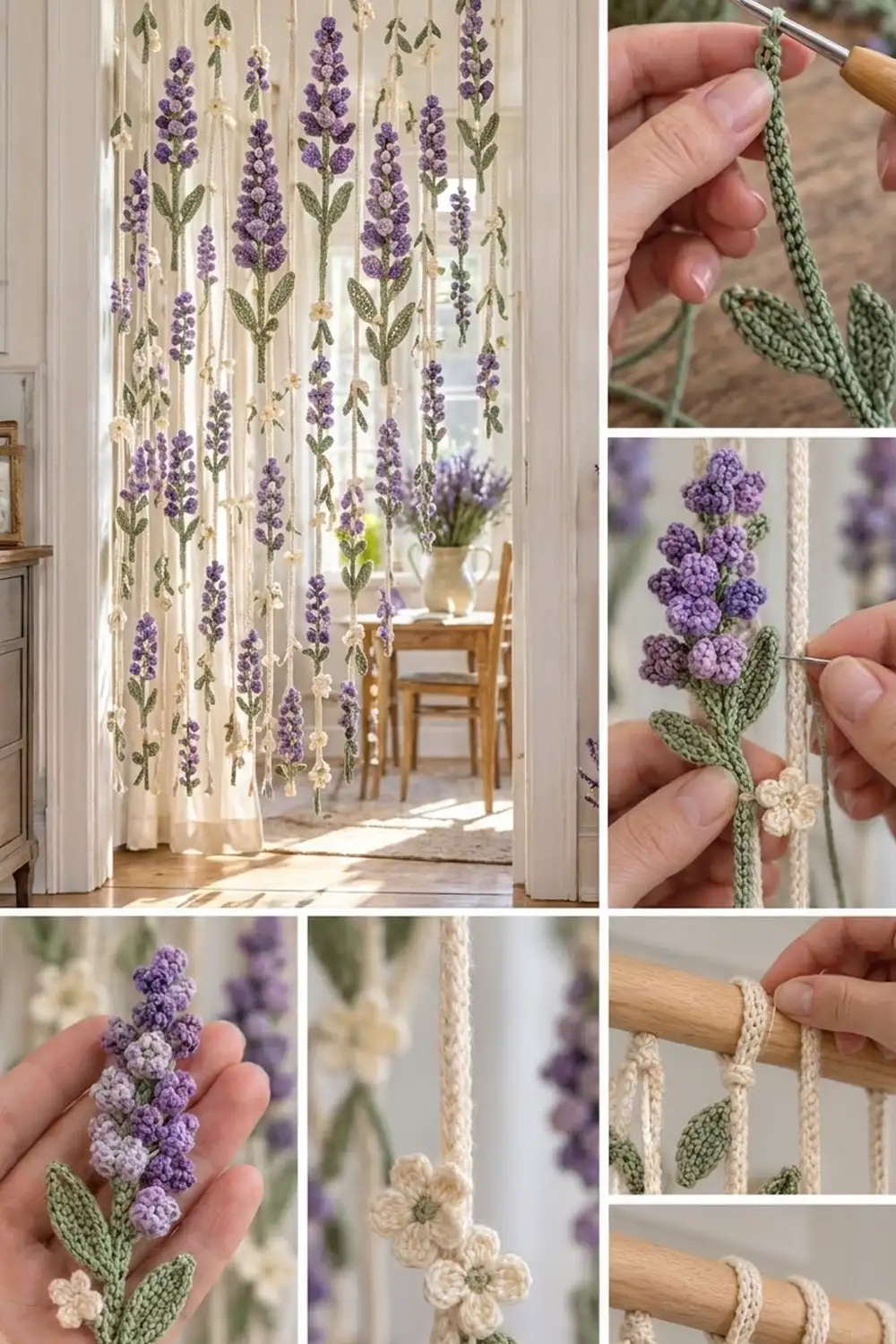
This curtain turns a plain doorway into a soft wall of lavender. Fourteen cream crochet cords hang from a wooden dowel, and each cord carries four lavender sprigs and six tiny cream flowers, staggered so the blooms seem to drift down the opening.
Each sprig has a sage-green stem, two pointed leaves with a center line, and a spike of bobble florets in three purples: plum, lavender, and pale lilac. The small five-petal flowers have a sage center and sit at the base of each sprig and along the bare stretches of cord. The look is cottage and farmhouse, light and airy, with daylight coming through between the strands.
The pattern uses US crochet terms. The finished curtain is 32.5 in (82.6 cm) wide from the first cord to the last, about 34.5 in (87.6 cm) across including the leaves, and hangs 78 in (198.1 cm) from the top of the dowel.
Construction is simple and repetitive. You make each cord as a chain with a hanging loop and slip stitch back along it. Each sprig is one green piece (stem plus two leaves) with purple bobbles worked straight onto the stem. You make the flowers separately, sew everything onto the cords following a layout grid, and slide the loops onto the dowel.
Finished Size and Construction
- Finished size: 32.5 in (82.6 cm) cord span x 78 in (198.1 cm) drop
- Skill level: Easy-Intermediate (easy stitches, lots of repeats)
- Terminology: US crochet terms
- Yarn weight: Worsted (#4), cotton or cotton blend
- Hook: 4.5 mm (US 7)
- Number of pieces: 154 (14 cords, 56 sprigs, 84 flowers)
- Layout: 14 vertical cords, 2.5 in (6.4 cm) apart on a 36 in (91.4 cm) dowel
- Piece sizes: cord 76 in (193.0 cm) plus a 5 in (12.7 cm) loop; sprig 6 in (15.2 cm) long x 3.5 in (8.9 cm) wide at the leaves; flower 1.5 in (3.8 cm) across
- Size before border: 32.5 in x 78 in (82.6 cm x 198.1 cm)
- Border depth: 0 in (0 cm). There’s no crocheted border. The top edge is finished with loops and wraps (see Border).
Materials
Pick a smooth, mercerized or combed worsted cotton with about 190 m per 100 g. Cotton keeps the cords from stretching under their own weight, and the bobbles and leaf edges come out crisp. Acrylic works, but it stretches more over a long drop.
- Cream (cords, petals): 220 g / 418 m
- Sage (stems, leaves, flower centers): 130 g / 247 m
- Lavender (medium purple, bobble Side A): 70 g / 133 m
- Plum (dark purple, bobble Side B): 70 g / 133 m
- Lilac (pale purple, crown bobbles): 40 g / 76 m
All quantities include a margin of about 15% for tails, swatching, and tension differences.
Tools:
- 4.5 mm (US 7) crochet hook
- Wooden dowel, 36 in (91.4 cm) long and 1 in (2.5 cm) thick, plus two brackets or hooks
- Tapestry needle
- Scissors
- Locking stitch markers (at least 10)
- Tape measure
- Blocking mats, rust-proof pins, and a spray bottle
Abbreviations (US Terms)
- ch – chain
- sl st – slip stitch
- sc – single crochet
- hdc – half double crochet
- dc – double crochet
- MR – magic ring
- st(s) – stitch(es)
- rep – repeat
- FLO / BLO – front loop only / back loop only
Bobble (bob): *Yarn over, insert hook in the stitch, yarn over and pull up a loop, yarn over and pull through 2 loops; rep from * 3 more times in the same stitch (5 loops on hook), yarn over and pull through all 5 loops. Each bobble is about 0.4 in (1.0 cm) across.
Back bump: The bar on the back of a chain. Working into it gives a neat, round cord.
Gauge and Checkpoints
Make one complete sprig and one flower first, then measure.
- Chain gauge: 4 ch = 1 in (2.5 cm). Slip stitching back along the chain keeps the same length.
- Sprig stem: 24 sl st = 6 in (15.2 cm).
- Leaf: 2 in (5.1 cm) long x 0.9 in (2.3 cm) wide.
- Bobble spike: 3 in (7.6 cm) long x about 1.5 in (3.8 cm) wide.
- Flower: 1.5 in (3.8 cm) across.
If it’s too big: Go down to a 4.0 mm hook. Long chains especially tend to grow if your chain tension is loose.
If it’s too small: Go up to a 5.0 mm hook. If only the cord is short, add or remove chains in multiples of 4 (1 in / 2.5 cm each) and keep the layout grid as written.
Measure the cord along a table, flat but not stretched. Then hang it for 10 minutes and measure again. A cotton cord should grow no more than 1 in (2.5 cm).
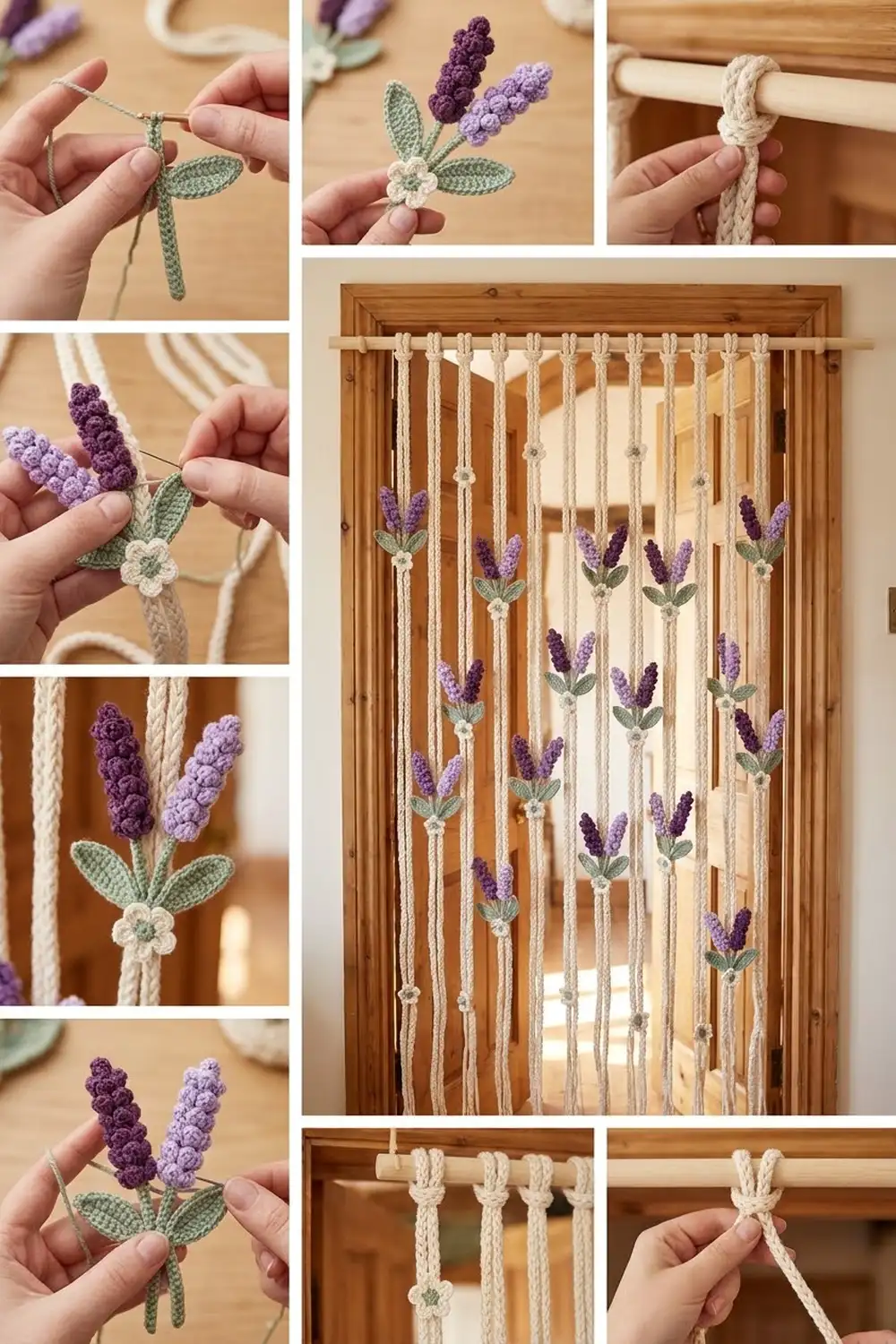
Cord (make 14, Cream)
Hanging loop: Ch 20, sl st in the first ch to form a ring. That’s 20 ch, a loop 5 in (12.7 cm) around, which slides easily over a 1 in (2.5 cm) dowel.
Cord chain: Ch 304 from the join, about 76 in (193.0 cm). Place a marker every 40 ch so you can count quickly.
Row 1: Sl st in the back bump of the 2nd ch from the hook and each of the next 302 ch. That’s 303 sl st, which brings you back to the ring.
Loop finish: Sl st in the back bump of each of the 20 ring chains, then sl st into the base of the ring. That’s 323 sl st total (303 on the cord + 20 on the loop).
Wrap: Fasten off with a 20 in (50.8 cm) tail. Wrap the tail tightly around the cord just below the loop 6 times to make a 0.5 in (1.3 cm) collar, then pass the needle up through the wraps twice and trim.
Checkpoint: Measured from the bottom of the wrap, the cord is 76 in (193.0 cm), with a 5 in (12.7 cm) loop above the wrap.
Lavender Sprig (make 56)
The sprig is worked from the tip down to the base. Stitch 1 is the tip, and stitch 24 is the base.
Stem and Leaves (Sage)
Foundation: Ch 25.
Spike zone: Sl st in the back bump of the 2nd ch from the hook and each of the next 11 ch. That’s 12 sl st (sts 1–12).
Stem: Sl st in the back bump of the next 4 ch (sts 13–16).
Leaf 1: Ch 8.
– Side 1: Working into the front loop of the leaf chain: sl st in the 2nd ch from the hook, sc, hdc, dc, dc, hdc, sc in the last ch (7 sts, ending at the stem).
– Side 2: Rotate. Working into the remaining top loop of the same 7 ch: sc, hdc, dc, dc, hdc, sc, sl st (7 sts, ending at the tip). Sl st in the tip ch.
– Vein: Sl st in the back bump of each of the 7 leaf ch, working back toward the stem (7 sl st). This makes a raised vein on the back and pulls the center line tight on the front.
– Sl st in the last stem st worked. The leaf points to the left.
Stem: Sl st in the back bump of the next 4 ch (sts 17–20).
Leaf 2: Turn the stem over so the new leaf points to the right. Work it the same as Leaf 1.
Stem: Sl st in the back bump of the last 4 ch (sts 21–24). Fasten off with a 12 in (30.5 cm) tail for sewing.
Checkpoint: 24 stem sts measuring 6 in (15.2 cm). The leaves sit 4 in (10.2 cm) and 5 in (12.7 cm) from the tip, on opposite sides.
Bobble Spike (three purples)
Crown (Lilac): Join with a sl st in st 1 (the tip). [Bob, ch 1] 3 times in the same st. That’s 3 bobbles. Fasten off.
Side A (Lavender): Hold the stem with the front loops facing you. Join with a sl st in the FLO of st 2, then bob in the FLO of the same st. *Sl st in the FLO of the next st, bob in the FLO of the next st; rep from * 4 more times. That’s 6 bobbles (in sts 2, 4, 6, 8, 10, and 12) and 5 sl st. Fasten off.
Side B (Plum): Turn the sprig over. Join in the BLO of st 2 and work as for Side A into the back loops. That’s 6 bobbles and 5 sl st. Fasten off.
Spike total: 15 bobbles (3 + 6 + 6). Because the bobbles on the two sides are worked in the same stitches, they pair up and form a full, rounded spike.
Checkpoint: The spike is 3 in (7.6 cm) long and about 1.5 in (3.8 cm) wide. For a natural mixed look, swap Lavender and Plum between sides on every other sprig. Weave in the purple tails along the stem, inside the bobbles.
Small Flower (make 84)
Rnd 1 (Sage): 5 sc in MR, pull the ring closed, join with a sl st to the first sc. That’s 5 sc. Fasten off.
Rnd 2 (Cream): Join with a sl st in any sc. *(Ch 2, 2 dc, ch 2, sl st) in the same sc, sl st in the next sc; rep from * 4 more times, working the last sl st into the joining st. That’s 5 petals (10 dc total). Fasten off with a 10 in (25.4 cm) tail.
Checkpoint: 1.5 in (3.8 cm) across, with a green center about 0.4 in (1.0 cm) wide.
Make All Pieces
| Piece | Quantity | Colors |
|---|---|---|
| Cord | 14 | Cream |
| Sprig | 56 (4 per cord) | Sage, Lilac, Lavender, Plum |
| Flower | 84 (6 per cord) | Sage, Cream |
The cords alternate between Layout A (odd cords) and Layout B (even cords). Positions are measured down from the bottom of the wrap. A sprig “at 4 in” has its tip at 4 in and its base 6 in lower, at 10 in.
Cord:   1  2  3  4  5  6  7  8  9 10 11 12 13 14
Layout: A  B  A  B  A  B  A  B  A  B  A  B  A  B
Layout A (cords 1, 3, 5, 7, 9, 11, 13):
– Sprig tips at 4, 22, 40, and 58 in (10.2, 55.9, 101.6, 147.3 cm)
– Base flowers at 10, 28, 46, and 64 in (25.4, 71.1, 116.8, 162.6 cm)
– Spacer flowers at 16 and 52 in (40.6, 132.1 cm)
Layout B (cords 2, 4, 6, 8, 10, 12, 14):
– Sprig tips at 13, 31, 49, and 67 in (33.0, 78.7, 124.5, 170.2 cm)
– Base flowers at 19, 37, 55, and 73 in (48.3, 94.0, 139.7, 185.4 cm)
– Spacer flowers at 25 and 61 in (63.5, 154.9 cm)
Within each layout, sprigs repeat every 18 in (45.7 cm), and B sits 9 in (22.9 cm) lower than A. That offset gives the diagonal, scattered look across the doorway. Each cord has 4 + 2 = 6 flowers, and 14 x 6 = 84 flowers.
Joining
Method: Whipstitch tacks with the sprig’s Sage tail, then a Cream flower sewn over the base.
Stitch-to-stitch logic: The cord and the stem share the same gauge of 4 sts per inch, so one stem stitch lines up with one cord stitch. A sprig tip at 4 in sits on cord st 16, counting down from the wrap.
1. Lay the cord flat and mark the sprig’s tip and base positions from the grid.
2. Lay the stem along the front of the cord, tip up.
3. Tack stem sts 6, 12, 18, and 24 to the cord, 6 cord sts apart: 4 tacks, each 1.5 in (3.8 cm) apart.
4. At st 24, wrap the Sage tail around the cord twice and knot it on the back.
5. Center a flower over the base so it covers the knot. Sew through its center and each petal tip with the Cream tail.
6. Sew spacer flowers through the center and 2 petals.
Tension: Make each tack snug but not tight. If you pull the tacks, the cord puckers and gets shorter. Before you knot, check that the 6 in (15.2 cm) section of cord under the stem still measures 6 in.
Hanging: Slide the loops onto the dowel in order, 1 to 14, with the wraps facing front. Leave 1.75 in (4.4 cm) of dowel at each end and space the cords 2.5 in (6.4 cm) apart, center to center.
Size checkpoint: 32.5 in (82.6 cm) from cord 1 to cord 14, and 78 in (198.1 cm) from the top of the dowel to the end of the cords.
Border
This design has no crocheted border. The loops and wraps along the dowel act as the finished top edge, and the cord ends are the finished bottom edge.
Border gauge (spacing): 1 cord every 2.5 in (6.4 cm).
- Top edge: 14 loops of 20 ch each, with 14 wraps of 6 turns.
- Side margins: 1.75 in (4.4 cm) of bare dowel at each end.
- Bottom edge: 14 cord ends. Weave each tail 2 in (5.1 cm) up into its cord.
Why the math works: 14 cords create 13 gaps, and 13 x 2.5 in = 32.5 in (82.6 cm). Adding the two margins gives 32.5 + 1.75 + 1.75 = 36 in (91.4 cm), exactly the length of the dowel. For the drop, the 76 in (193.0 cm) cord plus about 2 in (5.1 cm) of loop and wrap gives 78 in (198.1 cm). The last Layout B base flower sits at 73 in, which leaves 3 in (7.6 cm) of bare cord at the bottom.
Final Blocking
- Before sewing, mist the sprigs and flowers lightly.
- Pin each leaf to a point at the tip, 2 in (5.1 cm) long.
- Pinch each bobble spike round and lay it straight along a 3 in (7.6 cm) line.
- Pin the flower petals out to 1.5 in (3.8 cm) across.
- Let everything dry completely.
- After joining, hang the curtain and mist the cords. Let them hang for 24 hours so they settle and straighten.
- Measure the drop again and adjust any loop wraps if the cords sit unevenly.
Final Quality-Control Checklist
- [ ] 14 cords, each 76 in (193.0 cm) below the wrap
- [ ] 56 sprigs, each with 24 stem sts, 2 leaves, and 15 bobbles
- [ ] 84 flowers, each with 5 petals, 1.5 in (3.8 cm) across
- [ ] Layouts alternate A, B, A, B across the dowel
- [ ] Every sprig base is covered by a flower
- [ ] Cords evenly spaced at 2.5 in (6.4 cm)
- [ ] All tails woven in, none visible from the back
- [ ] Bottom ends level within 0.5 in (1.3 cm)
Troubleshooting
Cords are different lengths: Chain tension varies. Count the chains with markers every 40, and hang all the cords together before sewing anything on.
Cord twists: Make sure you’re working into the back bump every time. Hanging the cord with a little weight on the end, such as a clothespin, also helps.
Leaves curl: Your vein sl sts are too tight. Work them loosely, or block the leaves flat.
Spike looks thin: Check that both sides have 6 bobbles and that Side B went into the back loops, not the same front loops.
Flowers cup: Your magic ring is too small. Use exactly 5 sc and pull the ring closed gently.
Curtain hangs crooked: Even out the spacing on the dowel and check the wraps.
Care
Hand wash in cool water with mild soap, press out the water in a towel, and dry flat, then rehang. Dust between washes with a cool hair dryer or a gentle shake.
Final Notes
Every measurement depends on the previous one. Get 4 ch = 1 in (2.5 cm) and you get a 6 in (15.2 cm) stem and a 76 in (193.0 cm) cord. The cord plus loop gives a 78 in (198.1 cm) drop. Fourteen cords at 2.5 in (6.4 cm) span 32.5 in (82.6 cm) on a 36 in (91.4 cm) dowel. Check your gauge once and the rest of the curtain follows.
Happy crocheting!