

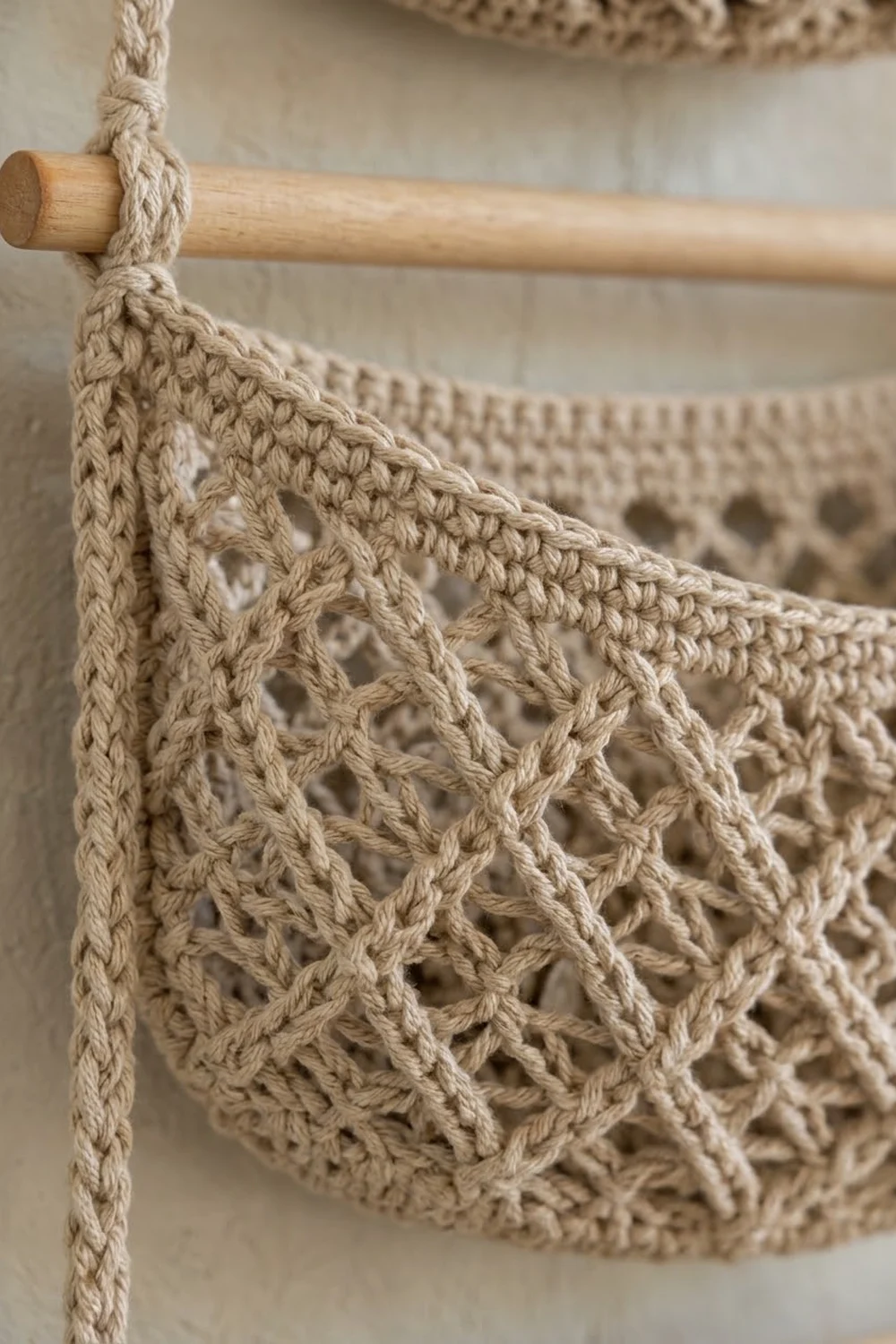
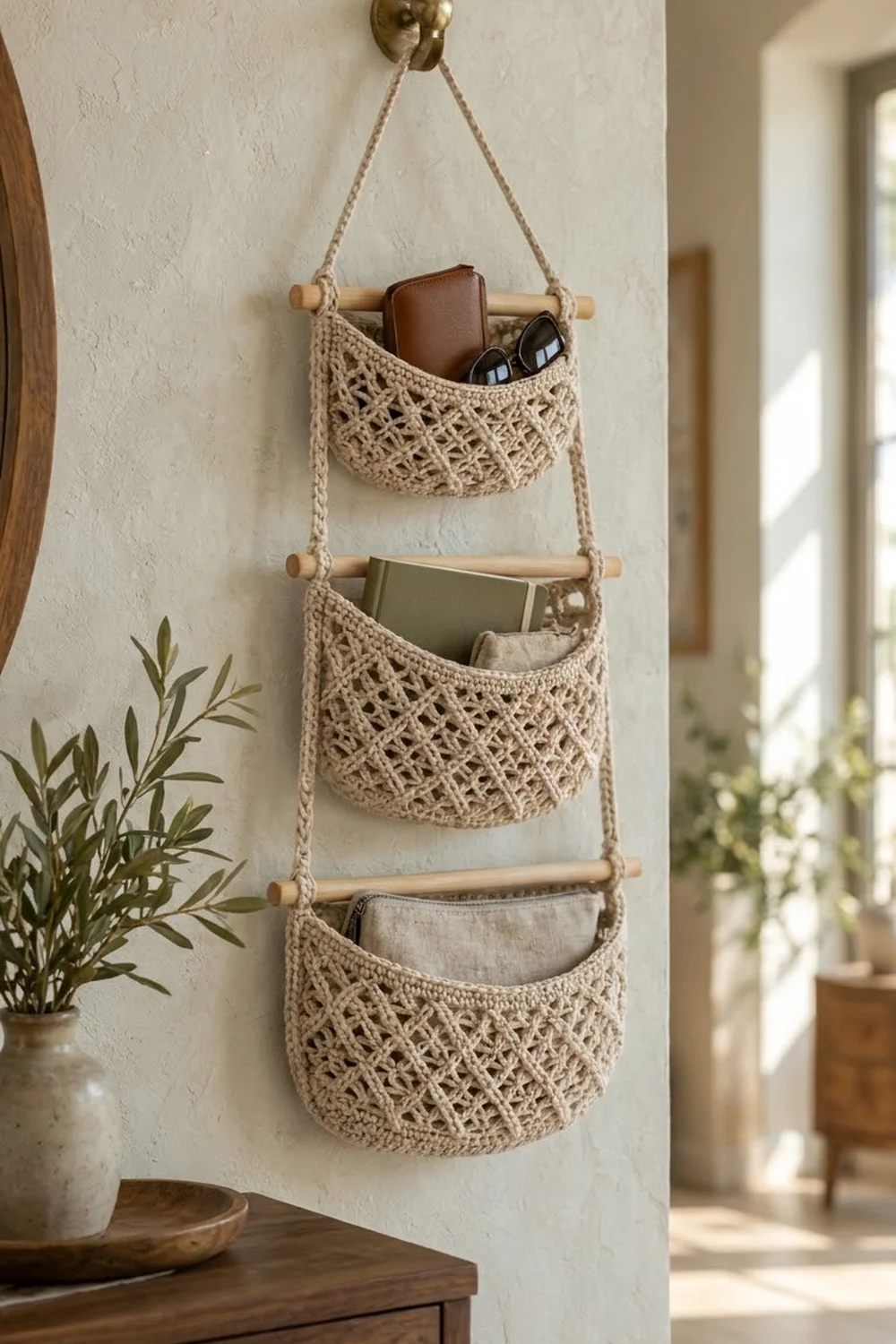
This three-tier hanging organizer is made of three crochet pockets in graduated sizes, three plain wooden dowels and one long braided cord. Each pocket has a solid single crochet base, open lattice sides with a diagonal diamond pattern and a firm solid rim. The whole piece hangs from one loop on a single wall hook.
The organizer uses only one natural oatmeal cotton, so the texture carries the design. It has a calm, slightly coastal look and suits an entryway, a desk wall or a bathroom. The pockets are deep enough for a wallet and sunglasses, a notebook or a zip pouch.
The pattern uses US crochet terms. The finished organizer is 14 in (35.6 cm) wide at the bottom dowel and 30.25 in (76.8 cm) tall from the hanging loop to the bottom of the largest pocket. Laid flat, the pockets measure 7 in (17.8 cm), 9 in (22.9 cm) and 11 in (27.9 cm) wide.
The construction is simple. Each pocket starts as a flat oval base. A back-loop round turns the sides upward, a trellis mesh forms the walls, and the pocket finishes with a solid rim band and a folded dowel casing across the back half. A Romanian cord is then knotted onto the dowel ends to link the three tiers.
Finished Size and Construction
- Finished size: 14 in (35.6 cm) wide x 30.25 in (76.8 cm) tall
- Skill level: Intermediate
- Terminology: US
- Yarn weight: Worsted (#4) cotton or 3 mm cotton string
- Hook: 4.5 mm (US 7)
- Number of pieces: 3 pockets (Small, Medium, Large) + 1 cord + 3 dowels
- Layout: 1 column of 3 tiers, smallest on top
- Pocket size (flat width x height): Small 7 x 5.75 in (17.8 x 14.6 cm); Medium 9 x 6.5 in (22.9 x 16.5 cm); Large 11 x 7.25 in (27.9 x 18.4 cm)
- Pocket height before rim: Small 4.75 in (12.1 cm); Medium 5.5 in (14.0 cm); Large 6.25 in (15.9 cm)
- Rim (border) depth: 1 in (2.5 cm)
Materials
Choose a smooth, firm cotton that shows stitches clearly. Cotton holds the mesh open and stretches very little under weight. Avoid soft acrylic blends, which let the pockets sag.
- Natural oatmeal cotton: 300 g, about 450 m (492 yd) total
- Small pocket: 50 g, about 75 m
- Medium pocket: 70 g, about 105 m
- Large pocket: 95 g, about 143 m
- Cord: 30 g, about 45 m
These quantities include a margin of about 20 percent for swatching and differences in tension.
Tools:
- 4.5 mm (US 7) crochet hook
- 3 wooden dowels, 3/8 in (1.0 cm) diameter: 10 in (25.4 cm), 12 in (30.5 cm) and 14 in (35.6 cm) long
- 4 locking stitch markers
- Tapestry needle
- Scissors and measuring tape
- Wall hook rated for at least 5 lb (2.3 kg)
Abbreviations (US Terms)
- ch – chain
- sc – single crochet
- sl st – slip stitch
- st(s) – stitch(es)
- sk – skip
- yo – yarn over
- BLO – back loop only
- FLO – front loop only
- rep – repeat
- rnd(s) – round(s)
- ch-5 loop – the space under a chain of 5
Special stitch – Romanian cord: Ch 2, sc in 2nd ch from hook. Turn the work clockwise so the side faces you. Insert the hook in the single vertical loop on the left side, yo, pull up a loop, yo, pull through both loops (1 sc made). Turn clockwise again, insert the hook under the 2 side loops now facing you, sc. Rep from * to make a firm, round, braided cord.
Gauge and Checkpoints
Solid gauge: 16 sc x 16 rnds = 4 in (10.2 cm).
Mesh gauge: 1 ch-5 loop repeat = 1 in (2.5 cm) wide; 2 mesh rnds = 1.5 in (3.8 cm) tall.
Make the Small pocket first and use it as your test piece.
- After base Rnd 4: The Small base measures 6.5 x 2.25 in (16.5 x 5.7 cm). The Medium base is 8.5 in (21.6 cm) long and the Large base is 10.5 in (26.7 cm) long. Both are 2.25 in (5.7 cm) wide.
- After the mesh: The Small pocket measures 4.75 in (12.1 cm) tall from the base fold.
- After the rim: The Small pocket measures 7 in (17.8 cm) wide flattened and 5.75 in (14.6 cm) tall.
If your base is too big, go down a hook size. If it is too small, go up a hook size. If only the mesh height is off, change the hook for the mesh rounds alone, or add or remove one mesh round. Each mesh round adds or removes 0.75 in (1.9 cm) of height.
Pocket Pattern
Stitch counts are given as Small (Medium, Large). The base is worked in joined rounds. Do not turn.
Base
Ch 19 (27, 35).
Rnd 1: Sc in 2nd ch from hook and in next 16 (24, 32) ch, 3 sc in last ch. Rotate and work along the opposite side of the chain: sc in next 16 (24, 32) ch, 2 sc in the first ch (the same ch as the first sc). Join with sl st in first sc. 38 (54, 70) sts
Place a marker in the first st of each round. The 3 sts at each narrow end are the increase zones.
Rnd 2: Ch 1, 2 sc in first st, sc in next 16 (24, 32) sts, 2 sc in each of next 3 sts, sc in next 16 (24, 32) sts, 2 sc in each of last 2 sts. Join. 44 (60, 76) sts
Rnd 3: Ch 1, sc in first st, 2 sc in next st, sc in next 16 (24, 32) sts, (sc in next st, 2 sc in next st) 3 times, sc in next 16 (24, 32) sts, (sc in next st, 2 sc in next st) 2 times. Join. 50 (66, 82) sts
Rnd 4: Ch 1, sc in first 2 sts, 2 sc in next st, sc in next 16 (24, 32) sts, (sc in next 2 sts, 2 sc in next st) 3 times, sc in next 16 (24, 32) sts, (sc in next 2 sts, 2 sc in next st) 2 times. Join. 56 (72, 88) sts
Each round adds 6 sts, 3 at each end. Each half of Rnd 4 holds 28 (36, 44) sts. Check the base size now.
Turning Round
Rnd 5: Ch 1, sc in BLO of each st around. Join. 56 (72, 88) sts = 56 (72, 88) worked 1 per existing st + 0 added.
The unworked front loops form a crisp ridge, so the sides rise straight up from the base.
Lattice Sides
Rnd 6 (mesh setup): Ch 1, sc in next st, ch 5, sk next 3 sts; rep from * around. Join with sl st in first sc. 14 (18, 22) ch-5 loops*
Each repeat uses 4 sts, so 56 (72, 88) ÷ 4 = 14 (18, 22) loops with nothing left over.
Rnd 7: Sl st in each of next 3 ch to reach the center of the first loop. Ch 1, sc in same loop, ch 5, sc in next ch-5 loop; rep from * around, ending ch 5. Join with sl st in first sc. 14 (18, 22) ch-5 loops*
Every sc lands in the center of a loop from the round below, so the anchor points shift by half a loop each round. That offset creates the diagonal lattice lines and the diamond openings.
Rnds 8–11 (8–12, 8–13): Rep Rnd 7. You now have 6 (7, 8) mesh rounds in total. 14 (18, 22) loops
The mesh section is 4.5 in (11.4 cm), 5.25 in (13.3 cm) or 6 in (15.2 cm) tall. Do not fasten off. Continue straight into the rim.
Make All Pieces
Make 1 of each:
- Small pocket: 50 g (75 m)
- Medium pocket: 70 g (105 m)
- Large pocket: 95 g (143 m)
- Cord: 30 g (45 m)
Every piece uses the same natural oatmeal color.
Layout grid (front view):
            ( hanging loop )
              /          \
  [==== top dowel 10 in / 25.4 cm ====]
          [ SMALL  7 in / 17.8 cm ]
 [===== middle dowel 12 in / 30.5 cm =====]
         [ MEDIUM  9 in / 22.9 cm ]
[====== bottom dowel 14 in / 35.6 cm ======]
         [ LARGE  11 in / 27.9 cm ]
Border (Rim Band and Casing)
Work the rim on each pocket right after the mesh. Border gauge: 16 sc = 4 in (10.2 cm); 4 rnds = 1 in (2.5 cm).
Rim Rnd 1: Ch 1, 4 sc in each ch-5 loop around. Join. 56 (72, 88) sts = 14 (18, 22) loops x 4 sc + 0 added. Front half: 28 (36, 44). Back half: 28 (36, 44).
Rim Rnds 2–4: Ch 1, sc in each st around. Join. 56 (72, 88) sts; 28 (36, 44) per half. Fasten off after Rnd 4.
Why the math works: In Rnd 6, each loop spanned exactly 4 base sts (1 sc + 3 skipped). Putting 4 sc back into each loop restores the base count. At 4 sts per inch, 56 (72, 88) sts make a circumference of 14 (18, 22) in (35.6, 45.7, 55.9 cm). Half of that is the flat width of 7 (9, 11) in (17.8, 22.9, 27.9 cm).
Place markers: Flatten the pocket so the long sides of the base lie front and back. Place a marker at each side fold, then shift the markers until each half holds exactly 28 (36, 44) sts.
Casing Row 1: Join yarn in the first back-half st. Ch 1, sc in FLO of each of the 28 (36, 44) back sts. Turn.
Casing Rows 2–6: Ch 1, sc in each st across. Turn. 28 (36, 44) sts in each row.
The flap is 1.5 in (3.8 cm) tall. Fold it toward the inside of the pocket. Sl st across, working through each st of Row 6 and the matching free back loop of Rim Rnd 4. 28 (36, 44) sl sts. Fasten off.
The result is a tube with a 1.5 in (3.8 cm) circumference. A 3/8 in (1.0 cm) dowel has a circumference of about 1.18 in (3.0 cm), so it slides through with a little room to spare. Both ends of the tube stay open.
Joining
The tiers are joined by the dowels and one continuous cord. Nothing is seamed side by side, so no stitches are added between pieces.
Make the cord: Work Romanian cord until it measures 70 in (177.8 cm). Fasten off and weave in the ends.
Insert the dowels: Slide the 10 in (25.4 cm) dowel through the Small casing, the 12 in (30.5 cm) dowel through the Medium casing and the 14 in (35.6 cm) dowel through the Large casing. Center each pocket so 1.5 in (3.8 cm) of dowel shows on each side.
Stitch-to-stitch logic: The casing seam has one sl st per st, joining Row 6 to Rim Rnd 4. Both layers have 28 (36, 44) sts, so the casing lies flat without puckering and the dowel supports the full back width.
Hanging loop: Fold the cord in half. Wrap a 12 in (30.5 cm) length of yarn tightly around both strands 8 times, 1 in (2.5 cm) below the fold. Tie off and bury the ends. This makes a 1 in (2.5 cm) loop.
Knot the tiers: Working from the top down, tie each cord strand onto a dowel end with a clove hitch, 0.75 in (1.9 cm) in from the end.
- Top dowel: 8 in (20.3 cm) below the loop wrap. On each side, the cord runs about 9 in (22.9 cm) on a diagonal.
- Middle dowel: 7 in (17.8 cm) below the top dowel.
- Bottom dowel: 8 in (20.3 cm) below the middle dowel.
Tension advice: Snug each clove hitch firmly, but don’t fully tighten it until both sides of that dowel match. Hang the piece and check that every dowel sits level before the final tightening.
Size checkpoint: The overall height is 8 + 7 + 8 + 7.25 = 30.25 in (76.8 cm). The Small pocket (5.75 in / 14.6 cm) leaves a 1.25 in (3.2 cm) gap above the middle dowel. The Medium pocket (6.5 in / 16.5 cm) leaves a 1.5 in (3.8 cm) gap above the bottom dowel.
Cord tails: About 5 in (12.7 cm) of cord remains below each bottom knot. Tie an overhand knot near the tip of each tail. You can also add a 2 in (5.1 cm) mini tassel to each tail.
Final Blocking
- Remove the dowels.
- Mist each pocket with water until it is damp but not soaked.
- Stuff each pocket with a folded towel to open the mesh and round out the base.
- Pin the rim straight and the width to 7 (9, 11) in (17.8, 22.9, 27.9 cm).
- Gently tug the lattice so the diamonds open evenly.
- Let the pockets dry completely, usually 12–24 hours.
- Put the dowels back in, hang the organizer and level the knots one last time.
Final Quality-Control Checklist
- Base Rnd 4: 56 (72, 88) sts
- Mesh rounds: 14 (18, 22) loops in every round
- Rim: 56 (72, 88) sts, 28 (36, 44) per half
- Casing: 6 rows of 28 (36, 44) sts, seam fully closed
- Pocket widths: 7, 9 and 11 in (17.8, 22.9 and 27.9 cm)
- Dowels show 1.5 in (3.8 cm) on each side of each pocket
- Dowel spacing: 7 in (17.8 cm) and 8 in (20.3 cm)
- All dowels hang level
- All ends woven in securely
Troubleshooting
Base curls up like a bowl: Your increases are too tight. Go up a hook size for the base, and check that each round adds exactly 6 sts.
Base ruffles: You have extra sts. Recount the straight sides, which should hold 16 (24, 32) sts.
Lattice slants unevenly: Make sure you sl st to the center of the first loop at the start of every round.
Pocket flares too much at the rim: Work Rim Rnd 1 with a hook one size smaller.
Casing too tight for the dowel: Add a 7th casing row before seaming.
Organizer tilts: Retie the clove hitch on the low side, measuring again from the loop wrap.
Care
Remove the dowels and hand wash in cool water with mild soap. Roll in a towel to press out the water, then dry flat with each pocket stuffed into shape.
Final Notes
Each measurement in this pattern leads to the next. A 16-sc gauge gives a base of 56 (72, 88) sts, which divides evenly into 14 (18, 22) mesh loops of 4 sts each. Working 4 sc into each loop brings the rim back to 56 (72, 88) sts, and half of that sets the pocket widths of 7 (9, 11) in (17.8, 22.9, 27.9 cm). Those widths leave 1.5 in (3.8 cm) of dowel showing on each side of the 10, 12 and 14 in (25.4, 30.5 and 35.6 cm) dowels. Measured knot spacing then sets the final height of 30.25 in (76.8 cm).
Check each stage and trust your counts, and the three tiers will hang straight and even.
Happy crocheting!