

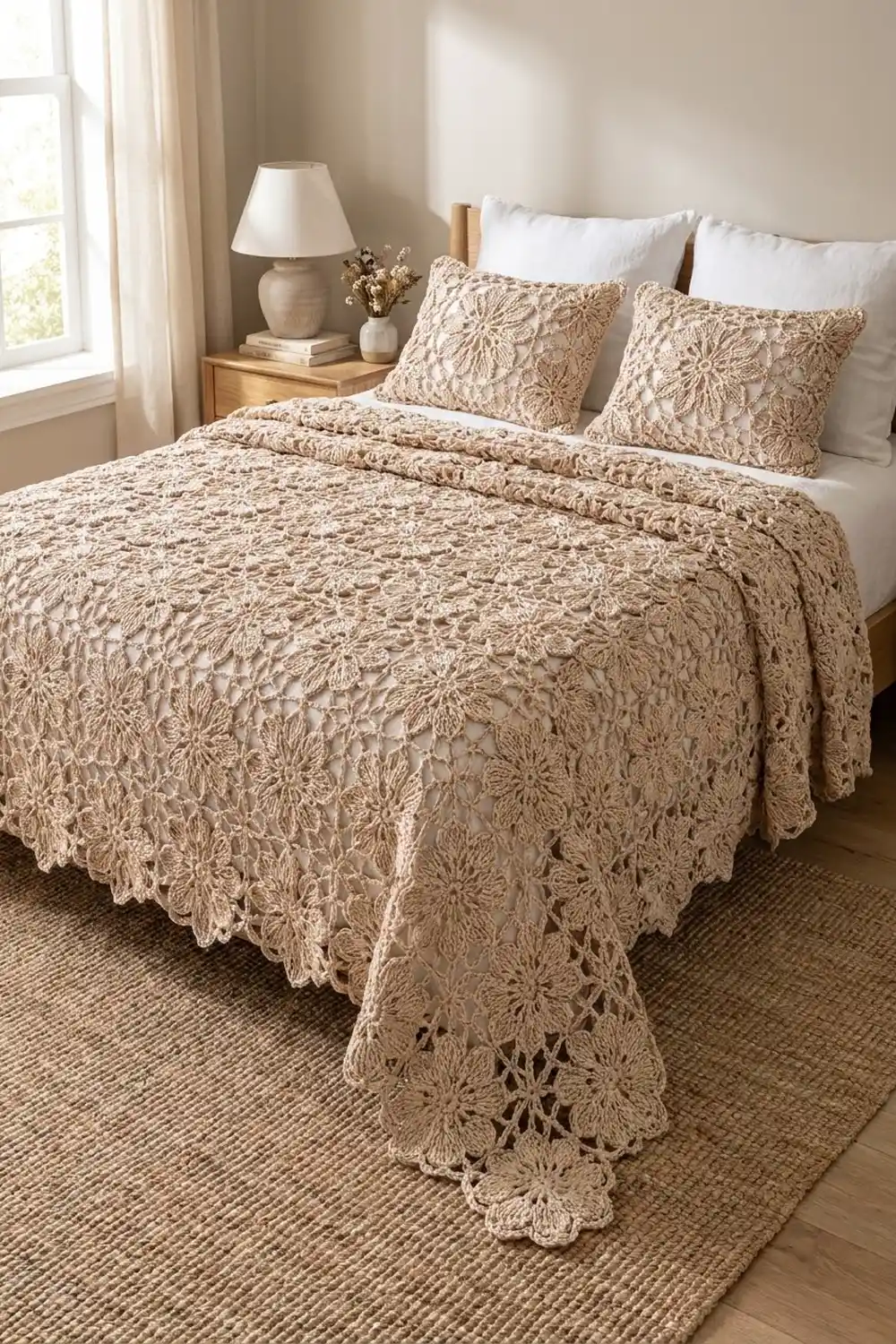
The Oat Blossom Bedspread is a romantic lace throw made from round flower motifs. Each flower has a small open center and eight long, pointed petals whose tall stitches stack into a soft ribbed texture. A frame of chain loops around each flower lets the motifs link together. Where four flowers meet, the loops leave a star-shaped opening.
The whole piece uses one warm oatmeal-beige shade, so the texture does the work. The style is calm, natural and slightly vintage. It looks good draped over a white duvet, where the open mesh shows the fabric underneath.
This pattern uses US crochet terms. The finished bedspread measures about 79 x 93 in (200.7 x 236.2 cm) including the border. That size covers the top of a queen bed and drops generously over the sides.
To make it, you work 143 motifs in 5 rounds each. From the second motif on, you join each one to its neighbors during the last round (join-as-you-go). A two-round shell border then follows the scalloped outer edge.
Finished Size and Construction
- Finished size: 79 x 93 in (200.7 x 236.2 cm)
- Skill level: Intermediate
- Terminology: US crochet terms
- Yarn weight: Worsted (#4), cotton or cotton blend
- Hook: 5 mm (H-8)
- Number of pieces: 143 motifs
- Layout: 11 motifs wide x 13 motifs long
- Motif size: 7 in (17.8 cm) across, measured from loop tip to loop tip after blocking
- Size before border: 77 x 91 in (195.6 x 231.1 cm)
- Border depth: 1 in (2.5 cm) on each side
Materials
Yarn: Choose a smooth, rounded worsted-weight cotton or cotton blend. These yarns show stitch definition and hold the pointed petals well. Avoid fuzzy or very splitty yarns, because they blur the ribbed petals and the open mesh.
- Oatmeal beige: about 3,000 g / 5,400 m (based on 100 g = 180 m balls)
Each motif uses about 19 g. All 143 motifs use about 2,720 g, and the border uses about 140 g. These quantities include a margin of about 140 g for gauge differences and swatching. Buy all the yarn from one dye lot.
Tools:
– 5 mm (H-8) crochet hook
– Locking stitch markers
– Tapestry needle
– Scissors
– Tape measure
– Blocking mats, rust-proof pins and a spray bottle
Abbreviations (US Terms)
- ch – chain
- sl st – slip stitch
- sc – single crochet
- hdc – half double crochet
- dc – double crochet
- tr – treble crochet
- sp – space
- st(s) – stitch(es)
- MR – magic ring
- JAYGO – join-as-you-go
Special stitch – Join-loop: Ch 3, insert your hook from the front into the target ch-7 loop of the neighboring motif, sl st, ch 3. A join-loop takes the place of one ch-7 loop (3 + 1 + 3 = 7).
Gauge and Checkpoints
Make one complete motif and block it before you start the full project. Gauge is not critical for a bedspread, but it controls both the final size and how much yarn you use.
- After Round 1: the ring measures 1.25 in (3.2 cm) across.
- After Round 3: the flower measures 4.5 in (11.4 cm) from petal tip to petal tip.
- After Round 4: 5.75 in (14.6 cm) across.
- After Round 5, blocked: 7 in (17.8 cm) from loop tip to loop tip.
- Weight: a finished motif weighs about 19 g.
If your motif is too big (more than 7.25 in / 18.4 cm), go down to a 4.5 mm hook. If it is too small (less than 6.75 in / 17.1 cm), go up to a 5.5 mm hook.
Every 0.25 in (0.6 cm) of difference per motif changes the bedspread by 2.75 in (7 cm) in width and 3.25 in (8.3 cm) in length.
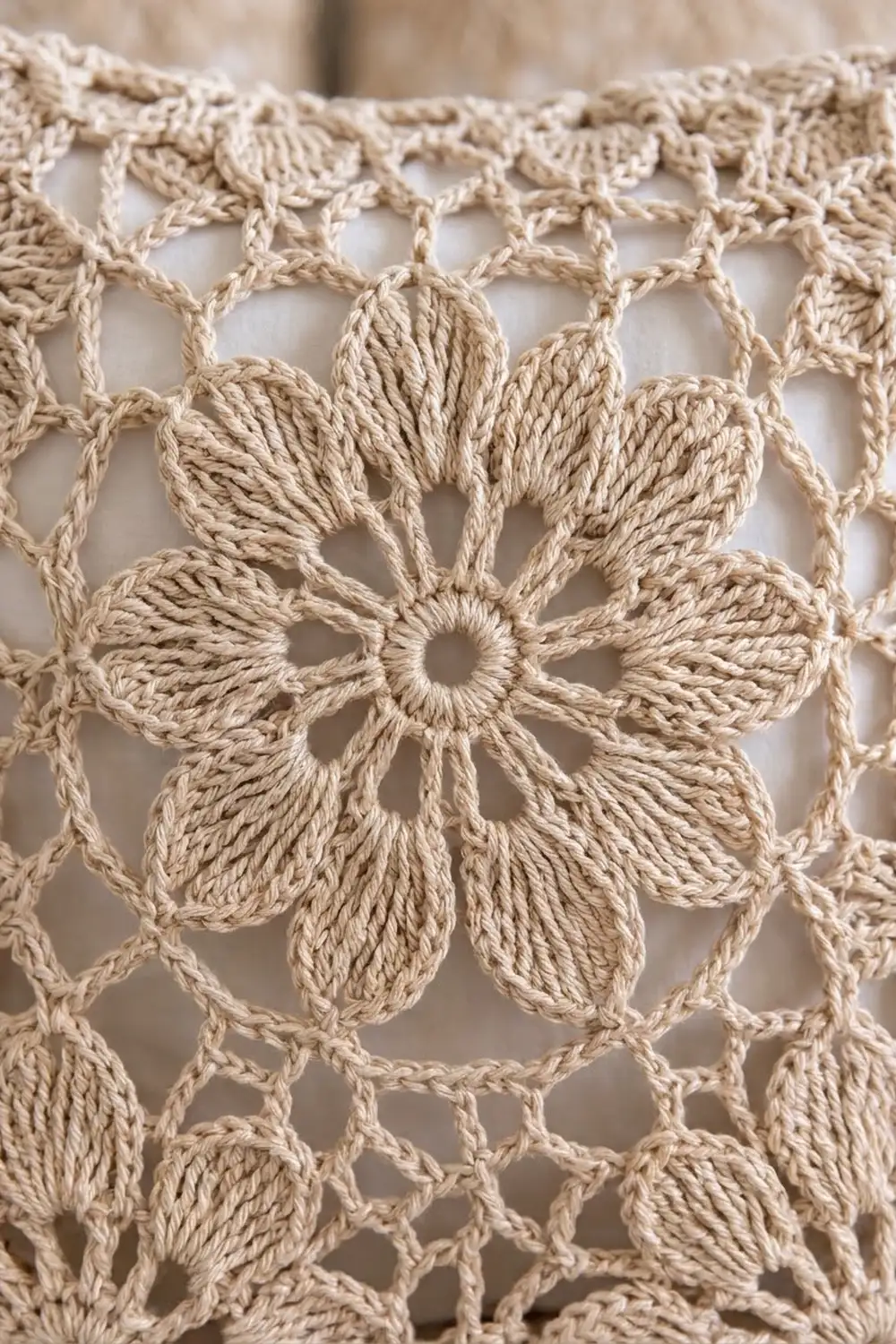
Flower Motif
Round 1: Make a magic ring. Ch 3 (counts as dc). Work 15 dc into the ring and pull it closed, leaving a small open center about 0.5 in (1.3 cm) wide. Sl st to the top of the beginning ch-3. (16 dc)
Round 2: Ch 1. Sc in the same st, ch 5, skip 1 st, sc in next st, ch 5, skip 1 st. Repeat from * to * 6 more times. Sl st to the first sc. (8 sc, 8 ch-5 sps)
Round 3 (petals): Sl st into the first ch-5 sp. In the ch-5 sp, work (hdc, 2 dc, 2 tr, ch 2, 2 tr, 2 dc, hdc), then sl st in the next sc. Repeat from * to * 7 more times, so the final sl st lands in the first sc. (8 petals, each with 10 sts and a ch-2 tip; 80 petal sts total)
The ch-2 tip gives each petal its point, and the paired tr create the raised ribbing down the center. Stretch each petal lightly lengthwise as you finish it.
Round 4: Sl st up the first petal to its ch-2 tip: sl st in the hdc, the 2 dc and the 2 tr, then sl st into the ch-2 sp. Ch 1. Sc in the ch-2 tip, ch 5, sc in the sl st between this petal and the next one, ch 5. Repeat from * to * 7 more times. Sl st to the first sc. (16 sc, 16 ch-5 sps)
Round 5: Sl st in the next 3 ch to reach the center of the first ch-5 sp. Ch 1. Sc in the ch-5 sp, ch 7. Repeat from * to * 15 more times. Sl st to the first sc. (16 sc, 16 ch-7 loops) Fasten off and weave in the ends.
Loop map for joining: Place the motif with a loop pointing straight up and to the right at a 45° angle. That loop is a corner loop. Count around, and every 4th loop is also a corner loop, for 4 corner loops in total. They point toward the diagonal neighbors.
Between each pair of corner loops are 3 side loops (first, center and last). Each motif therefore has 4 corner loops and 4 sides of 3 loops: 4 + 12 = 16.
Make All Pieces
Make 143 motifs in oatmeal beige, about 2,720 g in total. Motif 1 is worked completely as written. All other motifs are joined during Round 5.
Layout (11 across x 13 down, M = one motif):
Row 1:  M M M M M M M M M M M
Row 2:  M M M M M M M M M M M
Row 3:  M M M M M M M M M M M
...     (repeat to Row 13)
Row 13: M M M M M M M M M M M
Work in rows from left to right. Start every new row at the left edge.
Joining
Method: Join-as-you-go in Round 5. Work Round 5 as written, but wherever a loop lands on a joining position, work a join-loop instead of ch 7.
Side joins: Where two motifs sit side by side or one above the other, join only the center side loop to the facing center side loop of the neighbor. The first and last side loops stay free and form the lacy edges of the star-shaped gaps.
Corner joins:
– Inside the bedspread, four corner loops meet at one point. The first motif to reach that point works an ordinary ch-7 loop. Each later motif works a join-loop into the center of that first loop. All four corners lock at a single point, which creates the star mesh.
– On the outer edges, only two motifs meet at a corner point. Join their corner loops to each other in the same way.
– At the four corners of the bedspread, the outward-facing corner loop stays unjoined.
Stitch-to-stitch logic for one interior motif: A typical interior motif joins to its left and upper neighbors (2 center side loops) plus up to 3 corner points. Join in this order as you go around Round 5:
- Upper-left corner
- Top center loop
- Upper-right corner
- Left center loop (when you reach it)
- Lower-left corner (if a neighbor exists there)
All other loops are worked as normal ch-7 loops.
Tension: Keep each ch 3 of a join-loop the same height as half of a ch-7 loop. If the join chains are too tight, the flowers cup and the corners pull. If they are too loose, the star gaps sag. Do not twist the motif when you insert the hook. Always join from the front.
Size checkpoint: A joined 2 x 2 block should measure 14 x 14 in (35.6 x 35.6 cm) after light blocking. A completed row of 11 motifs should measure 77 in (195.6 cm). The full body before the border is 77 x 91 in (195.6 x 231.1 cm).
Border
Border gauge: Each motif adds 30 sc to its outer side, worked over 7 in (17.8 cm) of straight edge. That is about 4.3 sc per inch (1.7 sc per cm). The sc follow the curve of each motif, so the border keeps the scalloped hem.
Per-motif count along an edge:
– 3 sc in the outer half of the first corner loop
– 8 sc in each of its 3 free side loops (24 sc)
– 3 sc in the outer half of the next corner loop
That makes 3 + 24 + 3 = 30 sc per motif per side.
At each join point between two edge motifs, work 3 sc in the first motif’s outer half-loop and 3 sc in the second motif’s outer half-loop. Do not skip or decrease at the join.
Round 1: Join yarn in the unjoined corner loop of the top-left corner motif. In this loop, work 3 sc, ch 2, 3 sc. The first 3 sc belong to the side you just finished and the last 3 sc to the next side. Then work along the side as above.
- Short sides: 11 motifs x 30 = 330 sc each
- Long sides: 13 motifs x 30 = 390 sc each
At each of the 4 corners, work ch 2 between the two 3-sc groups. These ch-2 corner sps are not part of the side counts. Sl st to the first sc. (1,440 sc + 4 ch-2 corner sps)
Round 2 (shells): Sl st into the corner ch-2 sp. Ch 3 (counts as dc). Work (2 dc, ch 2, 3 dc) in the same sp. Then work each side as follows:
- Sc in next sc, skip 2 sc, 5 dc in next sc, skip 2 sc. Each repeat uses 6 sts. Repeat from * to * across the side.
- Short sides: 330 ÷ 6 = 55 repeats
- Long sides: 390 ÷ 6 = 65 repeats
- In each corner ch-2 sp, work (3 dc, ch 2, 3 dc).
Sl st to the top of the beginning ch-3. Fasten off.
Round 2 totals:
– 240 shells (1,200 dc)
– 240 sc
– 4 corner groups (24 dc)
– 4 ch-2 corner sps
– Total: 1,464 sts
Why the math works: The 30-sc motif count divides evenly by the 6-st repeat. Each motif therefore carries exactly 5 shells, centered on its own scallop. Every side starts and ends cleanly at the corners, so you never have to fudge the last repeat.
Final Blocking
- Weave in all remaining ends along stitch posts, never across open mesh.
- Lay the bedspread on blocking mats or on a clean carpet covered with towels. Work in sections if needed.
- Spray it evenly until damp, but not soaked.
- Pin the outer edge to 79 x 93 in (200.7 x 236.2 cm). Check that the corners are square by measuring both diagonals. They should be equal.
- Pin the star-gap join points into a straight grid, spaced 7 in (17.8 cm) apart.
- Shape each petal tip with your fingers so it points outward.
- Pin each shell scallop along the border.
- Let it dry completely before you unpin, which takes 24 to 48 hours.
Final Quality-Control Checklist
- 143 motifs in an 11 x 13 grid
- Every motif has 8 pointed petals and 16 ch-7 loops
- Each shared side joined only at its center loop
- All interior corner points join 4 loops at a single point
- No twisted joins
- Border Round 1: 330 sc on each short side and 390 sc on each long side
- Border Round 2: 55 or 65 shells per side, 5 per motif
- Finished size 79 x 93 in (200.7 x 236.2 cm)
- All ends secured and trimmed
Troubleshooting
Petals look rounded, not pointed: Check the ch-2 tip in Round 3. Tug each tip gently while it is still damp during blocking.
Motif cups or ruffles: Your Round 4 or Round 5 chains are too tight or too loose. Adjust the hook size for those rounds only.
Star gaps sag: The join-loop chains are too long. Keep each ch 3 snug.
Bedspread skews diagonally: You joined to the wrong loop. Recount the loop map: 3 side loops between each pair of corner loops.
Border ripples: You worked more than 8 sc per loop. Border cups: fewer than 8 sc. Recount one motif segment: it should have 30 sc.
Shell count off at a corner: Count each side in 30-st motif sections and fix the section that went wrong.
Care
Hand wash in cool water with a mild detergent and press the water out in a towel. Dry flat, reshaping the petals and scallops, and never hang the bedspread while it is wet.
Final Notes
Everything in this bedspread follows one measurement chain:
- A 1.25 in (3.2 cm) center grows into a 4.5 in (11.4 cm) flower and then a 7 in (17.8 cm) motif.
- 11 x 13 motifs make a 77 x 91 in (195.6 x 231.1 cm) body.
- 30 sc per motif per side carry 5 shells each.
- The 1 in (2.5 cm) border brings the total to 79 x 93 in (200.7 x 236.2 cm).
Check your first motif carefully, and the rest of the project will follow it.
Happy crocheting!