

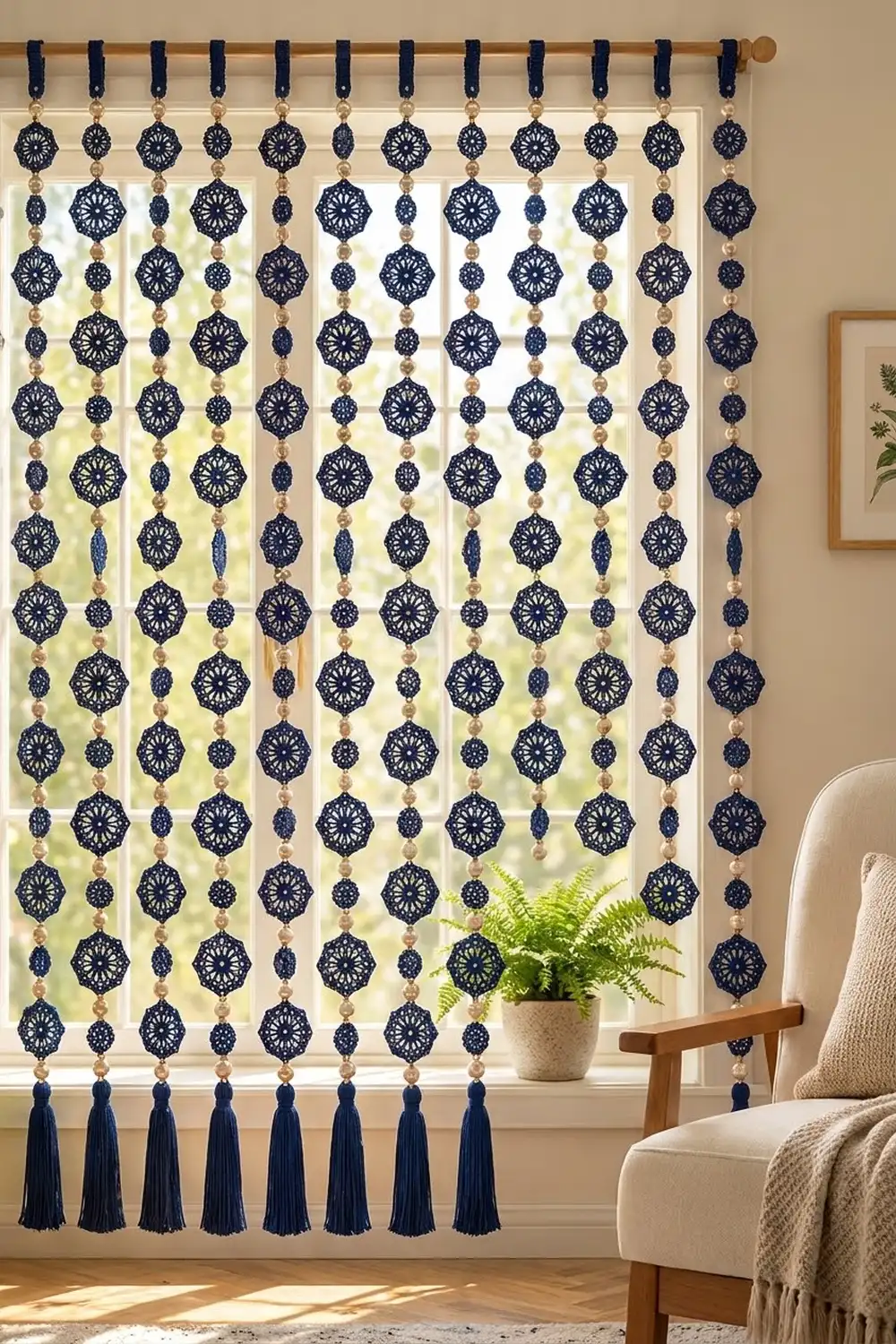
This curtain is made from twelve hanging strands of navy lace motifs, separated by pearl beads. Large lacy octagons alternate with small round wheels down each strand. A navy tassel finishes the bottom of every strand, and a crocheted loop tab at the top slides over a wooden rod.
Only one color is used: a deep navy cotton thread. The champagne pearl beads add a soft shine against it. The motifs have open, spoked centers, so light passes through and the window stays bright.
The pattern uses US crochet terms. The finished curtain measures about 41.75 in (106.0 cm) wide and 50 in (127.0 cm) long, measured from the top of the rod to the tips of the tassels.
You crochet the centers of all the motifs first. Then you work each motif’s edging round in order from top to bottom, and the edging joins it to a bead link from the motif above. Tabs and tassels finish each strand.
Finished Size and Construction
- Finished size: 41.75 in (106.0 cm) wide x 50 in (127.0 cm) long
- Skill level: Intermediate
- Terminology: US crochet terms
- Yarn weight: Size 3 cotton crochet thread (CYC #1 Super Fine)
- Hook: 2.25 mm (US B-1), plus a 0.75 mm steel hook for beads
- Number of pieces: 156 motifs (84 large octagons, 72 small wheels), 12 tassels, 156 beads
- Layout: 12 strands, each with 13 motifs (large, small, large… ending large)
- Piece size: large octagon 3 in (7.6 cm) flat to flat, 3.25 in (8.3 cm) point to point; small wheel 1.75 in (4.4 cm) across, picot to picot
- Size before border: large 2.75 in (7.0 cm) flat to flat; small 1.25 in (3.2 cm)
- Border depth: large 0.125 in (0.3 cm) per edge; small 0.25 in (0.6 cm) per edge including picots
Materials
Use a mercerized cotton thread. It holds the lace shape, blocks crisply, and doesn’t stretch much under the weight of the beads. Avoid acrylic, because the strands will grow longer over time as they hang.
- Navy: 600 g, about 1,644 m (1,800 yd), which is 12 balls of 50 g / 137 m (150 yd) each
- Pearl beads: 170 champagne pearl beads, 10 mm, with holes at least 2 mm (156 are needed)
Tools:
– 2.25 mm (US B-1) hook
– 0.75 mm steel hook for pulling a loop through each bead
– Tapestry needle
– Stitch markers
– Cardboard, 5.5 in (14.0 cm) tall, for winding tassels
– Sharp scissors
– Blocking mat, rust-proof pins, and spray bottle
– Wooden curtain rod, up to 1 in (2.5 cm) thick and at least 46 in (116.8 cm) long
All quantities include a margin of roughly 20% to cover gauge differences and test pieces. One strand uses about 111 m (121 yd) of thread.
Abbreviations (US Terms)
- ch – chain
- sl st – slip stitch
- sc – single crochet
- dc – double crochet
- sp(s) – space(s)
- rep – repeat
- beg – beginning
- MR – magic ring
Special stitch: Bead chain (BCh). Drop the loop from your hook. Slide one bead onto the 0.75 mm steel hook, catch the dropped loop with it, and pull the loop through the bead. Put the loop back on the 2.25 mm hook, then ch 1 to lock the bead in place.
Link: Ch 2, BCh, ch 2. A finished link is 0.75 in (1.9 cm) long, from one motif’s edge to the next.
Gauge and Checkpoints
Before you start, make one large octagon and one small wheel as test pieces. Block them, then measure.
- Round 1 (both motifs): 0.75 in (1.9 cm) across
- Round 2 (both motifs): 1.25 in (3.2 cm) across
- Small wheel, Round 3: 1.75 in (4.4 cm) picot to picot
- Large octagon, Round 3: 1.75 in (4.4 cm)
- Large octagon, Round 4: 2.25 in (5.7 cm)
- Large octagon, Round 5: 2.75 in (7.0 cm) flat to flat
- Large octagon, Round 6: 3 in (7.6 cm) flat to flat
If your Round 1 is larger than 0.75 in (1.9 cm), switch to a 2.0 mm hook. If it is smaller, switch to a 2.5 mm hook. Every motif adds to the strand length, so an error of 0.125 in (0.3 cm) per motif adds about 1.625 in (4.1 cm) to each strand.
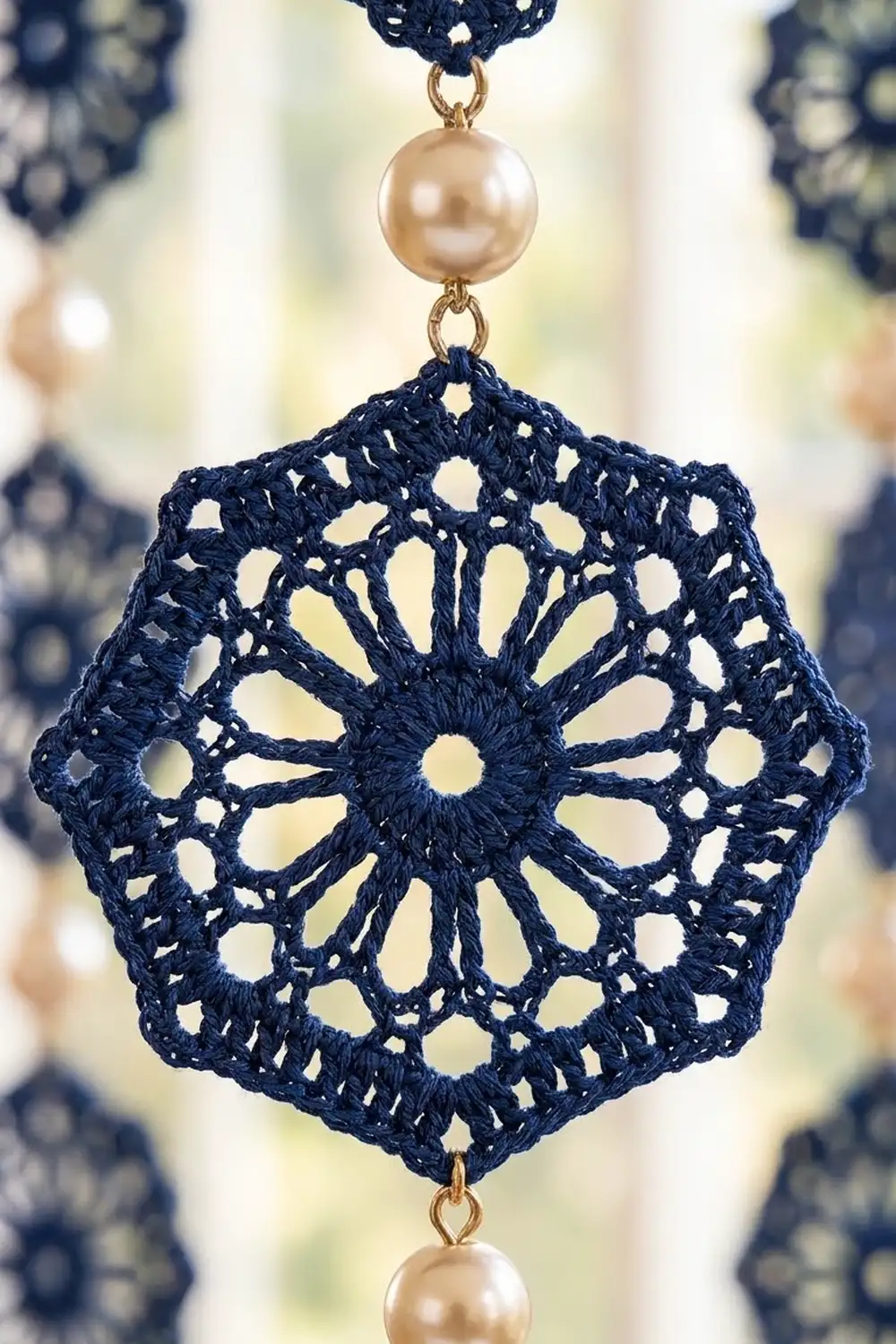
Large Octagon Center (make 84)
Use the 2.25 mm hook and navy thread.
Round 1: MR, ch 3 (counts as dc), 15 dc in ring, sl st to top of beg ch-3. (16 dc) Close the ring so it leaves a small center hole about 0.25 in (0.6 cm) wide.
Round 2: Ch 5 (counts as dc + ch 2), dc in next dc, ch 2; rep from * 14 more times, sl st in 3rd ch of beg ch-5. (16 dc, 16 ch-2 sps)* This round makes the spokes.
Round 3: Sl st in first ch-2 sp, ch 3 (counts as dc), 2 dc in same sp, ch 1, 3 dc in next ch-2 sp, ch 1; rep from * 14 more times, sl st to top of beg ch-3. (48 dc in 16 groups, 16 ch-1 sps)*
Round 4: Sl st in next 2 dc and in next ch-1 sp, ch 1, sc in same sp, ch 5, sc in next ch-1 sp, ch 5; rep from * 14 more times, sl st in first sc. (16 sc, 16 ch-5 loops)* These loops form the lacy ring.
Round 5 (octagon shaping): Sl st in first ch-5 loop, ch 3 (counts as dc), (2 dc, ch 2, 3 dc) in same loop [corner], 5 dc in next loop [side], (3 dc, ch 2, 3 dc) in next loop [corner]; rep from * 6 more times, 5 dc in last loop, sl st to top of beg ch-3. (88 dc: 8 corners x 6 dc + 8 sides x 5 dc; 8 ch-2 corner sps)*
Each straight edge now has 11 dc between corner spaces (3 + 5 + 3). Fasten off with a 6 in (15.2 cm) tail and weave it in. Check that the octagon is 2.75 in (7.0 cm) flat to flat.
Small Wheel Center (make 72)
Round 1: MR, ch 3 (counts as dc), 15 dc in ring, sl st to top of beg ch-3. (16 dc)
Round 2: Ch 5 (counts as dc + ch 2), dc in next dc, ch 2; rep from * 14 more times, sl st in 3rd ch of beg ch-5. (16 dc, 16 ch-2 sps)*
Fasten off and weave in the tail. Check that the wheel is 1.25 in (3.2 cm) across.
Make All Pieces
- Large octagon centers: 84 (7 per strand)
- Small wheel centers: 72 (6 per strand)
- Tassels: 12 (1 per strand)
- Beads: 156 (13 per strand)
Each column below is one strand, read from top to bottom. T = tab, L = large octagon, S = small wheel, o = bead link, Q = tassel.
Strand:  1  2  3  4  5  6  7  8  9 10 11 12
         T  T  T  T  T  T  T  T  T  T  T  T
         L  L  L  L  L  L  L  L  L  L  L  L
         o  o  o  o  o  o  o  o  o  o  o  o
         S  S  S  S  S  S  S  S  S  S  S  S
         o  o  o  o  o  o  o  o  o  o  o  o
        (repeat L / o / S / o four more times)
         L  L  L  L  L  L  L  L  L  L  L  L
         o  o  o  o  o  o  o  o  o  o  o  o
         Q  Q  Q  Q  Q  Q  Q  Q  Q  Q  Q  Q
Joining
You join each strand as you go, working from the top down. Each motif’s edging round (see Border, below) ends at its bottom point. The bottom point gets a bead link. The next motif’s edging round then catches the end of that link at its top point with a sl st.
Stitch-to-stitch logic:
– On a large octagon, the round starts at corner 1, which is the bottom point. The top point is corner 5, directly opposite. Corner 5 is the 4th bracketed corner in Round 6.
– On a small wheel, the round starts in ch-2 sp 1, which is the bottom point. The top point is sp 9, directly opposite. Sp 9 is the 8th bracketed repeat in Round 3.
– Join at a top point: Where the pattern says ch 3, work ch 1, sl st into the last ch of the link above, ch 1 instead. Then finish the stitch group as written.
Tension: Keep the link chains the same tension as your motif stitches. If they are tight, the beads will tilt. If they are loose, the strand will sag and grow longer. Before starting, lay a link against your ruler and check it measures 0.75 in (1.9 cm).
Strand checkpoint: Measure after the first three motifs (L, S, L) and two links: 3.25 + 1.75 + 3.25 + 0.75 + 0.75 = 9.75 in (24.8 cm). A full strand of 13 motifs and the 12 links between them measures 22.75 + 10.5 + 9 = 42.25 in (107.3 cm).
Border: Motif Edging Rounds
The curtain has no outer border. Each motif’s final edging round acts as its border. That round firms up the edge, adds picots, and carries the joins. Border gauge: 11 sc = one octagon side of about 1.25 in (3.2 cm), flat after blocking.
Large Octagon, Round 6 (border)
Rejoin navy with a sl st in any ch-2 corner sp. This corner is corner 1, the bottom point.
Round 6: Ch 1, sc in same corner sp, *sc in next 11 dc, (sc, ch 3, sc) in next ch-2 sp; rep from * 6 more times, sc in next 11 dc, sc in first corner sp, sl st in first sc.
- Per side: 13 sc (1 corner sc + 11 sc + 1 corner sc)
- Total: 8 sides x 13 = 104 sc
This is a conversion round. It has 88 sc (one per dc), plus 16 extra sc (2 in each corner sp), for 104 sc. Each corner sc belongs to one side only, so no corners are counted twice.
Joins: On the 4th repeat (corner 5), join to the link above, as described in Joining. The first octagon of each strand gets a hanging tab here instead (see below). Each octagon finishes with 6 ch-3 picots, at corners 2, 3, 4, 6, 7, and 8.
Bottom link: After the closing sl st, work a link: ch 2, BCh, ch 2. Fasten off with a 6 in (15.2 cm) tail.
Hanging tab (top octagon only): At corner 5, work (sc, ch 50, sc) in the sp. After you finish the round, rejoin at the base of the loop. Ch 1, work 70 sc over the ch-50 loop, sl st at the base, and fasten off. The loop is about 5 in (12.7 cm) around. That leaves about 2 in (5.1 cm) from the top of the rod to the octagon point.
Small Wheel, Round 3 (border)
Round 3: Sl st into first ch-2 sp. Ch 1, sc in same sp [bottom point], sc in next dc, *(sc, ch 3, sc) in next ch-2 sp, sc in next dc; rep from * 14 more times, sc in first sp, sl st in first sc.
- Total: 16 sc (one per dc) + 32 sc (2 per sp) = 48 sc
- Join: On the 8th repeat (sp 9), join to the link above. That leaves 14 ch-3 picots.
- Bottom link: Ch 2, BCh, ch 2, then fasten off.
Why the math works: On the octagon, 11 dc per side became 13 sc per side. The 2 extra sc per side sit in the corner spaces, so the edge lies flat without cupping. On the wheel, the 16 spokes and 16 spaces give 48 sc, 3 for each spoke-and-space unit. That spacing matches the curve of the circle.
Tassels (make 12)
- Wrap navy 60 times around the 5.5 in (14.0 cm) card.
- Slide a 12 in (30.5 cm) strand under the wraps at the top and tie it tightly.
- Cut the wraps open at the bottom edge.
- Wrap a separate strand 10 times around the bundle, 0.75 in (1.9 cm) below the top, and knot it.
- Trim the tassel to 5 in (12.7 cm).
Tie the top strands of the tassel around the last ch of the bottom link on the final octagon. Knot three times, then bury the ends inside the tassel.
Full strand length: 2 + 42.25 + 0.75 + 5 = 50 in (127.0 cm).
Final Blocking
- Weave in all ends before blocking. Leave the tassels unblocked.
- Lay one strand flat on the mat, straight and in order.
- Spray it with water until the thread is damp all the way through.
- Pin each octagon at all 8 points to 3.25 in (8.3 cm) point to point.
- Pin each wheel round to 1.75 in (4.4 cm), opening every picot.
- Straighten the links so each one measures 0.75 in (1.9 cm).
- Let the strand dry completely, then unpin it and repeat with the next strand.
- Mark the rod every 3.5 in (8.9 cm) for 12 positions. Slide the tabs on in order. The strands will span 38.5 in (97.8 cm) center to center, or 41.75 in (106.0 cm) overall.
Final Quality-Control Checklist
- Every octagon has 104 sc, 6 picots, 1 bottom link, and either 1 top join or 1 tab
- Every wheel has 48 sc, 14 picots, 1 bottom link, and 1 top join
- Each strand has 7 octagons, 6 wheels, 13 beads, 1 tab, and 1 tassel
- Every strand measures 50 in (127.0 cm), with no more than 0.5 in (1.3 cm) difference between strands
- All beads sit straight and are locked with a ch 1
- No loose tails show from either side
Troubleshooting
- Octagon cups: Your Round 5 corners are too tight. Loosen the ch-2, or go up 0.25 mm for Round 5 only.
- Octagon ruffles: Your ch-5 loops in Round 4 are too long. Try working ch 4, or tighten your tension.
- Strands hang at different lengths: Compare the links. Rework any that are not 0.75 in (1.9 cm).
- Bead won’t fit: Use a finer steel hook, or pick beads with larger holes.
- Motifs twist: Make sure each top join sits exactly opposite the bottom point. Block again.
- Tassel splays: Tighten the neck wrap and steam the tassel lightly.
Care
Hand wash in cool water with mild soap, gently press out the water, and dry each strand flat. Don’t hang the curtain while it’s wet, or the strands will stretch.
Final Notes
Every measurement depends on the one before it. If Round 1 measures 0.75 in (1.9 cm), the octagon blocks to 3 in (7.6 cm) flat to flat and 3.25 in (8.3 cm) point to point, and the wheel blocks to 1.75 in (4.4 cm). With 0.75 in (1.9 cm) links, a strand of 13 motifs comes to 42.25 in (107.3 cm). The tab, bottom link, and tassel bring it to 50 in (127.0 cm). Twelve strands spaced 3.5 in (8.9 cm) apart make a curtain 41.75 in (106.0 cm) wide. Check your gauge early and the rest will follow.
Happy crocheting!