

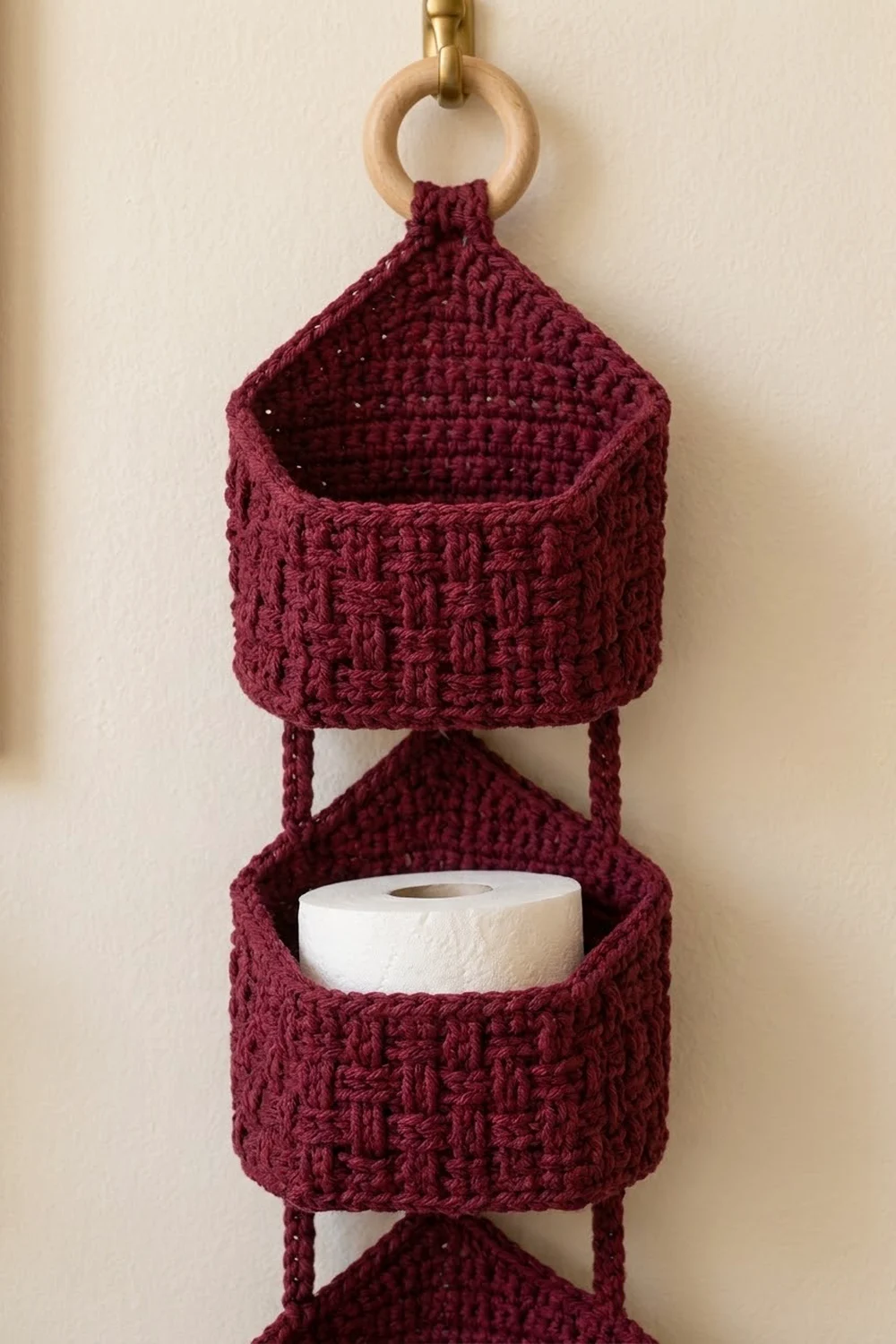
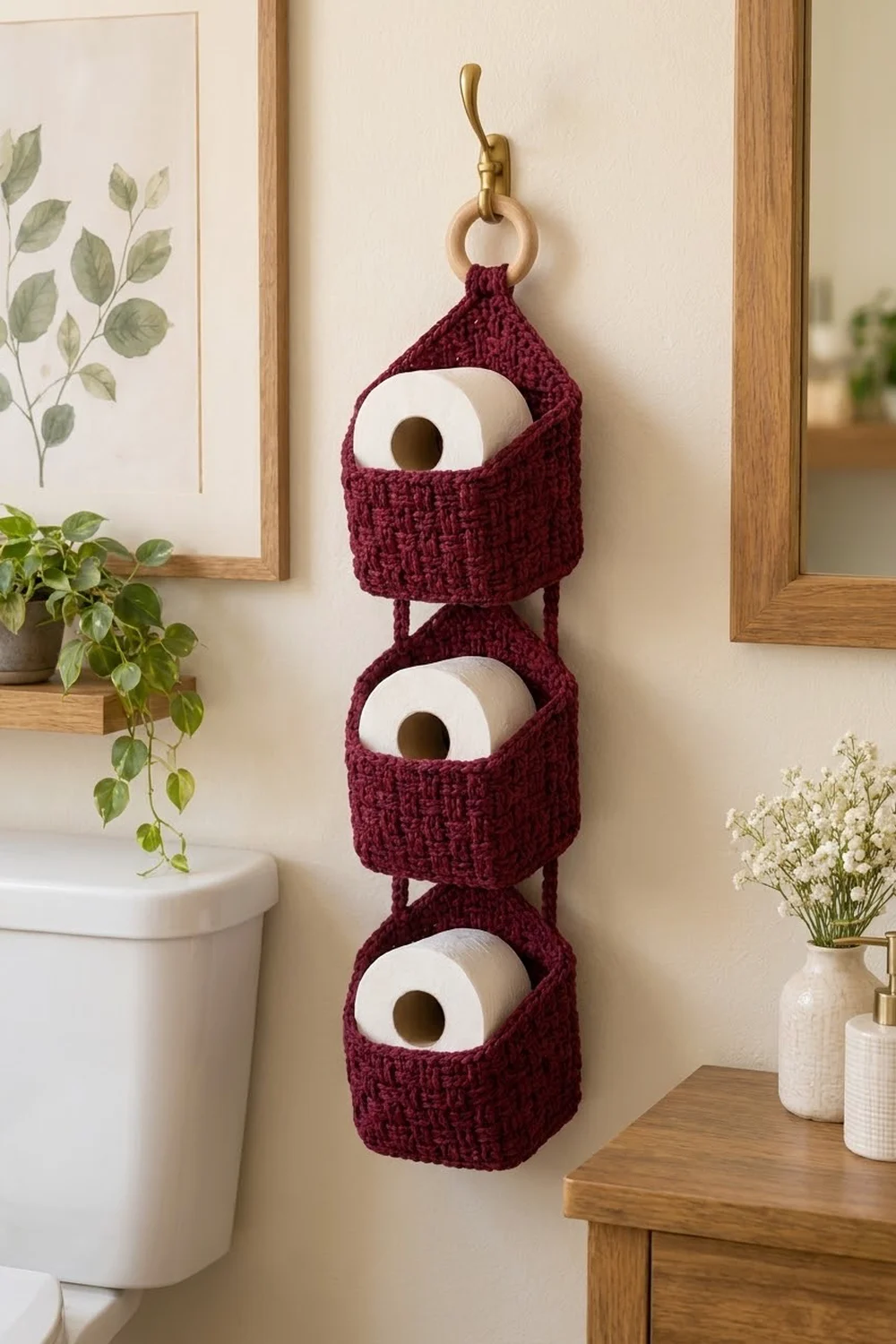
The Merlot Weave Hanging Toilet Paper Holder is a three-tier wall organizer. It has three box-shaped pockets, each holding one spare roll. Each pocket has a raised basketweave body and a gabled back panel shaped like a little house roof. The pockets hang in a neat column from a wooden ring.
The sample is worked in a single deep burgundy yarn. Using one color keeps the focus on the texture: chunky woven blocks on the walls, smooth single crochet on the roof panels, and a rope-like reverse single crochet edge along every top rim.
This pattern uses US crochet terms. Each pocket measures 5 in (12.7 cm) wide, 5 in (12.7 cm) deep, 4 in (10.2 cm) tall at the front, and 6.5 in (16.5 cm) tall at the peak of the back panel. The finished organizer hangs about 24 in (61.0 cm) from the ring to the bottom of the lowest pocket.
You work each pocket from the bottom up. First you crochet a flat single crochet base. Then you work the basketweave walls in joined rounds. The back panel continues in rows and narrows into a point, then becomes a strap. A border runs around the rim and roof edges. Finally, you sew the straps to join the three pockets.
Finished Size and Construction
- Finished size: about 5 in (12.7 cm) wide x 24 in (61.0 cm) long, hanging
- Skill level: Intermediate (post stitches, shaping, seaming)
- Terminology: US crochet terms
- Yarn weight: Worsted / medium (#4)
- Hook: 5.0 mm (H-8)
- Number of pieces: 3 pockets
- Layout: 1 column x 3 pockets, joined by straps
- Piece size: 5 in (12.7 cm) wide x 5 in (12.7 cm) deep x 6.5 in (16.5 cm) tall at the back
- Front wall before border: 3.5 in (8.9 cm)
- Border depth: 0.5 in (1.3 cm)
Materials
Choose a smooth worsted-weight yarn that holds its shape. Cotton or a cotton blend makes the firmest baskets. Acrylic also works and is easy to wash. Avoid fuzzy or very loose-plied yarn, because it hides the basketweave and splits during post stitches.
- Burgundy: 260 g / about 475 m (520 yd), worsted weight. Each pocket uses about 70 g. The tab and straps use the rest.
Quantities include a margin of roughly 15-20% for swatching and tension differences.
Tools
- 5.0 mm (H-8) crochet hook
- Wooden ring, 2 in (5.1 cm) diameter
- Tapestry needle
- 4 stitch markers
- Scissors
- Measuring tape
- Optional: three 4.5 in (11.4 cm) squares of plastic canvas to stiffen the bases
Abbreviations (US Terms)
- ch – chain
- sl st – slip stitch
- sc – single crochet
- dc – double crochet
- BLO – back loop only
- FPdc – front post double crochet
- BPdc – back post double crochet
- sc2tog – single crochet 2 together
- rev sc – reverse single crochet (crab stitch)
- st(s) – stitch(es)
- RS – right side
Special stitch – reverse sc: Without turning, work from left to right. Insert the hook into the next stitch to the right, yarn over, pull up a loop, then yarn over and pull through both loops on the hook.
Standing sc: With a slipknot on the hook, insert the hook into the stitch, yarn over, pull up a loop, yarn over, and pull through both loops.
Gauge and Checkpoints
- Single crochet: 16 sts and 18 rows = 4 in (10.2 cm)
- Basketweave: 16 sts and 8 rounds = 4 in (10.2 cm). One block (4 sts x 2 rounds) is about 1 in (2.5 cm) square.
Finish one complete pocket before you start the others, and check these measurements as you go:
- Base after Row 22: 5 in x 5 in (12.7 cm x 12.7 cm).
- After Rnd 1: the perimeter is 20 in (50.8 cm), with 80 sts.
- After Rnd 8: the walls are 3.5 in (8.9 cm) tall.
- After Row 14 of the panel: the roof is about 3 in (7.6 cm) tall, so the panel peaks 6.5 in (16.5 cm) above the base.
Too big? Go down to a 4.5 mm hook. Too small? Go up to a 5.5 mm hook. Remake the base each time until it measures 5 in (12.7 cm) square. If the gauge is off by just 0.25 in (0.6 cm) on the base, all the other measurements will be off too.
Pocket (Make 3)
Base
Row 1: Ch 21. Sc in the 2nd ch from the hook and in each ch across, then turn. (20 sc)
Rows 2-22: Ch 1, sc in each st across, then turn. (20 sc)
Checkpoint: 5 in x 5 in (12.7 cm x 12.7 cm). If you are using plastic canvas, set it aside for now.
Walls
Rnd 1 (edge round): Do not turn. Ch 1, rotate the work, and sc down the row ends:
- Side A: 20 sc evenly across 22 row ends. Skip the 6th and 17th row ends.
- Back: 20 sc in the free loops of the foundation ch.
- Side B: 20 sc evenly across 22 row ends. Skip the same two row ends.
- Front: 20 sc across the tops of the Row 22 sts.
Join with a sl st to the first sc. (80 sc: 20 per side)
The sts are now numbered 1-20 (side A), 21-40 (back), 41-60 (side B), and 61-80 (front). Mark sts 21 and 40.
Rnd 2: Ch 2 (does not count as a st). Dc in the BLO of each st around, then join. (80 dc) Working in the back loops creates a crisp fold where the walls meet the base.
Rnds 3-4: Ch 2. FPdc 4, BPdc 4, repeat 10 times, then join. (80 sts)
Rnds 5-6: Ch 2. BPdc 4, FPdc 4, repeat 10 times, then join. (80 sts)
Rnds 7-8: Repeat Rnds 3-4. (80 sts) Fasten off.
The 20 blocks per round alternate front and back. Because 20 is an even number, the pattern lines up across the joining seam. Each side holds exactly 5 blocks. The front reads back-front-back-front-back, so it is centered and symmetrical.
Checkpoint: the walls are 3.5 in (8.9 cm) tall, with three bands of blocks.
Back Panel
You now work in rows over the back sts only (sts 21-40).
Row 1 (RS): With the outside of the basket facing you, make a standing sc in st 21. Sc in each st through st 40, then turn. (20 sc)
Rows 2-6: Ch 1, sc in each st across, then turn. (20 sc)
Row 7: Ch 1, sc2tog, sc to the last 2 sts, sc2tog, then turn. (18 sc)
Rows 8-14: Repeat Row 7. Each row has 2 fewer sts. Row 8 has 16 sc, Row 9 has 14, Row 10 has 12, Row 11 has 10, Row 12 has 8, Row 13 has 6, and Row 14 has 4.
Checkpoint: the roof is about 3 in (7.6 cm) tall, and the top is a flat, 4-st point 1 in (2.5 cm) wide.
Strap or Tab
Pockets B and C (strap): Rows 15-21: Ch 1, 4 sc, then turn. (4 sc per row, 7 rows, about 1.5 in / 3.8 cm) Fasten off, leaving a 12 in (30.5 cm) tail.
Pocket A (hanging tab): Rows 15-28: Ch 1, 4 sc, then turn. (4 sc per row, 14 rows, about 3 in / 7.6 cm) Fasten off, leaving a 12 in (30.5 cm) tail.
Border (Each Pocket)
The border uses the same single crochet gauge of 4 sts per 1 in (2.5 cm). Along the sloped roof edges, work 1 sc per row end. Single crochet rows are shorter than they are wide, and the slope makes each edge longer than its height. Together these keep the edge flat.
Row 1 (RS): With the outside facing you, join the yarn with a standing sc in the row end of panel Row 14, right where the strap begins. Then work:
- Right roof edge: 14 sc, 1 in each row end from Row 14 down to Row 1 (the standing sc counts as the first one)
- Side wall rim: 20 sc
- Front wall rim: 20 sc
- Other side wall rim: 20 sc
- Left roof edge: 14 sc, 1 in each row end from Row 1 up to Row 14
Total: 88 sc. Do not turn.
Row 2: Ch 1. Rev sc in each st back along the edge. (88 rev sc) Fasten off.
Why the math works: each rim count matches its wall exactly (20 + 20 + 20 = 60). Each roof edge matches its 14 rows (14 + 14 = 28). That gives 60 + 28 = 88, so no stitches are added or skipped. No stitches are worked at the back corners, because the panel rises directly from the back wall. The border adds 0.5 in (1.3 cm) to the front and side walls, bringing them to 4 in (10.2 cm).
Make All Pieces
- Pocket A (top): 1, with the 14-row hanging tab
- Pockets B and C (middle and bottom): 2, each with a 7-row strap
- Total: 3 pockets, all in burgundy, about 70 g each
Layout:
        ( wooden ring )
              |  tab of A
        [  Pocket A  ]
              |  strap of B
        [  Pocket B  ]
              |  strap of C
        [  Pocket C  ]
Joining
Method: Whipstitch with a tapestry needle, matching stitch to stitch.
- Tab to ring: Fold Pocket A’s tab over the wooden ring toward the back. Sew Row 28 to the back of Rows 15-16. Match all 4 sts, and work two passes for strength. The ring should sit about 1.5 in (3.8 cm) above the peak.
- Pocket B to Pocket A: Find Pocket A’s center back sts on base Rnd 1, which are sts 29-32. Eight sts are left on each side (21-28 and 33-40). Whipstitch the 4 sts of Row 21 on Pocket B’s strap to those 4 sts, matching them 1 to 1.
- Pocket C to Pocket B: Repeat step 2, sewing Pocket C’s strap to sts 29-32 of Pocket B.
Tension: Pull each stitch snug but not tight. Sew through both the strap and the base edge each time, then weave each tail back through the strap. These seams carry the full weight of the organizer, so knot securely.
Size checkpoint: Hang the organizer from the ring. The distances are 1.5 in (3.8 cm) for the tab, 6.5 in (16.5 cm) for each of the three pockets, and 1.5 in (3.8 cm) for each of the two straps. That adds up to 24 in (61.0 cm).
Final Blocking
- Spray each pocket lightly with water until it is damp, not soaked.
- Stuff each pocket firmly with a toilet paper roll or a folded towel about 5 in (12.7 cm) square.
- Pinch the four vertical wall corners and the base fold into sharp edges.
- Lay the organizer face down. Pin the roof panels flat into clean triangles, and pin the reverse single crochet edges straight.
- Let everything dry completely, which takes at least 24 hours.
- If you are using plastic canvas, slide one square into each base now.
- Hang the organizer and check that the pockets line up in a straight column.
Final Quality-Control Checklist
- [ ] Each base is 5 in x 5 in (12.7 cm x 12.7 cm).
- [ ] Each wall round has 80 sts, and the blocks alternate cleanly over the joining seam.
- [ ] The front and side walls are 4 in (10.2 cm) tall with the border.
- [ ] Each roof narrows evenly from 20 sts to 4 sts.
- [ ] Each border has 88 sts with no gaps at the strap base.
- [ ] The straps are centered on sts 29-32 of the pocket above.
- [ ] The tab is sewn securely around the ring.
- [ ] Total hanging length is about 24 in (61.0 cm).
- [ ] All tails are woven in and trimmed.
Troubleshooting
Walls flare outward: Your post stitches are too loose. Go down half a hook size for the walls only.
Basketweave blocks are misaligned: Check that every round has 80 sts. A missed post shifts the whole pattern.
Roof edges ripple: You worked more than 1 sc per row end. Remove the border and rework it with 14 sts per roof edge.
Roof edges pull in: Your border is too tight. Work Row 1 with a 5.5 mm hook.
Pockets tilt forward: The strap is sewn too far toward the front. Re-sew it to back sts 29-32.
Rolls fit too tightly: Your gauge is too tight. Check the base against the 5 in (12.7 cm) checkpoint.
Care
Hand wash in cool water, press out the water in a towel, and reshape each pocket around a roll to dry flat. Don’t wring or tumble dry.
Final Notes
The measurement chain is short and reliable. A 5 in (12.7 cm) square base gives an 80-st round. Seven dc rounds give 3.5 in (8.9 cm) walls, and the border adds 0.5 in (1.3 cm) for 4 in (10.2 cm) fronts. Fourteen roof rows give a 6.5 in (16.5 cm) back. Three pockets plus the tab and two straps hang about 24 in (61.0 cm). Check the base first and everything after it will fall into place.
Happy crocheting!