

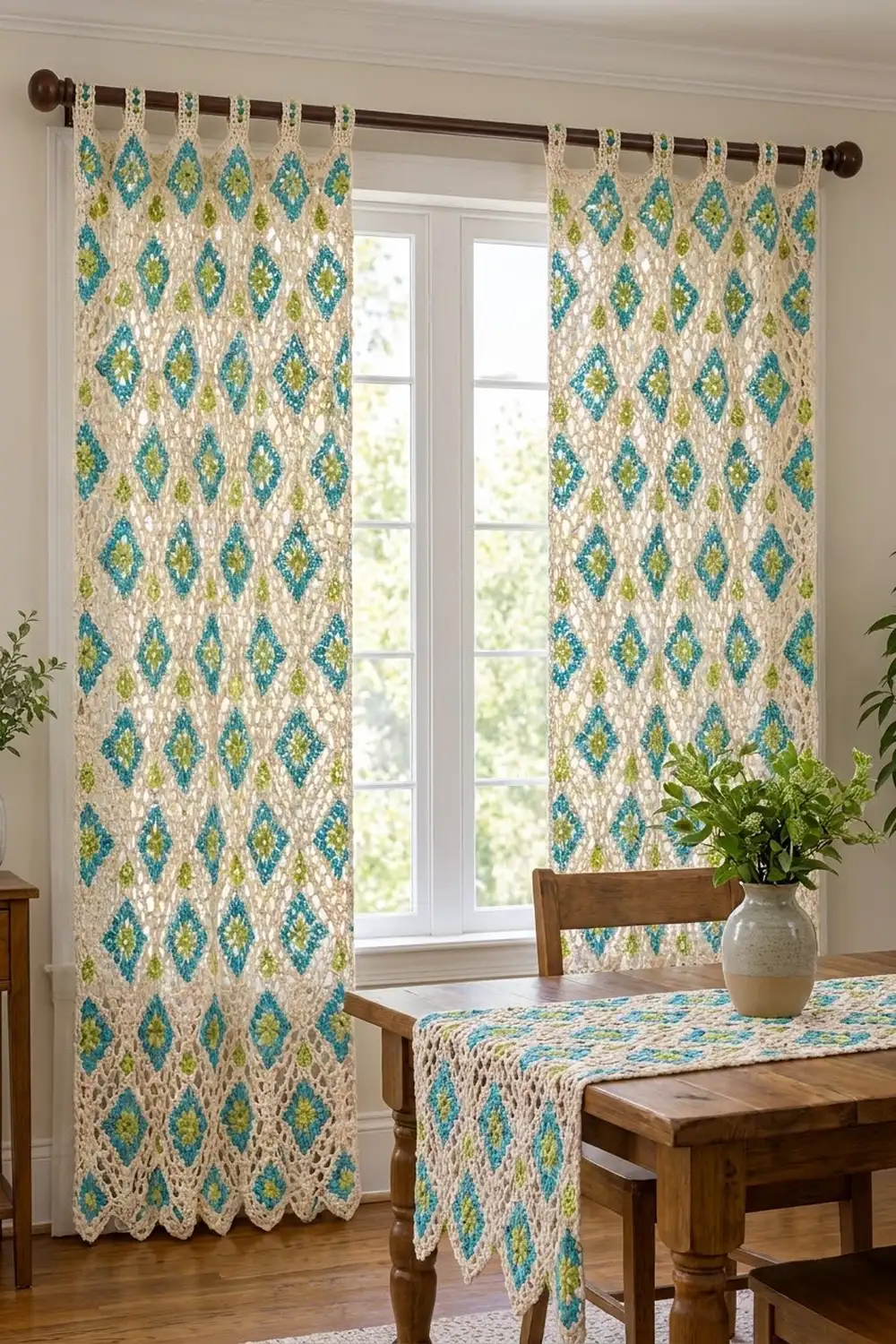
This curtain panel is an airy cream lattice set with bold teal diamonds. Each diamond has a bright lime-green flower at its center, and small green diamonds sit in the lattice between them. When the panel hangs at a window, light comes through the mesh and the colored diamonds seem to float on it.
The palette is three cotton colors: cream for the lattice, teal for the large diamonds, and lime green for the flower centers and the small accent diamonds. It has a fresh, vintage cottage style. The pattern uses US crochet terms throughout.
The finished panel measures 31 in (78.7 cm) wide and 72.75 in (184.8 cm) from the top border to the bottom points. The tab loops add 3.5 in (8.9 cm) above that, for 76.25 in (193.7 cm) overall. Most windows need two panels, so make the pattern twice for a pair.
The panel is built from 84 identical square motifs. In each motif, the teal square is set on point inside a cream square, so it reads as a diamond. Green clusters at each motif’s corners meet at the seams to form the small green diamonds. You join the motifs flat in a grid of 6 across by 14 down. Then you add a two-round border, a row of points along the bottom, and six tabs across the top.
Finished Size and Construction
- Finished size: 31 in x 72.75 in (78.7 cm x 184.8 cm), plus 3.5 in (8.9 cm) tabs
- Skill level: Intermediate
- Terminology: US crochet terms
- Yarn weight: Worsted (#4) cotton
- Hook: 5.0 mm (H-8)
- Number of pieces: 84 square motifs per panel, plus 6 tabs
- Layout: 6 motifs across x 14 motifs down
- Motif size: 5 in x 5 in (12.7 cm x 12.7 cm), 18 sts per side
- Size before border: 30 in x 70 in (76.2 cm x 177.8 cm)
- Border depth: 0.5 in (1.3 cm) on the sides and top; points add 1.75 in (4.4 cm) at the bottom
Materials
Use a smooth worsted-weight cotton. Cotton gives crisp stitch definition and holds its shape when it hangs. Avoid fuzzy or stretchy yarns, because they blur the lattice and can make a long panel sag.
Amounts for one panel (double them for a pair):
- Cream (lattice, border, tabs): 650 g, about 1,040 m
- Teal (large diamonds): 300 g, about 480 m
- Lime green (centers and accents): 150 g, about 240 m
The meterage assumes about 1.6 m per gram. Check your own yarn label.
Tools:
- 5.0 mm (H-8) hook
- Tapestry needle
- Scissors
- Stitch markers
- Tape measure
- Blocking mats and rust-proof pins
- Spray bottle
The amounts above include a margin of about 15 percent to cover gauge differences and swatching.
Abbreviations (US Terms)
- ch – chain
- sl st – slip stitch
- sc – single crochet
- hdc – half double crochet
- dc – double crochet
- tr – treble crochet
- sk – skip
- sp(s) – space(s)
- st(s) – stitch(es)
- BLO – back loop only
- RS – right side
Special stitch – corner shell: (2 dc, ch 2, 2 dc) all worked in the same stitch or space.
Gauge and Checkpoints
Make one complete motif and block it before you start the rest. The size of every later stage depends on this one square.
- Motif gauge: 1 motif = 5 in x 5 in (12.7 cm x 12.7 cm) after blocking
- Edge gauge: 18 sc along one side of the motif = 5 in (12.7 cm), which is 3.6 sc per inch
Checkpoints:
- After Round 1: about 1.2 in (3.0 cm) across
- After Round 3 (teal diamond): about 2.75 in (7.0 cm) from tip to tip
- After Round 5: about 4.5 in (11.4 cm) square
- After Round 7: 5 in (12.7 cm) square
If your motif is too big, go down half a hook size. If it is too small, go up half a hook size. Small errors add up quickly. A motif that is just 0.25 in (0.6 cm) too long makes the panel 3.5 in (8.9 cm) too long.
Motif (make 84)
Round 1 (green): Make a magic ring. Ch 3 (counts as dc), then work 15 dc into the ring. Sl st to the top of the ch-3 to join. Pull the ring closed and fasten off. (16 dc)
Round 2 (teal): Join teal in any dc. Ch 3 (counts as dc), then work (dc, ch 2, 2 dc) in the same st to make the first corner shell. Dc in each of the next 3 sts. Corner shell in the next st, then dc in each of the next 3 sts; repeat from * 2 more times. Sl st to the top of the ch-3 to join. (28 dc; 4 ch-2 sps)*
Round 3 (teal): Sl st into the next dc and into the ch-2 sp. Ch 3 (counts as dc), then work (dc, ch 2, 2 dc) in the same sp. Dc in each of the next 7 dc, then work a corner shell in the next ch-2 sp; repeat from * 2 more times. Dc in each of the last 7 dc, then sl st to the top of the ch-3 to join. Fasten off. (44 dc; 11 dc on each side; 4 ch-2 sps)*
These four ch-2 corners are the tips of the diamond. On each side, number the 11 dc as dc1 to dc11, counting away from a tip. The center dc (dc6) will become a corner of the cream square.
Round 4 (cream): Join cream in dc6 on any side. Ch 4 (counts as tr), ch 3, then tr in the same st. Ch 3, sk 2 dc, dc in dc9. Ch 3, sc in the ch-2 tip sp. Ch 3, sk dc1 and dc2 of the next side, then dc in dc3. Ch 3, sk 2 dc, then work (tr, ch 3, tr) in dc6; repeat from * 2 more times. Ch 3, sk 2 dc, dc in dc9, ch 3, sc in the tip sp, ch 3, dc in dc3, ch 3. Sl st to the top of the ch-4 to join. (20 sts: 8 tr, 8 dc, 4 sc; 20 ch-3 sps)*
The tall stitches start the cream corners. The short sc keeps each teal tip at the middle of a side.
Round 5 (cream): Sl st into the corner ch-3 sp. Ch 3 (counts as dc), ch 3, then dc in the same sp. Ch 2, dc in the next ch-3 sp, ch 2, tr in the next ch-3 sp, ch 2, tr in the sc, ch 2, tr in the next ch-3 sp, ch 2, dc in the next ch-3 sp, ch 2. Work (dc, ch 3, dc) in the corner sp; repeat from * 3 times, leaving out the last corner. Sl st to the top of the ch-3 to join, then fasten off. (28 sts; 24 ch-2 sps, 6 per side; 4 corner ch-3 sps)*
The tr stitches lift the low middle of each side, so the motif is now a level square.
Round 6 (green corner accents): This round is worked at each corner separately. Join green with a sl st in a corner ch-3 sp. Ch 3 (counts as dc), then work (dc, ch 2, 2 dc) in the same sp. Fasten off and leave 4 in (10.2 cm) tails. Repeat at the other 3 corners. (16 green dc; 4 ch-2 sps)
Round 7 (cream): Join cream in any green ch-2 sp. Ch 1, then work (sc, ch 2, sc) in the same sp. *Sc in each of the next 2 green dc. Sk the Round 5 corner dc, then work 2 sc in each of the next 6 ch-2 sps. Sk the Round 5 corner dc, then sc in each of the next 2 green dc. Work (sc, ch 2, sc) in the next corner sp; repeat from * 3 times, leaving out the last corner. Sl st to the first sc to join and fasten off.
Crochet over the green tails as you work this round, so you don’t need to weave them in.
Stitch count: (1 corner sc) + 2 + 12 + 2 + (1 corner sc) = 18 sc per side, counting both corner sc. That gives 72 sc in total, plus 4 ch-2 corner sps.
Make All Pieces
You need 84 motifs for one panel, all made the same way. Per motif, you use about 1.5 g of green, 3 g of teal, and 5.5 g of cream.
Layout grid (M = motif):
Row 1  (top):    M M M M M M
Rows 2-13:       M M M M M M   (12 identical rows)
Row 14 (bottom): M M M M M M
Block every motif to 5 in (12.7 cm) before joining.
Joining
Method: Flat slip-stitch join through the back loops.
Place two motifs side by side with the RS facing up. Join cream with a sl st through both corner ch-2 sps. Sl st through the BLO of each matching pair of sc, from stitch 1 to stitch 1 through stitch 18 to stitch 18. Finish with a sl st through both of the next corner ch-2 sps.
Each side has 18 sts, so the seams match exactly. The corner ch-2 sps are used only in the seams and add no stitches to the edge.
First join the motifs into 14 horizontal strips of 6. Then join the strips along their long edges. At each junction, sl st through all four corner sps so the green clusters meet and form a small diamond.
Tension: Keep your slip stitches as loose as the sc they go into. Tight seams pucker the panel and make it narrower. If your seams pull tight, go up one hook size for joining only.
Checkpoint: A strip of 6 motifs should measure 30 in (76.2 cm). The joined panel should measure 30 in x 70 in (76.2 cm x 177.8 cm).
Border
Border gauge: 3.6 sc per inch, the same as the motif edge. Top and bottom edges: 6 x 18 = 108 sts. Side edges: 14 x 18 = 252 sts. Skip the corner ch-2 sps at the seams, because they are already joined.
Round 1 (cream): Join in the ch-2 sp at the top right corner. Ch 1, then work (sc, ch 2, sc) in the same sp. Sc in each st across each edge, and work (sc, ch 2, sc) in each of the 3 remaining outer corner sps. Sl st to the first sc to join.
– Top and bottom: 108 sts + 2 corner sc = 110 sc each
– Sides: 252 sts + 2 corner sc = 254 sc each
– Total: 728 sc plus 4 corner ch-2 sps
Round 2 (cream): Sl st into the corner sp. Ch 1, then work (sc, ch 2, sc) in the same sp. Sc in each sc around, and work (sc, ch 2, sc) in each corner sp. Join.
– Top and bottom: 110 sts + 2 corner sc = 112 sc each
– Sides: 254 sts + 2 corner sc = 256 sc each
– Total: 736 sc
Bottom Points (cream, worked across the bottom edge only): With the RS facing you, join in the first sc of the bottom edge. Ch 1, then sc in each of the first 2 sts.
*Over the next 18 sts, work as follows: sl st in st 1, sc in sts 2-3, hdc in sts 4-5, dc in sts 6-7, tr in sts 8-9, ch 3, tr in sts 10-11, dc in sts 12-13, hdc in sts 14-15, sc in sts 16-17, and sl st in st 18. Repeat from * 5 more times. Sc in each of the last 2 sts and fasten off.
Count: 2 + (6 x 18) + 2 = 112 sts, which uses every stitch on the edge. You get 6 points, each centered under one column of motifs.
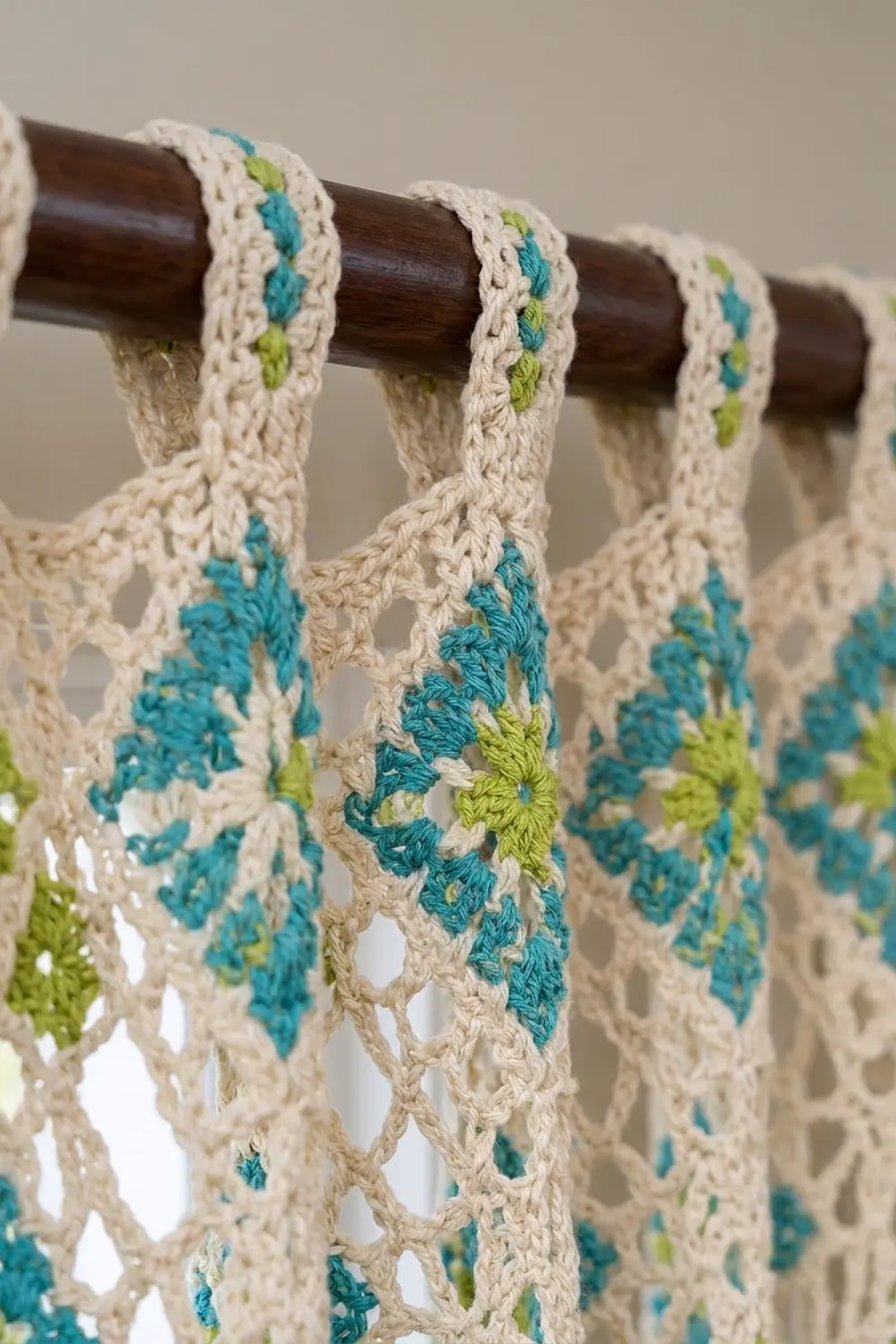
Tabs (make 6, cream): Count the 112 top sts from the right. Skip the first 2 sts. Each motif column then has its own section of 18 sts, and each tab is worked over sts 7-12 of a section. That centers the tab with 6 sts on each side.
- Row 1: With the RS facing you, join in st 7. Ch 1, then sc in sts 7-12 and turn. (6 sc)
- Rows 2-36: Ch 1, sc in each sc across, and turn. (6 sc)
The tab should be 8 in (20.3 cm) long and about 1.7 in (4.3 cm) wide. Fold it to the back and whipstitch the last row to the back of Border Round 1. This makes a 3.5 in (8.9 cm) loop that fits a rod up to 1.5 in (3.8 cm) across.
To finish each tab, surface sl st a teal line down its center. Then add small green French knots every 1 in (2.5 cm).
Why the math works: The border uses the same 3.6 sc per inch as the motif edges. That means 108 sts cover the 30 in (76.2 cm) width exactly, so the edges will not ruffle or draw in. The points and tabs are counted in 18-st sections, so they line up with the motif columns.
Final Blocking
- Weave in all remaining ends along the seams or inside the solid teal stitches.
- Lay the panel flat on mats with the RS facing up. Because it is long, block it in two halves.
- Pin the side edges straight to 31 in (78.7 cm) wide.
- Pin the length to 71 in (180.3 cm) from the top border to the base of the points.
- Pin each diamond tip and lattice opening so the shapes are crisp.
- Pin each bottom point at its ch-3 tip, 1.75 in (4.4 cm) below the border.
- Spray the panel until it is damp, not soaked, and let it dry completely.
- Steam the tabs flat on the back.
Final Quality-Control Checklist
- Every motif has 18 sc per side and measures 5 in (12.7 cm).
- Every teal diamond tip sits at the middle of its motif side.
- The green clusters meet at each junction to form a small diamond.
- The seams lie flat and do not pucker.
- The border counts are 112 on the top and bottom and 256 on each side.
- There are 6 even points, each centered under a motif column.
- There are 6 tabs of equal length, evenly spaced.
- The panel measures 31 in x 72.75 in (78.7 cm x 184.8 cm).
Troubleshooting
- The diamond looks like a square: The Round 4 corners went into the tips. Make sure they go into dc6, the center dc of each side.
- The motif cups: Your Round 5 tension is too tight. Loosen your chains or go up half a hook size.
- The motif ruffles: You have extra sc in Round 7. Count again to make sure each side has exactly 18.
- The panel is too narrow: The seams are too tight. Rejoin them with a larger hook.
- The bottom edge flares: The points are off count. Check that each section has exactly 18 sts.
- The tabs twist: You skipped a turning ch. Block the tabs flat before sewing them down.
Care
Hand wash in cool water with a mild detergent and press out the water in a towel. Dry the panel flat at its blocked size, and keep it out of the dryer.
Final Notes
Each 18-st motif edge measures 5 in (12.7 cm). Six motifs make 30 in (76.2 cm) across, and 14 make 70 in (177.8 cm) down. The two border rounds bring the panel to 31 in x 71 in (78.7 cm x 180.3 cm). The points add 1.75 in (4.4 cm) for a total of 72.75 in (184.8 cm), and the tabs hang the panel from the rod. If the first motif is right, every later stage will fit.
Happy crocheting!