

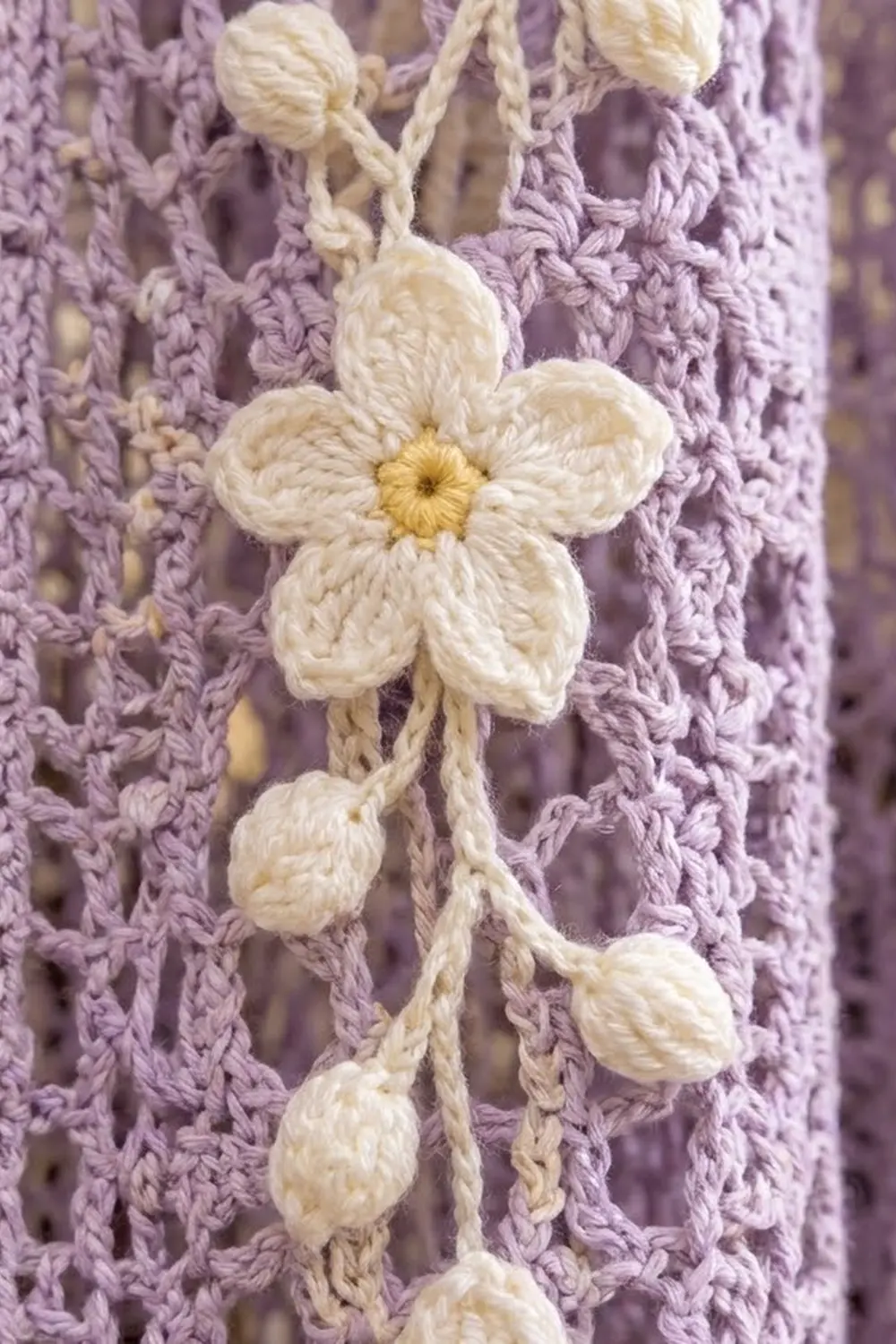
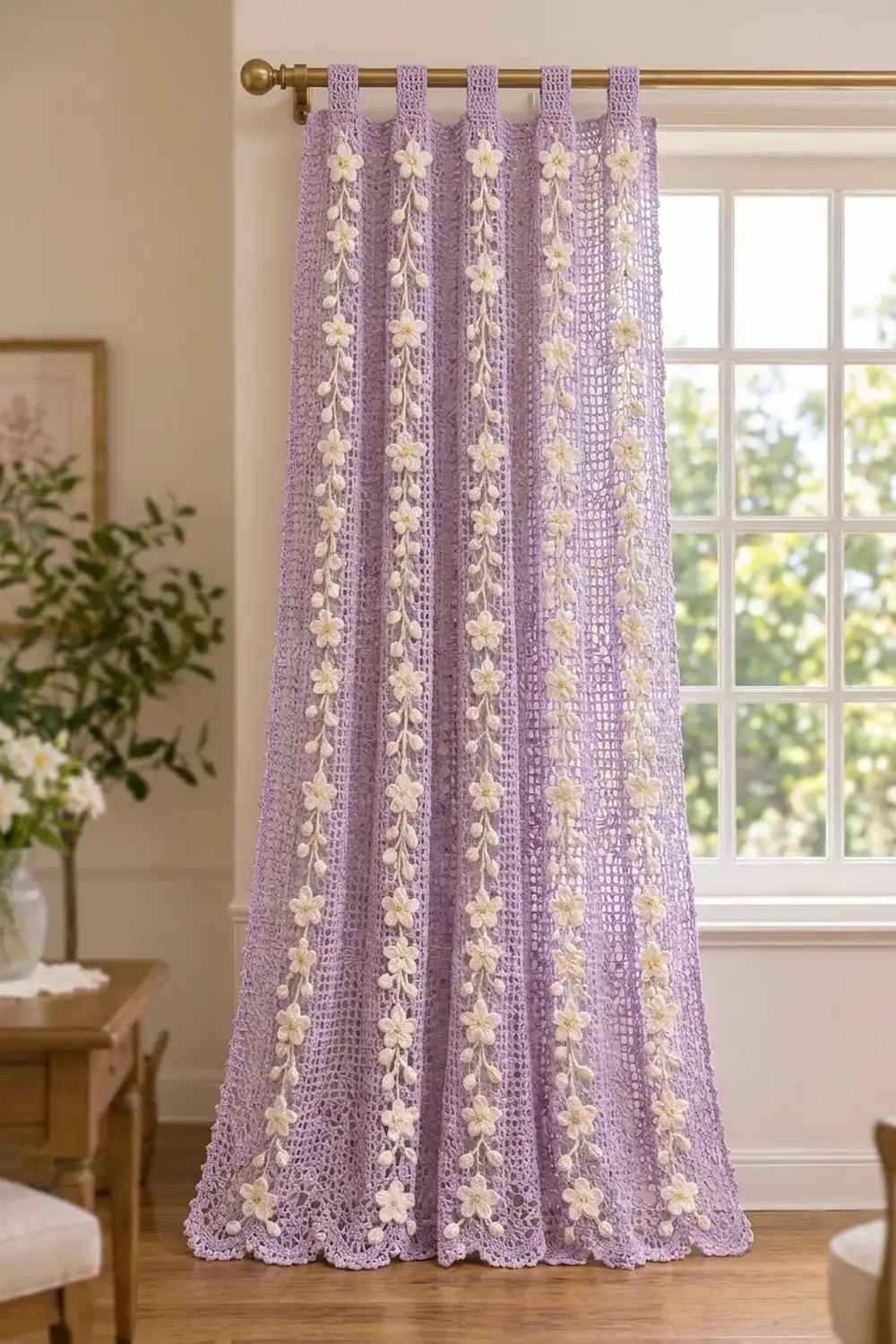
This tab-top curtain panel is a soft lavender lace with ivory flower vines running down it. Light comes through the open mesh, and the vertical bands of solid double crochet give it a gentle ribbed look. Ivory blossoms with butter-yellow centers sit along each band, with bobble buds branching off between them.
The palette is lavender, ivory and pale yellow, which gives the panel a cottage or vintage feel. A deep scalloped hem with picots finishes the bottom edge, and simple strip tabs at the top slide over a standard curtain rod.
The pattern uses US crochet terms. The finished panel is 29.5 in (74.9 cm) wide and 79 in (200.7 cm) long from the top edge to the scallop points. It hangs about 82 in (208.3 cm) from the top of the rod. To make a pair, crochet two panels.
The panel is worked flat in rows from the top down as one piece. Next comes a single crochet round all the way around, then scallop rows along the bottom and tabs along the top. The flowers and bud vines are made separately and sewn onto the vertical bands.
Finished Size and Construction
- Finished size: 29.5 in × 79 in (74.9 cm × 200.7 cm), plus 3 in (7.6 cm) tabs
- Skill level: Intermediate
- Terminology: US
- Yarn weight: DK (#3) cotton
- Hook: 4.0 mm (G-6)
- Number of pieces: 1 lace panel, plus 45 flowers and 45 vine units (appliqués)
- Layout: 5 vertical vines, each 9 flowers long
- Panel size before border: 29 in × 76 in (73.7 cm × 193.0 cm)
- Border depth: 0.25 in (0.6 cm) on the sides and top; 2.75 in (7.0 cm) at the bottom
Materials
Use a smooth mercerized or matte cotton DK of about 115 m per 50 g. Cotton holds the scallops crisply and doesn’t stretch much on a rod.
- Lavender (main color): 800 g (1,840 m)
- Ivory (flowers, vines): 175 g (403 m)
- Butter yellow (flower centers): 25 g (58 m)
All quantities are for one panel and include a margin of about 10–15%. Double them for a pair.
Tools:
– 4.0 mm (G-6) hook
– Tapestry needle
– Rust-proof pins and blocking mats or a large towel-covered surface
– Measuring tape
– Stitch markers
– Spray bottle or steam iron
Abbreviations (US Terms)
- ch: chain
- sl st: slip stitch
- sc: single crochet
- dc: double crochet
- sk: skip
- sp: space
- st(s): stitch(es)
- RS / WS: right side / wrong side
Special stitches:
– 5-dc bobble: (Yarn over, insert hook in the stitch, pull up a loop, yarn over, pull through 2 loops) 5 times in the same stitch. Then yarn over and pull through all 6 loops on the hook.
– Bud: Ch 3, work a 5-dc bobble in the 3rd ch from the hook, then sl st in that same ch.
– Picot: Ch 3, sl st in the 3rd ch from the hook.
Gauge and Checkpoints
Body gauge: 20 sts and 8 rows = 4 in (10.2 cm) in the body pattern
Single crochet gauge: 18 sc and 20 rows = 4 in (10.2 cm)
Chain gauge: 9 ch = 2 in (5.1 cm)
Test first. Before starting the panel, make one swatch and one flower.
Swatch: Ch 32. For Row 1, dc in the 4th ch from the hook and in each ch across (30 dc). For Row 2, ch 3, dc in the next 2 sts, ch 1, sk 1, then (dc in the next st, ch 1, sk 1) 9 times, and dc in the last 8 sts. Repeat Row 2 through Row 10, working each dc into a dc and skipping each ch-1 sp. The swatch should measure 6 in (15.2 cm) wide and 5 in (12.7 cm) tall.
Too big? Go down 0.5 mm. Too small? Go up 0.5 mm. Width matters most. A gauge that is off by 1 stitch per 4 in changes the panel width by almost 1.5 in (3.8 cm).
Checkpoints:
– Row 1: 145 dc = 29 in (73.7 cm)
– Row 40: 20 in (50.8 cm) long
– Row 80: 40 in (101.6 cm) long
– Row 152: 76 in (193.0 cm) long
– Flower after Round 1: 0.75 in (1.9 cm) across; finished flower 1.75 in (4.4 cm)
– Vine unit stem: 8 in (20.3 cm)
Main Panel
The panel is worked from the top edge down. The ch 3 at the start of each row counts as a dc.
Foundation: With lavender, ch 147.
Row 1 (RS): Dc in the 4th ch from the hook and in each ch across. Turn. (145 dc)
Row 2: Ch 3, dc in the next 2 sts. Ch 1, sk 1, (dc in the next st, ch 1, sk 1) 9 times, dc in the next 5 sts. Repeat from * 5 times in total. Then ch 1, sk 1, (dc in the next st, ch 1, sk 1) 9 times, and dc in the last 3 sts. Turn. (145 sts: 85 dc and 60 ch-1 sps)
Here is how each Row 2 section breaks down:
– Edge: 3 dc
– Mesh section: 19 sts (10 ch-1 sps and 9 dc)
– Band: 5 dc
The full row is 3 + (19 + 5) × 5 + 19 + 3 = 145.
Row 3: Ch 3, dc in the next 2 dc. Ch 1, sk the ch-1 sp, (dc in the next dc, ch 1, sk the ch-1 sp) 9 times, dc in the next 5 dc. Repeat from * 5 times in total. Then ch 1, sk the ch-1 sp, (dc in the next dc, ch 1, sk the ch-1 sp) 9 times, and dc in the last 3 sts. Turn. (145 sts)
Row 2 is symmetrical, so every dc lands on a dc and the mesh columns stack in straight lines.
Rows 4–151: Repeat Row 3. (145 sts in each row)
Row 152: Ch 3, dc in each dc and in each ch-1 sp across. (145 dc) Fasten off.
The panel now measures 29 in × 76 in (73.7 cm × 193.0 cm). The five 5-dc bands are each 1 in (2.5 cm) wide. Their centers are 4.8 in (12.2 cm) apart, and the outer bands sit 4.9 in (12.4 cm) in from each side edge.
Flowers (Make 45)
Round 1: With yellow, make a magic ring. Ch 1, work 10 sc in the ring, and join with a sl st to the first sc. (10 sc) Fasten off and pull the ring closed. It should measure 0.75 in (1.9 cm) across.
Round 2: Join ivory with a sl st in any sc. In the next sc, work (hdc, 2 dc, ch 1, 2 dc, hdc), then sl st in the next sc. Repeat from * 5 times in total. (5 petals, each with 6 sts and a ch-1 tip; 5 sl sts) Fasten off, leaving a 10 in (25.4 cm) tail for sewing.
Each petal spans 2 center stitches, so the 10 sc give exactly 5 petals. The finished flower is 1.75 in (4.4 cm) across.
Vine Units (Make 45)
Each unit is an 8 in (20.3 cm) stem with two bud sprigs.
Sprig: Ch 6 and make a Bud (tip bud). Sl st back in the next 3 ch of the 6-ch stalk. Ch 3 and make a Bud (side bud), then sl st in each of the 3 side ch. Sl st in the remaining 3 stalk ch. (2 buds, each about 0.4 in / 1.0 cm)
Unit: With ivory, ch 36.
– Sl st in the back bump of the 2nd ch from the hook and in the next 9 ch. (10 sl sts)
– Work a Sprig.
– Sl st in the next 12 ch, then work a Sprig.
– Sl st in the next 13 ch. (35 sl sts in total: 10 + 12 + 13)
Fasten off, leaving a 24 in (61.0 cm) tail. The end you fastened off is the top of the unit, where a flower will sit.
Totals per panel: 45 flowers, 45 units, 90 sprigs and 180 buds.
Appliqué Placement Map
Sew the appliqués on after the border and the first wet block (see Final Blocking). Each of the 5 bands gets 9 units, laid end to end down the band center:
Band:     1     2     3     4     5
2 in      F     F     F     F     F    <- flower 1
          |     |     |     |     |
10 in     F     F     F     F     F    <- flower 2
 ...     ...   ...   ...   ...   ...
66 in     F     F     F     F     F    <- flower 9
          |     |     |     |     |
74 in   stem ends (2 in above Row 152)
Flower centers sit 2 in, 10 in, 18 in, 26 in, 34 in, 42 in, 50 in, 58 in and 66 in below Row 1. In centimeters, that runs from 5.1 cm down to 167.6 cm. The tops of the units sit at those same points. Each flower covers the joint where one unit ends and the next begins. The last stem ends at 74 in (188.0 cm).
On each unit, angle the lower sprig to the left and the upper sprig to the right.
Border
Border gauge: 2 sc per dc row-end and 1 sc per stitch on the top and bottom edges. A dc row is 0.5 in (1.3 cm) tall, so 2 sc per row-end matches the body length without ruffling.
Round 1 (RS): Join lavender in the first st of Row 1 (top right corner). Work as follows:
– Top edge: 3 sc in the first st, sc in the next 143 sts, 3 sc in the last st. (149 sc)
– Side: 2 sc in each of the 152 row-ends. (304 sc)
– Bottom edge: 3 sc in the first st of Row 152, sc in the next 143 sts, 3 sc in the last st. (149 sc)
– Side: 2 sc in each of the 152 row-ends. (304 sc)
Join with a sl st to the first sc. Fasten off.
The total is 149 + 304 + 149 + 304 = 906 sc. The top and bottom counts of 149 include the corner groups (3 + 143 + 3), and the side counts don’t include any corners, so nothing is counted twice. The panel now measures 29.5 in × 76.5 in (74.9 cm × 194.3 cm).
Bottom scallops: You’ll work these across 145 sts: the center sc of each bottom corner group plus the 143 sc between them.
Row A (RS): Join lavender in the center sc of the first bottom corner. Ch 4 (counts as dc and ch 1), sk 1, dc in the next st. Ch 1, sk 1, dc in the next st. Repeat from * across, ending in the center sc of the other corner. Turn. (145 sts: 73 dc and 72 ch-1 sps)
Row B: Ch 1, sc in the first dc. Sk the next 3 sts, work 9 dc in the next dc, sk the next 3 sts, sc in the next dc. Repeat from * 18 times in total. Turn. (18 shells and 19 sc)
The math works because each repeat uses 8 sts, and 1 + 18 × 8 = 145. Every shell and every sc lands on a dc from Row A.
Row C: Ch 1, sc in the first sc. Ch 2, (dc in the next dc, ch 1) 8 times, dc in the next dc, ch 2, sc in the next sc. Repeat from * across. Turn. (Each scallop: 9 dc and 8 ch-1 sps)
Row D: Ch 1, sc in the first sc. Work 3 sc in the ch-2 sp. Then (sc in the next dc, then sc, picot, sc in the next ch-1 sp) 8 times. Sc in the next dc, 3 sc in the ch-2 sp, sc in the next sc. Repeat from * across. (577 sc and 144 picots)
Each scallop has 32 sc (3 + 24 + 1 + 3 + 1), so the row totals 1 + 18 × 32 = 577 sc. Fasten off.
Each scallop is 1.6 in (4.1 cm) wide, and 18 × 1.6 = 28.8 in, which matches the panel width. Rows A–D add 2.5 in (6.4 cm).
Tabs (make 8): With the RS facing, join lavender in st 1 of the 149 top sc.
- Row 1: Ch 1, sc in the same st and the next 8 sts. (9 sc)
- Rows 2–30: Ch 1, turn, sc in each sc. (9 sc in each row)
Fasten off, leaving a 16 in (40.6 cm) tail. The tab measures 6 in (15.2 cm) long.
Start the remaining tabs in sts 21, 41, 61, 81, 101, 121 and 141. That gives 8 tabs of 9 sts with 7 gaps of 11 sts: 72 + 77 = 149. Tabs are about 2 in (5.1 cm) wide with 2.2 in (5.6 cm) between them.
Fold each tab to the WS and whipstitch its last row along the base of Row 1. This makes a 3 in (7.6 cm) loop that fits a rod up to 1.25 in (3.2 cm) across.
Final Blocking
- Weave in all lavender ends along the solid bands, where they won’t show.
- Soak the panel in cool water for 15 minutes. Press out the water in a towel without wringing.
- Lay the panel flat and pin it to 29.5 in × 79 in (74.9 cm × 200.7 cm). Run a measuring tape down each band to keep it straight.
- Pin each of the 18 scallops at its center and open each picot.
- Let it dry completely.
- Pin the units and flowers to the map positions and sew them on with matching tails. Tack the stems every 1 in (2.5 cm), each bud at its base, and each flower at its petal bases and center.
- Lightly steam the appliqués from the WS, holding the iron above the fabric without pressing.
Final Quality-Control Checklist
- Every body row has 145 sts, and the bands run straight with no drift.
- The panel measures 29.5 in (74.9 cm) wide at the top, middle and hem.
- There are 18 even scallops, each with 8 picots.
- There are 8 tabs, evenly spaced and folded to the same depth.
- There are 45 flowers with 5 petals each and centers tight.
- There are 45 vine units with 4 buds each.
- Flowers are spaced 8 in (20.3 cm) apart on all five bands.
- All ends are secure and invisible from the RS.
Troubleshooting
- Bands wander or slant: You missed or added a mesh stitch. Count each section (3, 19, 5) for several rows.
- Sides ripple: The sides have too many sc. Work 3 sc for every 2 row-ends instead.
- Sides pull in: The sides have too few sc, or the sc are too tight. Use a hook 0.5 mm larger for Round 1.
- Scallops cup: Row D is too tight. Loosen the sc inside the picot groups.
- Flower center has a hole: Pull the magic ring tighter before you join the ivory.
- Buds look flat: Make sure all 6 loops come through together when you close the bobble.
- Panel too long after hanging: Cotton can drop slightly. Before you add the border, unpick Row 152 and work fewer rows.
Care
Hand wash in cool water with mild detergent, and dry flat to the blocked measurements. Don’t wring the panel or hang it while wet, because the weight can stretch the length.
Final Notes
The measurement chain is simple. A gauge of 20 sts = 4 in (10.2 cm) gives 145 sts at 29 in (73.7 cm), and 152 rows give 76 in (193.0 cm). Round 1 brings the panel to 29.5 in × 76.5 in (74.9 cm × 194.3 cm). The 18 scallops (1 + 18 × 8 = 145) bring the length to 79 in (200.7 cm), and eight tabs (8 × 9 + 7 × 11 = 149) span the top. Five bands of nine flowers each, spaced 8 in (20.3 cm) apart, complete the design. Check each number as you reach it and the panel will hang straight.
Happy crocheting!