

The Violet Bloom Hexagon Panel is a long honeycomb panel. Plum flowers sit inside light gray frames. Each motif has a raised gray center, six slit purple petals, and gray spokes that run out to crisp corners. The finished panel has pointed ends and long, straight sides.
The palette is just two colors: deep plum purple and silver gray. The gray holds the design together. It shows up as the flower centers, the frames, the seams, and the corded outer edge, so the purple flowers stand out cleanly.
This pattern uses US crochet terms. The finished panel measures about 13.1 x 29 in (33.3 x 73.7 cm), including the border.
Here is how it’s built. You make seven full hexagons in rounds and two half hexagons in rows, then slip-stitch them together in a 1-2-1-2-1 layout. Three border rounds finish the edge. Every motif side has the same stitch count, which keeps the joining and border math simple.
Finished Size and Construction
- Finished size: 13.1 x 29 in (33.3 x 73.7 cm)
- Skill level: Intermediate
- Terminology: US
- Yarn weight: DK (light #3)
- Hook: 4.0 mm (US G-6)
- Number of pieces: 7 full hexagons + 2 half hexagons
- Layout: Honeycomb rows of 1, 2, 1 (with a half hexagon on each side), 2, 1
- Piece size: each side 3.5 in (8.9 cm); 7 in (17.8 cm) point to point; 6.1 in (15.5 cm) flat to flat
- Size before border: 12.1 x 28 in (30.7 x 71.1 cm)
- Border depth: 0.5 in (1.3 cm)
Materials
Use a smooth cotton or cotton-blend DK yarn. It gives crisp stitches and shows off the petal slits. Choose about 225 m per 100 g.
- Color A, silver gray: 100 g (225 m)
- Color B, plum purple: 75 g (170 m)
These amounts include about a 20% margin for your gauge swatch and seaming.
Tools:
– 4.0 mm (US G-6) hook
– Tapestry needle
– Locking stitch markers
– Scissors
– Blocking mats, rustproof pins, and a spray bottle
Abbreviations (US Terms)
- ch – chain
- sl st – slip stitch
- sc – single crochet
- hdc – half double crochet
- dc – double crochet
- dtr – double treble crochet (yarn over 3 times, then work off 2 loops at a time 4 times)
- sk – skip
- sp – space
- MR – magic ring
- sc2tog / sc3tog – single crochet 2 or 3 stitches together
- rev sc – reverse single crochet (crab stitch)
Special stitch – Petal: Work (sc, hdc, 12 dc, hdc, sc) in one ch-8 loop. Because the stitches wrap around the chain loop, the petal keeps an open slit down its middle.
Gauge and Checkpoints
Gauge: 22 dc and 11 rows = 4 in (10.2 cm).
Make one full hexagon before anything else and measure it after each checkpoint:
- After Round 2: gray center about 1.25 in (3.2 cm) across
- After Round 4: flower about 4.5 in (11.4 cm) from petal tip to petal tip
- After Round 6: about 6 in (15.2 cm) point to point
- After Round 7: each side 3.5 in (8.9 cm), 7 in (17.8 cm) point to point
If your hexagon is too big, go down 0.5 mm in hook size. If it’s too small, go up 0.5 mm. Every side has to finish at 19 stitches and 3.5 in (8.9 cm), so fix gauge with the hook, not by changing stitch counts.
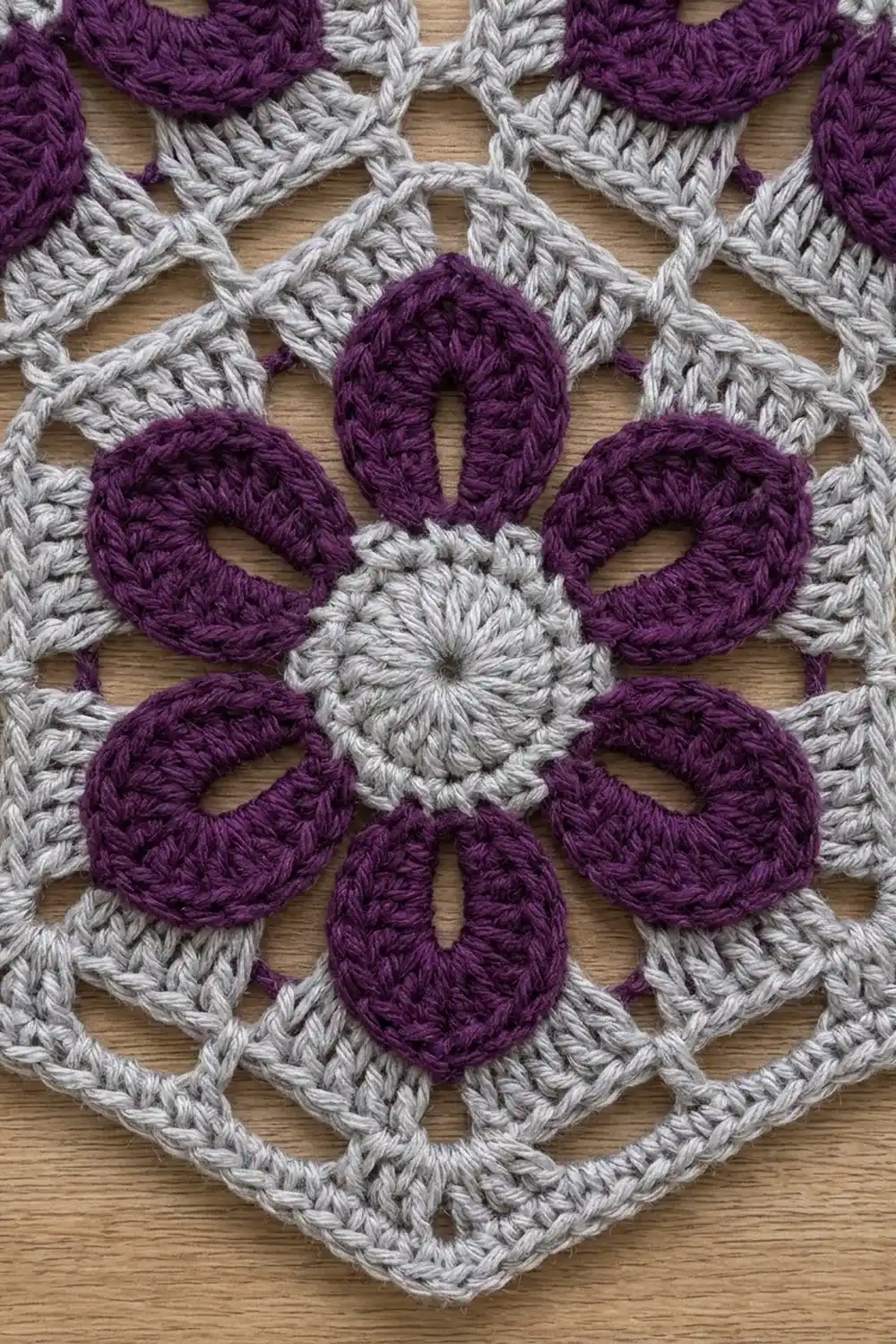
Full Hexagon (Make 7)
Round 1 (A): MR, ch 3 (counts as dc), 11 dc in ring, sl st to top of ch-3. (12 dc)
Round 2 (A): Ch 1, sc in next st, 2 sc in next st 6 times, sl st to first sc. (18 sc) Fasten off.
Round 3 (B): Join B with sc in any st, ch 8, sk 2, sc in next st 5 times, ch 8, sk 2, sl st to first sc. (6 sc, 6 ch-8 loops)
Round 4 (B): Petal in next ch-8 loop, sl st in next sc 6 times. (6 petals; 16 sts each = 96 petal sts, plus 6 sl sts) Fasten off.
Round 5 (A): The dtr spokes go into the Round 3 sc, behind the petals, and become the corners. The sc land on the petal tips. Join A with sl st in any Round 3 sc. Ch 5 (counts as dtr), ch 2, dtr in same sc. Ch 4, sc in sp between 6th and 7th dc of next petal, ch 4, (dtr, ch 2, dtr) in next Round 3 sc 5 times, ch 4, sc in petal tip, ch 4, sl st to top of ch-5. (12 dtr, 6 sc, 12 ch-4 sps, 6 corner ch-2 sps)
Round 6 (A): Sl st into the first ch-2 sp. Ch 3 (counts as dc), (dc, ch 2, 2 dc) in same sp. Dc in next dtr, 4 dc in ch-4 sp, dc in sc, 4 dc in ch-4 sp, dc in next dtr, (2 dc, ch 2, 2 dc) in corner sp 5 times, then repeat the side once more without the last corner, and sl st to top of ch-3. Each side has 2 + 11 + 2 = 15 dc between corner ch-2 sps. (90 dc)
Round 7 (A): Sl st into the first ch-2 sp. Ch 3, (dc, ch 2, 2 dc) in same sp. Dc in each of next 15 dc, (2 dc, ch 2, 2 dc) in corner sp around, sl st to top of ch-3. This is a trim round. Each side has 15 (1 per existing st) + 4 (2 added at each corner) = 19 dc. (114 dc, 6 ch-2 sps) Fasten off.
In this pattern, a “side” means the 19 dc between two corner ch-2 sps. The corner spaces are counted separately.
Half Hexagon (Make 2)
The half hexagon is worked in turned rows. It is the same as the full hexagon cut in half straight through two opposite corners. You get 3 full sides, 3 petals, and one straight cut edge.
Row 1 (A): MR, ch 3 (counts as dc), 6 dc in ring, turn. (7 sts)
Row 2 (A): Ch 1, sc in next st, 2 sc in next st 3 times, sc in last st, turn. (10 sc) Fasten off.
Row 3 (B): Join B with sc in first st, ch 8, sk 2, sc in next st 3 times, turn. (4 sc, 3 ch-8 loops)
Row 4 (B): Ch 1, sl st in first sc, Petal in next ch-8 loop, sl st in next sc 3 times. (3 petals) Fasten off.
Row 5 (A): Join A with sl st in first Row 3 sc. Ch 5 (counts as dtr), ch 4, sc in petal tip, ch 4, (dtr, ch 2, dtr) in next Row 3 sc, ch 4, sc in petal tip, ch 4 twice, dtr in last Row 3 sc, turn.
Row 6 (A): Ch 3 (counts as dc), 2 dc in first dtr, 4 dc in ch-4 sp, dc in sc, 4 dc in ch-4 sp, dc in dtr, (2 dc, ch 2, 2 dc) in corner. Work the middle side as in Round 6. For the last side: dc in dtr, 4 dc, dc in sc, 4 dc, 3 dc in top of ch-5, turn. (15 dc per side)
Row 7 (A): Ch 3, 2 dc in first st, dc in next 14 sts, (2 dc, ch 2, 2 dc) in corner, dc in next 15, (2 dc, ch 2, 2 dc) in corner, dc in next 14, 3 dc in top of turning ch. (19 dc per side; 3 + 14 + 2 = 19 on each end side) Fasten off.
Checkpoint: The straight cut edge should measure 7 in (17.8 cm), the same as the full hexagon’s point-to-point length.
Make All Pieces
- Color A: 7 full hexagons (Rounds 1–2 and 5–7) and 2 half hexagons (Rows 1–2 and 5–7)
- Color B: petals for all 9 pieces (Rounds or Rows 3–4)
Weave in all ends before joining.
Layout (H = full hexagon, h = half hexagon with the cut edge facing out):
          [ H ]
       [ H ] [ H ]
  [h|] [   H   ] [|h]
       [ H ] [ H ]
          [ H ]
Joining
Join with A, wrong sides together, using a sl st seam through the back loops only. Line up the two sides stitch for stitch: corner ch-2 sp to corner ch-2 sp, then 19 dc to 19 dc. Every shared side has the same count, so nothing should be left over.
Seam the pieces row by row. Join the top hexagon to the two below it, then join the middle row and the half hexagons, and keep going down. The layout has 16 seams. Tug lightly after each seam. The seam should lie as flat as the fabric around it. If it puckers, loosen up or go up one hook size just for joining.
Checkpoint: The joined panel should measure 12.1 x 28 in (30.7 x 71.1 cm).
Border
The border is worked in sc, which runs about the same width as your dc, so 19 border sts cover each 3.5 in (8.9 cm) side.
Going around the outline, you’ll meet four kinds of points:
- 10 outer corners: the top and bottom tips, plus 4 on each long side
- 4 inner corners: where the top or bottom hexagon meets the next row
- 4 straight junctions: where a full hexagon’s corner meets a half hexagon’s point
- 2 cut edges: one on each half hexagon
Round 1 (A): Join with sc anywhere along a side. Work as follows:
- Sc in each dc along the 16 open full sides (19 each).
- In each outer corner ch-2 sp, work (sc, ch 2, sc).
- At each inner corner, sc2tog, with one leg in each motif’s ch-2 sp.
- At each straight junction, work 1 sc in the full hexagon’s ch-2 sp.
- Along each cut edge, work 38 sc: 19 from the point down to the ring, and 19 from the ring up to the other point. On each half, place them as Row 7 end: 2, Row 6: 2, Row 5: 6, Rows 3–4: 5, Row 2: 1, Row 1: 3.
The long straight edge on each side gets 19 + 1 + 38 + 1 + 19 = 78 sc. That’s 4 sides’ worth of stitches, because the 7 in (17.8 cm) cut edge equals two sides. Sl st to first sc.
Total: 304 (16 sides x 19) + 76 (cut edges) + 20 (corner sc) + 4 (inner corners) + 4 (junctions) = 408 sc, plus 10 ch-2 sps.
Round 2 (A): Ch 1. Sc in each sc. Work (sc, ch 2, sc) in each outer corner sp. At each inner corner, sc3tog over the sc2tog and the stitch on each side of it. Sl st to first sc.
Total: 408 − 8 (4 sc3tog) + 20 = 420 sc.
Round 3 (A): Ch 1. Rev sc in each sc and 2 rev sc in each corner sp. Sl st to first st.
Total: 420 + 20 = 440 rev sc. Fasten off.
Why the math works: Every side has the same 19 stitches. A cut edge is exactly two sides long, so it gets 38. Outer corners add stitches so the edge can turn, and inner corners take them away. Since the per-side counts never change, the border lies flat. Three short rounds add 0.5 in (1.3 cm) all around, taking the panel from 12.1 x 28 in (30.7 x 71.1 cm) to 13.1 x 29 in (33.3 x 73.7 cm).
Final Blocking
- Weave in the border ends.
- Lay the panel right side up on blocking mats.
- Pin the two tips 29 in (73.7 cm) apart.
- Pin the long sides 13.1 in (33.3 cm) apart, keeping them straight.
- Pin each outer corner, checking that every motif side is 3.5 in (8.9 cm).
- Spray until damp, not soaking.
- Shape the petals with your fingers, opening each slit and puffing up the gray centers.
- Let it dry completely before unpinning.
Final Quality-Control Checklist
- 7 full and 2 half hexagons, each with 19 dc per side
- All petal slits open, all spokes ending at corners
- 16 seams, all flat, with no leftover stitches
- Border counts: 408, 420, and 440
- Long sides straight; tips centered
- Final size 13.1 x 29 in (33.3 x 73.7 cm)
- All ends secured
Troubleshooting
- Petals curl or ruffle: The ch-8 is too tight. Chain more loosely, or work the chain with a hook one size up.
- Hexagon cups: The dtr spokes are too short. Pull up each loop to full height.
- Hexagon ruffles: Your corners are too loose. Make the ch-2 corners snug.
- Half hexagon edge too short: Re-check the Row 7 end counts. Each side must reach 19.
- Border waves: You have too many sts on the cut edges. Recount the 38.
- Border pulls in: Your rev sc is too tight. Loosen it, or use a hook one size up for Round 3.
- Inner corners pucker: Check that the sc2tog and sc3tog are in place.
Care
Hand wash in cool water with mild soap, press out the water in a towel, and dry flat. Reshape it while damp, and don’t hang it while wet.
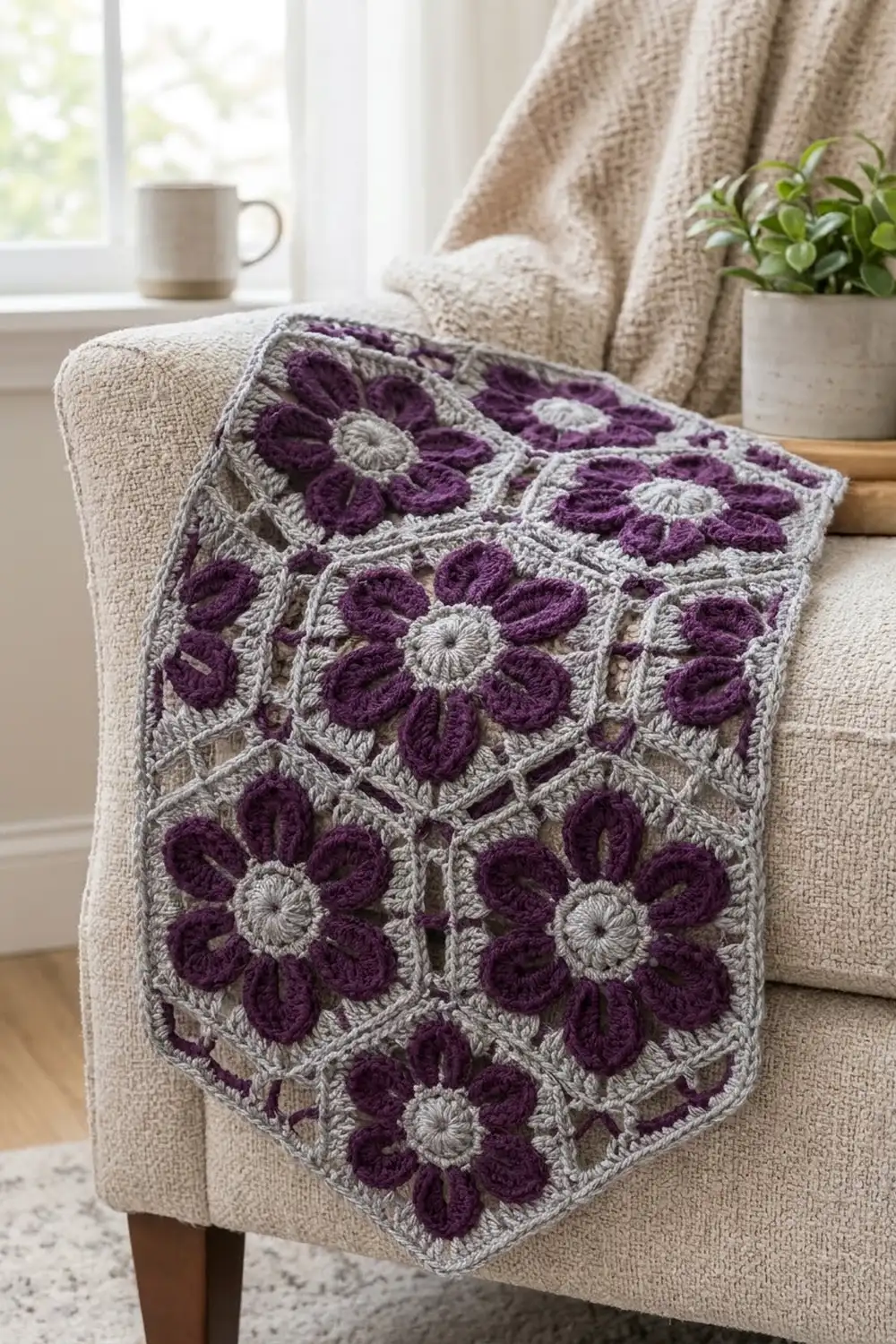
Final Notes
Each check builds on the one before it. A 22-dc gauge gives you a 3.5 in (8.9 cm) side with 19 dc. That makes each hexagon 7 in (17.8 cm) point to point and 6.1 in (15.5 cm) flat to flat. The joined layout measures 12.1 x 28 in (30.7 x 71.1 cm), and after a 0.5 in (1.3 cm) border, the panel finishes at 13.1 x 29 in (33.3 x 73.7 cm). Check one link at a time, and the plum flowers will sit right where they belong.
Happy crocheting!