

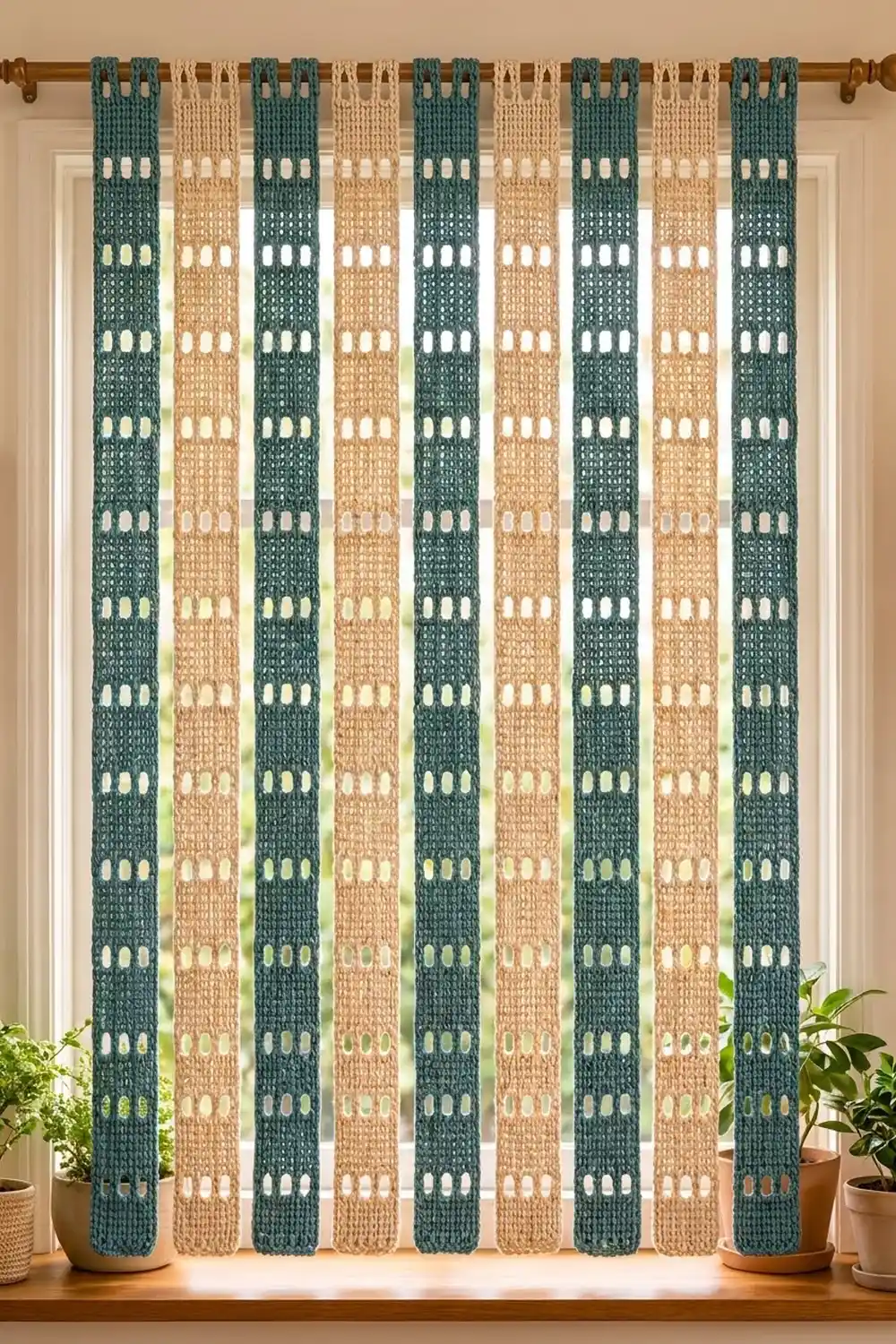
The Window Ladder Curtain is made of nine slim Tunisian crochet strips, each hanging from its own rod pocket. The fabric is dense and looks almost knitted. Every 2 in (5.1 cm), a row of four small eyelets lets daylight through, so each strip looks like a ladder of light.
The strips alternate between muted teal and warm cream, with teal on both outer edges. The look is calm and modern, with a little farmhouse feel. It suits a kitchen window, a pantry doorway or a reading nook.
This pattern uses US crochet terms. Each finished strip measures 4 in (10.2 cm) wide and 58 in (147.3 cm) long as it hangs. Hung with 2 in (5.1 cm) gaps, the nine strips cover 52 in (132.1 cm) of rod.
Each strip is worked flat in Tunisian simple stitch from the bottom up, with an eyelet row every eighth row. You then work one round of single crochet around the edge, fold the top over to make a rod pocket, and sew it down. The strips are never sewn to each other.
Finished Size and Construction
- Finished strip size (hanging): 4 in × 58 in (10.2 cm × 147.3 cm)
- Strip size before border: 3.5 in × 60 in (8.9 cm × 152.4 cm)
- Strip size after border, unfolded: 4 in × 60.5 in (10.2 cm × 153.7 cm)
- Border depth: 0.25 in (0.6 cm), 1 round of sc
- Rod pocket: 2.5 in (6.4 cm) deep, fits rods up to 1.25 in (3.2 cm) across
- Skill level: Easy to intermediate (basic Tunisian simple stitch required)
- Terminology: US
- Yarn weight: Worsted (#4), cotton or cotton blend
- Hook: 5.5 mm (I-9) Tunisian hook; 5.0 mm (H-8) standard hook for the border
- Number of pieces: 9 separate strips (5 teal, 4 cream)
- Layout: One row of 9 strips, alternating colors, spaced 2 in (5.1 cm) apart
- Total curtain width: 52 in (132.1 cm)
Materials
Yarn: Use a smooth worsted-weight cotton or cotton blend with about 170 m per 100 g (186 yd per 100 g). Cotton hangs straight, shows the eyelets clearly and holds up to sunlight better than most acrylics. Avoid fuzzy yarns, which fill in the eyelets.
- Teal (5 strips): 500 g / 850 m (930 yd)
- Cream (4 strips): 400 g / 680 m (744 yd)
One strip uses about 151 m (165 yd), or roughly 89 g. The amounts above include a margin of about 10% for the gauge swatch and small tension differences.
Tools:
– 5.5 mm (I-9) Tunisian hook, any length (only 14 loops are on the hook at once)
– 5.0 mm (H-8) standard crochet hook
– Tapestry needle
– Locking stitch markers
– Rigid tape measure
– Blocking mats and rust-proof pins
– Curtain rod, up to 1.25 in (3.2 cm) across
Abbreviations (US Terms)
- ch – chain
- sc – single crochet
- sl st – slip stitch
- st(s) – stitch(es)
- sk – skip
- yo – yarn over
- RS / WS – right side / wrong side
- FwP – forward pass (loops picked up onto the hook, right to left)
- RetP – return pass (loops worked off the hook, left to right)
Special stitches:
- Tss (Tunisian simple stitch): Insert the hook from right to left under the next front vertical bar, yo, and pull up a loop. Leave the loop on the hook.
- End st: Insert the hook under both strands of the last vertical bar at the left edge, yo, and pull up a loop. This keeps the edge firm.
- Standard RetP: Yo, pull through 1 loop. Then [yo, pull through 2 loops] until 1 loop remains. That last loop counts as the first stitch of the next row.
- Eyelet (Tunisian yarn over): In the FwP, yo, then sk the next vertical bar. The yo stays on the hook as a loop and is worked off as normal in the RetP. In the next row, work a Tss under the slanted yo strand as if it were a vertical bar.
Gauge and Checkpoints
Gauge: 16 sts and 16 rows = 4 in (10.2 cm) in Tss with the 5.5 mm hook, measured after blocking. That is 4 sts and 4 rows per inch (2.5 cm).
Test with the first strip. Work Rows 1–12, then lay the piece flat without stretching it and measure.
- Checkpoint 1 (Row 12): 3.5 in × 3 in (8.9 cm × 7.6 cm)
- Checkpoint 2 (Row 44): 11 in (27.9 cm) long, still 3.5 in (8.9 cm) wide
- Checkpoint 3 (Row 124): 31 in (78.7 cm) long
- Checkpoint 4 (Row 240): 60 in (152.4 cm) long
- Checkpoint 5 (after border): 4 in × 60.5 in (10.2 cm × 153.7 cm)
- Checkpoint 6 (after folding): 4 in × 58 in (10.2 cm × 147.3 cm)
If your strip is too wide or too long, go down to a 5.0 mm (H-8) Tunisian hook. If it is too narrow or too short, go up to a 6.0 mm (J-10). Width matters most, because nine strips multiply any error. Being off by 0.25 in (0.6 cm) per strip adds up to 2.25 in (5.7 cm) across the curtain.
Tunisian simple stitch curls toward the front. That is normal. The border and blocking will flatten it.
Strip Pattern (Make 9)
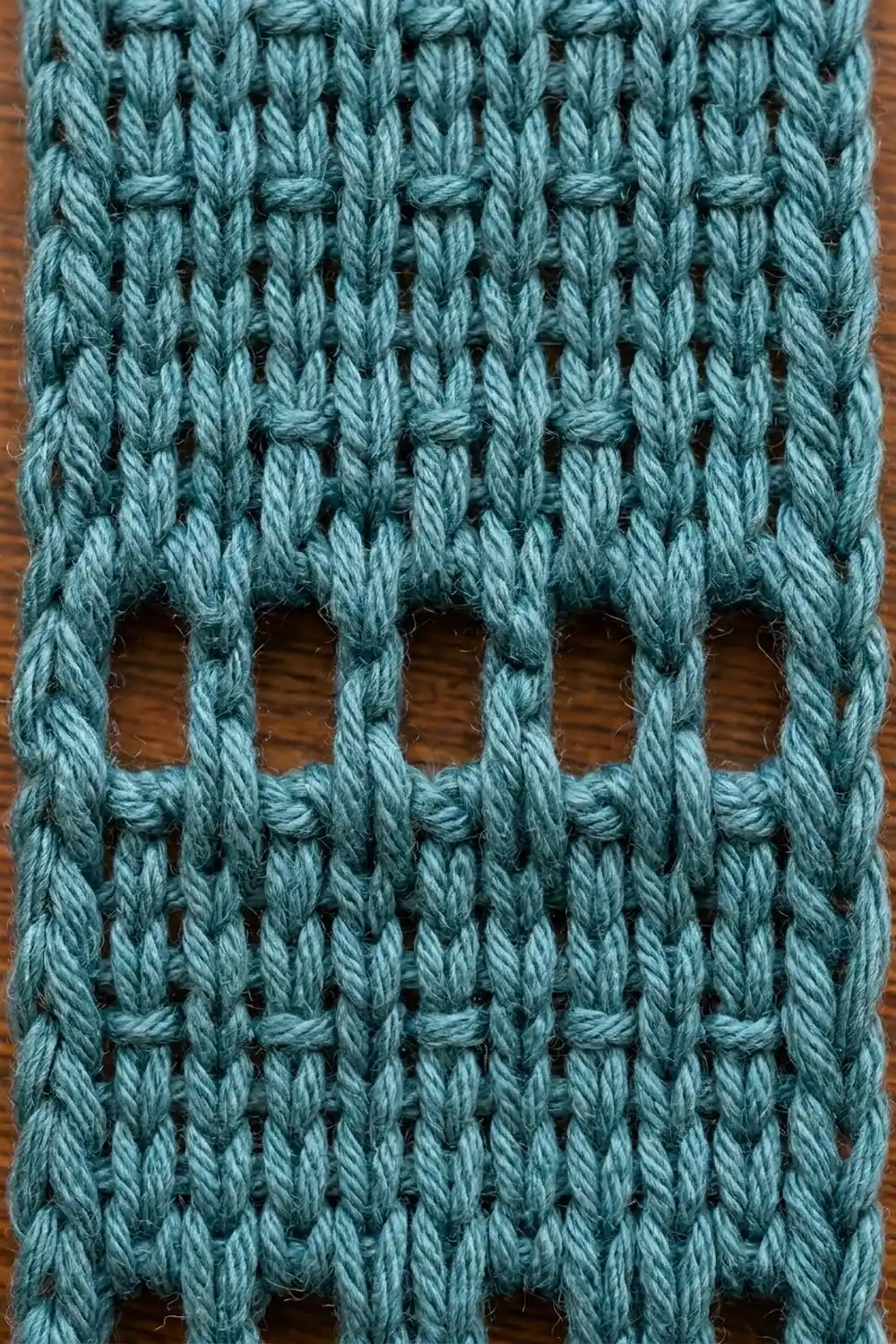
Each strip has 14 sts across. The eyelet row places 4 eyelets in these columns:
2 solid | eyelet | 2 solid | eyelet | 2 solid | eyelet | 2 solid | eyelet | 2 solid
That gives 2 + 4 + (3 × 2) + 2 = 14 sts. The eyelets are evenly spaced, and two solid columns frame each long edge.
Foundation
Row 1: Ch 14.
– FwP: Pull up a loop in the back bump of the 2nd ch from the hook and of each remaining ch. (14 loops on hook)
– RetP: Standard RetP. (14 sts)
Bottom solid section
Rows 2–4:
– FwP: The loop on the hook counts as the first st. Tss in each of the next 12 sts, then end st in the last st. (14 loops)
– RetP: Standard RetP. (14 sts)
The strip now measures 1 in (2.5 cm) long.
Eyelet block (8 rows, repeat 28 times)
Row 5 (eyelet row):
– FwP: The loop on the hook counts as the first st. Tss in the next st. [Yo, sk next st, Tss in each of next 2 sts] 3 times. Yo, sk next st, Tss in next st, end st in last st. (14 loops: 10 pulled-up loops + 4 yo loops)
– RetP: Standard RetP. Work the yo loops off like any other loop. (14 sts, with 4 eyelets)
Rows 6–12:
– FwP: The loop on the hook counts as the first st. Tss in each of the next 12 sts, then end st in the last st. In Row 6, the 4 Tss over the eyelets go under the yo strands.
– RetP: Standard RetP. (14 sts)
These 8 rows (Rows 5–12) make one eyelet block, which is 2 in (5.1 cm) long.
Rows 13–228: Repeat Rows 5–12 another 27 times, for 28 blocks in total.
The eyelet rows fall on Rows 5, 13, 21 and so on up to Row 221, which is the 28th and last one. Row 228 ends the last block. Every row has 14 sts.
The strip now measures 57 in (144.8 cm) long.
Top solid section and rod pocket
Rows 229–240: Work as Row 2 (Tss rows). (14 sts each row)
Counting the 7 solid rows that end the last block, there are now 19 solid rows above the last eyelet row. That is 4.75 in (12.1 cm), enough room for the rod pocket.
Bind-off: The loop on the hook counts as the first st. [Insert the hook as for Tss under the next vertical bar, yo, pull through the bar and the loop on the hook] 12 times. Then sl st in the end st the same way. Do not fasten off. Keep the last loop for the border.
The strip now measures 3.5 in × 60 in (8.9 cm × 152.4 cm).
Make All Pieces
Make 9 strips:
- Teal: 5 strips
- Cream: 4 strips
Order on the rod, viewed from the room:
[T]  [C]  [T]  [C]  [T]  [C]  [T]  [C]  [T]
 ^-- 2 in (5.1 cm) gap between strips --^
T = teal, C = cream. Every strip is 4 in (10.2 cm) wide and 58 in (147.3 cm) long as it hangs.
Before you start the borders, put all nine strips side by side. Every strip should be 60 in (152.4 cm) long, give or take 0.5 in (1.3 cm), with its eyelet rows level with the other strips. Rows are the same in every strip, so a strip that is off in length points to a tension problem, not a counting problem.
Joining (Rod Pocket Seam)
The strips are not joined to each other. The only seam in this project closes each strip’s own rod pocket.
Method: Whipstitch on the WS, using the yarn color of that strip.
- Finish the border first (see below).
- Lay the strip WS up. Fold the top end toward you along the line between Rows 231 and 232. The folded flap is 2.5 in (6.4 cm) deep: 9 rows (2.25 in / 5.7 cm) plus the 0.25 in (0.6 cm) border.
- The bordered top edge now lies on Row 222, just above the last eyelet row (Row 221). Pin it straight.
- Stitch to stitch: The top border edge has 18 sc between its two corner-center sc (counted below). Match them to Row 222 like this: the 12 middle top sc go to the 12 middle Tss of Row 222, one to one. Each pair of corner sc goes to the edge st and the side border sc next to it. Whipstitch through both loops of each top sc and the matching vertical bar.
- Leave the sides of the pocket open for the rod.
Tension: Pull each whipstitch snug, but no tighter than the Tss fabric. A tight seam puckers across the front and pulls the eyelet row out of line.
Size checkpoint: The pocket lies flat at 4 in × 2.5 in (10.2 cm × 6.4 cm). The hanging strip measures 58 in (147.3 cm) from the fold to the bottom edge.
Border
Border gauge: 4 sc per in (2.5 cm) along both stitch edges and row edges, worked with the 5.0 mm hook. Tss has 4 sts and 4 rows per inch, so one sc in every stitch and one sc in every row end matches the fabric exactly.
Round 1: Use the 5.0 mm hook and the loop left from the bind-off. Work around the whole strip, with the RS facing.
- Top edge: 3 sc in the first bind-off st (corner). Sc in each of the next 12 sts. 3 sc in the last st (corner).
- Left long edge: Sc in the end of each row from Row 239 down to Row 2. That is 238 sc. Rows 240 and 1 are covered by the corners.
- Bottom edge: 3 sc in the first foundation ch (corner). Sc in each of the next 12 ch. 3 sc in the last ch (corner).
- Right long edge: Sc in the end of each row from Row 2 up to Row 239. That is 238 sc.
- Join with a sl st to the first sc and fasten off.
Counts per side, counting the middle sc of each corner group as part of both sides it touches:
- Short sides (top and bottom): 14 sc each (12 + 2 corner centers)
- Long sides: 240 sc each (238 + 2 corner centers)
- Round total: 12 + 12 + 238 + 238 + (4 corners × 3) = 512 sc
Why the math works: The short sides have 14 sc for 14 Tss sts, and the long sides have 240 sc for 240 rows. The border uses exactly one stitch per stitch and one per row. Its gauge matches the fabric, so it adds 0.25 in (0.6 cm) on every side without ruffling or pulling in. Width: 3.5 + 0.25 + 0.25 = 4 in (10.2 cm). Length: 60 + 0.25 + 0.25 = 60.5 in (153.7 cm).
Final Blocking
- Weave in all ends along the WS of the border, not across the eyelets.
- Soak each strip in cool water for 15 minutes, then press out the water. Do not wring it.
- Roll the strip in a towel to remove more water.
- Lay it WS up on the blocking mats and pin it out to 4 in × 60.5 in (10.2 cm × 153.7 cm).
- Pin both long edges every 3 in (7.6 cm), keeping them perfectly straight. This takes out the Tunisian curl.
- Open each eyelet gently with a fingertip so all four in the row line up.
- Let it dry completely, usually 24 hours. Unpin.
- Fold and sew the rod pocket as described in the Joining section.
- Hang all strips on the rod and space them 2 in (5.1 cm) apart.
Final Quality-Control Checklist
- [ ] Each strip has 14 sts on every row and 4 eyelets in every eyelet row
- [ ] There are 28 eyelet rows per strip, all level across the curtain
- [ ] There are 4 solid rows below the first eyelet row and 19 above the last
- [ ] The border has 512 sc, with 14 per short side and 240 per long side
- [ ] Each blocked strip measures 4 in × 60.5 in (10.2 cm × 153.7 cm)
- [ ] Each pocket is 2.5 in (6.4 cm) deep and open at both sides
- [ ] Each strip hangs 58 in (147.3 cm) long
- [ ] The strips run teal, cream, teal and so on, with teal at both ends
- [ ] The curtain covers 52 in (132.1 cm) with even 2 in (5.1 cm) gaps
Troubleshooting
The strip curls into a tube. Tss always curls. Make your RetP a little looser, block firmly, and check that the border has exactly one sc per row.
The strip gets wider as you go. You are probably picking up a loop from the horizontal strand at the far left. Count 14 loops at the end of every FwP.
An eyelet has closed up. In the next row, you probably worked the Tss into the bar beside the yo strand instead of under the yo strand itself. Rip back and work under the slanted yo strand.
The eyelets lean to one side. Make sure the RetP takes the first loop off alone, then works 2 together.
The border ruffles. You have worked more than one sc per row end. Rip back and count 238 sc between the corners.
The border pulls in. Use a 5.5 mm hook for the border.
One strip is shorter than the others. Rows are fixed, so this is tension. Wet-block that strip to the target length, pinning it at 60.5 in (153.7 cm).
The bottom of the pocket seam shows on the front. Sew only through the back strand of each Row 222 stitch.
Care
Hand wash in cool water with mild detergent and dry flat, reshaping each strip to 4 in × 60.5 in (10.2 cm × 153.7 cm) before you fold the pocket back down. Do not tumble dry, because heat can shrink cotton and change the strip lengths.
Final Notes
The whole curtain depends on one chain of measurements:
- Gauge: 16 sts and 16 rows = 4 in (10.2 cm)
- 14 sts × 240 rows = 3.5 in × 60 in (8.9 cm × 152.4 cm)
- One round of sc brings each strip to 4 in × 60.5 in (10.2 cm × 153.7 cm)
- A 2.5 in (6.4 cm) fold gives a hanging length of 58 in (147.3 cm)
- Nine strips with eight 2 in (5.1 cm) gaps make 52 in (132.1 cm) of curtain
Check your gauge on the first strip, count your loops on every row, and the rest falls into place.
Happy crocheting!