

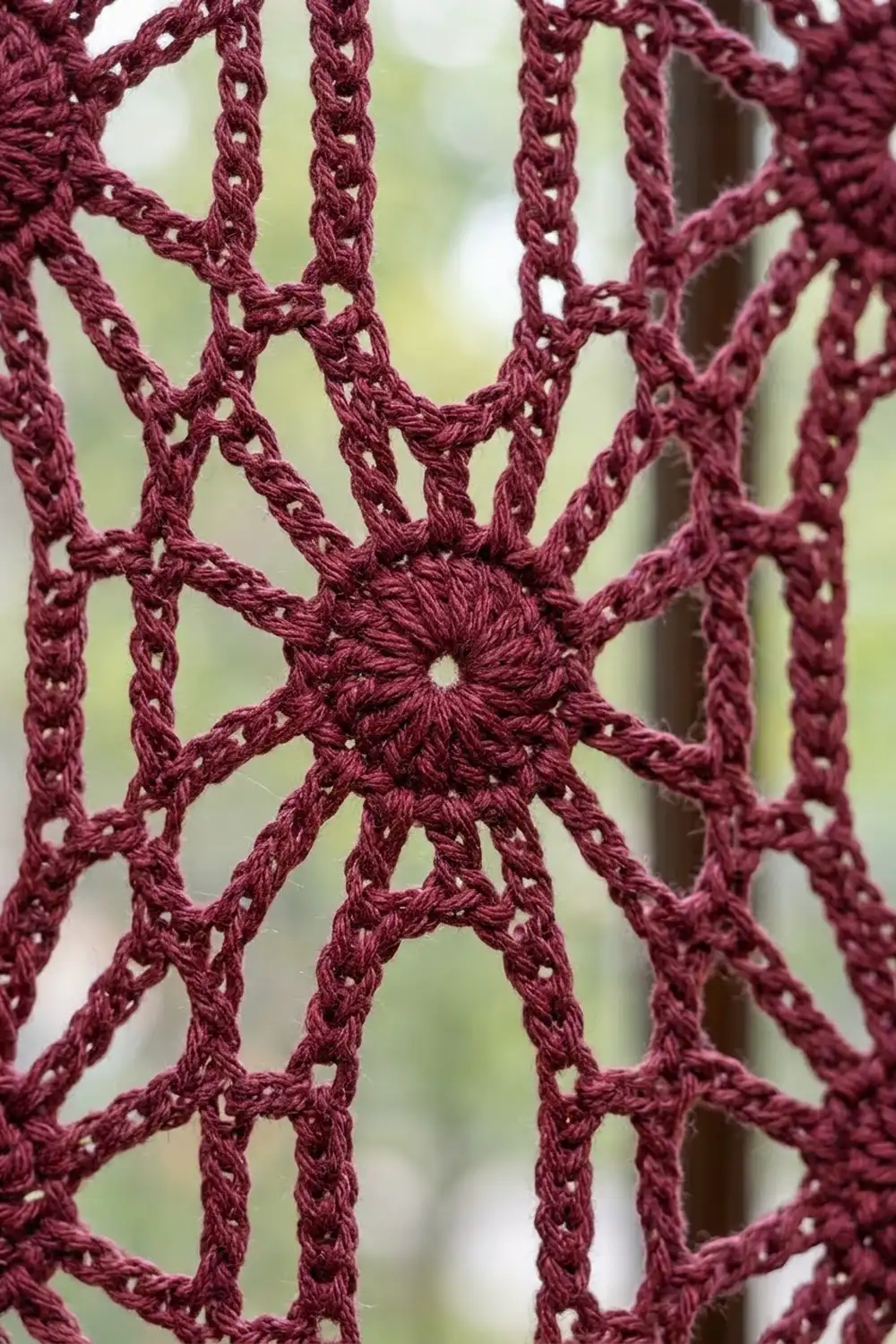
The Bordeaux Starburst Lace Curtain Panel is an openwork panel that lets light through and still keeps its shape. Columns of starburst medallions, each narrowing to a raised popcorn center, sit between neat ladder columns of stacked double crochet. The bottom edge has a firm single crochet band and a row of small shell scallops. Flat tabs along the top slide straight onto a curtain rod.
The sample is worked in one deep burgundy mercerized cotton. It gives clear stitch definition and a slight sheen when light comes through the window. The style is classic and a little vintage, so it suits a study, a reading nook, or a kitchen window.
This pattern uses US crochet terms. The finished panel measures 29.75 in (75.6 cm) wide by 50 in (127.0 cm) long. The tab loops add another 2.5 in (6.4 cm) above the top edge.
You work the panel in rows from the bottom up as one piece, so there are no motifs to join. After the body, two rounds of single crochet frame all four edges. A shell row then finishes the bottom, and you work seven tabs on the top edge. For a pair, make a second identical panel.
Finished Size and Construction
- Finished size: 29.75 in x 50 in (75.6 cm x 127.0 cm), plus 2.5 in (6.4 cm) tab loops
- Skill level: Intermediate
- Terminology: US crochet terms
- Yarn weight: DK (#3) mercerized cotton
- Hook: 4.5 mm (US 7)
- Number of pieces: 1 panel (make 2 for a pair)
- Layout: 8 medallion columns across, 16 medallions tall
- Piece size before border: 28.75 in x 48.5 in (73.0 cm x 123.2 cm)
- Border depth: 0.5 in (1.3 cm) on the sides and top; 1 in (2.5 cm) on the bottom
Materials
Choose a smooth mercerized cotton or cotton blend in DK weight. Cotton keeps the lace crisp, blocks well, and doesn’t stretch much when the panel hangs. Avoid fuzzy or very stretchy yarn, because the long chain spaces will droop.
- Burgundy (one color): 400 g, about 900 m (984 yd), for example 8 balls of 50 g / 113 m
- 4.5 mm (US 7) crochet hook
- Tapestry needle
- Stitch markers
- Tape measure
- Blocking mats or a clean towel-covered surface, plus rust-proof pins
- Spray bottle or basin for wet blocking
The yarn amounts include a margin of about 15% for swatching and small gauge differences. For a pair of panels, double everything.
Abbreviations (US Terms)
- ch – chain
- sl st – slip stitch
- sc – single crochet
- dc – double crochet
- sk – skip
- sp – space
- st(s) – stitch(es)
- rep – repeat
- pc – popcorn
- RS – right side
Popcorn (pc): Work 5 dc in the same stitch. Take the hook out of the loop and insert it from front to back into the top of the first dc of the group. Pick up the dropped loop and pull it through. The popcorn counts as 1 stitch. The side it pops toward is the RS.
Counting rule: In this pattern, each chain counts as 1 stitch. A ch-3 sp counts as 3 sts, a ch-4 sp as 4 sts, and a ch-5 sp as 5 sts. The ch-3 at the start of every row counts as the first dc.
Gauge and Checkpoints
Gauge (blocked): 1 pattern repeat is 14 sts wide by 6 rows tall and measures 3.5 in x 3 in (8.9 cm x 7.6 cm). That works out to 4 sts and 2 rows per 1 in (2.5 cm).
Test swatch: Ch 33. Work Row 1 (31 dc), then work Rows 2–7 once. You now have 2 medallions side by side and 3 ladder columns. Wet block the swatch and let it dry. Over its 7 rows it should measure 7.75 in (19.7 cm) wide by 3.5 in (8.9 cm) tall.
Panel checkpoints:
– After Row 1: 28.75 in (73.0 cm) wide
– After Row 25 (4 medallion rows): 12.5 in (31.8 cm) tall
– After Row 97: 28.75 in x 48.5 in (73.0 cm x 123.2 cm), lightly stretched flat
– After Border Round 2: 29.75 in x 49.5 in (75.6 cm x 125.7 cm)
– After the shell row: 29.75 in x 50 in (75.6 cm x 127.0 cm)
If your swatch is too big, go down 0.5 mm in hook size. If it is too small, go up 0.5 mm. Lace grows when you block it, so always measure a blocked and dried swatch, never a fresh one.
Panel Body
The panel has 8 repeats of 14 sts, plus 3 sts for the last ladder column: 8 x 14 + 3 = 115 sts. Every row follows the same layout: one 3-dc ladder column, then 8 sets of (11 medallion sts + one 3-dc ladder column).
Foundation: Ch 117.
Row 1 (band row): Dc in 4th ch from hook (the 3 skipped ch count as the first dc), dc in each ch across. Turn. (115 dc)
Row 2: Ch 3 (counts as dc), dc in next 2 sts, ch 3, sk 3 sts, dc in next 5 sts, ch 3, sk 3 sts, dc in next 3 sts; rep from * 7 more times. Turn.
(115 sts: 9 ladder columns x 3 dc = 27 dc, plus 8 medallion sections x 11 sts = 88 sts)*
Row 3: Ch 3, dc in next 2 dc, ch 4, sk the ch-3 sp and next dc, dc in next 3 dc, ch 4, sk next dc and ch-3 sp, dc in next 3 dc; rep from * 7 more times. Turn.
(115 sts; each medallion = 4 + 3 + 4 = 11 sts)*
Row 4 (center row): Ch 3, dc in next 2 dc, ch 5, sk the ch-4 sp and next dc, pc in next dc, ch 5, sk next dc and ch-4 sp, dc in next 3 dc; rep from * 7 more times. Turn.
(115 sts; each medallion = 5 + 1 pc + 5 = 11 sts)*
This is where the starburst forms. The diamond has narrowed to one popcorn, and the long ch-5 spaces open out on both sides of it.
Row 5: Ch 3, dc in next 2 dc, ch 4, sk first 4 ch of the ch-5 sp, dc in 5th ch, dc in top of pc, dc in first ch of next ch-5 sp, ch 4, sk remaining 4 ch, dc in next 3 dc; rep from * 7 more times. Turn.
(115 sts; each medallion = 4 + 3 + 4 = 11 sts)*
Row 6: Ch 3, dc in next 2 dc, ch 3, sk first 3 ch of the ch-4 sp, dc in 4th ch, dc in next 3 dc, dc in first ch of next ch-4 sp, ch 3, sk remaining 3 ch, dc in next 3 dc; rep from * 7 more times. Turn.
(115 sts; each medallion = 3 + 5 + 3 = 11 sts)*
Row 7 (link band): Ch 3, dc in next 2 dc, (dc, ch 1, dc) in ch-3 sp, dc in next 5 dc, (dc, ch 1, dc) in next ch-3 sp, dc in next 3 dc; rep from * 7 more times. Turn.
(115 sts: 99 dc and 16 ch-1s)*
In Row 7, each medallion section has 11 sts: a 3-st (dc, ch 1, dc) group, then 5 dc, then another 3-st group. Across the row that gives 27 ladder dc + 8 x 11 = 115 sts.
Rows 8–97: Rep Rows 2–7 fifteen more times. In Row 2, “sk 3 sts” now skips a (dc, ch 1, dc) group from Row 7, so each medallion sits directly above the one below. Do not fasten off. (97 rows total, 16 medallions in each column, 115 sts per row)
Check: 1 + (16 x 6) = 97 rows. At 2 rows per inch, 97 rows = 48.5 in (123.2 cm).
Border
Border gauge: 4 sc = 1 in (2.5 cm) along every edge, which matches the body’s 4 sts per inch. On the sides, each dc row-end is 0.5 in (1.3 cm) tall, so 2 sc per row-end gives exactly 4 sc per inch.
In this border, the side counts do not include the corners. Each corner is a separate ch-2 sp.
Round 1: Ch 1, do not turn. Working across the top of Row 97, sc in each st across. (115 sc on top) Ch 2 for the corner. Turn the work and go down the side, working 2 sc in each row-end. (97 x 2 = 194 sc) Ch 2. Working across the bottom in the foundation ch, sc in each ch. (115 sc) Ch 2. Work up the other side, 2 sc in each row-end. (194 sc) Ch 2, sl st to first sc.
(618 sc: 115 + 194 + 115 + 194, plus 4 corner ch-2 sps)
Round 2: Ch 1, sc in each sc around, working (sc, ch 2, sc) in each corner ch-2 sp. Sl st to first sc.
(626 sc: top 117, sides 196 each, bottom 117, plus 4 corner ch-2 sps)
Each side gains 2 sc, one from each of its corner sps. Each sc round adds 0.25 in (0.6 cm) on every edge, so the panel is now 29.75 in (75.6 cm) wide. Fasten off.
Bottom Shell Row: With RS facing, join yarn with a sc in the first sc of the bottom edge, just after the corner sp. Sk 1 sc, 3 dc in next sc, sk 1 sc, sc in next sc; rep from * 28 more times. Fasten off.
(29 shells and 30 sc)*
Why this works: each shell repeat uses 4 sc, and you need 1 sc to start. Since 1 + (29 x 4) = 117, the shells fit the bottom edge exactly and lie flat without ruffling.
Tabs (make 7): Work the tabs across the 117 sc on the top edge of Round 2, counting between the corner sps. Place markers first: skip 4 sc, mark 7 sc for Tab 1, skip 10 sc, mark 7 sc for Tab 2, and keep going the same way. This adds up to 4 + (7 x 7) + (6 x 10) + 4 = 117 sc.
- Row 1: With RS facing, join yarn with sc in the first marked sc, sc in next 6 sc. Turn. (7 sc)
- Rows 2–20: Ch 1, sc in each sc across. Turn. (7 sc)
Fasten off and leave a 12 in (30.5 cm) tail. At 4 sc rows per inch, each tab is 1.75 in (4.4 cm) wide and 5 in (12.7 cm) long. Fold each tab to the wrong side and sew its last row along the back of Round 1. This makes a 2.5 in (6.4 cm) loop that fits rods up to 1.25 in (3.2 cm) in diameter.
Final Blocking
- Weave in all ends along the ladder columns or the border, never through the chain spaces.
- Soak the panel in cool water with a little wool wash for 15 minutes.
- Gently press out the water without wringing. Roll the panel in towels to remove more water.
- Lay it flat on mats and pin the corners to 29.75 in x 50 in (75.6 cm x 127.0 cm).
- Pin along each side every 3 in (7.6 cm), keeping the ladder columns straight and parallel.
- Pin the point of each shell scallop along the bottom edge.
- Open each medallion with your fingers so the popcorn is centered and the chain spaces are even.
- Let the panel dry completely before you unpin it. If it has relaxed a lot, give it a light steam at its final size.
Final Quality-Control Checklist
- 115 sts in every body row and 97 rows in total
- 8 medallion columns and 9 straight ladder columns
- Every medallion has 1 popcorn, centered on Row 4 of its repeat
- Border Round 2: 117 / 196 / 117 / 196 sc, with 4 corner sps
- 29 shells along the bottom, all lying flat
- 7 tabs, evenly spaced and all the same length
- Blocked size: 29.75 in x 50 in (75.6 cm x 127.0 cm)
Troubleshooting
Medallions lean to one side: In Rows 3 and 4, make sure you skip the whole chain space plus 1 dc. A miscounted skip moves the medallion center.
Panel gets narrower or wider as you go: Count 115 sts at the end of every Row 7. Most errors come from working into the ch-3 turning chain as an extra stitch.
Side border ripples: You worked more than 2 sc per row-end. If it puckers instead, you worked fewer than 2.
Shell row ruffles: Your shells may have 4 or 5 dc. Keep each one to 3 dc.
Popcorns sink to the back: Insert the hook from front to back when you close each popcorn, so it pops toward the RS.
Panel too long after hanging: Cotton relaxes a little over time. Re-wet the panel and block it shorter. On your next panel, you can also leave out one 6-row repeat before the border.
Care
Hand wash in cool water, or machine wash on a gentle cycle in a mesh bag. Lay flat to dry and re-block if needed. Do not tumble dry.

Final Notes
The measurements build in a simple chain. One 14-st by 6-row repeat measures 3.5 in x 3 in (8.9 cm x 7.6 cm). Eight repeats plus the last ladder column give 115 sts, or 28.75 in (73.0 cm), and 97 rows give 48.5 in (123.2 cm). The two sc rounds bring the panel to 29.75 in x 49.5 in (75.6 cm x 125.7 cm). The shell row finishes it at 50 in (127.0 cm) long, and the tabs add 2.5 in (6.4 cm) loops on top. If you check each step of that chain, your panel will hang straight and even.
Happy crocheting!