

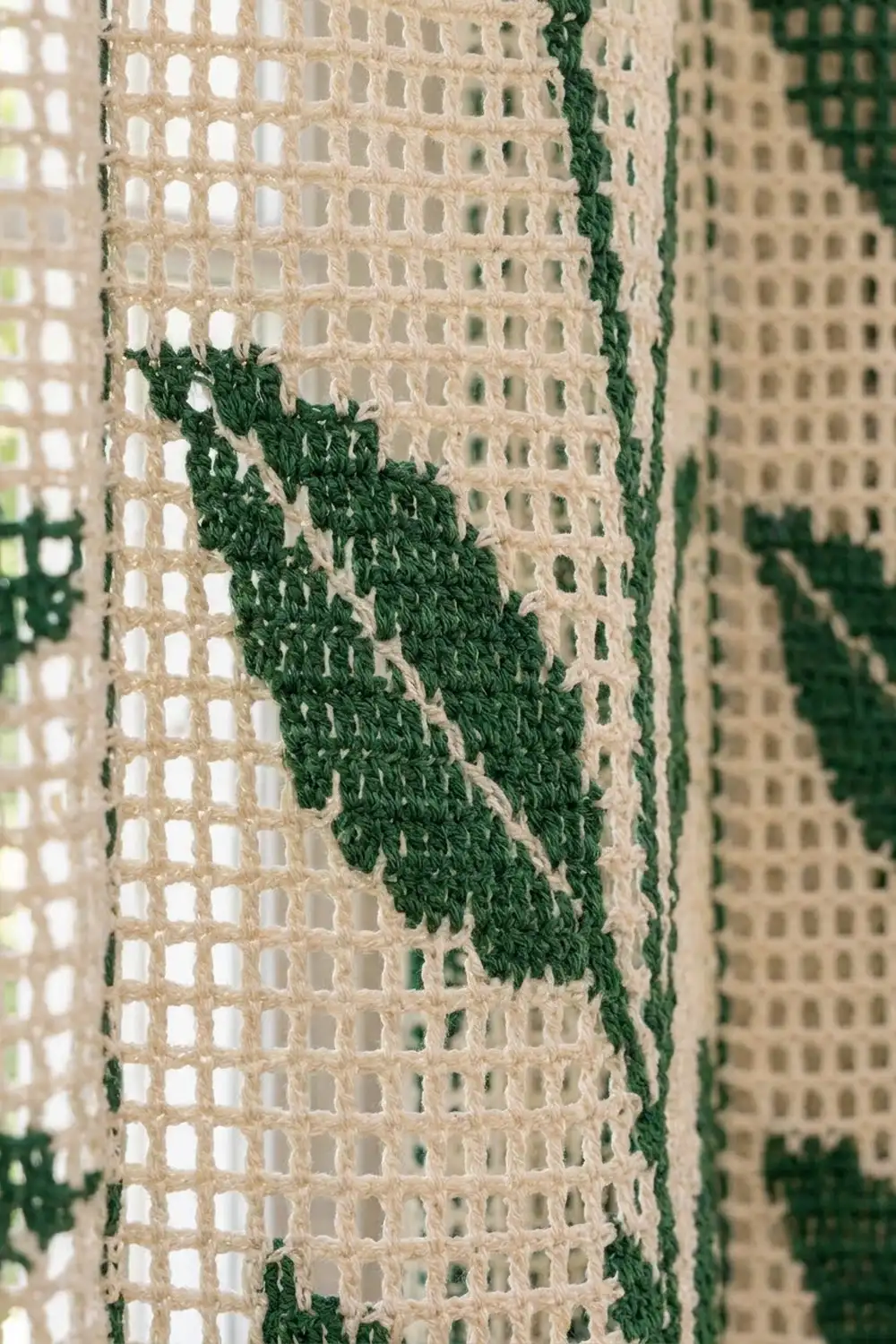
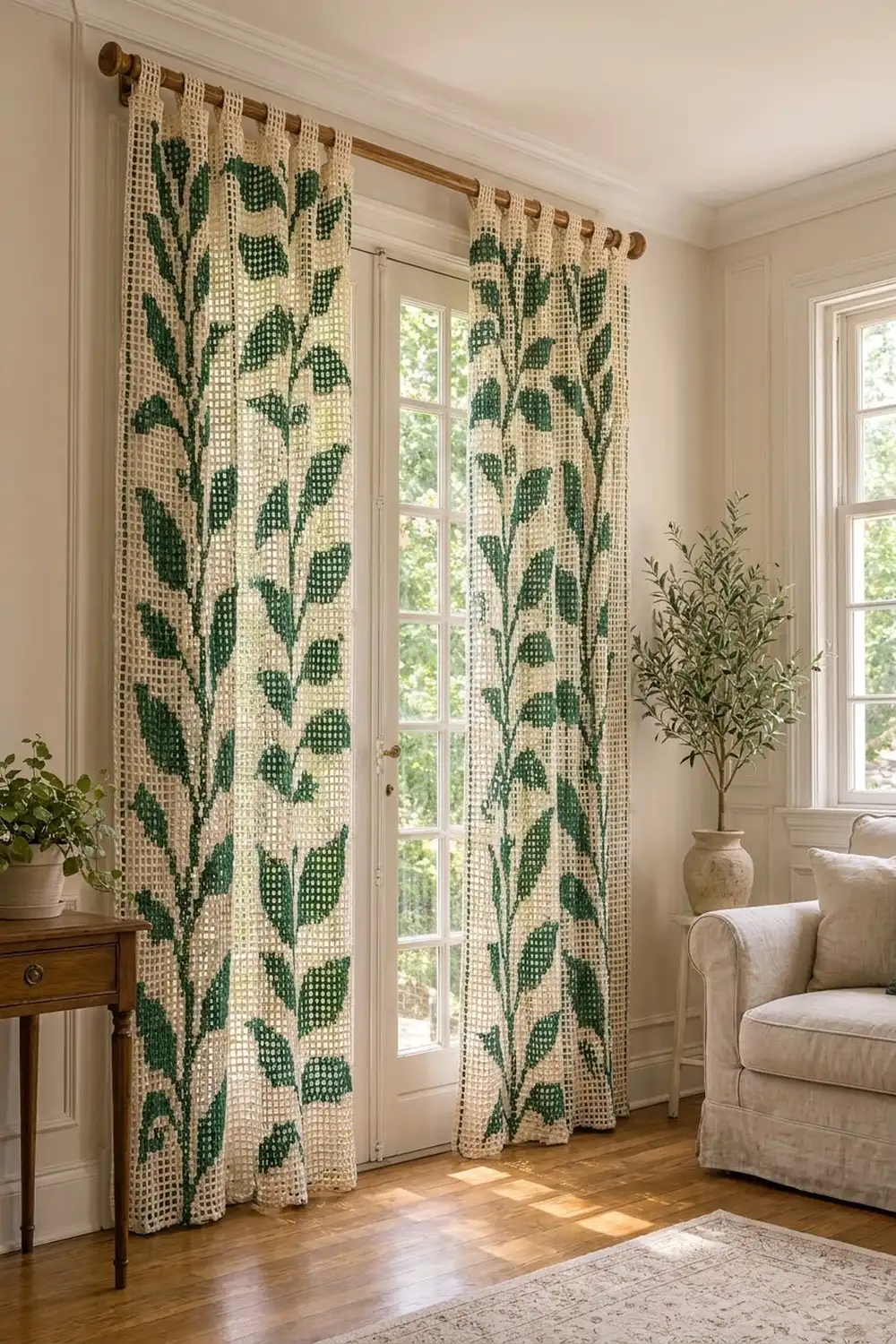
These tab-top curtains bring a garden indoors. Cream filet mesh lets the light through, and climbing green vines with pointed leaves run up each panel. When the light is behind them, the vines show up as clean silhouettes.
There are only two colors: a soft cream background and a deep forest green for the vines. The style is classic filet crochet, a grid of open and filled blocks, with a simple, modern botanical design. This pattern uses US crochet terms throughout.
Each finished panel measures 32 in wide by 79 in long (81.3 × 200.7 cm), not counting the tabs. The tabs add about a 3 in (7.6 cm) loop above the panel.
Each panel is made from two identical vertical strips worked from the bottom up. You seam the strips together, work a two-round single crochet border around the panel, then add six mesh tabs along the top. The pattern gives instructions for one panel. Make two panels for a pair.
Finished Size and Construction
- Finished panel size: 32 × 79 in (81.3 × 200.7 cm), without tabs
- Skill level: Intermediate (filet crochet plus simple color changes)
- Terminology: US crochet terms
- Yarn weight: Sport (#2) mercerized cotton
- Hook: 3.5 mm (E-4)
- Number of pieces: 2 strips per panel (4 strips for a pair)
- Layout: 2 strips side by side, seamed along their long edges
- Strip size: 15.5 × 78 in (39.4 × 198.1 cm), 31 blocks × 156 rows
- Size before border: 31 × 78 in (78.7 × 198.1 cm)
- Border depth: 0.5 in (1.3 cm) on each side
- Tabs: 6 per panel, each 1.5 in (3.8 cm) wide, folded into a 3 in (7.6 cm) loop
Materials
Use a smooth, mercerized sport-weight cotton or cotton blend. It keeps the mesh crisp and holds up well in sunlight and in the wash. Avoid fuzzy or very stretchy yarns, because long panels can grow when they hang.
Per panel:
– Cream (background): about 250 g / 750 m (820 yd)
– Forest green (vines): about 50 g / 150 m (164 yd)
For a pair: double these amounts, 500 g / 1,500 m cream and 100 g / 300 m green.
The quantities assume about 150 m per 50 g and include a margin of roughly 15% for swatching and tails.
Tools:
– 3.5 mm (E-4) crochet hook
– 4 small yarn bobbins for green
– Tapestry needle
– Stitch markers
– Measuring tape
– Rust-proof pins and blocking space (a bed or floor covered with towels works well)
– Spray bottle
Abbreviations (US Terms)
- ch – chain
- sl st – slip stitch
- sc – single crochet
- dc – double crochet
- sk – skip
- st(s) – stitch(es)
- sp – space
- RS / WS – right side / wrong side
Special stitches:
– Open block: ch 2, sk 2 sts, dc in next st.
– Filled block: dc in each of next 2 sts (or 2 dc in a ch-2 sp), dc in next dc.
– Green block: a filled block worked in green. Change to green on the last yarn over of the dc before the block. Change back to cream on the last yarn over of the block’s closing dc.
Every row has a ch-3 at the start (it counts as the first dc) and then 31 blocks of 3 sts each, so every row is 1 + (31 × 3) = 94 sts.
Gauge and Checkpoints
Gauge: 12 blocks and 12 rows of open mesh = 6 in (15.2 cm) square. That is 2 blocks and 2 rows per inch, or 0.5 in (1.3 cm) per block.
Make a test piece first: ch 39, dc in the 4th ch from the hook and in each ch across (37 sts = 12 blocks), then work 11 rows of open blocks. Block the swatch before you measure it.
Checkpoints:
– After Row 10 of a strip: 15.5 in (39.4 cm) wide, 5 in (12.7 cm) tall
– After one 24-row motif repeat: the motif adds 12 in (30.5 cm) of height
– Finished strip: 15.5 × 78 in (39.4 × 198.1 cm)
– Joined panel: 31 × 78 in (78.7 × 198.1 cm)
– Bordered panel: 32 × 79 in (81.3 × 200.7 cm)
If your piece is too big, go down 0.25 mm in hook size. If it is too small, go up 0.25 mm. Over 156 rows, being off by only 1 row per 6 in (15.2 cm) changes the length by about 6.5 in (16.5 cm), so check row gauge carefully.
Strip (Make 2)
Block numbering: Blocks are numbered 1–31 from right to left as you look at the right side. On RS (odd) rows you work block 1 first. On WS (even) rows you work block 31 first. Block 16 is the center block, where the stem sits.
Color handling: Wind one green bobbin for the stem and one for each leaf. When a green block is followed by more cream, lay the cream along the tops of the stitches and work over it inside the green blocks. Never carry cream across open blocks. Leave idle green on the WS of the work.
Foundation (cream): Ch 96.
Row 1 (RS): Dc in 4th ch from hook (the skipped ch counts as a dc) and in each ch across. Turn. (94 sts = 31 filled blocks)
This solid row forms the firm bottom band.
Rows 2–5: Ch 3 (counts as dc), work 31 open blocks across. Turn. (94 sts: 31 dc + 31 ch-2 sps)
Rows 6–149 (vine): Work the 24-row motif below 6 times. Rows 6–29 are repeat 1, rows 30–53 repeat 2, rows 54–77 repeat 3, rows 78–101 repeat 4, rows 102–125 repeat 5, and rows 126–149 repeat 6.
On each row, ch 3 and then work 31 blocks. The blocks listed are green filled blocks. All other blocks are cream open blocks. Each row is 94 sts.
24-Row Vine Motif
| Motif Row | Green blocks | Green total |
|---|---|---|
| 1 | 16 | 1 |
| 2 | 16 | 1 |
| 3 | 15–16 | 2 |
| 4 | 13–16 | 4 |
| 5 | 11–16 | 6 |
| 6 | 9–13, 16 | 6 |
| 7 | 8–12, 16 | 6 |
| 8 | 8–11, 16 | 5 |
| 9 | 8–10, 16 | 4 |
| 10 | 8–9, 16 | 3 |
| 11 | 16 | 1 |
| 12 | 16 | 1 |
| 13 | 16 | 1 |
| 14 | 16 | 1 |
| 15 | 16–17 | 2 |
| 16 | 16–19 | 4 |
| 17 | 16–21 | 6 |
| 18 | 16, 19–23 | 6 |
| 19 | 16, 20–24 | 6 |
| 20 | 16, 21–24 | 5 |
| 21 | 16, 22–24 | 4 |
| 22 | 16, 23–24 | 3 |
| 23 | 16 | 1 |
| 24 | 16 | 1 |
Motif rows 3–10 make the first leaf, which grows away from the stem toward the block-1 edge. Motif rows 15–22 make the mirrored leaf on the opposite side.
On rows 6–10 and 18–22, the open blocks between the leaf and the stem split the leaf from the stem, which gives it its pointed, angled shape. Each leaf covers 8 rows by 8 blocks, about 4 × 4 in (10.2 × 10.2 cm), on the diagonal.
Each repeat has 80 green blocks: 40 on motif rows 1–12 and 40 on motif rows 13–24.
Rows 150–155: Ch 3, work 31 open blocks. Turn. (94 sts)
Row 156: Ch 3, dc in each st and 2 dc in each ch-2 sp across. Fasten off. (94 sts = 31 filled blocks)
The strip is now 156 rows, 78 in (198.1 cm) long and 15.5 in (39.4 cm) wide. Weave in all green tails along the green blocks so they don’t show through the open mesh.
Make All Pieces
For one panel, make 2 strips. For a pair, make 4 strips.
- Cream: worked in every strip for the background, the bottom band (Row 1), and the top band (Row 156)
- Green: 480 green blocks per strip (6 repeats × 80), which is 960 per panel
Layout (one panel, viewed from RS):
+-----------+-----------+
|  Strip B  |  Strip A  |
|  vine at  |  vine at  |
|  block 16 |  block 16 |
+-----------+-----------+
   bottom band (Row 1)
Both strips face RS up with Row 1 at the bottom. Put block 31 of Strip A next to block 1 of Strip B.
Joining
Lay the two strips RS up, side by side, with the bottom bands lined up. Pin them at every motif repeat, every 24 rows, so the leaves on both strips sit at the same height.
Thread a tapestry needle with cream. Whipstitch through the matching row-ends, working 2 stitches into each dc row-end. Each strip has 156 row-ends, so you will work 312 whipstitches. Go through the outer loop of each edge dc so the seam lies flat.
The seam adds no width: 15.5 + 15.5 = 31 in (78.7 cm). The top and bottom edges now have 94 + 94 = 188 sts each.
Tension: Sew loosely enough that the seam stretches like the mesh does. If it puckers, the panel will hang shorter at the center. Every 20 rows, lay the work flat and check that the seam is the same length as the outer edges.
Checkpoint: The joined panel measures 31 × 78 in (78.7 × 198.1 cm).
Border
Border gauge: 6 sc = 1 in (2.5 cm), 2 rounds = 0.5 in (1.3 cm).
Round 1: With RS facing, join cream in the first st of Row 156 (the top-right corner).
– Ch 1. Work sc in each st across the top. (188 sc)
– Ch 2 for the corner.
– Down the side, work 3 sc in each row-end. (156 × 3 = 468 sc)
– Ch 2.
– Along the bottom, work sc in each foundation ch. (188 sc)
– Ch 2.
– Up the other side, work 3 sc in each row-end. (468 sc)
– Ch 2. Join with sl st to the first sc.
Total: 188 + 468 + 188 + 468 = 1,312 sc, plus 4 corner ch-2 sps.
Round 2: Ch 1. Work (sc in corner ch-2 sp, ch 2, sc in same sp) at each corner, and sc in each sc along the sides. Join.
– Top and bottom: 1 + 188 + 1 = 190 sc each, counted between corner ch-2 sps
– Each side: 1 + 468 + 1 = 470 sc
Total: 190 + 470 + 190 + 470 = 1,320 sc. Do not fasten off.
Why the math works: The panel is 31 in wide and has 188 sts along the top. At the border gauge of 6 sc per inch, 188 sc covers 31.3 in, which lies flat without flaring. Each dc row is 0.5 in tall, so 3 sc per row-end is 6 sc per inch, the same gauge. That gives 468 ÷ 6 = 78 in (198.1 cm), matching the side length. Two rounds add 0.5 in (1.3 cm) on every edge, so 31 + 1 = 32 in and 78 + 1 = 79 in.
Tabs (6): Place markers on the 190 top sc of Round 2. Count from the right corner with RS facing. Tabs go on sts 1–10, 37–46, 73–82, 109–118, 145–154, and 181–190, with 26 sc between tabs.
Check: (6 × 10) + (5 × 26) = 190.
For each tab, join cream in the first marked st.
– Row 1: Ch 3 (counts as dc), dc in next 9 sts. Turn. (10 sts)
– Rows 2–12: Ch 3, work 3 open blocks. Turn. (10 sts)
– Fasten off, leaving a 12 in (30.5 cm) tail.
Each tab is 6 in (15.2 cm) long and 1.5 in (3.8 cm) wide. Fold it to the WS and sew the last row to the back of border Round 1. This makes a 3 in (7.6 cm) loop.
Final Blocking
- Weave in all remaining tails, following the dc posts.
- Soak the panel in cool water for 15 minutes. Press the water out gently. Do not wring it.
- Roll the panel in towels to remove extra water.
- Lay it flat RS up on towels or blocking mats.
- Pin the corners to 32 × 79 in (81.3 × 200.7 cm).
- Pin along each edge every 4 in (10.2 cm), keeping the rows of mesh straight.
- Line up the leaf rows across the seam and straighten the center stems.
- Mist the tabs and pin them flat.
- Let the panel dry completely, which takes 24–48 hours.
Final Quality-Control Checklist
- Every strip has 156 rows and 94 sts per row
- Each strip has 6 vine repeats, with matching leaves across the seam
- The seam lies flat and is the same length as the outer edges
- Border Round 2 counts: 190 sc on the top and bottom, 470 sc on each side
- The 6 tabs are evenly spaced, 26 sc apart
- The blocked panel measures 32 × 79 in (81.3 × 200.7 cm)
- No green tails show through the open blocks
Troubleshooting
- Mesh slants: Your dc stitches are leaning. Work each dc straight into the closing dc below, not into the chain.
- Green blocks are tighter than the open mesh: Loosen up when working over the carried cream, or go up 0.25 mm for green rows only.
- Cream shows inside green blocks: Keep the carried strand along the very top of the stitches and tug it gently before you turn.
- Panel too long after hanging: Cotton can drop under its own weight. Rewash the panel, block it to size, and let it dry flat before you hang it again.
- Border ripples: Change the side count to 5 sc per 2 row-ends, keeping the total even.
- Border cups inward: Your stitches are too tight. Go up one hook size for the border only.
Care
Hand wash or machine wash in a mesh bag on a gentle cycle in cool water, then dry flat at full size. Don’t hang the curtains while they are wet, because the weight will stretch the mesh.
Final Notes
The measurements build on each other. A gauge of 2 blocks per inch gives 31-block strips that are 15.5 in (39.4 cm) wide. At 2 rows per inch, 156 rows gives a length of 78 in (198.1 cm). Two seamed strips make a 31 × 78 in (78.7 × 198.1 cm) panel, and the 0.5 in (1.3 cm) border brings it to 32 × 79 in (81.3 × 200.7 cm). If you check gauge early and measure at each checkpoint, your panels will match each other and hang straight. Happy crocheting!